Learn about the role of heat transfer in improving Organic Rankine Cycle efficiency for converting low-temperature thermal energy to power.
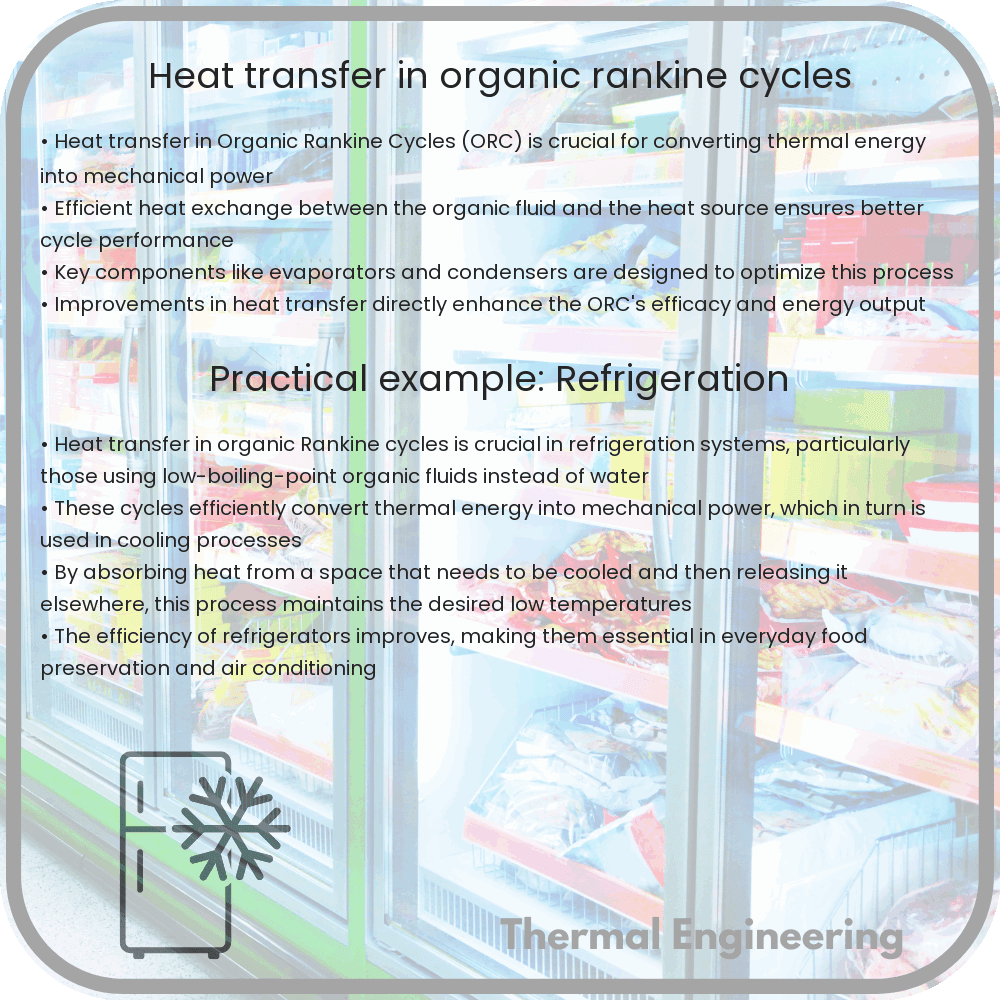
Understanding Heat Transfer in Organic Rankine Cycles
The Organic Rankine Cycle (ORC) is a widely used system in the field of energy engineering, especially for converting low-temperature thermal energy into electrical power. The fundamental principle behind the ORC is similar to a traditional Rankine cycle, with the major difference lying in the use of organic fluids instead of water. This adaptation allows the ORC to efficiently operate at lower heat source temperatures, making it ideal for renewable energy applications such as biomass, geothermal, and waste heat recovery.
Basics of Heat Transfer in ORC
Heat transfer in an Organic Rankine Cycle is a critical aspect that determines the efficiency and effectiveness of the cycle. It occurs in three main components: the evaporator, the condenser, and sometimes the regenerator.
Evaporator
In the evaporator, heat from an external source is transferred to the organic working fluid, causing it to vaporize. The efficiency of this process depends on the thermal characteristics of the fluid used, including its boiling point, thermal conductivity, and heat capacity. Effective heat transfer within the evaporator is crucial as it directly affects the turbine’s input steam quality and, consequently, the overall efficiency of the cycle.
Condenser
Following the expansion in the turbine, the vaporized working fluid must be condensed back into a liquid to complete the cycle. This occurs in the condenser, where heat is removed from the working fluid and transferred to another medium, typically air or cooling water. The design of the condenser plays a significant role in the cycle’s efficiency, influencing how quickly and effectively the fluid can be condensed at the lowest possible temperature.
Regenerator
Some advanced ORC systems include a regenerator (or recuperator) to enhance thermal efficiency. By recovering residual heat from the turbine-exhausted vapor before it enters the condenser, the regenerator preheats the fluid entering the evaporator. This process reduces the thermal energy required from the heat source, thereby increasing the system’s overall efficiency.
Factors Influencing Heat Transfer
Several factors impact the heat transfer rates and thermal efficiency in an ORC. These include:
- Choice of Working Fluid: The physical and chemical properties of the working fluid such as boiling point, specific heat, and thermal conductivity, determine its heat transfer capabilities.
- Temperature Gradients: Larger temperature differences between the heat source and the working fluid typically result in more efficient heat transfer.
- Heat Exchanger Design: The effectiveness of heat exchangers, including their size, shape, and construction material, also influences the rate of heat transfer.
- Operational Pressure: Higher pressures generally increase the thermal efficiency of the cycle but require stronger, more expensive materials and components.
Mathematical Representation of Heat Transfer
The basic equation governing the heat transfer within components of the ORC can be represented as:
Q = ṁ * cp * ΔT
where:
- Q is the rate of heat transfer,
- ṁ (dot over m) is the mass flow rate of the working fluid,
- cp is the specific heat capacity of the fluid,
- ΔT is the temperature change of the fluid.
The effectiveness of these heat transfer processes determines the overall thermal efficiency of the Organic Rankine Cycle, affecting both its economic feasibility and environmental impact. Advances in materials science, thermodynamic research, and fluid dynamics continue to push the boundaries of ORC technology, making it a key component of sustainable energy systems.
Conclusion
Understanding and optimizing heat transfer in Organic Rankine Cycles is essential for maximizing the efficiency of converting low-grade heat sources into usable power. With continued research and technological advancements, ORCs have the potential to play a significant role in global efforts towards cleaner, more sustainable energy systems.