Learn about jet pumps, devices using fluid dynamics to transfer fluids efficiently without direct contact, ideal for handling impure or abrasive materials.
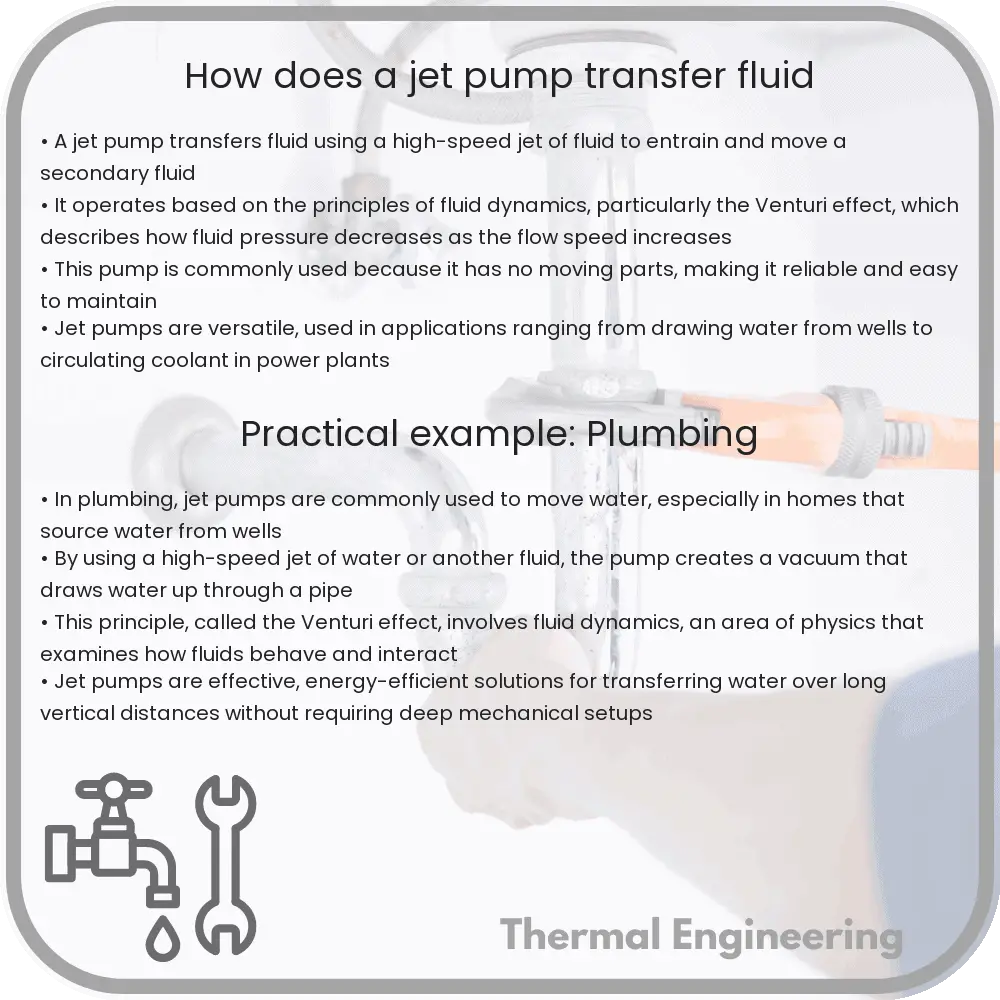
Understanding the Mechanics of a Jet Pump
A jet pump, often used in various engineering applications, is a unique device designed to transfer fluids from one location to another without any moving parts directly contacting the fluid. This article explains the basic principles behind how a jet pump operates and its typical uses in different industries.
What is a Jet Pump?
A jet pump is a type of pump that uses the principles of fluid dynamics to move a fluid by converting the kinetic energy of a driving fluid to pressure energy. It is particularly useful in applications where the pumped fluid might contain impurities or abrasive materials that can wear down or damage traditional pumps with mechanical parts.
How Does a Jet Pump Work?
The operation of a jet pump involves several key components and stages:
- Drive Nozzle: The jet pump begins with a high-speed jet of fluid being expelled by a nozzle. This driving fluid is typically a liquid, but can sometimes be a gas in specific applications.
- Venturi Tube: After exiting the nozzle, the high-speed stream flows through a tube with a narrowed throat, known as a venturi. The design of the venturi causes the velocity of the fluid to increase and the pressure to decrease, creating a suction effect.
- Suction Chamber: The suction chamber feeds the fluid to be pumped into the venturi tube. Because of the low pressure at the jet nozzle exit, fluid is drawn into the venturi tube where it mixes with the driving fluid.
- Diffuser: After the fluids have mixed, they pass through a diffuser where the velocity of the combined fluids decreases, and the pressure increases. This increase in pressure enables the lifting or transportation of the fluid mixture to its intended destination.
Key Principles Behind Jet Pump Efficiency
The efficiency of a jet pump relies on the design of the nozzle and venturi tube, as well as the velocity and pressure of the driving fluid. Key principles include:
- Bernoulli’s Principle: This principle states that an increase in the speed of a fluid occurs simultaneously with a decrease in pressure or a decrease in the fluid’s potential energy. It is critical for the suction effect in jet pumps.
- Conservation of Momentum: In jet pumps, the momentum of the drive fluid is transferred to the sucked fluid, resulting in the movement of the mixed fluid towards the discharge point.
Applications of Jet Pumps
Jet pumps are versatile and used in a variety of settings:
- Well water extraction: They’re commonly used to pump water from deep wells.
- Chemical process industries: Their ability to handle impure fluids makes them suitable for transporting mixtures in chemical processes.
- Marine applications: Used for circulating water in marine environments, and also in some desalination processes.
Conclusion
Jet pumps serve as an effective solution in various industries due to their simplicity, durability, and ability to handle impure fluids. Understanding how they operate not only broadens one’s knowledge of fluid dynamics but also illustrates the practical applications of physics in everyday technology.