Learn about thermocline storage systems, their role in renewable energy, and how they utilize thermal stratification for efficient thermal energy storage.
Understanding Thermocline Storage Systems
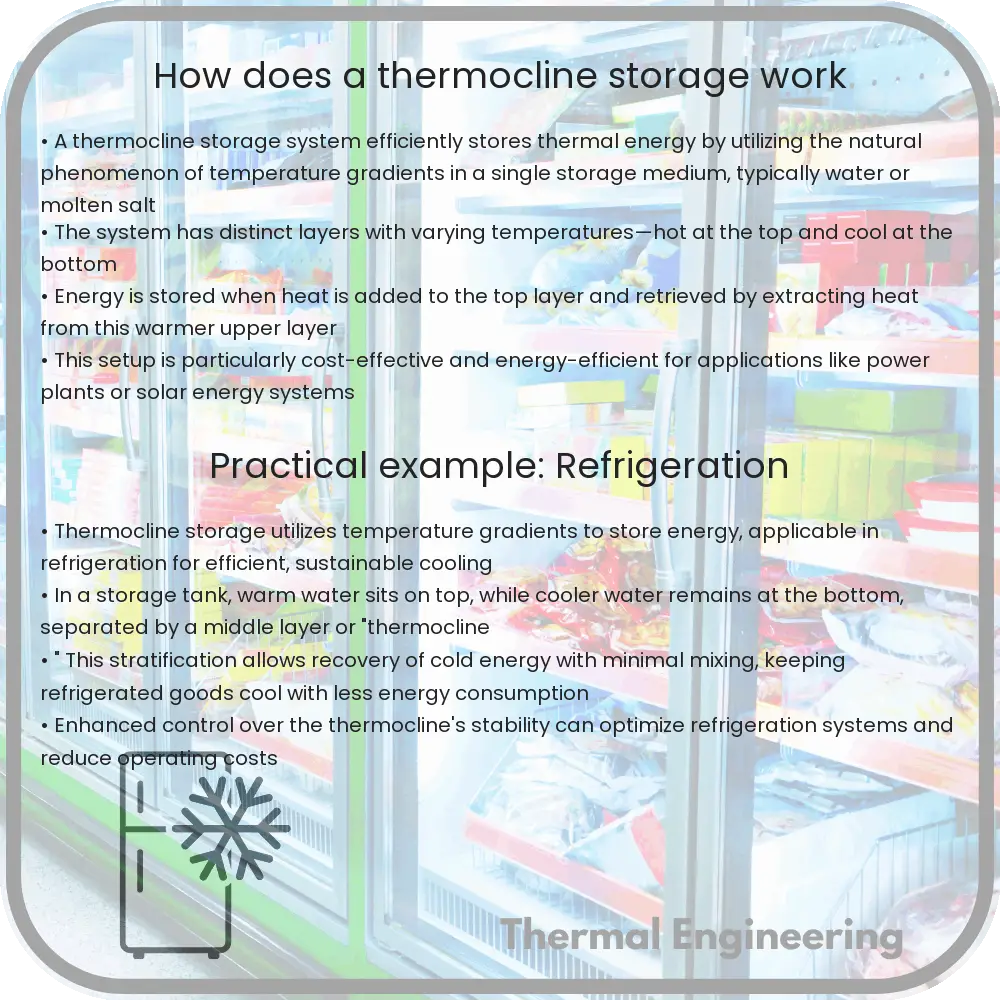
Thermocline storage systems are an innovative approach to storing thermal energy, particularly useful in the context of concentrated solar power plants and other applications requiring energy storage over time. This system efficiently stores heat by exploiting the natural phenomenon of thermal stratification. By understanding the basic principles of thermocline storage, we can appreciate its role in enhancing renewable energy technologies.
What is a Thermocline?
A thermocline refers to a layer in a body of fluid (liquid or gas) where the temperature changes more drastically with depth than it does in the layers above or below. In the context of energy storage, a thermocline can be formed within a single storage tank that contains a fluid medium, usually water or molten salt, which acts as the thermal storage substance. This thermocline effectively separates the hotter fluid above from the cooler fluid below.
How Thermocline Storage Works
The basic operation of a thermocline storage system involves three key phases: charging, storing, and discharging:
- Charging: During this phase, hot fluid (such as molten salt or oil heated by solar energy) is introduced at the top of the storage tank. As it enters, it stays on top of the cooler fluid due to its lower density, thereby heating the upper layer.
- Storing: Once the charging phase is complete, the stratified tank now contains a gradient of temperatures from hot at the top to cool at the bottom. The distinct thermocline region in the middle acts as a barrier that minimizes mixing between the layers.
- Discharging: When the stored energy is needed, the hot fluid is drawn from the top of the tank for use in generating power. As hot fluid is removed, cooler fluid from the bottom of the tank is gradually moved upwards to be reheated, thereby maintaining the system’s efficiency.
Advantages of Thermocline Storage
Thermocline storage systems offer several significant advantages:
- Cost-effectiveness: Using a single tank reduces the cost compared to systems requiring separate hot and cold storage tanks.
- Efficiency: The natural stratification reduces heat loss and helps in maintaining a high temperature difference across the storage medium.
- Simplicity: The design and operation of a thermocline system are relatively straightforward, which can lead to lower maintenance and operational costs.
Applications of Thermocline Storage Systems
While widely recognized for use in concentrated solar power plants, thermocline storage systems are also being explored for other applications such as:
- Industrial waste heat recovery
- Desalination plants
- Enhanced geothermal systems
Conclusion
Thermocline storage systems represent a vital engineering solution that leverages the principles of thermodynamics to improve the feasibility and efficiency of renewable energy sources. By understanding these systems, we can continue to innovate and expand their applications, ensuring that sustainable energy solutions become more prevalent globally. Thermocline storage not only promotes the use of solar energy but also helps in making renewable energy sources more reliable and accessible.