Learn about thermopile sensors, devices that measure temperature by detecting thermal radiation and converting it into an electrical signal based on the Seebeck effect.
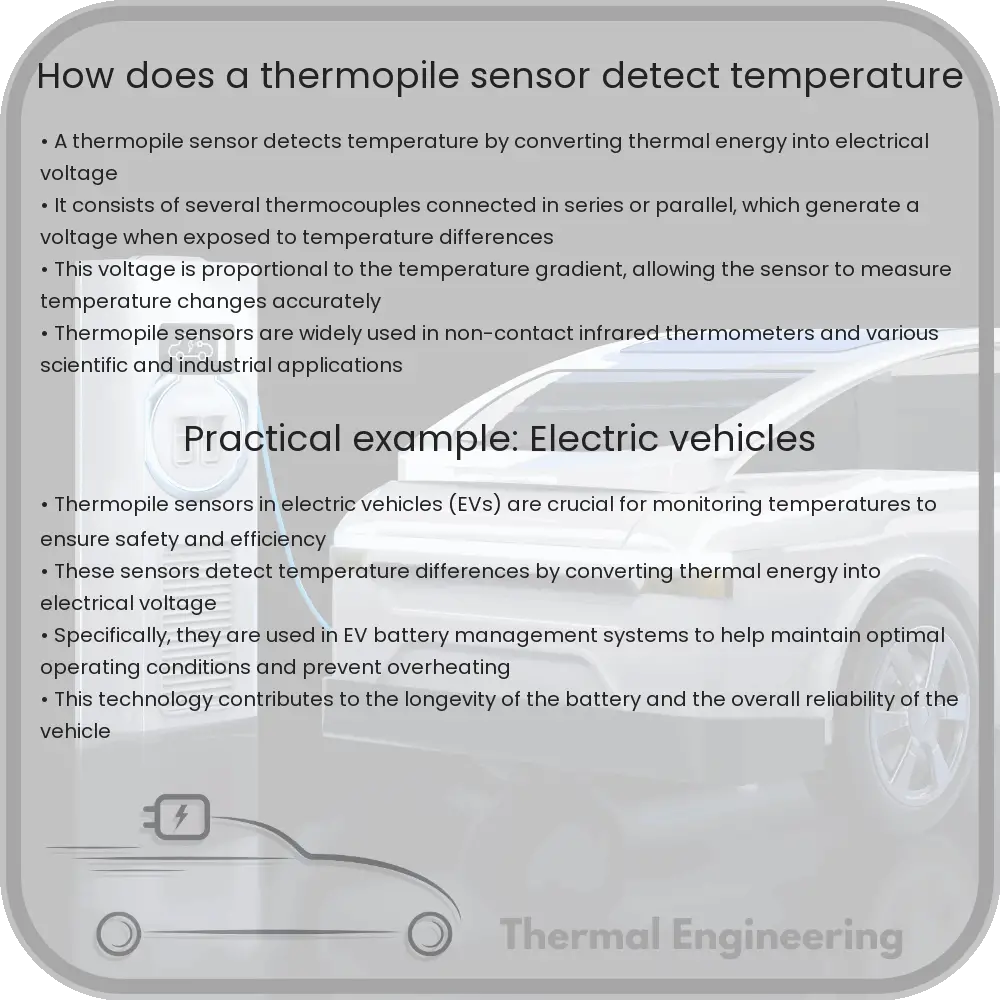
Understanding Thermopile Sensors
Thermopile sensors are intriguing devices used extensively to measure temperature. These sensors leverage the principles of thermoelectricity to detect thermal radiation and convert it into an electrical signal. Let’s delve into how these sensors operate, their components, and their applications in the real world.
Principles of Operation
A thermopile sensor is essentially an array of several thermocouples connected in series or parallel to enhance the electrical output signal. A thermocouple, as the fundamental unit of a thermopile, operates on the Seebeck effect. This effect states that a voltage is generated when there is a temperature difference between two dissimilar metal junctions. In simple terms, this voltage is given by:
V = S*∆T
where:
- V is the voltage produced,
- S is the Seebeck coefficient (material-dependent), and
- ∆T (Delta T) represents the temperature difference between the hot and cold junctions.
In a thermopile, multiple thermocouples are connected so that their voltages add up. The ‘hot’ junctions are exposed to the object whose temperature is being measured, while the ‘cold’ junctions are maintained at a known reference temperature. The resulting output voltage of the thermopile is thus proportional to the temperature difference between these junctions, allowing for accurate temperature readings.
Components of a Thermopile Sensor
- Absorber: This component absorbs the infrared radiation from the object whose temperature is being measured. It is typically black to maximize absorption.
- Thermocouples array: As noted, these are connected in series or parallel to produce a measurable voltage.
- Reference junction: Held at a known temperature, this helps in establishing the baseline for temperature difference.
- Signal processing circuit: This component amplifies and converts the thermopile voltage to a usable output, such as digital data.
Applications of Thermopile Sensors
Thermopile sensors find applications in various fields due to their ability to perform non-contact temperature measurements. Key applications include:
- Medical devices: Used in ear thermometers and other diagnostic equipment to measure body temperature without direct contact.
- Home appliances: Integrated in devices like microwaves and pyrometers for temperature monitoring.
- Industrial monitoring: Employed in processes that require the monitoring of high temperatures, such as in furnaces.
- Environmental systems: Used to monitor ambient temperatures or for fire detection.
The operational simplicity and effectiveness of the thermopile sensor in measuring temperature through electromagnetic radiation make it a valuable tool in both everyday appliances and specialized equipment. Its non-intrusive nature also ensures that measurements can be taken without the need to physically alter or disturb the target, preserving integrity and efficiency.
Conclusion
Thermopile sensors are an elegant application of thermoelectric principles, enabling accurate and reliable temperature measurements across diverse sectors. By understanding how these devices function, we can better appreciate the sophisticated yet straightforward technology that impacts our daily lives and industrial processes alike.