Uncover the details of thermal refining, a key metallurgical process that enhances metal properties and performance.
Understanding Thermal Refining and Its Impact on Metal Quality
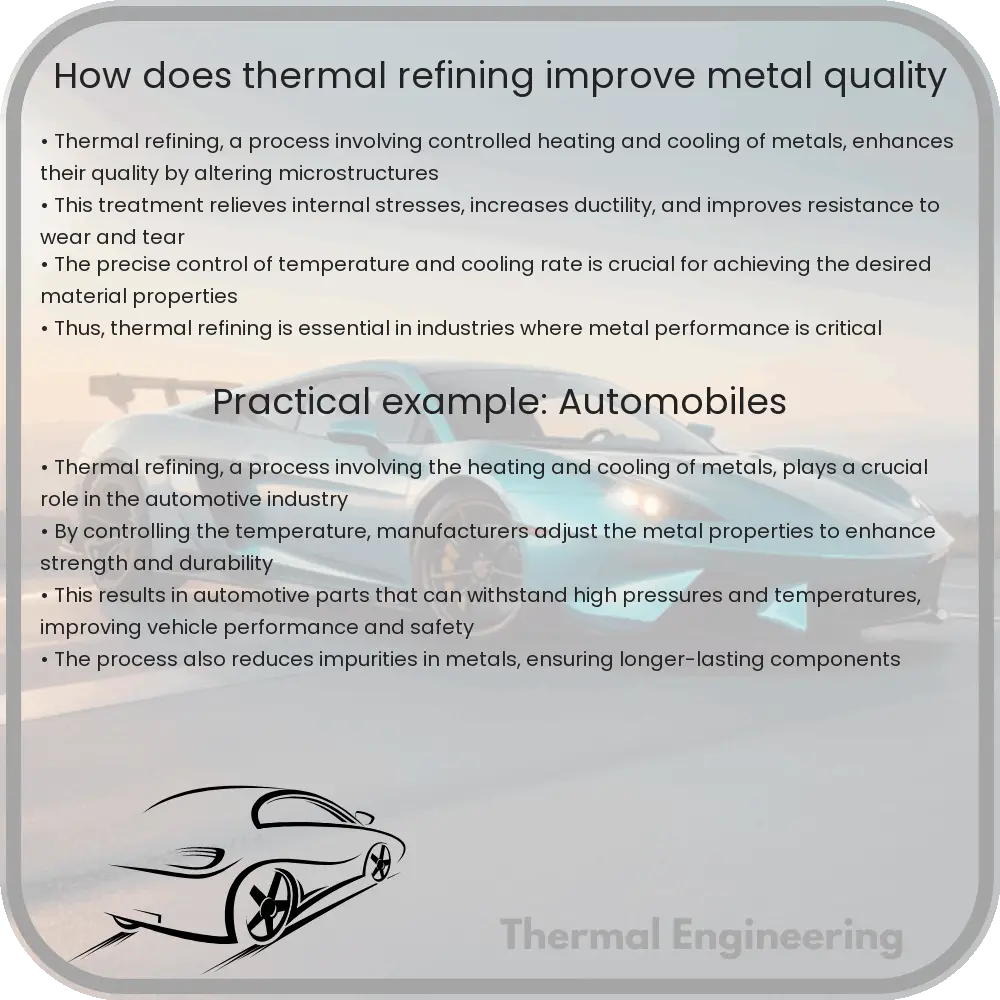
Thermal refining, also known as heat treatment, is a crucial process in metallurgy, designed to improve the physical and chemical properties of metals. This treatment enhances the usability of metals in various industrial applications by increasing their strength, toughness, and wear resistance, while also reducing their brittleness. This process not only refines the qualities of the metal but also ensures that it can be used in more demanding environments and applications.
The Process of Thermal Refining
Thermal refining typically involves three main steps: heating, holding, and cooling the metal. Each step is crucial in altering the microstructure of the material, which in turn, affects its overall properties and performance.
- Heating: The metal is heated to a precise temperature where its structure becomes malleable. The temperature and rate of heating depend on the type of metal and the desired properties.
- Holding: At this temperature, the metal is held for a specific amount of time to allow transformations within its microstructure. This is also known as ‘soaking’.
- Cooling: The metal is then cooled at a controlled rate. Rapid cooling (quenching), slow cooling (furnace cooling), or a controlled sequence of both can be used depending on the desired outcome.
Types of Heat Treatment Processes
There are several types of heat treatment processes, each tailored to achieve specific property enhancements:
- Annealing: This process softens the metal, making it more workable and reducing stress. It involves heating the metal above its recrystallization temperature and then slowly cooling it.
- Normalizing: Similar to annealing, this process makes the metal tougher. The metal is heated slightly higher than in annealing and then allowed to cool in air.
- Hardening: To increase the hardness and strength of the metal, it is heated to a high temperature and then rapidly cooled or quenched. Common quenching mediums include water, oil, or air.
- Tempering: Often performed after hardening, tempering reduces brittleness and enhances the toughness of the metal. The metal is heated to a temperature below its hardening temperature and held before being cooled.
Benefits of Thermal Refining
Through modifying the microstructure of metals, thermal refining enhances numerous qualities necessary for demanding industrial applications:
- Increase in strength: By altering grain sizes and forming new phases, metals become stronger and can withstand higher stresses.
- Improved toughness: Heat treatments adjust the toughness of a metal, making it resilient against sudden impacts.
- Enhanced wear resistance: Hardened surfaces are more resistant to wear and erosion, which is vital in mechanical components.
- Controlled brittleness: Metals can be made less brittle through tempering, which avoids sudden failure under stress.
Thermal refining is, therefore, a vital process in metalworking that significantly improves the performance and longevity of metal products. By understanding and applying the right heat treatment techniques, engineers can design components that meet stringent standards and endure harsh operational conditions.