Dive into the physics of superconductors and their ability to conduct electricity without resistance, exploring Cooper pairs, the Meissner effect, and applications.
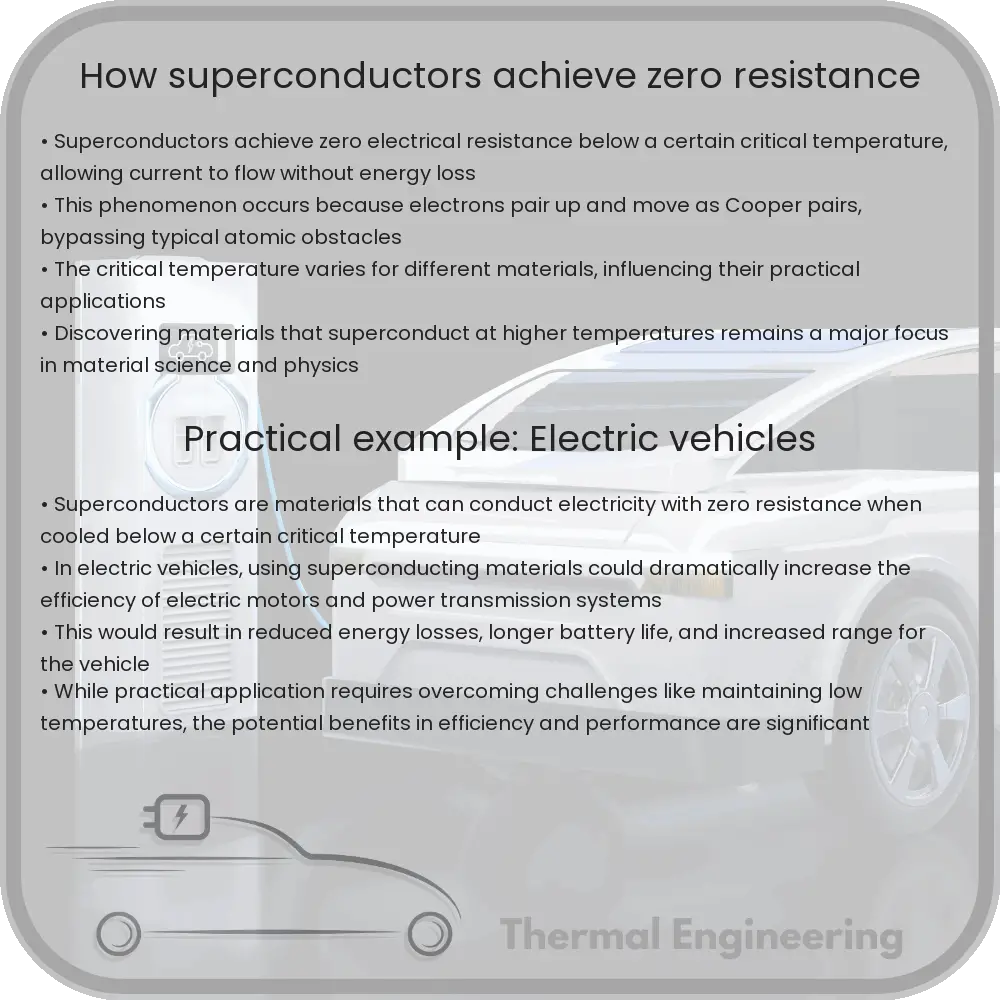
Understanding How Superconductors Achieve Zero Resistance
Superconductivity is a fascinating phenomenon in physics and engineering whereby certain materials can conduct electric current with zero electrical resistance. This occurs under specific conditions, primarily low temperatures. The transition into a superconductive state not only epitomizes a perfect conductor scenario but also provides profound implications for energy efficiency and technological advancement. Let’s delve into how superconductors achieve this remarkable state.
Discovery and Basics of Superconductivity
Superconductivity was first discovered in 1911 by Dutch physicist Heike Kamerlingh Onnes, who observed that mercury, when cooled below a temperature of approximately 4.2 Kelvin (-268.95 degrees Celsius), conducted electricity without resistance. Since then, many other superconducting materials have been discovered, each characterized by a critical temperature below which they must be cooled to exhibit superconductivity.
How Superconductivity Works: The Zero Resistance Effect
The underlying principle of how superconductors achieve zero resistance lies in the behavior of electrons within the material. Under normal conditions, electrons move through a conductor in a somewhat scattered manner, frequently colliding with atoms and other electrons. This interaction causes resistance and subsequently generates heat.
However, in a superconducting state, electrons behave differently. They pair up in what is known as Cooper pairs. A Cooper pair consists of two electrons that are bound together at a very low temperature through lattice vibrations in the material’s structure, or phonons. This pairing occurs because the overall system can lower its energy through this unique bond.
The Role of Cooper Pairs
These Cooper pairs follow Bose-Einstein condensation statistics, unlike the Fermi-Dirac statistics obeyed by normal unpaired electrons. As a result, these electron pairs act as a single quantum mechanical entity and can move through the lattice structure of the superconductor without scattering off of atoms. Essentially, the Cooper pairs can navigate the atomic lattice freely because they are not hindered by the energy barriers that affect normal single electrons.
The coherence length, typically much larger than the atomic spacing, ensures that the movement of these pairs is coherent over large distances, further supporting the zero-resistance state. This coherence protects the pairs from the typical electron-phonon interactions that cause resistance in ordinary conductors.
The Meissner Effect: Magnetic Field Exclusion
Another hallmark of superconductivity is the Meissner effect, discovered in 1933 by Walther Meissner and Robert Ochsenfeld. This phenomenon is characterized by the complete expulsion of a magnetic field from a superconductor. When a material transitions into its superconducting state, it actively excludes magnetic fields from its interior; this is distinct from merely being a perfect conductor, as a perfect conductor would allow existing magnetic fields to remain locked within.
The Meissner effect is explained by the London brothers, Fritz and Heinz, in 1935. They showed that the magnetic field’s exclusion is due to supercurrents induced in the superconductor, which cancel the applied magnetic field within. These surface currents flow without resistance, further supporting the zero resistance phenomenon.
Applications and Future Outlook
- Magnetic Levitation Trains: Utilize the repulsive force from the Meissner effect for near-frictionless movement.
- Medical Imaging (MRI): Superconductors help create strong and stable magnetic fields necessary for high-resolution imaging.
- Large Hadron Collider (LHC): Uses superconducting magnets to steer particles along their paths during high-energy collisions.
Understanding and improving superconductors continues to be a robust field of research, particularly in searching for materials that can achieve superconductivity at higher temperatures. These advancements promise to revolutionize industries by making electrical systems more efficient, thus reducing global energy usage and pushing the boundaries of technological innovation.
Superconductivity not only showcases the depth of quantum mechanics but also offers practical applications that could significantly alter the technological landscape. By achieving zero resistance, superconductors open up new possibilities in energy efficiency and high-power applications, marking one of the most significant discoveries in the field of condensed matter physics.