Learn about fish swimming and hydrodynamics, analyzing the forces, fluid dynamics, and applications in technology.
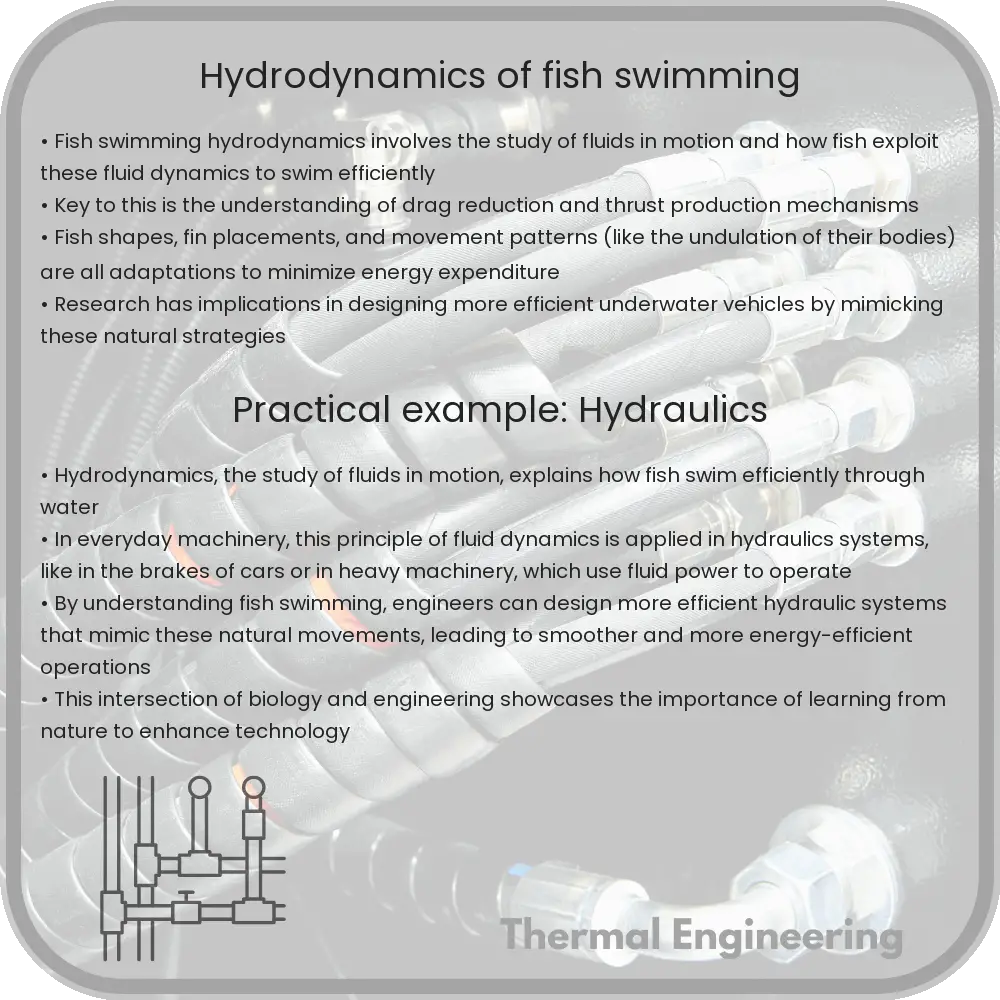
Understanding the Hydrodynamics of Fish Swimming
Fish swimming is an elegant demonstration of nature’s mastery of hydrodynamics, the branch of physics concerned with the properties of fluids in motion. By studying how fish swim, scientists and engineers can uncover principles applicable to various technologies, including bio-inspired robotics, underwater vehicles, and energy-efficient propulsion systems.
How Fish Swim: Basic Mechanics
Fish propel themselves through water primarily using their body and fins. The mechanics involve generating thrust while minimizing resistance from the surrounding water. This balance is crucial for the efficient movement of fish through various aquatic environments.
- Body Shape: Fish have streamlined bodies that reduce drag, the resisting force caused by motion through a fluid. The tapering shape at both ends allows water to flow smoothly over the body, enabling higher speeds with less energy.
- Muscle Movement: Fish muscles work in segments, contracting sequentially from head to tail, which creates a wave-like motion along their body. This motion, often referred to as undulatory swimming, pushes water backwards, thereby propelling the fish forward.
- Fins: Fins serve multiple functions including steering, stability, and propulsion. The tail fin, or caudal fin, is particularly important for the thrust during fast swimming and maneuvering.
Hydrodynamics: Forces and Fluid Dynamics
Understanding the hydrodynamics of fish swimming involves analyzing the forces involved and how they interact with the fluid environment. The key forces are thrust and drag, alongside buoyancy and lift.
- Thrust: This force propels the fish forward and is generated primarily by the movement of the caudal fin. The action of the fin against the water creates a force in the opposite direction according to Newton’s third law of motion.
- Drag: As fish swim, they encounter drag force that opposes their motion. Drag includes both skin friction, arising from the viscosity of the water and interaction with the fish’s skin, and form drag, caused by the displacement of water by the fish’s body.
- Lift: Similar to aerodynamics in air, lift in water can occur due to the hydrodynamic effects on the body and fins of the fish, particularly at higher speeds.
- Buoyancy: This force acts upwards, counteracting the weight of the fish and is crucial for maintaining depth without expending large amounts of energy in vertical movement.
Mathematical Modeling in Fish Hydrodynamics
To analyze and predict fish swimming patterns, scientists use mathematical models that describe the fluid dynamics involved. The basic equations include the Navier-Stokes equations, which describe the motion of fluid substances:
\[
\rho \left(\frac{\partial \mathbf{v}}{\partial t} + \mathbf{v} \cdot \nabla \mathbf{v}\right) = -\nabla p + \mu \nabla^2 \mathbf{v} + \mathbf{f}
\]
Here, \( \rho \) is the fluid density, \( \mathbf{v} \) represents the velocity field, \( p \) stands for pressure within the fluid, \( \mu \) is the dynamic viscosity, and \( \mathbf{f} \) denotes external forces applied to the fluid. This equation, combined with boundary conditions and fluid properties, helps simulate how fish interact with the surrounding water.
Applications in Engineering and Technology
The study of fish swimming is not just an academic pursuit but has practical applications in engineering and technology. For instance:
- Autonomous Underwater Vehicles (AUVs): Design principles derived from fish can be used to develop AUVs that are more efficient and capable of agile maneuvers in complex underwater environments.
- Robotic Fish: Bio-inspired robotics include the development of robotic fish that mimic the swimming mechanisms of real fish, useful in underwater exploration and monitoring.
- Energy Efficiency: Understanding and applying the principles of fish swimming can lead to the design of propulsion systems that are more energy-efficient and less environmentally invasive.
By exploring the hydrodynamics of fish swimming, both scientists and engineers can better understand fluid dynamics. This knowledge not only advances our grasp of biological mechanisms but also inspires innovative solutions in technology and environmental stewardship.