Explore the principles of underwater vehicle hydrodynamics, focusing on how vehicles like submarines and AUVs navigate water, and factors like buoyancy and drag affecting their movement.
Understanding Underwater Vehicle Hydrodynamics
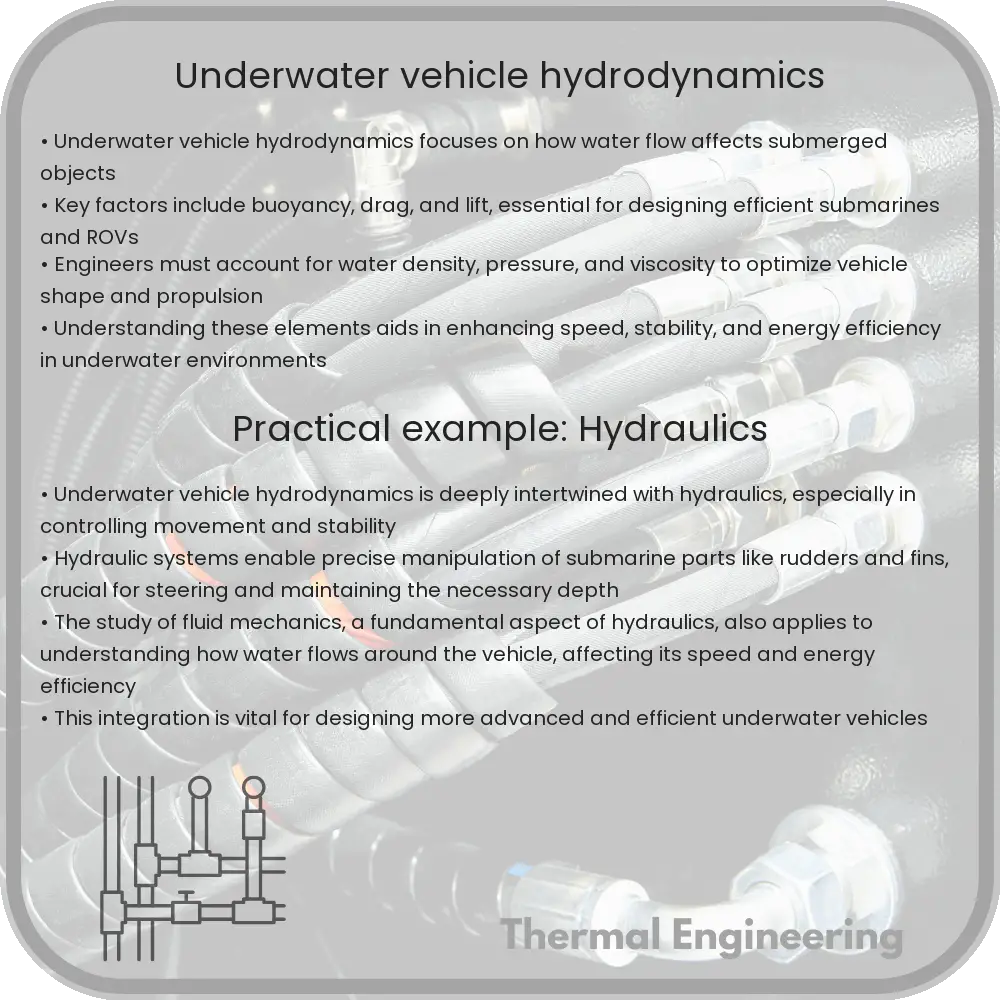
Underwater vehicle hydrodynamics is a branch of fluid dynamics that deals specifically with how underwater vehicles move through water. This complex field of engineering combines principles from several areas, including marine engineering, mechanical engineering, and naval architecture, to optimize the design and operation of submersible and semi-submersible vehicles like submarines, Autonomous Underwater Vehicles (AUVs), and Remotely Operated Vehicles (ROVs).
Factors Influencing Underwater Hydrodynamics
The movement of underwater vehicles is influenced by various hydrodynamic factors, which include buoyancy, drag, lift, and thrust. To understand how these factors interact, it’s important to look at the equations and principles that govern them.
- Buoyancy: Governed by Archimedes’ principle, buoyancy dictates that an underwater vehicle must displace a volume of water equivalent to its own weight to remain submerged at a neutral buoyancy.
- Drag: This is the resistance an object encounters as it moves through the water. Drag force (FD) can be calculated using the equation: FD = (1/2) * ρ * v2 * CD * A, where ρ (rho) is the water density, v is the velocity of the vehicle relative to the water, CD is the drag coefficient, and A is the cross-sectional area.
- Lift: Lift force is essential particularly in winged underwater vehicles, such as hydrofoils. It is generated by the motion of the vehicle through water and can be described by similar equations to those used in aerodynamics.
- Thrust: Thrust must overcome drag for the vehicle to move forward, generated through propulsion systems such as propellers or jets.
Design Considerations and Challenges
Designing an efficient underwater vehicle involves balancing these forces while considering operational parameters and environmental conditions. The shape of the vehicle, type of materials used, and the configuration of its propulsion system are all critical decisions that impact hydrodynamic and operational efficiency.
- Shape and Hull Design: The hydrodynamic efficiency of underwater vehicles is greatly influenced by their shape. Streamlined designs reduce drag, allowing for faster speeds and lower energy consumption.
- Material Selection: Materials must withstand high pressures and corrosive saltwater environments while being lightweight to optimize performance.
- Propulsion Systems: The design of the propulsion system must match the specific mission requirements of the vehicle, whether it’s high-speed maneuvering or stability for clear imaging and data collection.
Computational Tools in Hydrodynamic Analysis
Advancements in computational fluid dynamics (CFD) have significantly enhanced the capability to predict and analyze the hydrodynamic performance of underwater vehicles. CFD enables engineers to simulate fluid flow around the vehicle’s structure in a virtual environment, allowing for optimizations in design stages before physical models are tested in water tanks or real-world scenarios.
Applications of Underwater Vehicles
The optimized hydrodynamics of underwater vehicles are critical in a variety of applications:
- Military: Submarines and other underwater vehicles play key roles in defense, needing high speeds and maneuverability.
- Research and Exploration: AUVs are used in oceanography, environmental monitoring, and resource discovery, requiring vehicles to have a long operational range and stable movement capabilities.
- Industrial: In the offshore oil and gas industry, ROVs perform maintenance and installation tasks on underwater equipment.
The evolving field of underwater vehicle hydrodynamics continues to push the boundaries of what is possible in maritime engineering, improving the performance, efficiency, and capabilities of vehicles beneath the ocean’s surface.