Learn about Krypton Fluoride Excimer Lasers, key UV light sources in industrial and medical applications, explained through their operation and physics.
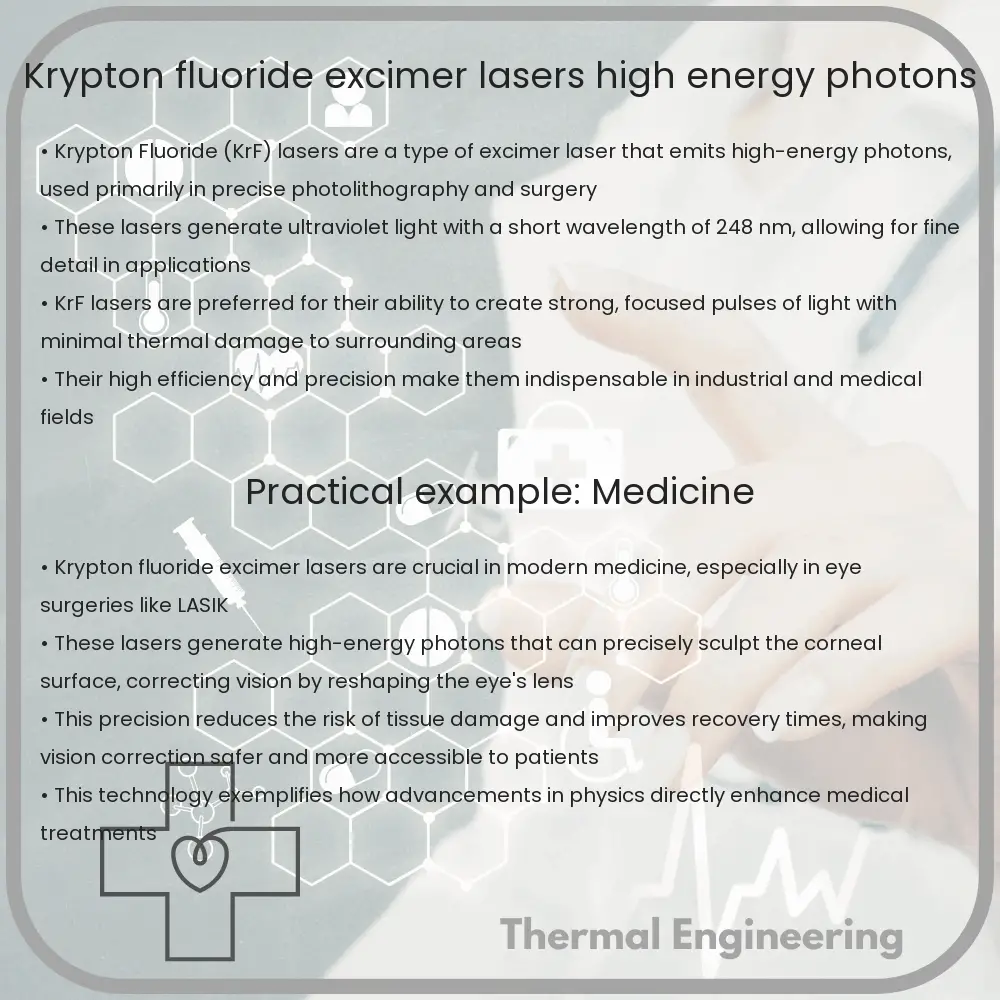
Understanding Krypton Fluoride Excimer Lasers
Excimer lasers, a critical class in the family of ultraviolet lasers, have found extensive applications in various scientific, medical, and industrial fields. One of the most potent among them is the Krypton Fluoride (KrF) laser. This article aims to demystify how KrF lasers operate, their mechanism, and the nature of the high-energy photons they emit.
Basics of Excimer Lasers
The term ‘excimer’ is derived from ‘excited dimer’, although in practice most excimer lasers, including the KrF laser, use a combination of noble gases and halogens. These lasers are distinct because they operate using a pseudomolecule formed by a noble gas and a halogen which only exists in an excited electronic state; it dissociates back to its constituent atoms upon returning to the ground state, releasing ultraviolet light.
The Composition and Operation of KrF Lasers
Krypton Fluoride lasers produce light typically at 248 nm wavelength, falling in the ultraviolet (UV) spectrum. Let’s look deeper into its operation:
- Krypton Gas and Fluorine Mixture: The laser medium consists of a mixture of krypton gas and fluorine. Under typical operation, this mixture is excited electrically or through other energy sources.
- Formation of Excited Dimers: When energy is supplied, a krypton atom and a fluorine atom bond briefly to form an excited dimer (KrF*). This state is highly energetic and unstable.
- Emission of UV Light: As the excited KrF* molecules return to their ground state (dissociating into Kr and F), they emit photons in the ultraviolet range, particularly at a wavelength of 248 nm.
Production of High-Energy Photons
The photons emitted by KrF lasers are of high energy primarily due to their short wavelength (UV light). The energy \( E \) of a photon can be calculated using the equation:
\[ E = h \cdot \nu \]
where \( h \) is Planck’s constant (approximately \( 6.626 \times 10^{-34} \) Joule·seconds) and \( \nu \) (nu) is the frequency of the light. Since frequency and wavelength (\( \lambda \)) are related through the speed of light \( c \) (\( \nu = c / \lambda \)), UV photons are more energetic compared to visible light due to shorter wavelengths.
Applications of KrF Lasers
Krypton Fluoride lasers are particularly valuable due to their ability to produce these high-energy photons efficiently. Applications of KrF lasers include:
- Photolithography: Used extensively in semiconductor manufacturing to etch microcircuits on silicon wafers.
- Medicine: In procedures like LASIK eye surgery for precise and minimally invasive corneal modification.
- Spectroscopy: Utilized in research to study materials at molecular and atomic levels.
In conclusion, the Krypton Fluoride excimer laser is a pivotal technology in modern manufacturing and medical treatments, thanks in large part to its production of high-energy UV photons. Understanding the basic physics and engineering principles behind such laser systems not only broadens our scientific knowledge but also enables continued innovation in applications impacting daily life and health.