Learn about Liquid Silicone Rubber (LSR), its key properties like thermal stability and versatility in medical and industrial applications.
Understanding Liquid Silicone Rubber: Properties and Applications
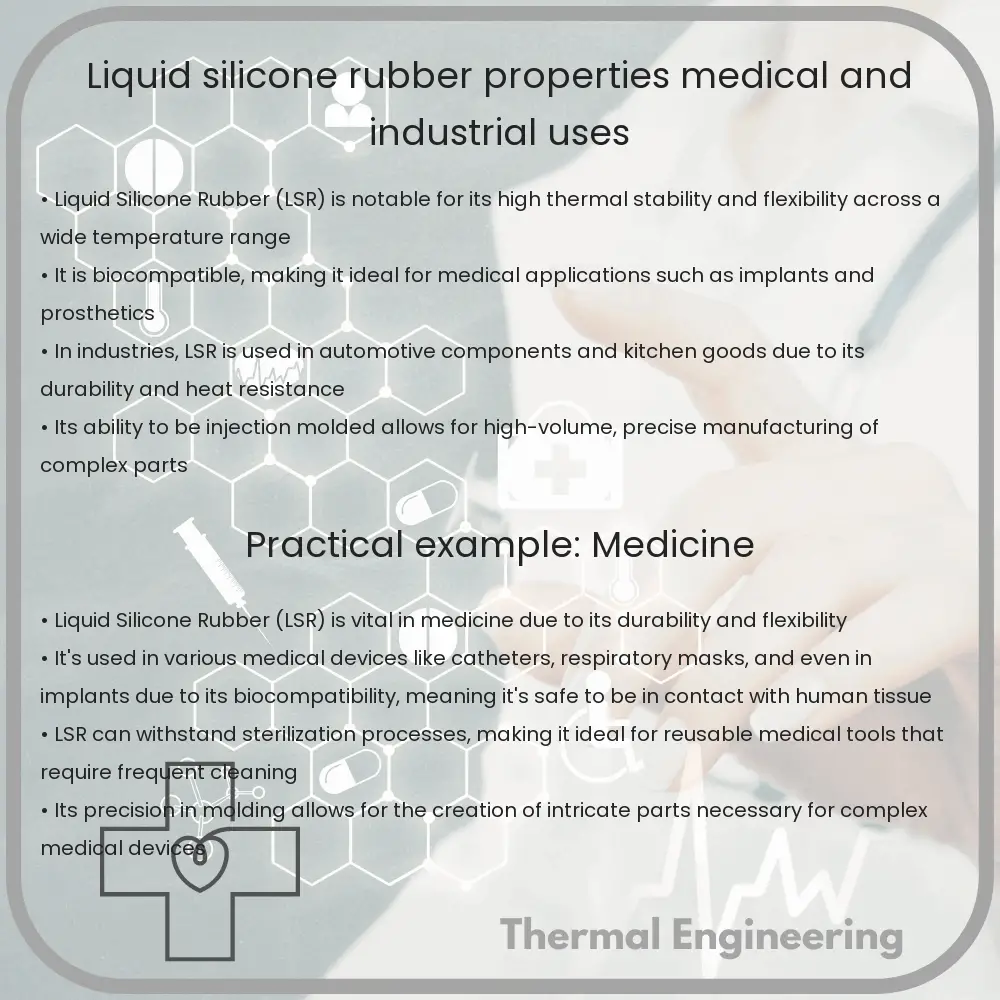
Liquid Silicone Rubber (LSR) is a versatile material used across various industries due to its remarkable properties and adaptability. This high-purity silicone is well-suited for injection molding, allowing for the efficient fabrication of products that require precision, durability, and thermal stability.
Key Properties of Liquid Silicone Rubber
LSR boasts several physical and chemical characteristics that make it particularly useful in demanding environments:
- Thermal Stability: LSR maintains its properties across a wide temperature range, typically from -55°C to +300°C.
- Chemical Resistance: It is highly resistant to water, oxidation, and various chemicals, including acids and alkali.
- Electrical Insulation: LSR has excellent insulating properties, which make it ideal for use in electrical applications.
- Elasticity and Flexibility: This rubber exhibits high elongation and flexibility, which is maintained over its entire temperature range.
- Biocompatibility: Being non-toxic and hypoallergenic, LSR is suitable for medical applications that come into contact with human tissue.
Medical Applications of Liquid Silicone Rubber
In the medical field, LSR’s unique properties are highly valued:
- Surgical Tools: Due to its sterilizability and biocompatibility, LSR is used in manufacturing various surgical instruments and devices.
- Prosthetics: LSR is used in making flexible, durable prosthetic components that are comfortable for long-term wear.
- Medical Implants: Its stability and biocompatibility make it suitable for creating implants such as heart valves and skin adhesives.
- Dental Products: LSR is employed in creating dental molds and appliances due to its precision in molding and non-reactive nature.
Industrial Uses of Liquid Silicone Rubber
LSR application extends well into various industrial sectors:
- Automotive Components: It is used to make seals, gaskets, hoses, and other components that require high durability and resistance to extreme temperatures.
- Aerospace Applications: The thermal and chemical resistance of LSR makes it suitable for manufacturing insulation materials and components exposed to harsh environmental conditions in aerospace technology.
- Electronics: LSR’s insulating properties are employed in coating and protecting electronic components.
- Food Industry: Its non-toxic nature makes it ideal for food storage, cooking molds, and seals in appliances.
In conclusion, Liquid Silicone Rubber is a critical material that spans a wide range of applications from delicate medical tools to robust industrial components. Its unique properties of heat resistance, flexibility, and biocompatibility allow it to meet the requirements of highly specialized applications, making it a backbone material in modern manufacturing and product design.