Explore the unique properties and diverse applications of nickel foam in battery technology and thermal management systems.
Introduction to Nickel Foam
Nickel foam is a highly porous, metallic structure consisting of nickel or nickel alloy. It features a unique 3D open cell structure, characterized by a large surface area, high porosity, and low density. These properties make nickel foam an ideal candidate for various engineering applications, including battery production and thermal management systems.
Applications in Battery Technology
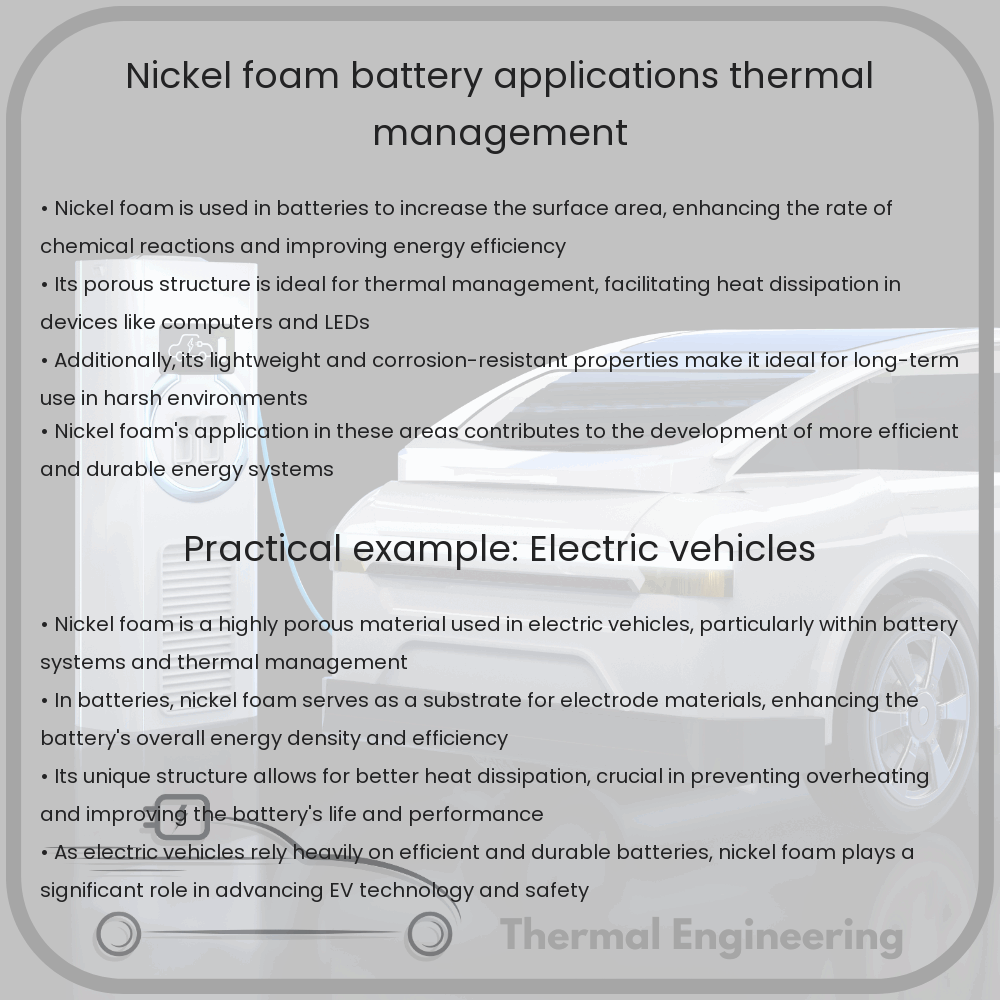
Nickel foam serves as an excellent substrate or current collector in batteries, particularly in nickel-based and lithium-based batteries. Its open cellular structure allows for efficient electrode material deposition, facilitating better ion transport and enhancing the overall electrochemical performance of the battery.
- Battery Cathodes: In lithium-ion batteries, nickel foam is utilized as a scaffold to hold active cathode materials. This facilitates better contact between the electrode and electrolyte, improving charging and discharging efficiency.
- Supercapacitors: Supercapacitors utilize nickel foam for its high surface area, promoting rapid charge and discharge rates. This application is critical in delivering high power density and enhancing energy storage capabilities.
Thermal Management
In the realm of thermal management, nickel foam’s large surface area and thermal conductivity contribute effectively to heat dissipation. It is commonly used in heat exchangers where efficient heat transfer is crucial. The foam can be integrated into systems requiring passive cooling solutions to manage the thermal load more effectively.
- Heat Exchangers: Nickel foam is incorporated into heat exchanger designs to increase the heat transfer area, promoting greater efficiency in transferring heat between materials and fluids.
- Electronics Cooling: In electronic components, where maintaining lower operational temperatures is vital for reliability and performance, nickel foam helps dissipate heat thereby protecting sensitive parts.
Conclusion
The versatility of nickel foam is evident from its extensive use in battery technology and thermal management. Its unique properties like high porosity and good thermal conductivity make it an indispensable material in engineering applications aimed at enhancing efficiency and performance. As technology progresses, the applications of nickel foam are expected to expand, paving the way for more innovative uses in various fields.