Learn how regenerative turbines enhance efficiency in low flow, high head applications with their unique energy recycling process.
Understanding Regenerative Turbines
Regenerative turbines, also known as peripheral or vortex turbines, are a type of dynamic turbine machinery that are distinguished by a unique method of energy transfer. Unlike traditional turbines, where fluid flow directly exits after transferring its energy, regenerative turbines recirculate the working fluid. This regenerative action increases the fluid’s energy with each pass through the turbine’s periphery, improving efficiency particularly in low flow and high head applications.
How Regenerative Turbines Work
Regenerative turbines feature an impeller with radial vanes, wrapped around a ring-shaped channel. As the fluid enters the turbine at the center, it is accelerated by the spinning impeller and moves outward through a circular path. The key element of these turbines is their ability to channel the fluid back into the same flow path, continuously recirculating and increasing its pressure and velocity with each pass through the impeller.
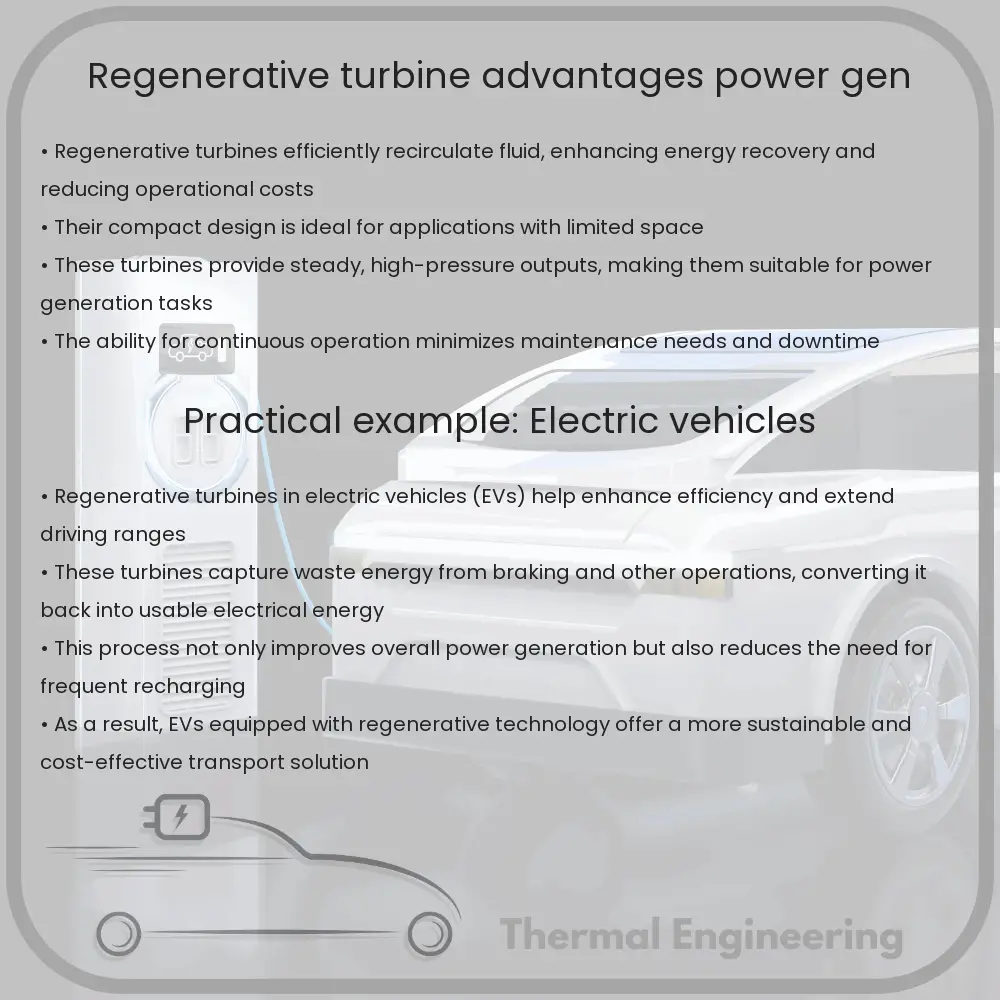
Advantages of Regenerative Turbines
- High Efficiency at Low Flow Rates: These turbines are particularly effective in applications where low flow rates are coupled with high head conditions, where traditional centrifugal pumps might fail to operate efficiently.
- Compact Design: Their unique design allows for a more compact build compared to other turbines, saving space while delivering similar or superior performance.
- Constant Pressure: Regenerative turbines can maintain a more constant pressure and smoother flow without the pulsations typically seen in other turbine types.
- Self-priming: These turbines have the ability to self-prime, drawing fluid into the impeller without the need for an external priming system.
- Minimal Wear: Due to the minimal fluctuations in pressure and the closed loop of fluid motion, regenerative turbines exhibit lower rates of wear and tear, leading to longer operational life and reduced maintenance requirements.
Power Generation with Regenerative Turbines
While regenerative turbines are commonly used in industrial applications such as pumping of volatile or liquefied gases, their high efficiency and steady output make them suitable for small-scale power generation purposes. In renewable energy sectors, particularly in geothermal and co-generation plants, the ability to handle low flow rates with high thermal energy efficiently can significantly enhance overall system performance.
In geothermal power systems, for example, the turbines help in extracting power from low-pressure steam sourced from underground reservoirs. This steam, which might not be fully utilized by conventional turbines, can be effectively used in a regenerative turbine to generate power, thereby increasing energy recovery.
Conclusion
Regenerative turbines offer a versatile and efficient solution in scenarios requiring high head and low flow conditions, delivering consistent performance and reliability. Their use in power generation, while still evolving, shows potential for significant contributions to the sustainable energy landscape. With their compact design, low maintenance, and operationally versatile nature, regenerative turbines represent a valuable tool in modern engineering applications.