Learn about self-priming pumps, their unique air-evacuating feature, operation ease, and extensive industrial applications.
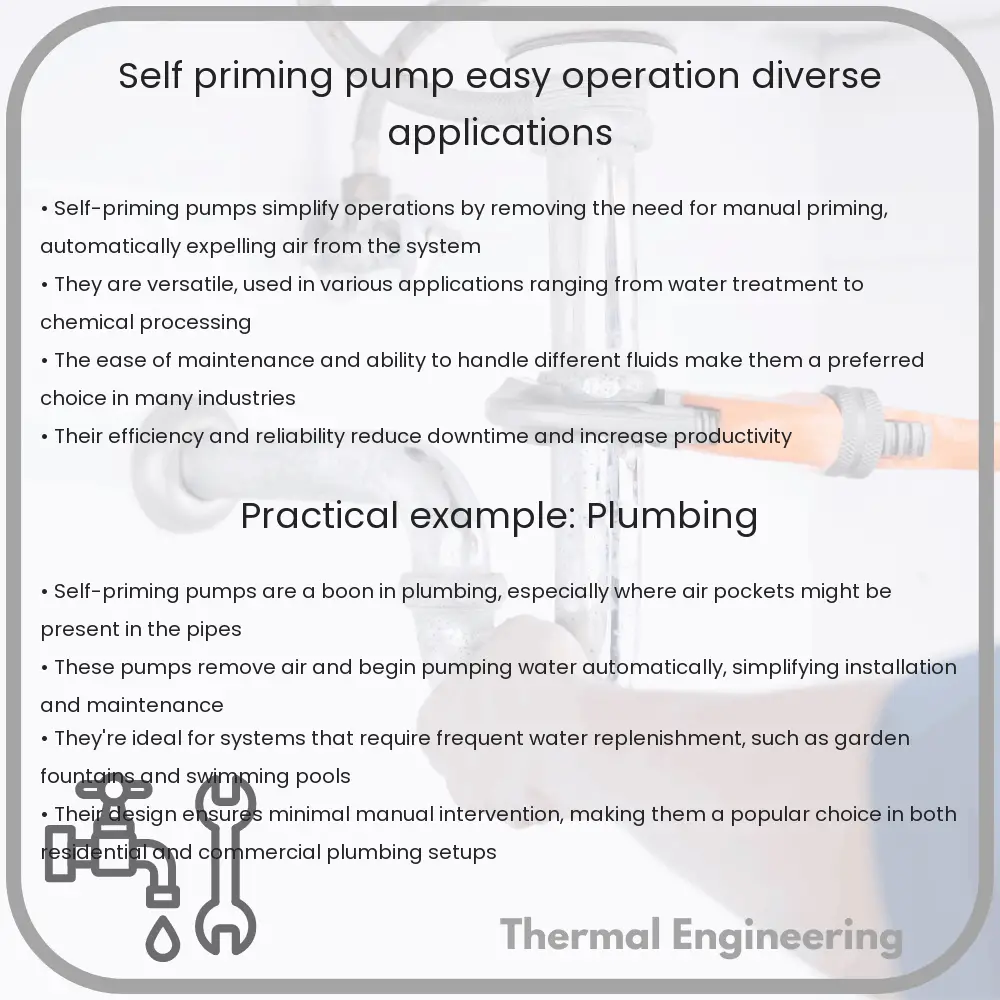
Understanding Self-Priming Pumps: Easy Operation and Diverse Applications
Self-priming pumps are a type of pump that can evacuate air from its casing and suction line without external intervention, allowing for a seamless start-up. This unique feature not only simplifies the setup and operation but also broadens their application in various industries. This article will explore the working principle, advantages, and common applications of self-priming pumps.
How Self-Priming Pumps Work
The main characteristic that distinguishes self-priming pumps from other pump types is their ability to prime themselves during their initial use and after if they run dry or are initially filled with air. The priming process involves several stages:
- Evacuation: The pump begins by evacuating air from the pump casing and suction piping through an integral air-water separator or priming chamber.
- Air Discharge: As the pump operates, it moves the air-water mixture toward the discharge, leaving a lower pressure area at the intake.
- Fluid Intake: As air is expelled, the atmospheric pressure and fluid weight push water up the suction pipe, filling the vacuum left by expelled air, and primes the pump automatically.
This process enables the pump to create enough vacuum to start lifting the liquid, typically water, without needing an initial manual prime.
Advantages of Self-Priming Pumps
- Ease of use: Due to their ability to self-prime, these pumps reduce the need for manual priming, making them easy to start and operate.
- Flexibility: Their design allows them to handle a variety of fluids, including those with dissolved gases or air pockets.
- Adaptability: Self-priming pumps are proficient in varying water levels, which is particularly advantageous for fluctuating water sources such as ponds or streams.
- Reduced Infrastructure: They generally do not require additional components like foot valves and can manage with less perfect suction conditions, thus lowering setup costs and complexities.
Applications of Self-Priming Pumps
Self-priming pumps have diverse applications across various sectors due to their versatile design and robust functionality. Some typical uses include:
- Water and Wastewater: These pumps are widely used in municipal water services, sewage treatment plants, and flood control management due to their ability to handle solids and semi-solids efficiently.
- Marine and Shipping: In marine environments, self-priming pumps facilitate efficient bilge, ballast, and waste water handling, critical for the operation of commercial and recreational vessels.
- Industrial: Many industries, including mining, petrochemical, and food processing, use these pumps for tasks like tank emptying, pumping abrasive slurry, and handling volatile liquids.
- Agriculture: For irrigation purposes, self-priming pumps are used to pump water from sources like ponds or rivers to fields, adapting easily to varying water levels and source locations.
In conclusion, self-priming pumps offer significant advantages in terms of ease of operation and flexibility, positioning them as an excellent choice for a wide range of applications where varying fluid conditions and the ability for rapid startup are critical. Their innovative design simplifies operation and maintenance, making them a favored choice in both industrial and environmental applications.