Learn about sloshing dynamics, the movement of liquids in containers, crucial for the safety and design of transport systems.
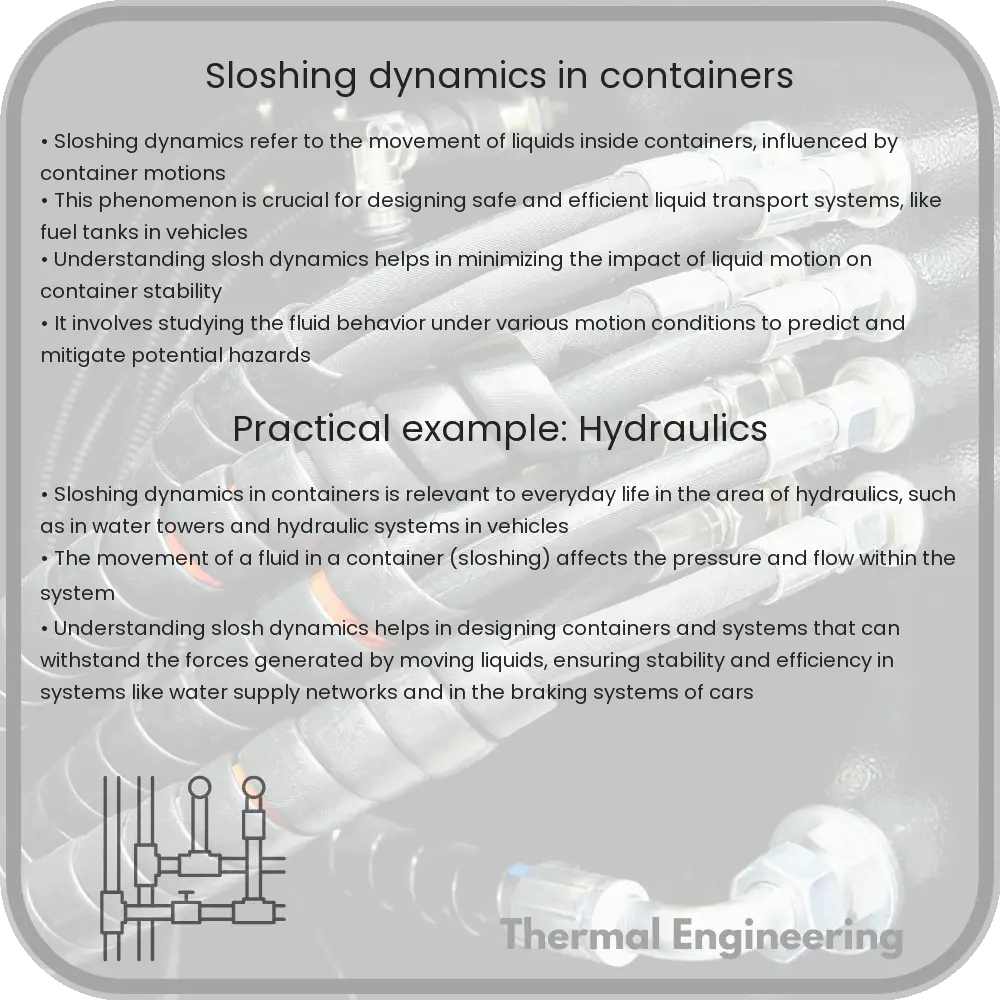
Understanding Sloshing Dynamics in Containers
Sloshing refers to the movement of a liquid inside a partially filled container, which can occur during transportation or any motion of the container. Sloshing can affect the stability of the container and the entire structure it supports, such as a cargo ship or a tanker truck. Understanding the dynamics of sloshing is crucial for the design and safety of these transport systems.
Factors Influencing Sloshing
Sloshing dynamics can be influenced by several factors including:
- The fluid properties, such as density and viscosity.
- The fill level of the container.
- The shape and dimensions of the container.
- The amplitude and frequency of the external forcing.
The interaction between these factors can lead to complex fluid motions and forces exerted on the container walls.
Mathematical Modeling of Sloshing
The mathematical description of sloshing typically involves the potential flow theory, where the fluid is considered inviscid (having no viscosity) and incompressible. The Navier-Stokes equations, which describe the motion of viscous fluid substances, can be simplified under these assumptions.
For small amplitude oscillations, the sloshing in containers can be approximately modeled by the linear wave equation:
\[ h(x,t) = \sum A_n \sin(n \pi \frac{x}{L}) \cos(\omega_n t) \]
where:
- \( h(x,t) \) is the height of the liquid surface above the rest position.
- \( A_n \) are the amplitudes of the modes.
- \( n \) is the mode number.
- \( L \) is the length of the tank.
- \( \omega_n \) is the natural frequency of the \( n^{th} \) mode.
The natural frequencies \(\omega_n\) are particularly important and can be calculated as:
\[ \omega_n = \sqrt{\frac{n^2 \pi^2 g}{L}} \]
where \( g \) is the acceleration due to gravity.
Practical Considerations and Safety
Understanding and predicting sloshing is essential for the safe design of liquid-carrying vehicles and tanks. Measures such as baffles or changes in container geometry can be used to mitigate the sloshing effects. For accurate predictions, more sophisticated computational fluid dynamics (CFD) simulations are usually required.
CFD simulations consider complex aspects like the exact fluid properties, detailed geometries, and non-linear interactions which are beyond the scope of simple analytical models.
Application in Real-World Designs
The principles of sloshing dynamics are applied in various engineering fields:
- Automotive engineering, for the design of fuel tanks in vehicles.
- Shipbuilding, where liquid cargo can significantly impact the stability of the ship.
- Civil engineering, for designing water towers and other liquid containers that can be subjected to environmental forces.
By incorporating sloshing dynamics into their designs, engineers can enhance stability, efficiency, and safety of systems that involve liquid storage and transport.
In conclusion, sloshing dynamics is a fascinating area of fluid mechanics with significant applications in engineering. The ability to predict sloshing behavior is key to designing safer and more efficient systems that face the challenges of liquid motion.