Learn about synthetic air, its precise composition, key roles in calibration and industrial applications, and vital thermal properties.
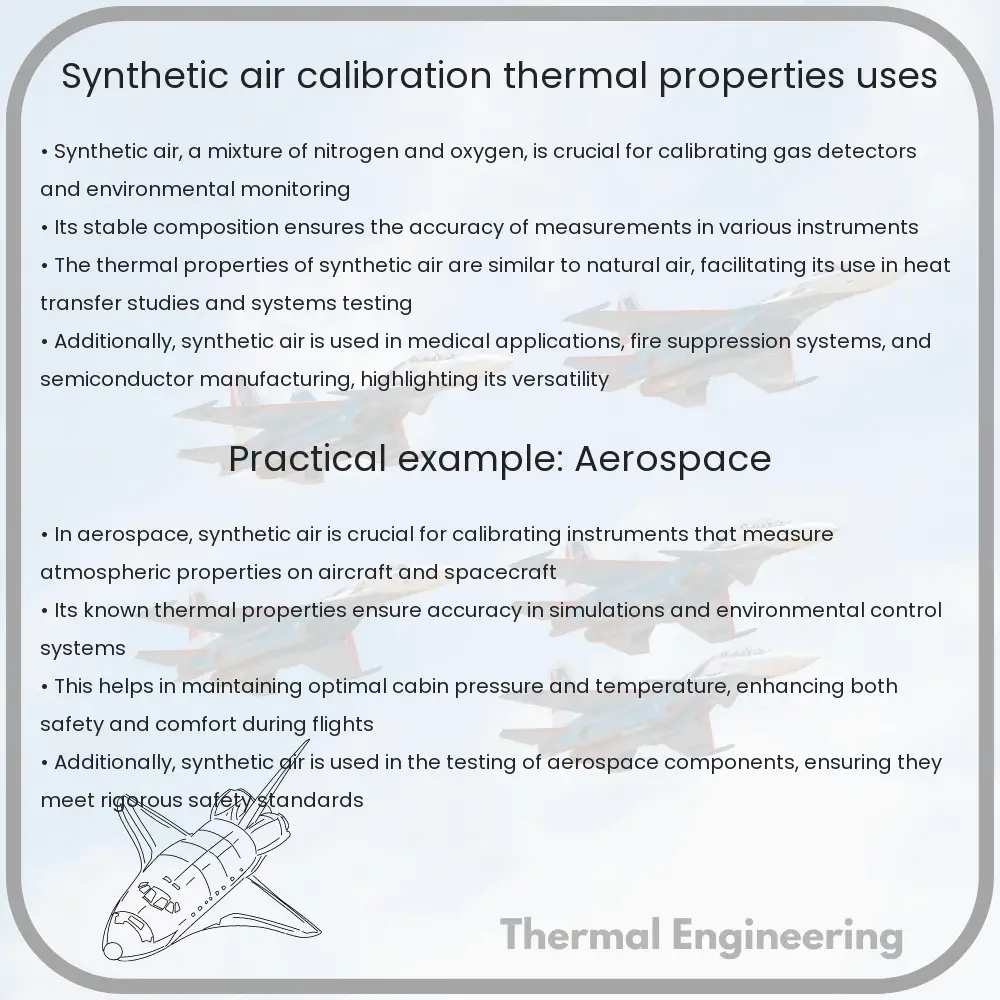
Understanding Synthetic Air: Composition, Calibration, and Thermal Properties
Synthetic air is a meticulously engineered blend of gases used primarily for scientific research, calibration of air monitoring equipment, and various industrial applications. Essentially, it simulates the composition of Earth’s atmosphere and offers a controlled baseline for experiments and equipment testing. Understanding its properties and uses is essential for professionals in numerous fields of science and engineering.
Composition of Synthetic Air
Synthetic air is primarily composed of nitrogen (N2) and oxygen (O2), the two most abundant gases in Earth’s atmosphere. The typical ratio closely mimics that of natural air, with about 78% nitrogen and 21% oxygen. The remaining 1% consists of argon and other trace gases. However, unlike natural air, synthetic air is often devoid of variable components like water vapor, carbon dioxide, and other pollutants, unless specifically added for a particular application.
Calibration of Instruments Using Synthetic Air
The primary use of synthetic air is in the calibration of air monitoring and analytical instruments. Calibration is crucial for ensuring that devices provide accurate readings. For example, gas detection instruments used in environmental monitoring, safety systems in industrial settings, and medical applications often require regular calibration with synthetic air to maintain accuracy.
- The consistency and purity of synthetic air allow for high-reliability calibration.
- It helps in establishing a reference point for measuring concentrations of pollutants and other gases.
- Synthetic air can be enriched with specific gases like carbon monoxide or methane to create calibration standards for various scenarios.
Thermal Properties of Synthetic Air
Synthetic air has thermal properties close to those of natural air since its major components are the same. These properties are crucial in applications involving heat exchange, combustion processes, and thermal energy studies among others. A key aspect of its thermal behavior is characterized by specific heat capacity, thermal conductivity, and density:
- Specific Heat Capacity: The ability to absorb heat with changes in temperature. For synthetic air, typical values are around 1005 J/(kg*K) at constant pressure and 718 J/(kg*K) at constant volume.
- Thermal Conductivity: The rate at which heat passes through a specified material, generally falling within the range of 0.024 to 0.026 W/(m*K) at room temperature.
- Density: This varies with temperature and pressure, following the ideal gas law PV = nRT (where P is pressure, V is volume, n is the amount of substance, R is the gas constant, and T is temperature in Kelvin).
Applications of Synthetic Air
Beyond its use in calibration, synthetic air supports a wide array of applications. Its production and delivery in controlled, contaminant-free conditions make it ideal for sectors where purity is paramount.
- Laboratory Research: Provides a stable atmosphere for experiments, particularly in chemical reactions, where introducing variables can lead to unwanted results.
- Healthcare: Used in respiratory apparatus for patients, ensuring that they breathe clean and controlled air compositions.
- Aerospace and Automotive Testing: Utilized in engine testing facilities to simulate real-world atmospheric conditions under controlled lab environments.
- Electronics Manufacturing: Prevents contamination during the production of sensitive electronic components.
Through its versatile applications and fundamental role in science and technology, synthetic air greatly assists in enhancing environmental sustainability, supporting medical advancements, and promoting manufacturing precision. Grasping its properties and functionality can enable engineers and scientists to optimize its use and explore further potential applications.