Learn about the composition, properties, and diverse engineering applications of air in our detailed guide.
Air: Composition, Properties, and Applications
Air is a vital component of the Earth’s atmosphere, a clear and odiferous gas that is essential for life on our planet. In this article, we will explore what air is composed of, its properties, and its numerous applications in different fields of engineering.
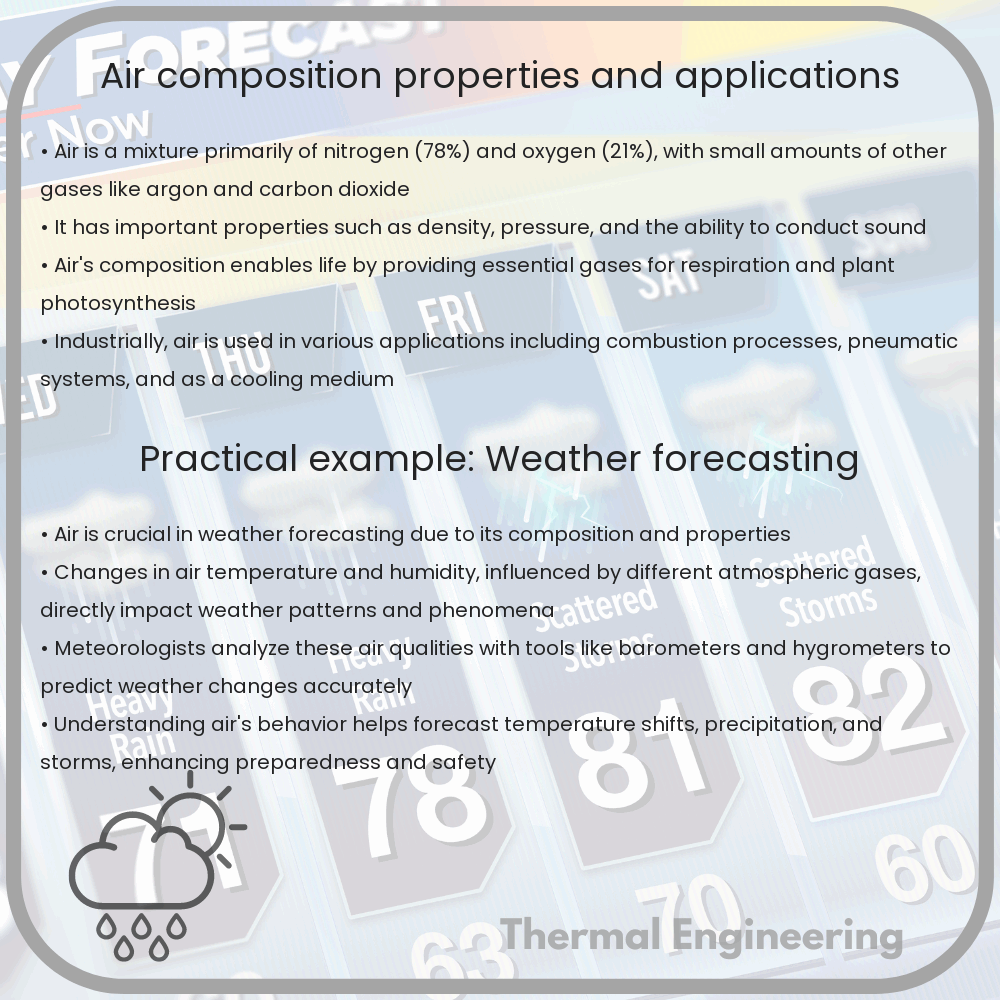
Composition of Air
The air around us is a complex mixture of several gases. Here are the primary components:
- Nitrogen (N2) – approximately 78%
- Oxygen (O2) – about 21%
- Argon (Ar) – around 0.93%
- Carbon Dioxide (CO2) – about 0.04%
- Trace amounts of other gases such as neon, helium, methane, krypton, and hydrogen.
In addition to these gases, air also contains water vapor, whose concentration varies according to the humidity of the environment.
Properties of Air
Air possesses several important physical properties which influence how it interacts with its surroundings:
- Density: The density of air is about 1.225 kg/m3 at sea level and decreases with altitude.
- Pressure: Air pressure is the force exerted by air on any surface in contact with it. At sea level, the standard atmospheric pressure is approximately 101.3 kPa.
- Temperature: The temperature of the air affects its density and pressure. Generally, warmer air is less dense and rises, whereas cooler air is denser and sinks.
- Humidity: This refers to the amount of water vapor present in the air. Higher humidity decreases air density and can influence weather patterns and human comfort.
Applications of Air in Engineering
Air is used in a wide range of engineering applications, owing to its properties and availability. Here are a few key applications:
- Aeronautical Engineering: Air’s properties are fundamental in the study of aerodynamics. Engineers design aircraft surfaces to optimize air flow, reducing drag and increasing lift.
- HVAC Systems: Heating, Ventilation, and Air Conditioning (HVAC) systems use air for regulating indoor temperatures. By understanding the principles of air flow, pressure, and humidity, engineers create more efficient and comfortable environments.
- Pneumatics: Pneumatics involves using compressed air to do work. Air is compressed in a cylinder and then used to power mechanical movements – a principle used in various tools, from jackhammers to automated machinery in factories.
- Environmental Engineering: Engineers study the composition of air to monitor and control pollution levels, ensuring cleaner air by designing systems that filter out harmful gases and particulate matter.
In conclusion, air is not only essential for sustaining life, but it also plays a critical role in various engineering disciplines. Understanding its composition and properties helps engineers to innovate and create systems that improve our lives, emphasizing the significant interdisciplinary nature of engineering and sciences.