Learn about the essential strategies and technologies for effective thermal management in power electronics to ensure device efficiency and longevity.
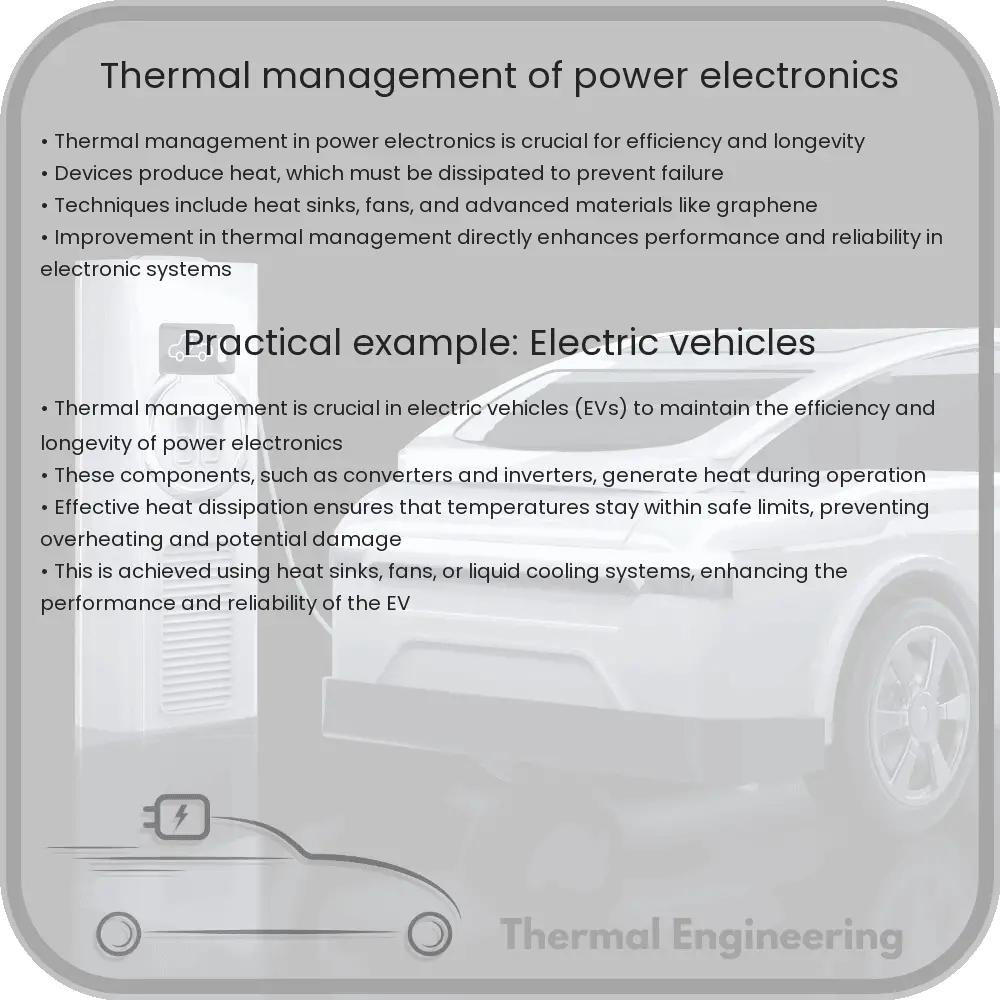
Understanding Thermal Management in Power Electronics
Thermal management is a crucial aspect of power electronics, which ensures that devices operate within safe temperature limits and maintain efficiency and reliability. Power electronic devices, such as inverters, converters, and power supplies, generate heat during operation due to electrical losses. The goal of thermal management is to effectively dissipate this heat, thereby preventing overheating and prolonging the life of the components.
Key Concepts and Importance
When electrical current flows through a power electronic component, it encounters resistance, which results in power loss primarily in the form of heat. This phenomenon is described by Joule’s Law, represented as:
P = I2R
where P is the power loss in watts, I is the current in amperes, and R is the resistance in ohms. Managing this heat is vital because excessive temperature can lead to semiconductor failure, solder melting, and degradation of encapsulant materials.
Methods of Heat Dissipation
- Heat Sinks: One of the most common methods used is attaching a heat sink to the component. Heat sinks increase the surface area that is in contact with the air, thus enhancing heat dissipation through convection.
- Liquid Cooling: More advanced systems may use liquid cooling, where a coolant is circulated around the components to absorb heat, then moved away to dissipate the heat externally. This method is particularly effective for high-power applications.
- Thermal Interface Materials (TIMs): These materials are used to improve the thermal contact between the heat source and the heat sink. Examples include thermal greases, pads, and adhesive films.
- Forced Air Cooling: This involves using fans or blowers to increase the airflow over the component, thus improving the heat transfer rate.
Design Considerations
Effective thermal management in power electronics involves several design considerations:
- Material Selection: The choice of materials, such as the type of heat sink material, impacts the thermal conductivity and, thus, the overall efficiency of heat dissipation.
- Component Layout: Strategic placement of components can help minimize hot spots and facilitate uniform heat distribution.
- Environment: The surrounding environment, including ambient temperature and airflow, must be considered when designing thermal management systems.
Advanced Technologies in Thermal Management
As power density in electronics increases, advanced thermal management techniques become essential. Some emerging technologies include:
- Phase Change Materials (PCMs): These materials absorb and release heat while changing phase, typically from solid to liquid, helping to regulate temperature in the device.
- Microchannel Heat Exchangers: These involve small channels through which coolant flows, allowing for efficient heat transfer from smaller or more densely packed electronic components.
Conclusion
Thermal management is a critical field within engineering that ensures the efficiency, reliability, and longevity of power electronics. Through a combination of careful design and advanced technologies, engineers can effectively manage heat generation and dissipation in various electronic applications. As technology evolves, the demand for more innovative cooling solutions is likely to increase, pushing the boundaries of what is currently known in thermal management.