Explore the dynamics of blood flow in arteries, focusing on fluid dynamics, artery structure, and impacts on cardiovascular health.
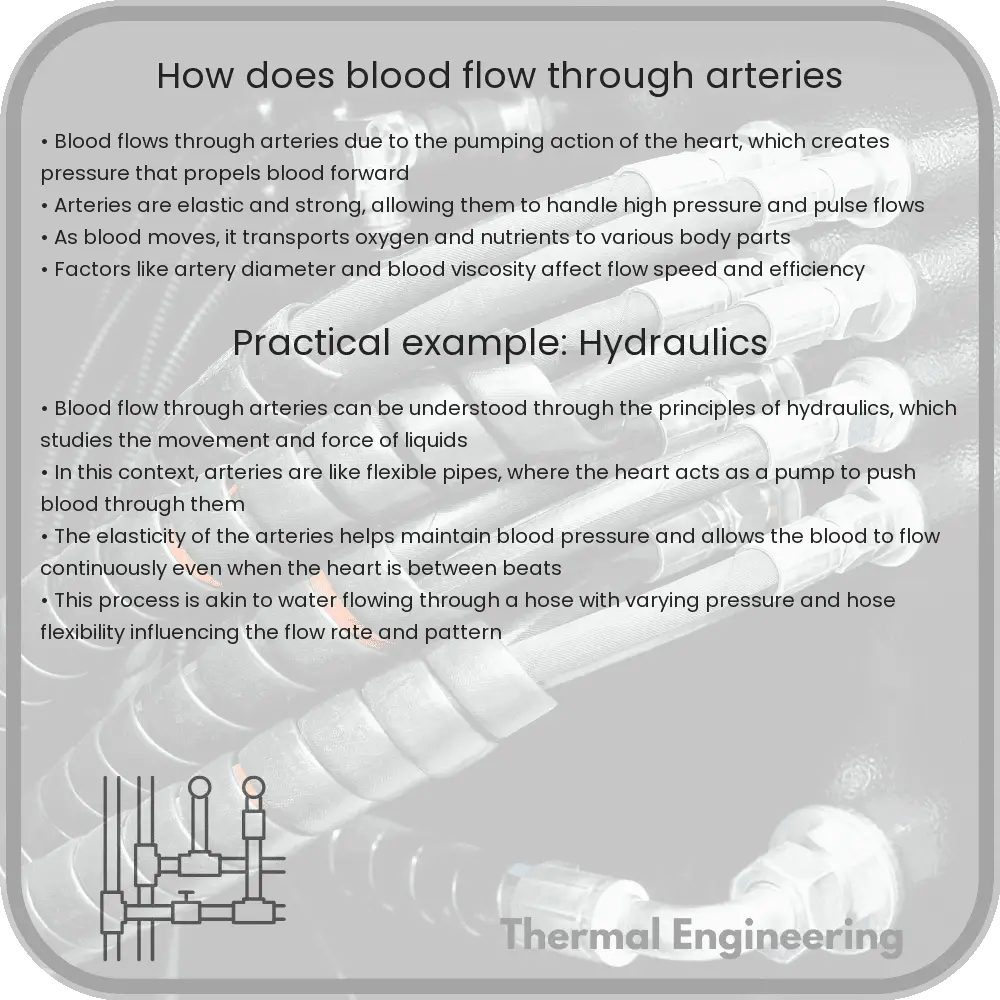
Understanding How Blood Flows Through Arteries
The human circulatory system is a complex and vital system responsible for transporting blood, nutrients, oxygen, carbon dioxide, and hormones throughout the body. Central to this system are the arteries, which play a crucial role in directing blood flow from the heart to various parts of the body. This article explores the dynamics of how blood flows through arteries and the physical principles governing this essential physiological process.
Arterial Structure and Function
Arteries are blood vessels that carry oxygen-rich blood away from the heart. They are constructed of multiple layers: an inner lining called the endothelium, a middle layer of smooth muscle, and an outer layer of connective tissue. The elasticity of the artery walls is crucial for maintaining blood flow during the different phases of the cardiac cycle.
The Physics of Blood Flow
Blood flow through arteries can be primarily understood through principles of fluid dynamics. The flow of blood is influenced by several factors such as pressure, resistance, and the physical properties of blood and arterial walls.
- Pressure Gradient: Blood flow is driven by a pressure gradient created by the heart’s pumping action. When the heart contracts, it generates high pressure (systolic pressure), forcing blood through the arterial system. Blood flow continues as the pressure decreases until the next heart contraction.
- Poiseuille’s Law: This principle helps quantify blood flow (Q) through a cylindrical vessel based on the radius, length of the vessel, viscosity of the fluid, and pressure difference across the vessel. Mathematically, it is given by the equation:
Q = (π * ΔP * r4) / (8 * μ * L),
where ΔP is the pressure difference, r is the radius of the artery, μ is the viscosity of the blood, and L is the length of the artery.
- Reynolds Number: The flow of blood can be laminar or turbulent, depending on the Reynolds number, which is calculated based on factors like blood velocity, arterial diameter, and blood viscosity. Laminar flow (smooth and regular) is typical in smaller arteries, while turbulent flow may occur in larger arteries or those with obstructions.
Role of Arterial Elasticity
Arterial elasticity plays a significant role in damping the pulsatile nature of blood flow, which is a result of the heart’s rhythmic contractions. This characteristic is due to the elastin and collagen fibers in the artery walls, allowing them to expand and contract, thereby smoothing out the pressure fluctuations and ensuring a more steady flow of blood through the arterial network.
Medical Implications
Understanding blood flow in arteries is critical for diagnosing and treating various cardiovascular diseases. Conditions like atherosclerosis (narrowing of arteries due to plaque buildup) can alter the dynamics of blood flow, leading to increased blood pressure and risk of heart attack or stroke. Medical interventions such as stents or bypass surgery are designed to restore normal blood flow and reduce these risks.
Conclusion
The study of how blood flows through arteries integrates principles of physics and biology to provide insights into human health and disease. By understanding the dynamics at play, medical professionals can better diagnose, treat, and manage cardiovascular conditions, ultimately leading to improved health outcomes.