Understanding thermodynamics in additive manufacturing enhances process optimization and material properties.
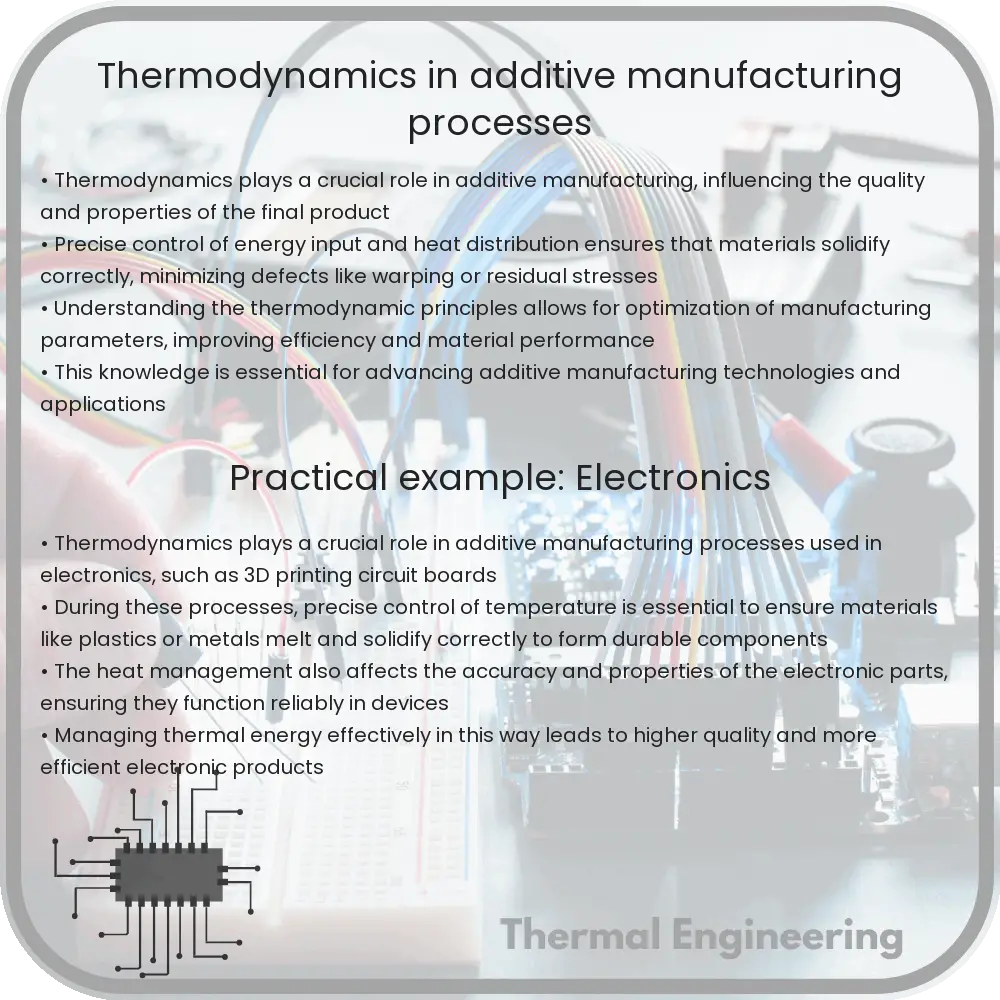
The Role of Thermodynamics in Additive Manufacturing Processes
Additive manufacturing, commonly known as 3D printing, is a transformative approach to industrial production that enables the creation of lighter, stronger parts and systems. It is a process of joining materials to make objects from 3D model data, usually layer upon layer, as opposed to subtractive manufacturing methodologies. Understanding the thermodynamics involved in additive manufacturing is critical for optimizing these processes, enhancing material properties, and ensuring the structural integrity of manufactured parts.
Basic Concepts of Thermodynamics in Additive Manufacturing
Thermodynamics in the context of additive manufacturing primarily involves the study of energy transformations and heat transfer mechanisms that occur during the printing process. These transformations can significantly affect the microstructure, mechanical properties, and dimensional accuracy of the finished product.
- Heat Transfer: The most predominant aspect of thermodynamics in additive manufacturing is heat transfer. Methods such as laser sintering or electron beam melting involve melting and solidification of materials, which requires precise control of heat sources.
- Phase Changes: The materials used, typically metal or polymer powders, undergo phase changes during the manufacturing process. Understanding the melting and solidification behaviors, which are dictated by the thermodynamic properties of the material, is essential for predicting the final product’s quality.
- Thermal Stresses: Rapid heating and cooling cycles can introduce thermal stresses in the manufactured parts. These stresses might lead to warping, distortions, or even failures, which are critical to evaluate from a thermodynamics perspective.
Thermodynamic Analysis in Additive Manufacturing
To mitigate issues associated with thermal behaviors, thermodynamic analysis is employed. This analysis helps in understanding energy absorption, heat distribution, and the evolution of temperature gradients within the material. Such computational analyses often involve a few fundamental equations:
- Conservation of Energy: Generally expressed as
Q = ΔU + W, whereQis the heat added to the system,ΔUis the change in internal energy, andWis the work done by the system. - Heat Conduction Equation: Also known as Fourier’s law, it is described by
q = -k∇T, whereqrepresents the heat flux,kthe thermal conductivity, and∇Tthe temperature gradient. - Convective Heat Transfer: Convective cooling rates can also influence the solidification process, given by
Q = hA(Tsurface - Tfluid), wherehis the convective heat transfer coefficient,Ais the surface area, andTare the temperatures of the surface and fluid respectively.
Applications and Implications
Understanding the thermodynamic principles in additive manufacturing allows for the refinement of process parameters such as energy input, layer thickness, and scanning speed. It aids in reducing defects, improving surface finish, and achieving dimensional accuracy. Moreover, advanced thermodynamic models contribute to the development of new materials specifically tailored for additive manufacturing that exhibit desirable thermal and mechanical properties.
In conclusion, the interplay of thermodynamics in additive manufacturing is an essential area of study for advancing this technology. As new materials and more complex builds are explored, the role of thermodynamic analysis will only grow, ensuring the efficient and reliable production of high-quality parts.