Explore how thermodynamic principles govern the efficiency of membrane separation processes used in various industries.
Understanding the Thermodynamics of Membrane Separation Processes
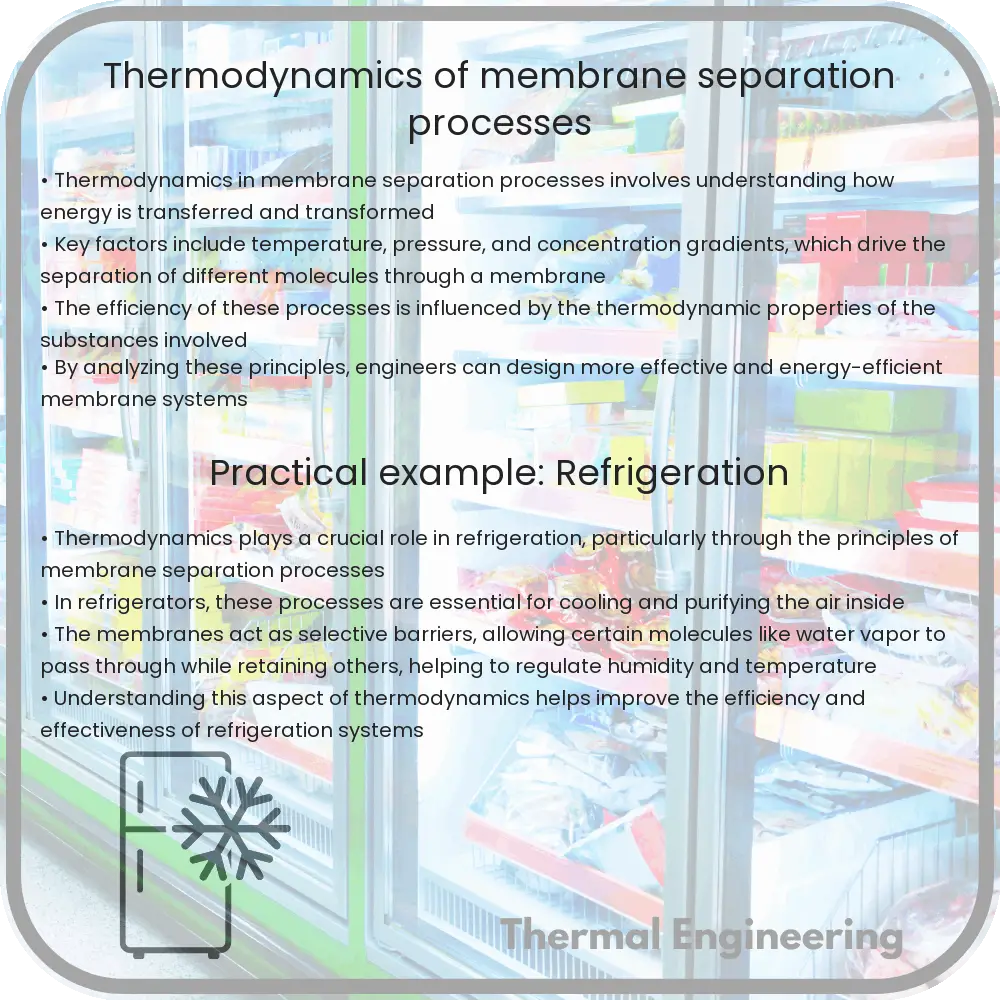
Membrane separation is a crucial engineering technique used across various industries, from water purification to gas separation. The basic principle behind membrane separation is the selective barrier mechanism, where certain molecules are allowed to pass while others are blocked. The efficiency and selectivity of these processes are largely determined by thermodynamic principles, which help us understand and predict the behavior of these separations.
Basic Principles of Membrane Separation
At the core of membrane technology are the concepts of chemical potential and driving forces. In any membrane separation process, a difference in chemical potential between two sides of the membrane drives the transfer of mass. This transfer can be driven by differences in concentration, pressure, or temperature, leading to different types of membrane processes such as reverse osmosis, nanofiltration, and gas separation.
Thermodynamics and Energy Considerations
The Second Law of Thermodynamics plays a key role in membrane separation. It implies that for a spontaneous process to occur, the entropy of the system should increase. In practical terms, this means designing membrane processes that minimize energy consumption while maximizing separation efficiency. The efficiency of a process is often determined by its ability to retain this balance under operational conditions.
Models of Membrane Separation
To describe and optimize membrane separation processes, engineers use various thermodynamic models. These models help in understanding how temperature, pressure, and concentration gradients affect separation efficiency and selectivity:
- Solution-Diffusion Model: This model assumes that the feed solution dissolves in the membrane material, and the separation is governed by the differences in the diffusion rates of various components through the membrane.
- Porous Model: In this model, the membrane is considered as a porous medium. The separation is based on the size and shape of the pores relative to the particles being separated.
- Thermodynamic Models: These models integrate the laws of thermodynamics directly into the analysis, typically by analyzing the entropy generation or the exergy (usable energy) destruction in the membrane process.
Entropy and Membrane Processes
Entropy, a measure of disorder or randomness in a system, is a fundamental concept in thermodynamics that also affects membrane technology. During separation, the aim is often to decrease the entropy associated with mixing different particles or molecules. The generation of entropy associated with mixing can often determine the feasibility and efficiency of a membrane separation process.
Real-World Applications
Understanding the thermodynamics of membrane processes has profound practical implications:
- Water Desalination: Making freshwater from seawater by removing salts through reverse osmosis.
- Gas Separation: Such as the extraction of oxygen from air in medical applications or hydrogen purification in petrochemical processes.
- Pharmaceutical Production: Purification steps in drug synthesis, often requiring precise separation of complex mixtures.
In conclusion, the thermodynamics of membrane separation processes is a key aspect of engineering that allows the design and optimization of systems to carry out critical separations in industry and environmental management. Recognizing the thermodynamic constraints and capabilities of membranes enables engineers to innovate and enhance the sustainability and efficiency of these vital systems.