Learn about thermoelectric materials, their ability to convert temperature differences into electrical voltage, and their applications in energy conversion.
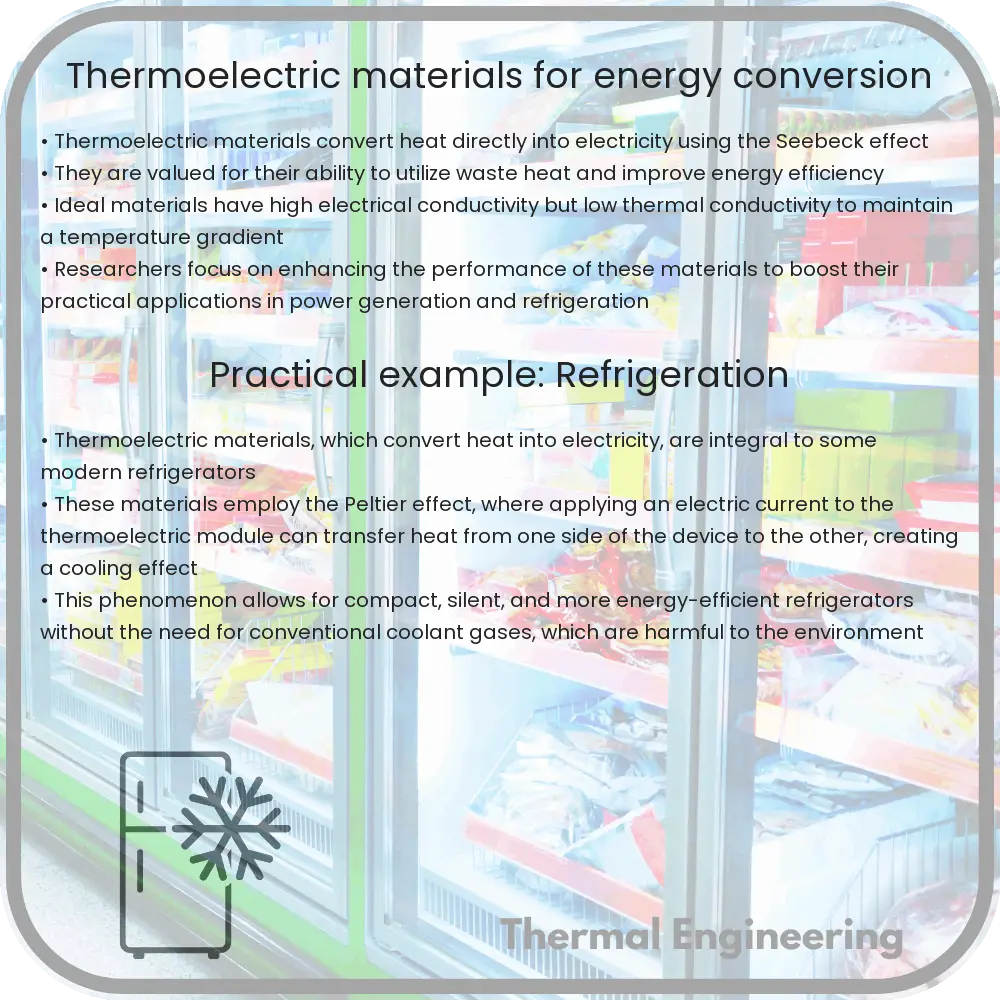
Understanding Thermoelectric Materials for Energy Conversion
Thermoelectric materials have the distinctive ability to convert temperature differences into electrical voltage and vice versa. This property opens the door to a variety of applications, including power generation from waste heat, energy harvesting, and environmentally friendly refrigeration. In this article, we’ll explore the fundamentals of thermoelectric materials and their role in energy conversion technologies.
How Thermoelectric Materials Work
Thermoelectric materials function based on the Seebeck and Peltier effects—a set of phenomena discovered in the early 19th century. The Seebeck effect describes the generation of an electric current when there is a temperature difference across a material. Conversely, the Peltier effect refers to the creation or absorption of heat when an electric current flows through a material.
A practical thermoelectric device typically consists of pairs of n-type and p-type semiconductor materials that form a thermocouple. These materials are connected electrically in series and thermally in parallel. When a temperature gradient is applied across the device, it induces a voltage difference between the hot and cold junctions, resulting in electric power generation.
Key Parameters of Thermoelectric Materials
- Seebeck Coefficient (S): This is the measure of the induced voltage in response to a temperature difference across a material. The higher the Seebeck coefficient, the more effective the material is at converting thermal energy to electrical energy.
- Electrical Conductivity (σ): Efficient thermoelectric materials should have high electrical conductivity to reduce Joule heating and thereby increase efficiency.
- Thermal Conductivity (κ): Ideally, thermoelectric materials should have low thermal conductivity to maintain a temperature gradient.
The overall efficiency of a thermoelectric material can be evaluated using a dimensionless figure of merit, ZT, given by:
ZT = (S2 * σ * T) / κ
where T is the absolute temperature in Kelvin (K). Materials with higher ZT values are considered better for thermoelectric applications.
Advancements in Thermoelectric Materials
Research in thermoelectric materials has evolved substantially, identifying several promising materials with high ZT values. Bismuth telluride (Bi2Te3), lead telluride (PbTe), and skutterudites are among the most effective thermoelectric materials for mid-range temperature applications. Additionally, recent advancements in nanostructuring and alloying have paved the way for enhanced thermoelectric properties by reducing thermal conductivity while maintaining or improving electrical properties and Seebeck coefficient.
Applications of Thermoelectric Materials
- Waste Heat Recovery: Utilizing thermoelectric generators to capture and convert waste heat from industrial processes or vehicle exhaust into usable electricity.
- Energy Harvesting: Thermoelectric devices can be used to harness energy from the environment, such as body heat, to power small electronic devices.
- Solid-State Cooling: By reversing the process, thermoelectric materials can be used for cooling purposes, offering a compact and environmentally friendly alternative to traditional refrigeration technologies.
Challenges and Future Outlook
Despite their potential, widespread adoption of thermoelectric materials is hindered by challenges such as high production cost, material scarcity, and lower efficiency at room temperature. Ongoing research is aimed at overcoming these hurdles by developing materials with higher ZT values, optimizing material structures, and exploring new, more abundant materials.
As we continue to seek sustainable and efficient energy solutions, thermoelectric materials stand out as a fascinating field of study, promising a future where converting waste heat into electrical power could become commonplace in everyday applications.