Explore effective turbine blade cooling techniques and their impact on engine efficiency and durability in high-temperature environments.
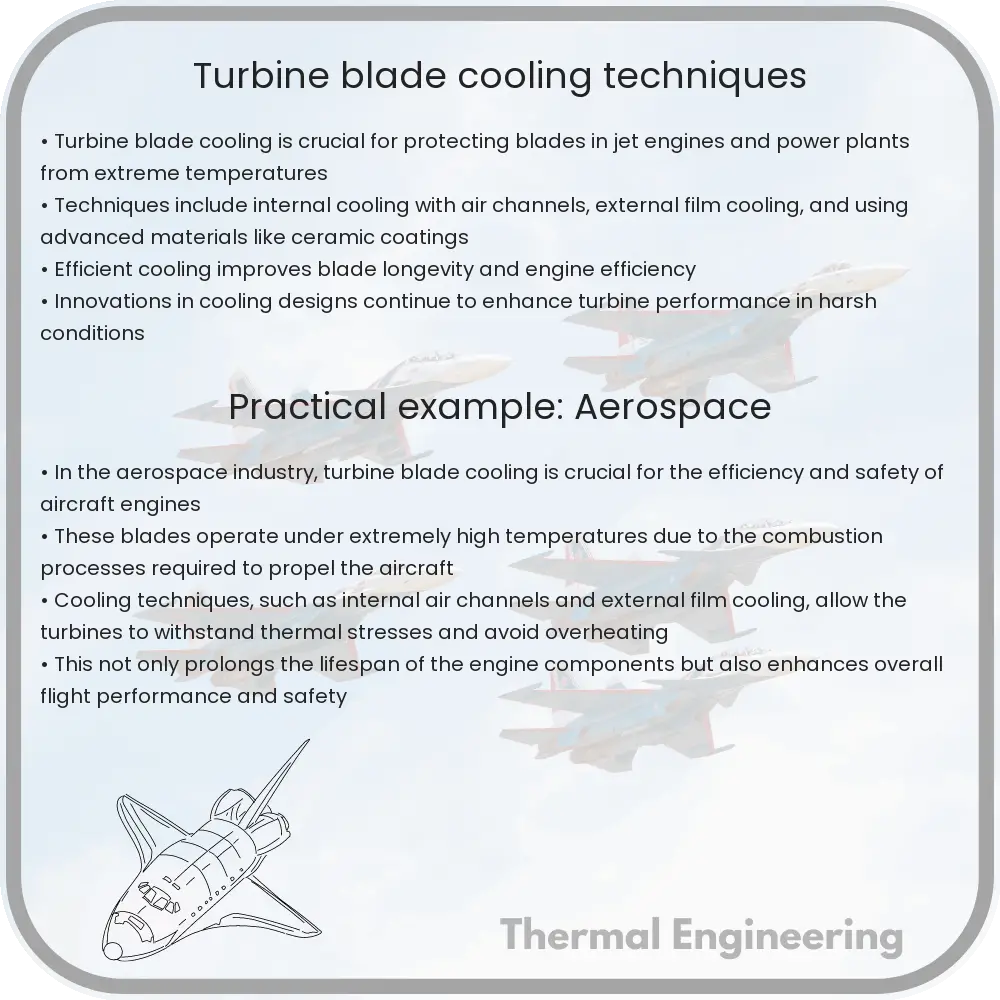
Understanding Turbine Blade Cooling Techniques
Turbine blades are crucial components in various engines, such as those in jet aircraft and power plants. These blades are subjected to extremely high temperatures and pressures, making effective cooling essential to maintain their structural integrity and performance. In this article, we explore the various techniques used to cool turbine blades, enhancing their efficiency and lifespan.
Why is Turbine Blade Cooling Necessary?
The efficiency of a turbine is significantly enhanced by operating at high temperatures. However, these high temperatures can exceed the melting point of the materials used for turbine blades. Effective cooling methods are therefore critical to prevent blade failure, reduce thermal stresses, and maintain operational efficiency.
Methods of Turbine Blade Cooling
Turbine blade cooling can be achieved through several techniques. These methods are broadly classified into internal cooling, external cooling, and combined cooling processes.
- Internal Cooling: Internal cooling involves the use of cool air passed through channels within the turbine blade. The air absorbs the heat from the blade and is expelled back into the main gas stream. Some common internal cooling methods include:
- Convection Cooling: This technique uses coolant air that flows through passages formed inside the turbine blade.
- Impingement Cooling: Jet plates with multiple holes direct jets of cooling air onto the internal surface of the blade, enhancing heat transfer.
- Film Cooling: Small amounts of cooling air are ejected through tiny holes on the surface of the blade, creating a thin film between the blade surface and the hot gases.
- External Cooling: This approach includes the use of coatings and thermal barrier coatings (TBCs), which protect the blade by providing a thermal resistance layer on the surface.
- Combined Cooling Methods: Often, a combination of internal and external cooling methods provides the most effective cooling. For example, the use of internal cooling channels along with film cooling and a thermal barrier coating is a common practice.
Advanced Cooling Technologies
In recent years, advancements in cooling technologies continue to develop, offering more resilience against high temperatures. Some innovative cooling methods include:
- Transpiration Cooling: Similar to film cooling, but with much finer holes, allowing for a more even distribution of the cooling air across the blade surface.
- Additive Manufacturing: 3D printing technologies enable more complex internal cooling channel designs that were not feasible with traditional manufacturing methods.
- Enhanced Thermal Barrier Coatings: New materials and application techniques have led to more durable and effective TBCs that further insulate the blades from high temperatures.
Impact of Blade Cooling on Turbine Efficiency
While cooling is essential for the turbine’s longevity and safe operation, it presents a paradox; cooling uses up some of the turbine’s output power, thus reducing overall efficiency. The key challenge for engineers is to maximize cooling effectiveness while minimizing performance penalties. Ongoing research and development focus on optimizing cooling techniques to strike the right balance between durability and efficiency.
The field of turbine blade cooling is a fascinating area of engineering that blends material science, thermodynamics, and fluid dynamics to solve complex challenges in turbine technology. As materials and manufacturing techniques evolve, cooling methods will continue to improve, enabling more efficient and powerful turbines.