Learn about hydrodynamic lubrication, a key mechanical engineering concept enhancing machinery performance by reducing friction through a lubricant film.
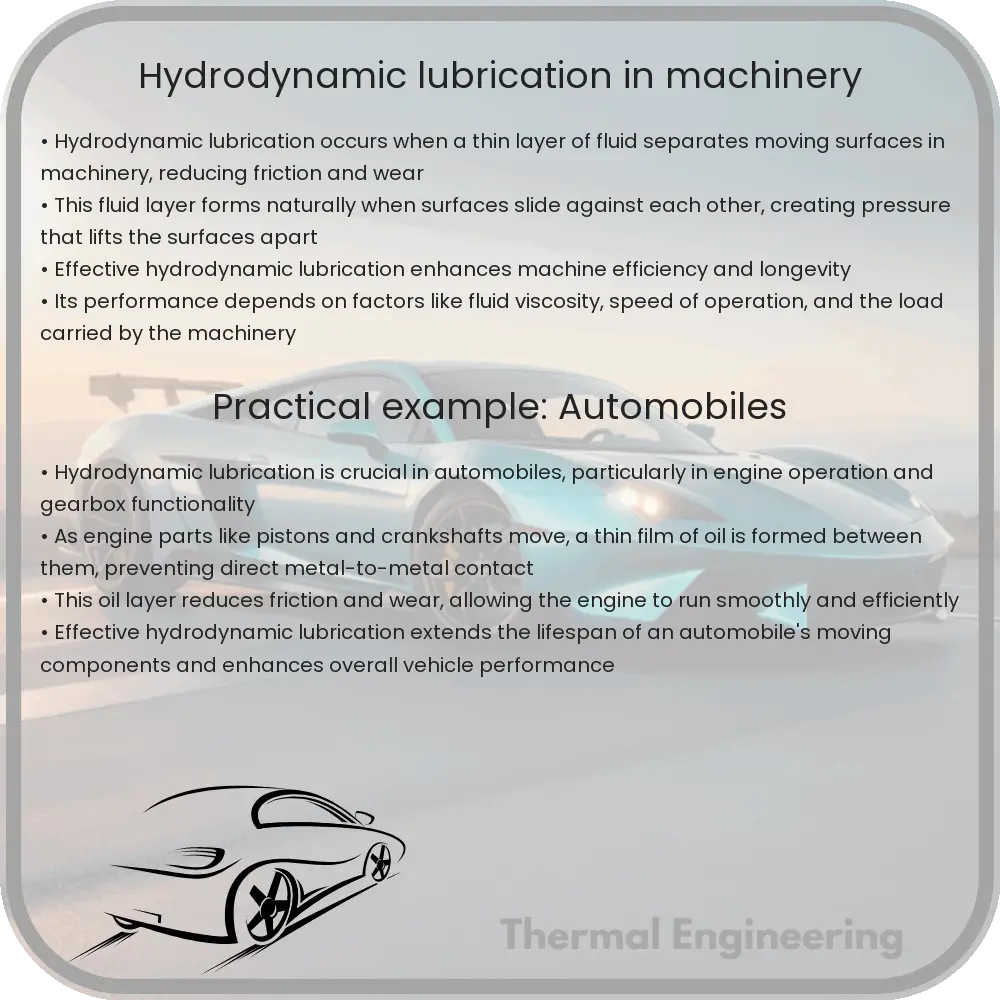
Understanding Hydrodynamic Lubrication in Machinery
Hydrodynamic lubrication is a critical concept in the field of mechanical engineering, particularly concerning the longevity and efficiency of machinery. It refers to a regime of lubrication that occurs when the surfaces in relative motion are completely separated by a continuously maintained film of lubricant. This phenomenon significantly reduces friction and wear between moving parts, enhancing machinery performance and durability.
How Hydrodynamic Lubrication Works
In hydrodynamic lubrication, the lubricant is dragged along by a moving surface and builds up a pressure gradient as it is squeezed into a narrowing space between two surfaces, typically referred to as the ‘converging wedge’. As the lubricant pressure increases, it lifts the moving object, creating a lubricating film that fully separates the surfaces. This process depends greatly on the speed of movement, viscosity of the lubricant, surface roughness, and the geometry of the surfaces.
Key Parameters Affecting Hydrodynamic Lubrication
- Viscosity: The thickness of the lubricant, which needs to be sufficient to create a load-bearing film. Higher viscosity lubricants generally provide better separation between surfaces under high loads or low speeds.
- Surface Speed: Higher speeds enhance the lubricant film’s thickness by dragging more lubricant into the contact zone.
- Load: The normal force applied to the surfaces. Higher loads require a thicker film to prevent the surfaces from coming into contact.
- Geometry of Surfaces: The shapes and alignment of the moving surfaces affect how efficiently a lubricant film can be formed and maintained.
The Hydrodynamic Lubrication Equation
The classical Reynolds Equation is central to understanding and calculating hydrodynamic lubrication. This equation is given by:
\[ \frac{\partial}{\partial x} \left( h^3 \frac{\partial p}{\partial x} \right) + \frac{\partial}{\partial y} \left( h^3 \frac{\partial p}{\partial y} \right) = 6 \mu \frac{\partial (u h)}{\partial x} + 6 \mu \frac{\partial (v h)}{\partial y} \]
where p represents the pressure in the lubricant, h the film thickness, \mu the lubricant viscosity, and u and v the velocities of the surfaces in the x and y directions, respectively.
Applications of Hydrodynamic Lubrication
Hydrodynamic lubrication is extensively applied in various mechanical systems, including:
- Bearings: Journal bearings and thrust bearings use this principle to support heavy loads and rotational speeds.
- Gear Systems: It helps in reducing the wear and tear on gear teeth in high-load conditions.
- Internal Combustion Engines: Components like pistons and crankshafts rely on hydrodynamic lubrication for smooth operation.
- Turbine Machinery: Hydrodynamic lubrication assists in the efficient performance of turbines found in power generation and hydraulic systems.
Challenges and Considerations
Despite its benefits, achieving and maintaining hydrodynamic lubrication can be challenging. It requires the correct selection of lubricant, regular maintenance, and careful consideration of design parameters. Environmental conditions like temperature can additionally affect viscosity and thus the effectiveness of the lubrication. Engineers must carefully design and maintain systems to sustain the right conditions for hydrodynamic lubrication.
In conclusion, hydrodynamic lubrication is a fundamental aspect of mechanical engineering that ensures efficient and long-lasting machinery performance. By understanding and applying the principles of hydrodynamic lubrication, engineers can significantly enhance the functionality and longevity of mechanical systems.