Explore the intricacies of Hawking radiation, a pivotal concept that illustrates how black holes can emit radiation and potentially evaporate, challenging traditional notions of black hole permanence.
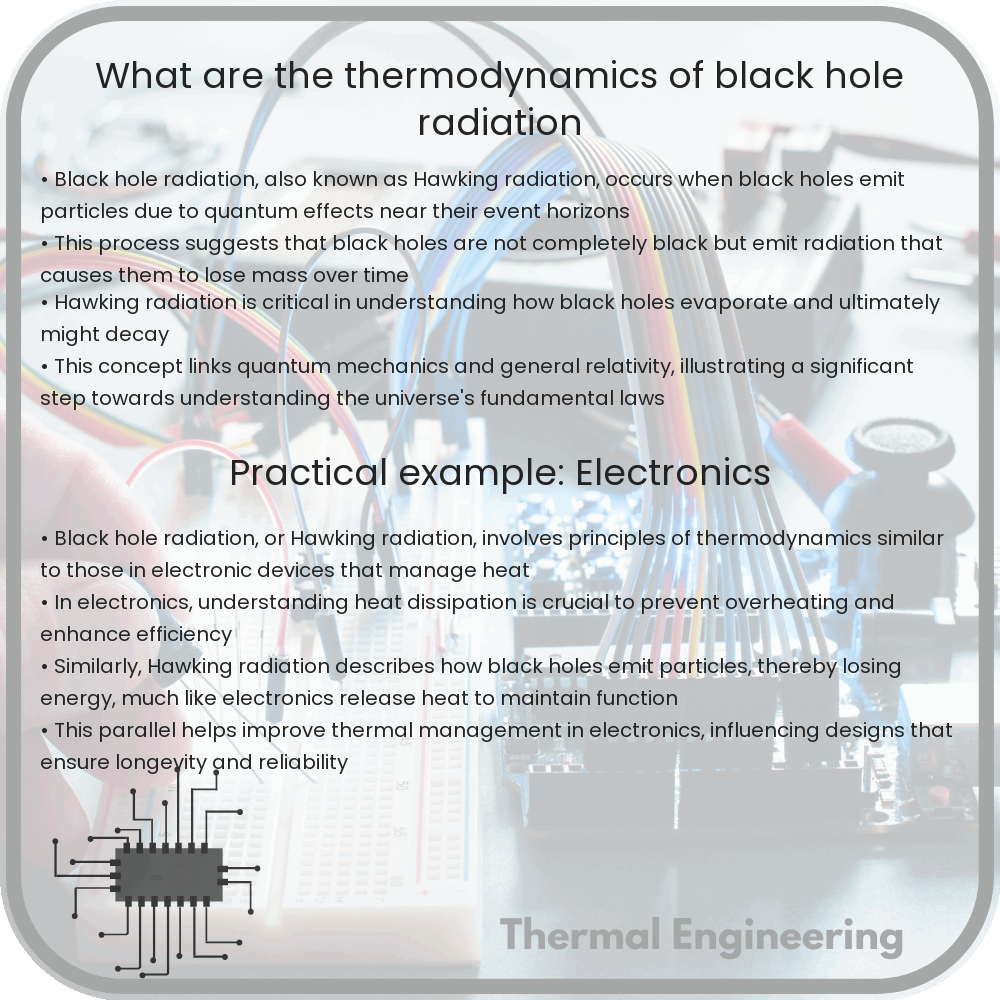
Understanding the Thermodynamics of Black Hole Radiation
Black hole radiation, more commonly known as Hawking radiation, is a theoretical prediction that arises from the field of quantum mechanics and general relativity. It suggests that black holes, which were once thought to absorb everything and emit nothing, actually emit radiation and can potentially evaporate over time. This phenomenon profoundly connects the realms of thermodynamics, quantum physics, and gravitational theory.
Theoretical Foundation
The concept of black hole radiation was proposed by physicist Stephen Hawking in 1974, fundamentally challenging the understanding that nothing could escape from a black hole. The theory combined principles from quantum mechanics with general relativity, depicting a scenario where particle-antiparticle pairs are created near the event horizon of a black hole.
- Event Horizon: The boundary around a black hole beyond which no matter or radiation can escape.
- Particle-Antiparticle Pairs: In quantum mechanics, these pairs of particles with opposite charges may appear spontaneously near the event horizon.
When these pairs form, one particle may fall into the black hole while the other escapes. The particle that escapes carries away energy, leading to a decrease in the mass of the black hole—a process not visible but theoretically sound.
Mathematical Descriptions
The temperature T of the Hawking radiation from a black hole can be described by the equation:
\[ T = \frac{\hbar c^{3}}{8 \pi G M k_{B}} \]
Where:
- \(\hbar\) (h-bar) is the reduced Planck constant,
- c is the speed of light in vacuum,
- G is the gravitational constant,
- M is the mass of the black hole,
- kB is the Boltzmann constant.
This relationship shows that the thermal radiation temperature is inversely proportional to the mass of the black hole, suggesting that larger black holes emit less radiation and thus have lower temperatures.
Entropy and Information Paradox
Another intriguing aspect of black hole thermodynamics is the concept of entropy. The entropy of a black hole is proportional to its surface area (A) and can be expressed as:
\[ S = \frac{k_{B} c^{3} A}{4 G \hbar} \]
This implies that the black hole’s entropy, which accounts for the unknown information within the black hole, increases as its surface area grows. Connected to this is the information paradox, a famous dilemma about whether information that falls into a black hole is lost forever or can be in some way retained or emitted back out, contravening the classical notions of physics.
Implications and Modern Research
The phenomenon of black hole radiation has numerous implications for modern physics, including the eventual fate of black holes and the ultimate theory of quantum gravity, which seeks to unify quantum mechanics with general relativity. While directly observing Hawking radiation remains beyond current technological capabilities, these theoretical insights continue to inspire extensive research and debate in theoretical physics, cosmology, and quantum mechanics.
Hawking radiation not only enhances our understanding of celestial mechanics but also challenges and expands the scope of theoretical physics. By bridging elements from various physics fields, it remains one of the most fascinating topics in the study of cosmology and black hole physics.