Learn about argon gas, a non-reactive noble gas with applications in welding, manufacturing, and thermal insulation.
Introduction to Argon Gas
Argon is a colorless, odorless, tasteless, and non-toxic gas that belongs to the noble gases group in the periodic table. Represented by the symbol Ar, its atomic number is 18. Due to its inert properties, argon is not very reactive and forms very few compounds under ordinary conditions. This makes it highly valuable in various industrial applications where materials must be protected from the reactive effects of air.
Properties of Argon
Argon has several notable physical and chemical properties:
- Density (at STP): approximately 1.784 g/L, which is roughly 1.38 times that of air.
- Boiling Point: -185.9°C (-302.6°F)
- Melting Point: -189.3°C (-308.7°F)
- It is mostly used in situations where materials need to be isolated from air that might contain oxygen or other reactive gases.
Inertness and Protective Applications
One of the key features of argon is its inertness, meaning it does not easily react with other elements or compounds. This characteristic is critically important in many fields such as:
- Manufacturing: Argon is used to create an inert atmosphere in processes where materials must be protected from the surrounding air, such as in the manufacturing of titanium and other reactive elements.
- Preservation: It is employed in the preservation of historical documents and materials where oxygen and moisture in the air might cause damage.
Thermal Insulation
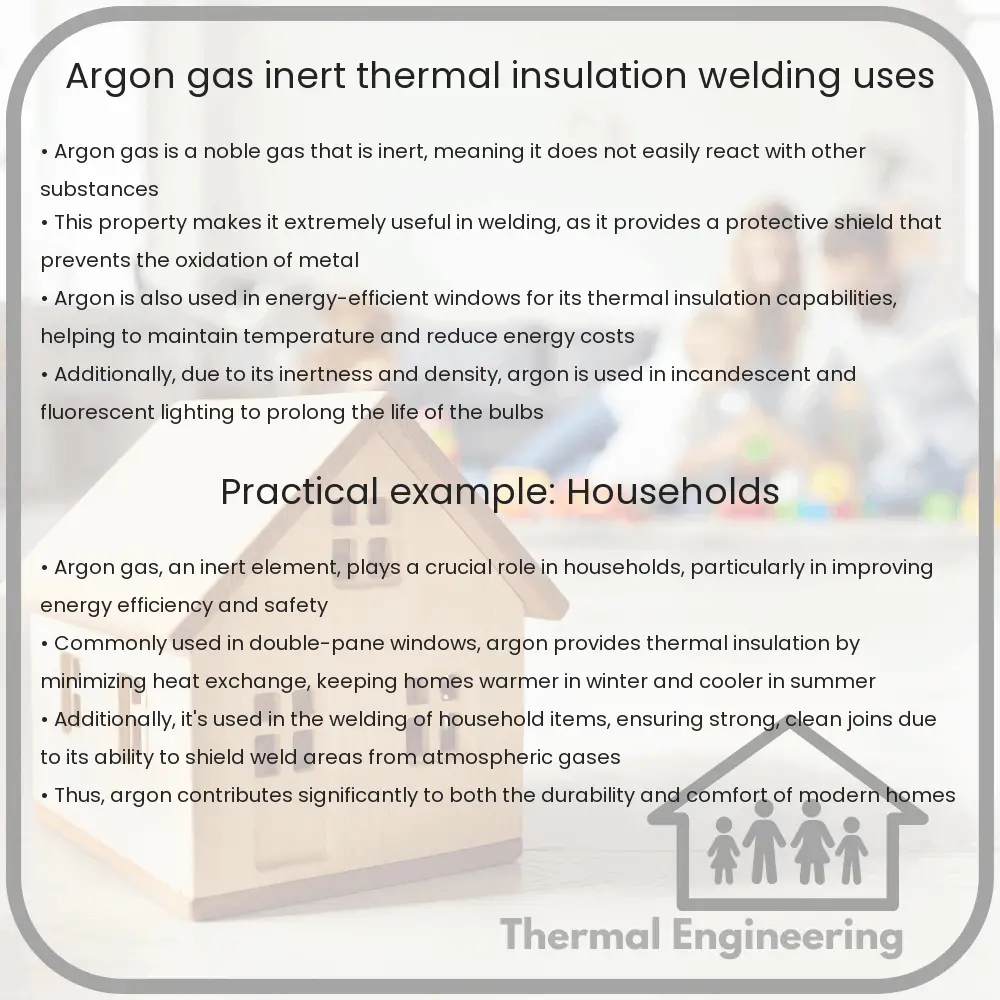
Argon’s low thermal conductivity makes it an excellent insulating gas, which is why it is used in double-pane windows. These windows help maintain temperature control inside buildings by reducing heat transfer between the inside and outside. Here, argon gas fills the space between the two panes of glass, significantly reducing thermal exchange and improving energy efficiency.
Uses in Welding
Welding is another major application of argon, particularly in arc welding processes such as Gas Tungsten Arc Welding (GTAW, or TIG) and Metal Inert Gas Welding (MIG). In these processes, argon is used to shield the weld area from atmospheric gases such as nitrogen and oxygen, which can cause fusion defects, porosity, and weld spatter if they come into contact with the superheated metal. The properties of argon help in producing a cleaner, stronger weld:
- Plasma Stability: Argon helps stabilize the plasma arc during the welding process.
- Splash Reduction: It reduces the spattering of molten metal during welding.
Conclusion
Argon is an indispensable gas in various industries, ranging from manufacturing to construction, thanks to its inert nature and thermal insulation properties. Whether it’s protecting historic artifacts or aiding in the creation of robust metal joints in welding, argon continues to be an important player in the engineering and industrial fields.