Facebook Instagram Youtube Twitter

Fluid mechanics in food processing

Learn how fluid mechanics is essential in food processing for optimizing safety, efficiency, and quality through heating, mixing, and more.
Fluid mechanics in food processing

Introduction to Fluid Mechanics in Food Processing

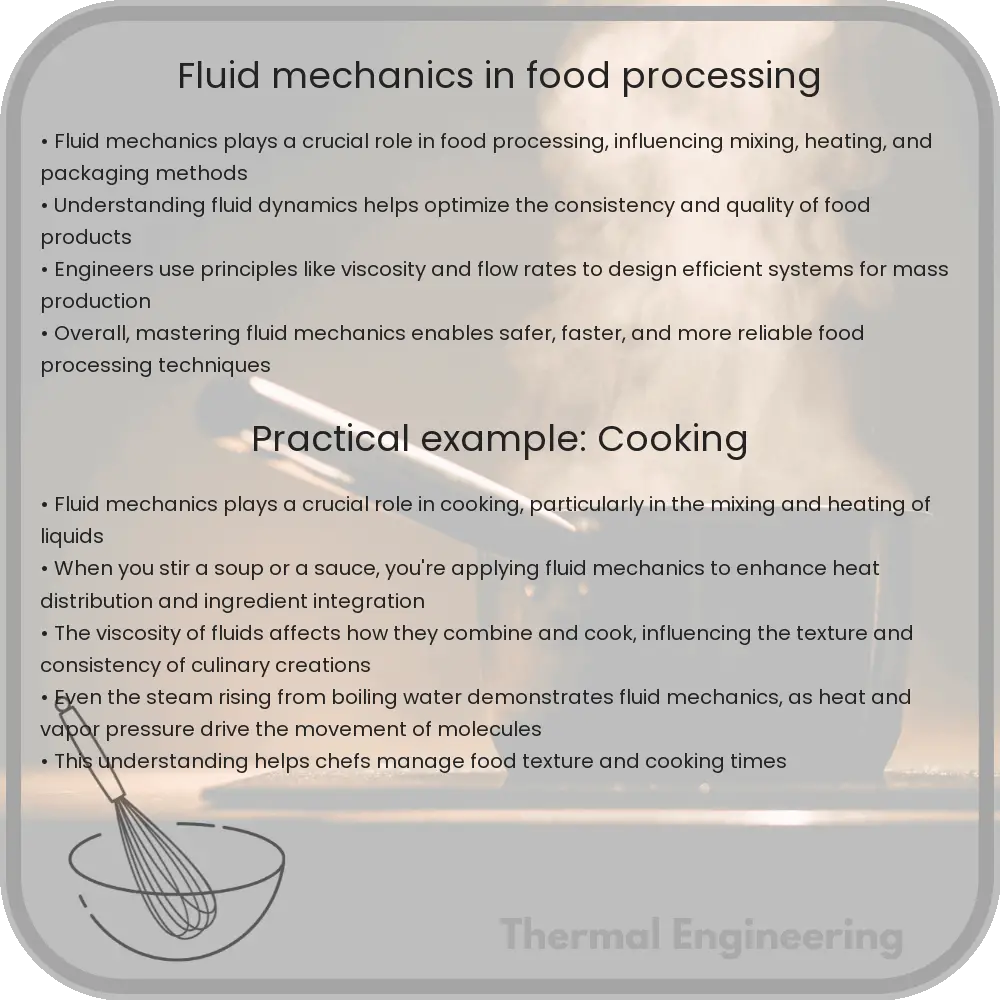
Fluid mechanics is a branch of engineering that studies the behavior of fluids (liquids and gases) and the forces on them. Fluid mechanics is crucial in many aspects of food processing, which involves the mass production, processing, and preservation of food. Understanding the principles of fluid mechanics enables engineers to design systems that improve the safety, efficiency, and quality of food products.

Key Applications of Fluid Mechanics in Food Processing

  • Heat Transfer: Many food processing operations involve heating or cooling to ensure food safety and prolong shelf life. Fluid mechanics plays a vital role in optimizing heat transfer processes such as pasteurization, where liquid foods are heated to destroy harmful microorganisms. The rate of heat transfer is crucial and can be modeled by understanding the fluid properties and flow characteristics.
  • Mixing and Agitation: Effective mixing of fluids is essential in food processing to achieve consistent flavor, color, and texture. Fluid mechanics aids in designing equipment like mixers and agitators, ensuring homogeneous mixing of ingredients with different viscosities.
  • Cleaning and Sanitization: Cleaning in place (CIP) systems use jets and sprays of cleaning solutions to clean the interior surfaces of pipes and tanks used in food processing. The design of these systems is based on principles of fluid dynamics to ensure effective cleaning and minimize water and chemical usage.
  • Product Filtration: Filtration processes are used to clarify beverages and remove particulate matter. The flow of fluid through a filter media involves various fluid mechanics principles, including pressure drops and flow rates.

Mathematical Description of Fluid Flow

The fundamental equations of fluid mechanics include the continuity equation, which ensures mass conservation, and the Navier-Stokes equations, which describe the momentum conservation in fluid flow. These equations can be stated as:

  • Continuity Equation: \( \nabla \cdot \vec{v} = 0 \), where \( \vec{v} \) represents the velocity field of the fluid.
  • Navier-Stokes Equations: \( \rho \left(\frac{\partial \vec{v}}{\partial t} + \vec{v} \cdot \nabla \vec{v}\right) = -\nabla p + \mu \nabla^2 \vec{v} + \vec{f} \), where \( \rho \) is the fluid density, \( p \) is the fluid pressure, \( \mu \) is the viscosity, and \( \vec{f} \) represents the body forces per unit volume.

These equations, along with empirical data specific to individual food components, allow engineers to design equipment and processes that optimize fluid flow characteristics for enhanced food safety and quality.

Conclusion

Fluid mechanics plays a vital role in food processing engineering by helping to design systems that improve production efficiency, product quality, and safety. By applying the principles of fluid dynamics, engineers can solve practical problems related to heating, mixing, cleaning, and filtration in the food industry, making the processes more efficient and environmentally friendly. As the food industry continues to evolve, the role of fluid mechanics will grow even more critical, emphasizing the need for ongoing research and development in this area.


Multiphase flow simulation in CFD

Explore the complexities of multiphase flow simulation in CFD and its crucial role across various engineering fields.

Multiphase flow simulation in CFD

Understanding Multiphase Flow Simulation in CFD

Computational Fluid Dynamics (CFD) is a crucial tool in the field of engineering, used to simulate and analyze the behavior of fluids in various applications. One of the more complex aspects of CFD involves multiphase flow simulation, which studies the flow with multiple phases (solid, liquid, or gas) interacting within the same system. This type of simulation is pivotal in industries like aerospace, chemical processing, and oil and gas.

Multiphase flow simulation addresses the challenges posed by the dynamic interaction between different phases, which can significantly affect the energy, momentum, and mass transfer within a system. Understanding the basics of this simulation can provide insights into highly complex phenomena essential for improving designs and processes in engineering.

Key Concepts in Multiphase Flow Simulation

  • Phases: The different materials in a flow—each with distinct properties like density, viscosity, and thermal conductivity—are referred to as phases. Commonly, these include gases, liquids, and solids.
  • Interfaces: The surfaces where two phases meet are called interfaces. Accurately predicting the behavior at these points is critical to the simulation’s success.
  • Interactions: Phases can interact through various mechanisms such as drag, heat transfer, and mass transfer, affecting overall flow properties.

Mathematical Modeling in Multiphase Flow

The mathematical representation of multiphase flow is complex due to the interactions between different phases. The primary equations used include:

  • Navier-Stokes Equations: These equations, which form the basis of fluid motion simulations, are extended to accommodate multiple phases. They incorporate terms to account for the momentum transfer due to pressure and viscous forces within each phase.
  • Conservation Laws: Laws of mass, momentum, and energy conservation are applied separately to each phase but are linked through the interaction terms.
  • Volume of Fluid (VOF) Model: This method tracks the volume fraction of each fluid within computational cells. It is particularly useful for free surface flows where the interface between the phases can deform freely.
  • Eulerian-Eulerian and Eulerian-Lagrangian Approaches: In the Eulerian-Eulerian approach, all phases are treated as interpenetrating continua. Contrastingly, the Eulerian-Lagrangian approach treats one phase as a continuous field, while the dispersed phase(s) are tracked as discrete particles or bubbles.

Applications of Multiphase Flow Simulation

Multiphase flow simulations are utilized across a broad spectrum of engineering disciplines. Some typical applications include:

  • Oil and Gas: In the petroleum industry, multiphase flow simulations are critical for designing pipelines and separators that deal with the simultaneous flow of oil, water, and gas.
  • Chemical Reactors: Chemical engineers use these simulations to design reactors where reactions occur between gases, liquids, and solids, optimizing reaction rates and product yields.
  • Environmental Engineering: CFD models help in studying pollutant dispersion in air and water, aiding the design of systems to control environmental pollution.
  • Aerospace: In rocket and jet propulsion systems, simulating the interaction between different phases of propellants can lead to improvements in efficiency and performance.

Multiphase flow simulation in CFD represents a cornerstone of modern engineering, offering detailed insights that lead to more efficient and effective designs. As computational power increases and algorithms become more refined, the accuracy and scope of these simulations will continue to enhance, broadening their application in real-world challenges.

CFD for environmental impact assessment

Computational Fluid Dynamics (CFD) is used in engineering to analyze fluid flows for environmental impact assessments.

CFD for environmental impact assessment

Understanding Computational Fluid Dynamics (CFD) in Environmental Impact Assessments

Computational Fluid Dynamics (CFD) is a powerful tool in the field of engineering that utilizes numerical analysis and data structures to solve and analyze problems involving fluid flows. Engineers use CFD to simulate the flow of gases and liquids, predicting the impact of environmental changes and interventions. This capability is particularly important in assessing environmental impacts, enabling engineers and scientists to predict and mitigate adverse effects before they occur.

Role of CFD in Environmental Impact Assessments

Environmental impact assessments (EIAs) are critical in ensuring that proposed projects will not adversely affect the environment or, if they do, that the impacts are minimized. CFD plays a key role in EIAs by providing detailed simulations of how air, water, and pollutants travel through and interact with the environment under various conditions. This section explores some of the primary applications of CFD in environmental planning and impact assessment.

  • Air Quality Analysis: CFD is used to simulate the dispersion of pollutants in the atmosphere, helping to predict the concentration and distribution of harmful substances in the air. This is crucial for assessing the impact of industrial emissions, vehicular pollution, and even odors.
  • Water Pollution Control: Engineers use CFD to model the movement and spread of pollutants in water bodies. This can include anything from chemical spills, sediment transportation, to thermal discharges from power plants.
  • Renewable Energy Systems: CFD aids in the design and optimization of renewable energy systems such as wind turbines and hydroelectric power plants, ensuring they interact with their environments efficiently and sustainably.
  • Building and Urban Planning: In urban areas, CFD helps simulate wind flow and thermal effects, which are essential for understanding the environmental impact of new constructions on local air quality and wind comfort.

How CFD Works in Environmental Applications

At its core, CFD involves solving the Navier-Stokes equations, which describe how the velocity field of fluid substances varies in space and time. These equations are complex and difficult to solve analytically, especially when dealing with real-world environments that include various irregular shapes and boundary conditions. CFD splits the region of interest (such as a section of river, a street, or around a building) into a large number of small, discrete cells or volumes, creating a mesh.

The fluid properties and flow characteristics are computed for each cell. These properties might include velocities, pressures, temperatures, and chemical concentrations, depending on what is being modeled. The results for each cell are then integrated to provide a detailed simulation of the entire system. By adjusting various parameters in the model, engineers can predict how changes in the system (like the introduction of a new pollutant source or a change in building design) could affect the environment.

Benefits and Challenges of Using CFD in EIAs

Benefits:

  • CFD provides a detailed, visual representation of potential environmental impacts, which can be essential for decision-making and for communicating effects to stakeholders or the public.
  • It allows for the testing of multiple scenarios quickly and cost-effectively, without the need for expensive and time-consuming physical models or prototypes.
  • CFD models can be adjusted and scaled as more data becomes available or as project designs change, providing flexibility in long-term planning.

Challenges:

  • CFD simulations require significant computational resources and expertise, which can be a barrier for some organizations.
  • The accuracy of a CFD simulation is highly dependent on the quality of the input data and the resolution of the mesh. Poor data or an inadequate mesh can lead to misleading results.
  • Interpreting CFD results also requires deep understanding of fluid dynamics and environmental science, which can necessitate interdisciplinary teams of experts.

In conclusion, while CFD is an incredibly powerful tool in environmental impact assessments, its effective use demands careful attention to detail, high-quality data, and cross-disciplinary collaboration. As computational power increases and simulation technologies advance, the role of CFD in environmental engineering is set to become even more pivotal.

Fluid dynamics in microreactors

Delve into the principles of fluid dynamics in microreactors, focusing on laminar flow, diffusion, and their impact on microreactor design.

Fluid dynamics in microreactors

Exploring Fluid Dynamics in Microreactors

Microreactors are a fascinating application of both engineering and chemistry, increasingly crucial in fields like pharmaceuticals, energy, and specialty chemicals. These small devices, often just millimeters in size, require an in-depth understanding of fluid dynamics to optimize reactions and processes at a microscale. Here, we’ll delve into the principles of fluid dynamics in microreactors, focusing on how these principles influence design and performance.

Understanding Fluid Flow in Microreactors

Fluid dynamics in microreactors is primarily concerned with the behavior of liquids and gases at very small scales. At such scales, the properties of fluid flow can differ significantly from those observed in larger systems. The two key aspects we consider in microreactors are laminar flow and diffusion.

  • Laminar Flow: In microreactors, the flow is usually laminar, meaning the fluid flows in parallel layers with minimal mixing or disruption between them. This is quantified by the Reynolds number (Re), which is typically low in microreactors (Re < 2000). The Reynolds number is calculated using the formula:

    Re = (ρ*u*L) / μ

    where ρ represents the density of the fluid, u is the flow velocity, L is a characteristic length (like diameter of the microchannel), and μ is the dynamic viscosity of the fluid.

  • Diffusion: Due to the small dimensions and the dominance of laminar flow, mixing in microreactors is primarily governed by diffusion rather than convection. The Péclet number (Pe), which compares the rate of advection of a physical quantity by the flow to the rate of diffusion of the same quantity, tends to be low. It is given by:

    Pe = (u*L) / D

    where D is the diffusivity of the fluid. A lower Péclet number indicates that diffusion is more significant compared to advection.

Design and Application of Microreactors

The unique characteristics of fluid flow in microreactors influence their design. Microreactors are typically designed to enhance surface area-to-volume ratios, which helps in improving heat transfer and mass transfer efficiencies. This enhancement is crucial for exothermic reactions where precise temperature control is necessary to prevent unwanted by-products.

  1. Material Selection: The choice of materials for constructing microreactors is critical. Materials must not only resist chemical attack but also withstand high pressures and temperatures. Common materials include stainless steel, glass, and various polymers.
  2. Channel Design: The design of the channels within the microreactor is tailored to specific reactions. For example, serpentine and zig-zag channels are used to enhance mixing under laminar flow conditions.
  3. Scaling Up: While microreactors offer many advantages on a small scale, scaling them up for industrial production is challenging. Solutions often involve numbering-up, where multiple microreactors are operated in parallel to increase throughput without compromising the advantages of microscale operation.

The Impact of Microreactors in Industry

Microreactors are transforming various industries by allowing for safer, more precise, and cost-efficient chemical synthesis. Their ability to control reaction conditions precisely helps in reducing waste and improving the yield of desired products. Moreover, their small size and scalability make them ideal for on-site synthesis in pharmaceuticals and other industries, paving the way for more personalized and localized production methodologies.

In conclusion, fluid dynamics plays a pivotal role in the design and operation of microreactors. Understanding the intricacies of flow behavior at the microscale is fundamental in exploiting the full potential of these powerful tools in modern chemical engineering and industrial applications.

Hydropower plant flow optimization

Learn how flow optimization in hydropower plants enhances efficiency and electricity generation while ensuring environmental sustainability.

Hydropower plant flow optimization

Understanding Hydropower Plant Flow Optimization

Hydropower plants harness the energy of flowing water to generate electricity, and their efficiency hinges significantly on optimizing the flow of water through the system. Flow optimization applies engineering principles and advanced technologies to maximize electricity generation while protecting water resources and ensuring sustainable operation.

Key Components of Hydropower Systems

  • Dam: Stores water and creates a reservoir. It raises the water level, which increases the potential energy available for electricity generation.
  • Intake: Controls the amount of water that enters the turbines.
  • Penstock: A pipe that channels water from the reservoir to the turbines. The water’s pressure increases as it travels down the penstock due to gravitational force.
  • Turbine: Converts the kinetic and potential energy of water into mechanical energy.
  • Generator: Converts mechanical energy from the turbine into electrical energy.
  • Outflow: Water is discharged back into the river after passing through the turbine.

Principles of Flow Optimization

Flow optimization in hydropower plants involves adjusting the water flow to ensure that turbines operate at maximum efficiency. The amount of electricity generated depends on both the volume of water flow and the hydraulic head, which is the height of water above the turbine.

The fundamental equation for power generation in a hydropower plant can be expressed as:

P = ρgQHnetη,

where:

  • P is the power output (in watts),
  • ρ is the density of water (approximately 1000 kg/m3 for fresh water),
  • g is the acceleration due to gravity (9.81 m/s2),
  • Q is the flow rate (in m3/s),
  • Hnet is the net head, which accounts for the loss in head due to friction and turbulence along the penstock,
  • η is the efficiency of the turbine and generator.

Effective flow optimization seeks to find the optimal balance between these variables to maximize power output.

Technologies in Flow Optimization

  • Automated Intake Gates: These systems dynamically adjust the volume of water entering the penstocks based on power demand and water availability.
  • Advanced Turbine Designs: Modern turbines are designed to maximize efficiency and minimize environmental impact. Variable speed turbines, for instance, can adjust their operation according to changes in water flow and pressure.
  • Real-Time Data Analytics: Hydropower plants use sensors and monitoring systems to gather data on water flow, turbine performance, and environmental conditions. This data helps operators make informed decisions on real-time flow adjustments.
  • Computational Fluid Dynamics (CFD): Engineers use CFD simulations to analyze and predict fluid behavior in hydropower systems, allowing for improvements in turbine and penstock design.

Challenges in Flow Optimization

Despite the technological advances, several challenges persist in optimizing flow in hydropower systems:

  • Environmental Constraints: Managing water flow to satisfy environmental regulations and to preserve aquatic ecosystems can limit the operational flexibility of hydropower plants.
  • Sedimentation: Sediment build-up can reduce the effective volume of the reservoir and erode turbine blades, impacting efficiency and increasing maintenance needs.
  • Water Availability: Seasonal and annual variations in water availability due to climate change or other factors can affect the predictability and stability of hydropower production.

Flow optimization in hydropower plants is a dynamic and complex discipline that incorporates engineering expertise, advanced technology, and a sound understanding of environmental impacts. Improving these systems continues to be a top priority to increase the efficiency and sustainability of hydropower globally.

Heat transfer in porous media

Explore the complex process of heat transfer in porous media, covering conduction, convection, and radiation, crucial for various engineering applications.

Heat transfer in porous media

Understanding Heat Transfer in Porous Media

Heat transfer in porous media is a fundamental aspect of numerous engineering applications, ranging from geothermal engineering to the design of high-performance insulation materials. A porous medium is typically a solid containing interconnected pores filled with fluid (liquid or gas). This interplay between solid and fluid phases complicates the heat transfer process, making it a rich topic for study and critical for various technological advancements.

Basics of Heat Transfer Mechanisms

Heat transfer in porous media can occur through three primary mechanisms: conduction, convection, and radiation:

  • Conduction is the transfer of heat through a solid material without the movement of the material itself. In porous media, conduction occurs both in the solid matrix and across the fluid in the pores.
  • Convection involves the transfer of heat due to the physical movement of the fluid within the pores. This mechanism can be significantly complex depending on the fluid flow characteristics, which can be influenced by pore geometry and temperature gradients.
  • Radiation refers to heat transfer through electromagnetic waves. In porous media, radiation can play a role, particularly at high temperatures when the thermal radiation exchange between solid surfaces and between the solid and fluid becomes non-negligible.

Mathematical Modeling of Heat Transfer in Porous Media

Mathematical models of heat transfer in porous media often involve solving the energy balance equations that account for the heat conduction in solids and fluids, as well as convection and possible radiative heat transfer. The fundamental equation used is a form of the energy conservation equation, which can be expressed as:

ρc * (dT/dt) = ∇ · (k * ∇T) + S

where:

  • ρc is the volumetric heat capacity of the porous medium,
  • T is the temperature,
  • t is time,
  • k is the thermal conductivity,
  • ∇ denotes the gradient operator,
  • S represents the source terms due to internal heat generation or consumption.

For situations involving fluid flow, the convection term must be added to the model, incorporating the velocity of the fluid and its impact on heat transport.

Applications and Practical Considerations

Practical applications of understanding heat transfer in porous media include:

  • Enhanced Oil Recovery: Thermal methods of oil recovery depend on efficiently heating porous rock formations to reduce the viscosity of heavy crude oil.
  • Geothermal Energy: The extraction and management of geothermal energy rely heavily on the understanding of heat movement through porous geological formations.
  • Building Materials: The design of insulation materials, often porous in nature, depends on having a detailed insight into how heat is transferred through these materials.

In all these applications, engineers must often consider the specific properties of the porous medium, such as porosity, permeability, and the thermal properties of both the solid matrix and the fluid. Additionally, the size and shape of the pores and their distribution significantly affect the overall heat transfer characteristics.

Conclusion

Heat transfer in porous media is a complex but crucial aspect of many engineering fields. By understanding and modeling the various heat transfer mechanisms in these materials, engineers can design more effective systems and materials to manage thermal energy in applications as diverse as energy production, environmental control, and industrial processes.

Multiphase flows in space applications

This article delves into the complexities of managing multiphase flows, involving gas, liquid, and solid interactions, crucial for space technology and exploration.

Multiphase flows in space applications

Understanding Multiphase Flows in Space Applications

Multiphase flows, which involve the simultaneous flow of materials in different phases (gas, liquid, or solid), play a critical role in various space applications. These flows are particularly challenging to manage due to the unique conditions in space, such as microgravity, which significantly affect fluid behavior. This article explores the importance of understanding and controlling multiphase flows in the context of space travel and technology.

Key Challenges of Multiphase Flows in Space

The behavior of multiphase flows in space differs markedly from that on Earth due to the absence of gravity. This absence affects buoyancy and sedimentation processes, which are typically driven by gravitational forces. In space, these forces are minimal, leading to unique fluid dynamics. For instance, bubbles in a liquid will not rise to the surface as they do on Earth. Instead, they may remain dispersed throughout the liquid unless acted upon by other forces.

Applications in Space Technology

  • Life Support Systems: Effective management of air and water onboard spacecraft relies heavily on understanding multiphase flows. Processes such as water purification, air revitalization, and thermal management systems are designed to accommodate the peculiarities of fluid behavior in microgravity.
  • Propulsion Systems: Liquid propellants used in rockets often involve the handling of multiphase mixtures. Understanding how these mixtures behave under different conditions is crucial for the design of efficient propulsion mechanisms.
  • Pharmaceuticals: The manufacturing of pharmaceuticals in space, where compounds can be mixed more homogeneously, also depends on knowledge of multiphase flows to optimize the blending and dissolution processes.

Research and Experimentation

Significant research has been dedicated to understanding multiphase flows in space. Experiments conducted both in space stations, such as the International Space Station (ISS), and during parabolic flights provide valuable data that helps refine theoretical models. These experiments often focus on phenomena such as capillary flow, bubble formation and coalescence, and heat transfer in multiphase systems.

Mathematical Modeling of Multiphase Flows

Mathematical models play a crucial role in predicting and understanding the behavior of multiphase flows in space. The equations typically involve considerations of momentum, mass, and energy conservation. For example, the Navier-Stokes equation modified for zero-gravity conditions is often used to model the flow dynamics:

\[ \rho \left(\frac{\partial \mathbf{v}}{\partial t} + \mathbf{v} \cdot \nabla \mathbf{v}\right) = -\nabla p + \mu \nabla^2 \mathbf{v} + \mathbf{f}_{external} \]

Where \(\rho\) is the fluid density, \(\mathbf{v}\) is the velocity field, \(p\) is the pressure, \(\mu\) is the dynamic viscosity, and \(\mathbf{f}_{external}\) represents external forces such as magnetic or electric fields that may be used to control the flow in the absence of gravity.

Future Prospects

As space exploration advances and we look towards long-duration missions and extraterrestrial colonization, the importance of mastering multiphase flows will only increase. Innovations in computational fluid dynamics and enhanced experimental setups in space will drive forward our understanding and control of these complex systems. This advancement not only supports the feasibility of future space missions but also opens up possibilities for novel manufacturing processes and life support systems in extraterrestrial environments.

In conclusion, by advancing our knowledge of multiphase flows and their behavior in microgravity, we can significantly enhance the safety, reliability, and efficiency of space missions. The continuous study and application of this knowledge promise to unlock new frontiers in space travel and habitation.

Flow through porous media in geotechnical engineering

Exploring the movement of fluids in materials like soil and rock crucial for environmental and infrastructure projects in geotechnical engineering.

Flow through porous media in geotechnical engineering

Understanding Flow Through Porous Media in Geotechnical Engineering

In the field of geotechnical engineering, the study of how fluids move through porous media is crucial for a multitude of applications. This includes the analysis of groundwater flow, soil stabilization, and the management of environmental contamination. Porous media, in this context, refers to materials such as soil and rock that have voids or spaces through which fluids can pass.

Basic Concepts

The flow of water and other fluids through porous media is largely governed by the permeability of the material, which indicates the material’s ability to transmit water. Permeability depends on the size, distribution, and connectivity of the pores within the material. Generally, materials like gravel and sand have higher permeability compared to clay.

Darcy’s Law

The foundational principle used to describe flow through porous media is Darcy’s Law. It was formulated by Henry Darcy in 1856 based on his experiments on the flow of water through beds of sand. The law states that the flow rate of a fluid through a porous medium is proportional to the hydraulic gradient assuming the flow is laminar and the medium is saturated. Mathematically, Darcy’s Law can be represented as:

V = -K * (dh/dL)

  • V = Darcy’s velocity (m/s), which represents the velocity at which fluid flows through the porous medium.
  • K = hydraulic conductivity of the medium (m/s).
  • dh/dL = hydraulic gradient, which is the change in hydraulic head (h) over the change in distance (L).

Hydraulic Conductivity

Hydraulic conductivity (K) is a key parameter in geotechnical engineering, influencing how quickly water can move through soil or rock layers. It is impacted by several factors including the porosity of the material, the size of the grains, and the temperature of the fluid. In equations, it is often necessary to adjust hydraulic conductivity values according to the fluid viscosity and the characteristics of the medium.

Applications in Geotechnical Engineering

The principles of flow through porous media are applied in several key areas in geotechnical engineering:

  1. Groundwater Modeling: Predicting the movement of groundwater to help in designing foundations and assessing the potential for soil liquefaction during earthquakes.
  2. Contaminant Transport: Understanding how pollutants travel through soil and rock layers helps in designing effective remediation strategies.
  3. Slope Stability: Analyzing the flow of water within slopes is critical to predict and prevent landslides or slope failures.
  4. Earth Dams and Levees: Ensuring the safe design and operation of earth dams by assessing the seepage through the dam body and its foundation.

Challenges and Opportunities

While Darcy’s Law provides a basic framework, real-world scenarios often involve complexities like non-uniform hydraulic conductivity, anisotropic materials (where properties differ based on direction), and partially saturated media. Advanced computational tools and physical modeling are used to better understand and predict fluid movement in these situations.

As technology progresses, geotechnical engineering continues to evolve with improved methods for monitoring soil and groundwater flow, enhancing our ability to design safe and sustainable structures while protecting and managing the earth’s resources effectively.

By mastering the flow through porous media, geotechnical engineers can tackle a broad range of environmental and engineering challenges, making significant contributions to infrastructure development and environmental protection.

Fluid dynamics of snow and avalanches

Explore how the fluid dynamics of snow and avalanches are essential for predicting and managing these natural phenomena effectively.

Fluid dynamics of snow and avalanches

Fluid Dynamics of Snow and Avalanches

Understanding the fluid dynamics of snow and avalanches is critical for predicting and managing these natural phenomena. Avalanches pose significant risks in mountainous areas, and a grasp of their dynamics can lead to more effective mitigation strategies.

The Physics of Snow

Snow can be considered a granular material composed of snowflakes that have their own unique crystal structures. The behavior of snow under stress, whether due to natural settling or an external load, is critical to understanding avalanche mechanics. Snow’s response to stress can cause it to behave like a fluid under certain conditions, particularly during an avalanche.

How Avalanches Occur

Avalanches happen when the snowpack’s structure becomes unstable. This instability can be triggered by numerous factors including rapid temperature changes, rain, new snow loads, or disturbances such as the presence of a skier or loud noises. Once triggered, the snowpack can start moving downhill due to gravity, gaining speed and volume as it collects more snow.

Modeling Avalanche Fluid Dynamics

The movement of avalanches can often be described using concepts from fluid dynamics. One key parameter in avalanche modeling is the bulk density (ρ) of the snow, which significantly impacts the flow dynamics.

The basic fluid dynamics equation used in avalanche modeling is typically the incompressible Navier-Stokes Equation:

\[
\frac{\partial \mathbf{u}}{\partial t} + (\mathbf{u} \cdot \nabla)\mathbf{u} = -\frac{1}{\rho} \nabla p + \nu \nabla^2\mathbf{u} + \mathbf{g}
\]

Where:

  • u represents the velocity field of the snow
  • t is time
  • <ρ>ρ is the snow density
  • p

    is the pressure field

  • <ν>ν is the kinematic viscosity
  • g is the acceleration due to gravity

This equation helps describe how the flow of snow changes over time under various pressures and forces.

Slab Avalanches

Slab avalanches occur when a cohesive layer of snow (a slab) breaks loose over a weaker layer. The dynamics of these avalanches can be thought of in terms of blocks of snow moving over a fluidized layer of snow below, which acts as a lubricant, reducing friction and allowing the slab to accelerate.

Powder Snow Avalanches

Powder snow avalanches, also known as suspension avalanches, occur when the snow in the avalanche becomes fully suspended in the air and behaves much like a turbulent fluid. The fluid dynamics of these avalanches can be modeled using turbulent flow equations that account for the chaotic nature of the snow particles suspended in the air.

Preventive Measures and Prediction

Understanding the fluid dynamics of snow and avalanches facilitates the development of better prediction models and preventive measures. Structural barriers such as snow fences and retention dams can redirect or catch flowing snow, reducing the impact of avalanches in vulnerable areas. Additionally, detailed maps and models based on fluid dynamics principles help identify potential avalanche paths and inform effective zoning and land use planning.

By studying the fluid dynamics of snow, researchers and engineers can contribute to safer mountainous environments for communities and tourists alike.

Airflow in animal habitats

Learn how airflow management in animal habitats ensures optimal conditions for temperature, humidity, and contaminant control.

Airflow in animal habitats

Understanding Airflow in Animal Habitats

Airflow management is a critical component in designing and maintaining habitats for animals, whether in zoos, aquaria, or agricultural settings. Proper airflow is essential for controlling temperature, humidity, and removing contaminants such as odors, dust, and pathogens. This article explores the principles of airflow and how they are applied in creating suitable environments for various animal species.

Basics of Airflow

Airflow refers to the movement of air within and around a space. It is influenced by factors such as temperature differences, pressure differences, and mechanical systems like fans and vents. The goal in animal habitats is to replicate the natural conditions animals would experience in the wild as closely as possible, which includes maintaining an appropriate air exchange rate.

Key Principles of Airflow Design

  • Temperature Regulation: Most animals have specific temperature ranges in which they thrive. Airflow helps regulate the temperature within habitats to stay within these optimal ranges. For instance, in colder climates, warm air is introduced to maintain a consistent temperature.
  • Humidity Control: Like temperature, each species has specific humidity needs. Airflow aids in controlling the moisture levels in the air, which is particularly crucial in enclosed habitats like those found in aquaria or reptile houses.
  • Odor and Contaminant Removal: Effective airflow systems reduce the buildup of odors and harmful contaminants, which can significantly affect the health of both animals and visitors.
  • Creating Natural Environments: Birds, for example, require air movement to mimic their natural habitats, helping them maintain their natural behaviors and physical well-being.

Techniques and Systems for Managing Airflow

  1. Ventilation Systems: These are designed to bring in fresh air and remove stale air, balancing the air pressure and maintaining the desired climate within the habitat.
  2. Localized Climate Control: In habitats that house various species with varying needs, localized climate control systems can allow for different conditions in close proximity, all under one roof.
  3. HEPA Filters: High-Efficiency Particulate Air (HEPA) filters are employed to remove fine particles like dander, pollen, and microorganisms, ensuring the air remains clean and suitable for the animals’ respiratory systems.

Challenges in Designing Airflow Systems

Designing effective airflow systems for animal habitats comes with unique challenges. These include:

  • Size and Layout of the Habitat: Large or irregularly shaped habitats require specialized systems to ensure air is distributed evenly.
  • Species Diversity: Facilities that house multiple species need to accommodate a broad range of climate needs within a single system.
  • Outdoor and Seasonal Considerations: For habitats with outdoor areas, seasonal changes and weather conditions drastically influence the effectiveness of airflow systems.

Conclusion

Ensuring appropriate airflow in animal habitats is a complex yet vital part of maintaining the health and well-being of animals under human care. It demands a clear understanding of not only the engineering principles involved but also the specific biological needs of different species. As technology advances, so too does our capability to create more sophisticated and finely tuned environments that better mimic the natural world, promoting healthier, more active, and psychologically stable animals.