Facebook Instagram Youtube Twitter

Thermodynamic optimization of refrigeration cycles

Optimizing refrigeration cycles enhances cooling system efficiency, reduces energy use and operational costs in HVAC and industry.

Thermodynamic optimization of refrigeration cycles

Thermodynamic Optimization of Refrigeration Cycles

The optimization of refrigeration cycles is a critical aspect of engineering, especially in industries where cooling is essential, such as food storage, HVAC (Heating, Ventilation, and Air Conditioning) systems, and various process industries. The goal of thermodynamic optimization in refrigeration cycles is to enhance the efficiency and effectiveness of the cooling system while reducing energy consumption and operational costs.

Basic Principles of Refrigeration

Refrigeration cycles operate based on the principles of thermodynamics, particularly the first and second laws. A typical refrigeration cycle involves the compression, condensation, expansion, and evaporation of a refrigerant. The cycle’s efficiency is often expressed in terms of the Coefficient of Performance (COP), defined as the ratio of the heat removed from the refrigerated space to the work input required to remove the heat:

\[ \text{COP} = \frac{Q_L}{W} \]

where \( Q_L \) is the heat extracted from the low-temperature reservoir, and \( W \) is the work input to the compressor.

Key Steps in Optimizing Refrigeration Cycles

  • Selection of Refrigerant: The choice of refrigerant affects both the performance and environmental impact of the refrigeration cycle. Characteristics such as Global Warming Potential (GWP), Ozone Depletion Potential (ODP), thermodynamic properties, and safety (flammability, toxicity) need consideration.
  • Improvement of Component Efficiency: Enhancements in the efficiency of cycle components like compressors, evaporators, condensers, and expansion devices can significantly improve overall cycle efficiency. Advanced materials and innovative designs play crucial roles here.
  • Subcooling and Superheating: Adjusting the extent of subcooling (cooling the refrigerant below its condensation temperature) and superheating (heating the refrigerant above its boiling point) can maximize the thermodynamic efficiency of the cycle.
  • Heat Recovery: Utilizing heat recovery techniques, such as using the waste heat from the condenser for water heating or other processes, can effectively increase the overall energy efficiency of the system.

Advanced Techniques and Technologies

Recent innovations in refrigeration cycle optimization include:

  • Variable Speed Technologies: Using variable speed compressors and fans adjusts the operation based on load requirements, which can significantly reduce energy usage and enhance system longevity.
  • Advanced Control Systems: Smart control systems use sensors and algorithms to continuously monitor and adjust the refrigeration cycle for optimal performance under varying conditions.
  • Eco-friendly Refrigerants: The development and use of refrigerants with lower global warming potential are crucial for sustainable refrigeration solutions.
  • Thermal Energy Storage (TES): TES systems during periods of low demand can help in balancing load and reducing operational costs by utilizing off-peak electricity rates.

Conclusion

Thermodynamic optimization of refrigeration cycles not only supports improved system performance and energy efficiency but also contributes to the sustainability goals by reducing the carbon footprint associated with refrigeration and cooling systems. Ongoing research and development in this area hold the potential for continued advancements, making refrigeration processes more efficient and environmentally friendly.

Understanding these foundational concepts and advancements in refrigeration cycle optimization can aid engineers and technicians in designing more effective and efficient cooling systems, thereby impacting a wide range of industries globally.

Molecular thermodynamics of fluid mixtures

Understanding the study of fluid mixtures’ properties and behaviors at the molecular level in molecular thermodynamics.

Molecular thermodynamics of fluid mixtures

Understanding Molecular Thermodynamics of Fluid Mixtures

Molecular thermodynamics is a branch of thermodynamics focused on studying the properties and behaviors of fluid mixtures at the molecular level. This field is crucial for designing efficient separation processes, creating models for the prediction of mixture behaviors, and understanding the interactions between different molecules in mixtures. In this article, we will explore some core concepts and methodologies used in the molecular thermodynamics of fluid mixtures.

Key Concepts in Molecular Thermodynamics

  • Chemical Potential: The chemical potential of a substance in a mixture is a critical concept in molecular thermodynamics. It indicates the change in the thermodynamic potential of the system with the addition or removal of a substance’s particles at constant temperature and pressure. The chemical potential is defined for each component of the mixture and plays a vital role in determining mixture behavior.
  • Fugacity and Activity Coefficients: Fugacity represents an effective pressure that helps in quantifying the non-ideality of gases. For liquids in mixtures, activity coefficients serve a similar purpose by quantifying deviations from Raoult’s law, which predicts the vapor pressures of ideal mixtures.
  • Phase Equilibria: Understanding how different phases (solid, liquid, gas) coexist and interact in a mixture is essential. Phase equilibria involve the study of phase diagrams, which show the conditions under which different phases occur and coexist.

Thermodynamic Models for Fluid Mixtures

To predict and analyze the behavior of fluid mixtures, several thermodynamic models are used:

  • Equation of State (EoS) Models: These models, such as the Van der Waals equation and Peng-Robinson equation, relate pressure, volume, and temperature in a mathematically predictive manner, often incorporating corrections for non-ideal behaviors.
  • Activity Coefficient Models: Models like Wilson, NRTL (Non-Random Two-Liquid), and UNIQUAC (UNIversal QUAsiChemical) provide frameworks for calculating activity coefficients and predicting how mixtures deviate from ideal mixture laws.
  • Gibbs Free Energy Models: These models are concerned with understanding the energy changes associated with phase changes and mixing at the molecular level. They are essential in predicting solubility, phase separation, and equilibrium compositions.

Applications of Molecular Thermodynamics

The principles of molecular thermodynamics have several real-world applications in engineering and science, including:

  1. Design of Separation Processes: Essential for the chemical industry, accurate understanding and modeling of fluid mixtures can lead to more efficient distillation, absorption, extraction, and other separation processes.
  2. Pharmaceuticals: Drug formulation and manufacturing often require precise knowledge of solubility, mixing, and reactions at the molecular level.
  3. Environmental Engineering: The study of pollutant behaviors in mixed phases, understanding aqueous and atmospheric chemistries, and designing treatments for effluents involve molecular thermodynamics.

Challenges and Future Directions

Despite the advances in the molecular thermodynamics of fluid mixtures, challenges remain, especially in accurately predicting the behavior of highly non-ideal, complex mixtures. Future research is likely to focus on enhancing the accuracy of predictive models through high-level computational techniques like molecular dynamics simulations and integrating more comprehensive molecular-scale interactions.

In conclusion, molecular thermodynamics offers essential insights and tools for understanding and manipulating the complex behaviors of fluid mixtures in a wide array of applications. As computational methods advance and our understanding of molecular interactions deepens, the field of molecular thermodynamics is expected to provide even more reliable and practical models for industrial and scientific purposes.

Advanced thermal energy storage solutions

Explore advanced thermal energy storage solutions and their role in enhancing energy efficiency and reducing emissions.

Advanced thermal energy storage solutions

Advanced Thermal Energy Storage Solutions

Thermal energy storage (TES) is an innovative technology used to improve energy efficiency by storing thermal energy for later use. It plays a crucial role in balancing energy demand and supply, enhancing the performance of heating and cooling systems, and contributing to the reduction of carbon emissions. In this article, we will explore some of the most advanced thermal energy storage solutions that are shaping the future of energy management.

Types of Thermal Energy Storage

Thermal energy storage can be broadly categorized into three types: sensible heat storage, latent heat storage, and thermochemical storage.

  • Sensible Heat Storage: This method involves storing thermal energy by increasing the temperature of a storage medium. Common materials used for sensible heat storage include water, sand, and rocks.
  • Latent Heat Storage: Latent heat storage utilizes phase change materials (PCMs) that absorb or release heat at a constant temperature during phase transitions (e.g., from solid to liquid or vice versa). Common PCMs include paraffin waxes and salt hydrates.
  • Thermochemical Storage: Thermochemical energy storage involves using chemical reactions to store and release heat. This type of storage has the potential for very high energy density and can store thermal energy for extended periods without significant losses.

Recent Innovations in Thermal Energy Storage

Recent advancements in thermal energy storage technology focus on increasing efficiency, reducing costs, and enhancing the scalability of storage systems. Here are some notable innovations:

  1. Molten Salt Thermal Energy Storage: Used primarily in concentrated solar power (CSP) plants, molten salt storage involves using a mixture of salts that are capable of storing large quantities of heat at high temperatures. This solution is effective for providing consistent power supply, even during non-sunny periods.
  2. Cryogenic Energy Storage: This technology, also known as liquid air energy storage (LAES), stores electrical energy by cooling air until it liquefies, stores the liquid air at low temperatures, and then expands it to drive a turbine when energy is needed.
  3. Thermochemical Networks: These systems use chemical reactions to store and release heat. Recent developments are exploring the use of reversible chemical reactions that may allow for more compact and efficient storage systems.
  4. Phase Change Material (PCM) Enhancements: Improvements in PCM technology are focused on enhancing the material’s thermal conductivity and stability to increase its practical application potential. Advanced encapsulation techniques have also been developed to prevent material degradation over time and improve thermal exchange rates.

Applications of Advanced Thermal Energy Storage

Advanced thermal energy storage technologies have a broad range of applications in different sectors:

  • Residential and Commercial Buildings: TES systems can significantly reduce energy costs and improve the efficiency of heating, ventilation, and air conditioning (HVAC) systems. By storing excess heat or coolness during off-peak hours, TES can help manage load and reduce reliance on conventional energy sources.
  • Industrial Processes: Many industrial processes require heat or cool at specific times. TES can provide thermal energy as needed, enhancing process efficiency and reducing operational costs.
  • Renewable Energy Integration: TES is crucial for smoothing out the supply of renewable energy sources such as solar and wind, which are intermittent by nature. By storing excess energy produced during peak times, TES systems can stabilize the grid and ensure a consistent energy supply.
  • Power Plants: In thermal power plants, TES can be used to store excess heat generated during periods of low electricity demand. This stored energy can then be converted back into electricity during peak demand periods, increasing plant efficiency and reducing the need for additional fuel consumption.

In conclusion, advanced thermal energy storage solutions are pivotal in the transition towards more sustainable and efficient energy systems. By effectively managing energy resources and reducing dependence on fossil fuels, TES technologies contribute to a cleaner, more sustainable future.

Thermal performance of phase change materials in buildings

Learn about Phase Change Materials (PCMs), which improve building energy efficiency by storing and releasing thermal energy.

Thermal performance of phase change materials in buildings

Understanding the Role of Phase Change Materials in Enhancing Building Thermal Performance

Phase Change Materials (PCMs) have garnered significant attention in recent engineering studies focused on improving energy efficiency in buildings. These materials have the unique ability to store and release thermal energy during the process of melting and freezing, which can significantly enhance the thermal performance of buildings. This article explores the working mechanism, benefits, types, and practical applications of PCMs in building constructions.

How Do Phase Change Materials Work?

PCMs work based on the principle of latent heat. When these materials reach their melting point, they absorb a large amount of heat from the environment without showing a considerable increase in temperature. This process is known as the absorption of latent heat. Conversely, when the temperature drops, PCMs release the stored heat as they solidify, thereby maintaining a more stable indoor temperature.

The formula for latent heat \( L \) involved in the phase change is defined by:

\[ Q = m \times L \] where \( Q \) is the total heat absorbed or released, \( m \) is the mass of the PCM, and \( L \) is the latent heat of fusion or solidification.

Benefits of Using PCMs in Buildings

  • Energy Efficiency: By moderating indoor temperatures, PCMs can reduce the reliance on conventional heating and cooling systems, thus lowering energy consumption and costs.
  • Improved Comfort: PCMs contribute to maintaining a constant indoor climate, which can enhance comfort levels for occupants.
  • Reduced Carbon Footprint: Lower energy consumption directly contributes to reduced greenhouse gas emissions, aligning with sustainable building practices.
  • Versatility: PCMs can be integrated into various building materials like wallboards, floors, and ceilings or even used in HVAC systems.

Types of PCMs Used in Buildings

Based on their phase change temperature and application, PCMs are categorized mainly into three types:

  1. Organic PCMs: Includes paraffin waxes and fatty acids, known for their chemical stability and minimal supercooling.
  2. Inorganic PCMs: Comprises salt hydrates which offer higher latent heat per unit volume but might suffer from phase segregation and corrosion issues.
  3. Bio-based PCMs: Extracted from agricultural sources, these are considered environmentally friendly but may have lower thermal conductivity.

Practical Applications in Building Construction

PCMs can be effectively used in several parts of a building to optimize thermal performance:

  • In Walls: Incorporating microencapsulated PCMs into drywall or plaster can help regulate indoor temperatures by absorbing excess heat during the day and releasing it during cooler nights.
  • As Thermal Mass in Floors: Using PCM-infused floor tiles can assist in managing heat loads and enhance thermal comfort with less fluctuation in floor temperatures.
  • In Ceiling Panels: Ceiling panels equipped with PCMs can prevent the rise of hot air to the ceiling, reducing cooling demands especially in multi-storey buildings.
  • Within HVAC Systems: Integrating PCMs in HVAC systems can reduce peak load and improve system efficiency by leveraging the thermal storage capacity of PCMs.

Conclusion

Phase Change Materials represent a cutting-edge solution in the field of building engineering, offering a potential pathway to more sustainable and efficient building designs. By leveraging their unique thermal properties, PCMs help in creating more resilient and energy-efficient habitats, crucial in the face of global energy challenges and climate change.

As research continues and technologies advance, the application of PCMs in buildings is expected to expand, further unlocking their potential and contributing to sustainable urban development.

Hydroelasticity in floating structures

Explore hydroelasticity, the study of water forces and elastic behavior of floating structures in marine engineering.

Hydroelasticity in floating structures

Understanding Hydroelasticity in Floating Structures

Hydroelasticity is a fascinating area in the field of marine engineering that focuses on the interactions between water forces and the elastic behavior of floating structures. This concept is vital for designing safe and durable floating structures such as ships, offshore platforms, and even floating wind turbines. In this article, we’ll explore the basics of hydroelasticity, why it matters, and how it applies to real-world engineering tasks.

What is Hydroelasticity?

Hydroelasticity combines aspects of fluid dynamics and solid mechanics to study how elastic floating structures deform and respond under various hydrodynamic loads. In simpler terms, it considers both the structure’s flexibility and the impact of water waves and currents on that structure. This dual focus helps engineers predict the stresses and structural response of floating bodies in a fluid environment.

Key Components of Hydroelastic Response

  • Fluid Dynamics: This involves understanding how water flows around and affects the floating structure. The hydrodynamic pressures can greatly influence the structural integrity and stability of the structure.
  • Elastic Deformation: Floating structures are not perfectly rigid and can experience bending, twisting, and stretching. The measurement and prediction of these deformations under various conditions are crucial for ensuring that the structure performs as intended.
  • Wave-Structure Interaction: This is a critical factor in hydroelasticity. Waves can have both static and dynamic effects on a structure. Understanding this interaction is essential for predicting the lifespan and safety of the structure under normal and extreme sea conditions.

Mathematical Modeling in Hydroelasticity

Mathematical models in hydroelasticity typically combine the principles of wave theory with structural dynamics. The most common approach is to use a divided approach:

  1. Hydrodynamic Modeling: Calculating the water pressure distribution using potential flow theory or computational fluid dynamics (CFD).
  2. Structural Modeling: Analyzing the response of the structure using finite element methods (FEM) to understand how it deforms under the calculated pressures.

The coupling of these models is performed through the boundary conditions, where the pressure from the fluid model applies as an external load on the structural model.

Practical Applications of Hydroelasticity

Understanding and applying hydroelastic principles is essential in the design and maintenance of various types of marine and offshore structures:

  • Shipping: In designing ships, hydroelastic analysis helps in understanding how the hull bends and twists in rough seas, which is critical for ensuring the vessel’s safety and operational efficiency.
  • Offshore Platforms: These structures need to withstand significant ocean forces; hydroelastic modeling predicts how platforms respond to waves, currents, and wind.
  • Floating Wind Turbines: As newer applications, these turbines must operate safely on the high seas. Engineers use hydroelastic studies to optimize designs that balance structural stability and energy efficiency.

Conclusion

Hydroelasticity is a key factor in the design and analysis of floating structures in marine environments. By understanding how structures interact with the surrounding water, engineers can create safer and more durable marine systems. Whether it’s a gigantic oil platform or a small sailing boat, accounting for hydroelastic effects ensures that these structures can withstand the unpredictable forces of nature.

Through ongoing research and technological advancement, the field of hydroelasticity continues to evolve, providing increasingly sophisticated tools for tackling some of the most challenging problems in marine engineering.

Exergy analysis of renewable energy systems

Exergy analysis evaluates the efficiency and performance of renewable energy systems by assessing their potential to do useful work and identifying energy losses.

Exergy analysis of renewable energy systems

Understanding Exergy Analysis in Renewable Energy Systems

Exergy analysis is a powerful tool used in engineering to evaluate the performance and efficiency of energy systems. This approach is particularly valuable in the domain of renewable energy, where maximizing energy efficiency is crucial for sustainable development. At its core, exergy analysis involves analyzing the potential of an energy system to perform useful work and how much energy is lost to inefficiencies.

The concept of exergy—or ‘available energy’—is vital in understanding what portion of a given energy can be converted into useful work. Unlike energy, which is conserved according to the first law of thermodynamics, exergy is destroyed due to irreversibilities in a system, as expressed by the second law of thermodynamics. Consequently, exergy analysis provides a measure of how far a particular renewable energy system deviates from ideal performance.

Basics of Exergy in Renewable Energy Systems

Exergy of a system can generally be evaluated through the exergy balance equation which is expressed as:

Exergy In − Exergy Out + Exergy Generated − Exergy Destroyed = Exergy Accumulation.

In steady state systems, the exergy accumulation term is zero, simplifying the analysis.

In renewable energy systems, ‘Exergy In’ typically represents the incoming solar radiation, wind energy, or hydropower, while ‘Exergy Out’ refers to the delivered electrical energy or mechanical work. ‘Exergy Generated’ is usually absent as renewables do not typically generate exergy themselves. Significant attention is given to ‘Exergy Destroyed’, which provides insights into the system inefficiencies.

Application of Exergy Analysis in Various Renewable Energy Systems

  • Solar Power Systems: Exergy analysis helps to determine the efficiency of photovoltaic cells and solar thermal systems, taking into account factors such as solar radiation quality and conversion inefficiencies.
  • Wind Turbines: By studying the exergy destruction due to aerodynamic losses and mechanical friction, engineers can optimize turbine blade designs and control systems.
  • Hydroelectric Systems: Here, exergy analysis can evaluate the potential energy of water at a height and the losses involved in converting this potential into electric power.
  • Biomass Energy Systems: In biomass systems, exergy analysis is crucial to understand chemical energy conversion, energy losses in combustion, and overall system sustainability.

Benefits of Performing Exergy Analysis in Renewable Energy Systems

Performing exergy analysis on renewable energy systems provides several benefits:

  1. Increased System Efficiency: By identifying where and how exergy is destroyed, engineers can target specific areas for improvement, reducing energy waste and increasing the overall efficiency of the system.
  2. Optimization of Components: Exergy analysis directs efforts towards optimizing components and the system design to yield better performance and lower environmental impact.
  3. Better Resource Management: Understanding the exergy flows within renewable energy systems enables more effective management of resources, critical for long-term sustainability.

Conclusion

Exergy analysis serves as a potent method for evaluating and enhancing the efficiency and sustainability of renewable energy systems. By focusing on the quality of energy and the potential to do work, engineers can devise more efficient, innovative solutions that push the boundaries of what is possible in renewable energy technologies. As the demand for sustainable energy solutions increases, the role of exergy analysis in optimizing these systems will become increasingly pivotal.

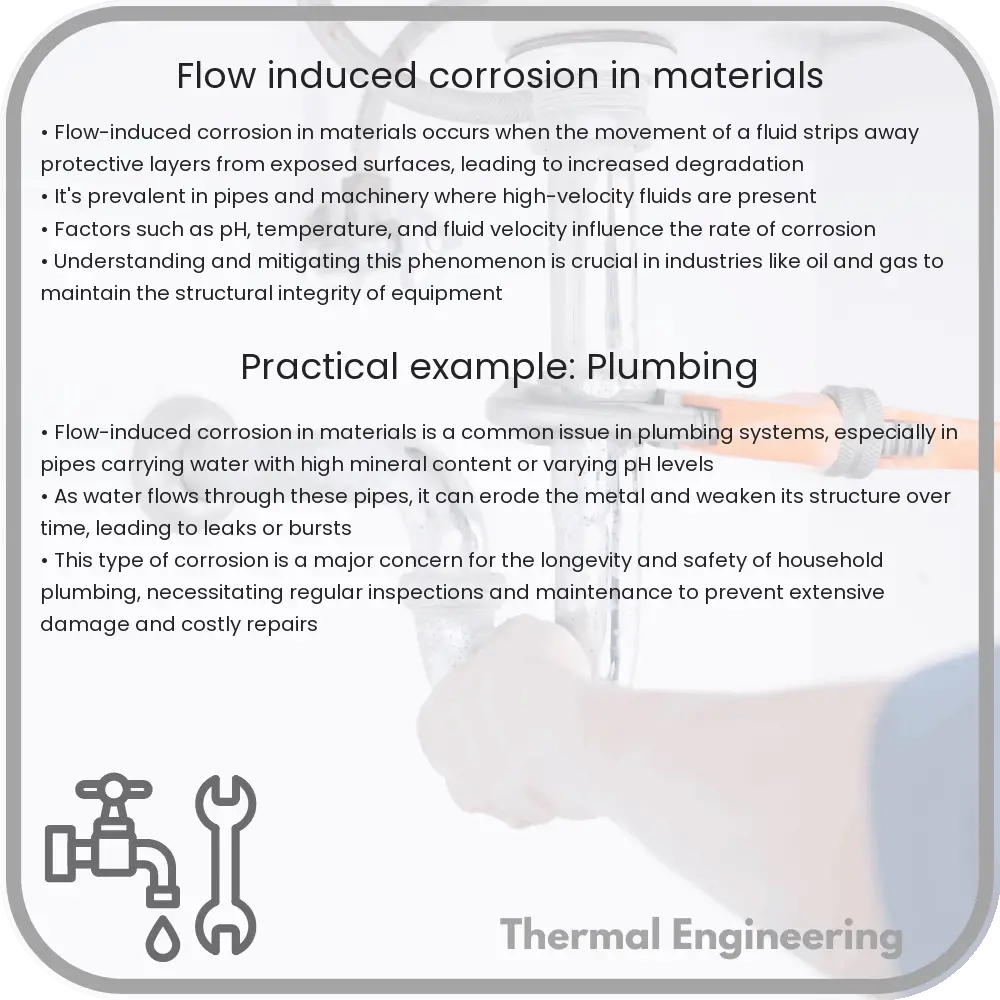
Flow-induced corrosion in materials

Learn about flow-induced corrosion (FAC), a significant concern where materials degrade faster due to liquid flow, impacting structural integrity.

Flow-induced corrosion in materials

Understanding Flow-Induced Corrosion in Materials

Flow-induced corrosion, also known as flow-accelerated corrosion (FAC), is a significant engineering concern in scenarios where materials are exposed to flowing liquids. The mechanism hinges not only on the chemical interactions between the material and its environment but also on hydrodynamic factors, leading to an escalated degradation rate. This type of corrosion primarily affects metals and can lead to severe consequences if not properly managed, such as the thinning of pipes and failure of structural components.

How Flow-Induced Corrosion Occurs

Flow-induced corrosion happens when a protective oxide layer on a metal surface is continuously removed due to the physical force of a liquid flowing against it. This is particularly critical in cases where water or steam is involved. The rate at which this corrosion occurs depends on several factors:

  • Fluid velocity: Higher velocities can increase the rate of corrosion as they enhance the rate of removal of the protective layer.
  • Chemistry of the fluid: Certain ions or a low pH in the fluid can accelerate the corrosion process.
  • Temperature: Elevated temperatures can increase the corrosiveness of the fluid, as well as the rate of reaction.
  • Material properties: Some materials are inherently more resistant to flow-induced corrosion due to their chemical composition and the stability of their oxide layers.

The corrosive process is often described by the equation:

Rcor = k * (vn)

Where Rcor represents the corrosion rate, k is a constant specific to the system, v is the fluid velocity, and n is an exponent that provides insight into the sensitivity of the corrosion rate to changes in velocity.

Real-World Implications and Prevention

In industrial settings, such as power plants and refineries, flow-induced corrosion can lead to failures in systems that are crucial for safety and operation, such as cooling systems or steam lines. The economic implications include not only repair and replacement costs but also potential downtime and losses due to operational interruptions.

Preventing flow-induced corrosion involves several strategies:

  • Material selection: Using materials with higher resistance to corrosion can significantly reduce the risk. Alloys containing chromium, for example, might form more stable oxide layers that resist removal.
  • Fluid treatment: Chemical additives can adjust the pH or reduce corrosive ions in the fluid, thus mitigating the corrosion process.
  • Design adjustments: Engineers can design systems in a way that minimizes high-velocity zones and turbulent flows, which are hot spots for severe flow-induced corrosion.
  • Regular monitoring: Implementing corrosion monitoring techniques, such as corrosion coupons, ultrasonic thickness measurement, and erosion-corrosion probes, can help detect early signs of FAC and prevent catastrophic failures.

Understanding flow-induced corrosion is crucial in both designing new systems and maintaining existing infrastructures. With appropriate materials, designs, and maintenance strategies, the detrimental effects of flow-induced corrosion can be significantly mitigated, enhancing both safety and efficiency in various applications.

Conclusion

Flow-induced corrosion continues to be a challenge in many industries, prompting ongoing research and development in material science and engineering strategies. By better understanding the dynamics of this destructive process, engineers can design more durable systems and contribute to longer-lasting and safer infrastructures and machinery.

Fluid flow in pharmaceutical manufacturing

Explore the crucial role of fluid flow in pharmaceutical manufacturing, focusing on its impact on process efficiency and product quality.

Fluid flow in pharmaceutical manufacturing

Understanding Fluid Flow in Pharmaceutical Manufacturing

Fluid flow is a critical component in pharmaceutical manufacturing, influencing the efficiency and safety of many processes. From the production of tablets and capsules to the creation of sterile injectables, mastering fluid dynamics is essential for ensuring high-quality outcomes in pharmaceuticals. Let’s delve into the importance of fluid flow and explore how it is managed in the industry.

Types of Fluids in Pharmaceutical Processes

The types of fluids used in pharmaceutical manufacturing can vary widely, including:

  • Water: Used in numerous formulations and as a solvent in the cleaning process.
  • Solutions: Often include active pharmaceutical ingredients (APIs) and other excipients.
  • Suspensions: Solid particles dispersed in a liquid medium, requiring careful handling to maintain uniformity.
  • Emulsions: Mixtures of two immiscible liquids, such as oil and water.

Key Fluid Flow Concepts in Pharmaceutical Manufacturing

Understanding several fundamental concepts of fluid dynamics is crucial for optimizing pharmaceutical manufacturing processes:

  • Laminar vs. Turbulent Flow: Laminar flow, characterized by smooth and orderly fluid motion, is typically desired in pharmaceutical manufacturing to ensure stable mixing and prevent damage to sensitive molecules. Turbulent flow, which is chaotic, can lead to unpredictable results and must be controlled or minimized.
  • Reynolds Number: This dimensionless number helps predict flow patterns in different fluid transport scenarios. A low Reynolds number (<2000) typically indicates laminar flow, while a high number (>4000) suggests turbulent flow.
  • Viscosity: A fluid’s resistance to flow, viscosity is a critical property in the manufacturing process. Higher viscosity can affect mixing, pumping, and the overall handling of fluids.

Engineering Applications

Engineering principles are applied to control and optimize fluid flow in various aspects of pharmaceutical manufacturing:

  • Pipe and Equipment Design: Designing equipment with appropriate dimensions and materials can promote desired flow characteristics and accommodate the specific properties of different fluids.
  • Agitation and Mixing: Mechanical agitators and mixers are used to achieve homogeneity in solutions and suspensions. Proper design and operation of these devices is critical to prevent excessive shear forces that could degrade the product.
  • Heat Transfer: Many pharmaceutical processes involve heat exchange, necessitating careful control of fluid dynamics to ensure efficient and uniform heat transfer.
  • Cleaning and Sterilization: Effective fluid flow is crucial for cleaning and sterilizing equipment, ensuring that all surfaces come into contact with cleaning agents and that residues are effectively removed.

Challenges in Managing Fluid Flow

Pharmaceutical manufacturers face several challenges when managing fluid flow, including:

  • Scaling up from Lab to Production: Processes developed at a laboratory scale may behave differently when scaled up to production due to changes in fluid dynamics.
  • Dealing with Complex Fluids: Fluids containing APIs and other compounds can have complex behaviors not seen in simpler fluids. This complexity requires sophisticated understanding and innovative engineering solutions.
  • Maintaining Sterility: In applications like the production of injectables, maintaining a sterile environment is paramount. Fluid flow must be managed to avoid contamination.

Conclusion

In conclusion, the intricacies of fluid flow in pharmaceutical manufacturing require a robust understanding of fluid dynamics and careful engineering design. By optimizing fluid handling processes, pharmaceutical manufacturers can enhance product quality, increase efficiency, and meet stringent regulatory standards. As technology advances, ongoing research and development in this area will continue to play a crucial role in the pharmaceutical industry’s ability to deliver safe and effective medications.

Heat transfer enhancement techniques

Learn about effective heat transfer enhancement techniques for improving system efficiency and performance in various engineering applications.

Heat transfer enhancement techniques

Understanding Heat Transfer Enhancement Techniques

Heat transfer plays a critical role in various engineering applications, from HVAC systems and refrigeration to automotive design and industrial processes. Enhancing heat transfer can lead to increased efficiency, reduced energy consumption, and overall performance improvement of systems. Here, we explore several effective techniques used to enhance heat transfer.

Active and Passive Methods

Heat transfer enhancement techniques are primarily divided into two categories: active and passive. Active methods require external energy, such as electricity or mechanical power, to increase heat transfer. In contrast, passive methods do not require any direct input of external energy.

Active Methods

  • Electrohydrodynamic Enhancement: This technique involves applying an electric field to a fluid, influencing its motion and thus enhancing convection heat transfer. It’s particularly useful in scenarios where natural convection is insufficient.
  • Mechanical Aids: Incorporating devices like fans, stirrers, or pumps to increase fluid motion and improve heat transfer rates falls under this category. These aids are common in industrial settings where large volumes of fluid need rapid heating or cooling.
  • Surface Vibration: Applying vibrations to a heat transfer surface can disrupt boundary layers, enhancing convective heat transfer. This method is suitable for specific applications where maintaining compact equipment is crucial.

Passive Methods

  • Surface Area Increase: Adding fins or other extended surfaces to a heat exchanger increases the total surface area available for heat transfer, thereby boosting the heat transfer rate.
  • Surface Roughness: Modifying the roughness of a surface can enhance turbulent flow and break up thermal boundary layers, facilitating better heat transfer.
  • Inserts and Obstacles: Placing objects like baffles or twisted tapes within a flow channel disrupts fluid flow, improving turbulence and consequently the heat transfer rate.
  • Nano-fluids: Utilizing fluids containing suspended nanoparticles can dramatically increase the thermal conductivity of the base fluid, offering substantial improvements in convective heat transfer.

Phase Change Methods

In areas where high heat fluxes are common, phase change methods such as boiling and condensation can be particularly effective. These methods leverage the latent heat of phase change to achieve significant heat transfer rates.

Heat Pipes

Heat pipes are a specialized passive heat transfer device. They utilize phase change and capillary action to transfer heat from a hot interface to a cooler interface efficiently. This technique is widely used in electronics cooling where space and weight are constraints.

Implications of Heat Transfer Enhancement

Enhancing heat transfer can lead to more compact designs, lower operational costs, and higher system reliability. However, each technique must be chosen based on specific application needs, considering factors such as space availability, cost implications, and energy efficiency.

Conclusion

Whether by active or passive means, enhancing heat transfer is integral to improving the performance and efficiency of engineering systems. As technology advances and demands for energy-efficient solutions increase, the development and application of these techniques will continue to play a pivotal role in engineering design and practice.

Understanding these methods and their applications helps engineers select the right heat transfer enhancement techniques, ultimately leading to more innovative and effective engineering solutions.

Aerodynamics of race cars

Learn how aerodynamics significantly enhances race car performance, focusing on optimizing speed, efficiency, and safety on the track.

Aerodynamics of race cars

Understanding the Aerodynamics of Race Cars

The engineering world continually seeks ways to enhance the performance and safety of race cars. One of the critical aspects making a significant difference in this area is aerodynamics. The field of aerodynamics in motorsports involves studying how air interacts with race cars. Effective aerodynamic design allows for better speed, stability, and efficiency on the racetrack.

Basics of Aerodynamics

Aerodynamics is fundamentally the study of how gases interact with moving bodies. When it comes to race cars, the air plays a crucial role in how the car performs. As the car propels forward, it has to cut through the air in front, which in turn exerts force opposite to the car’s motion known as drag. Minimizing drag and optimizing other forces via aerodynamic design is vital for attaining greater speeds and improving car handling.

Key Components Influencing Aerodynamics

  • Front Wing: Positioned at the front of the car, the front wing directs airflow over and around the body of the car, reducing turbulence and aiding in downforce, which keeps the car pressed against the track.
  • Rear Wing: Similar to the front, the rear wing helps in managing the airflow that leaves from the back of the car, crucial for maintaining balance and stability at high speeds.
  • Diffuser: The diffuser is located at the car’s underbody at the rear. It speeds up the air flowing underneath, which reduces pressure and increases downforce, thus improving grip.
  • Bodywork: The overall shape of the car’s body also plays a significant role. Sleeker designs help in reducing drag and can manage airflow more efficiently around the vehicle.

Principles of Aerodynamics in Racing

In racing, engineers strive to achieve the optimal balance between downforce and drag. Downforce helps increase the vehicle’s traction by pressing it onto the track without significantly adding to the resistance that it encounters. This balance is crucial because while downforce helps in cornering at higher speeds, excessive downforce can increase drag and reduce top speed.

The mathematical study of these dynamics often involves equations from fluid dynamics, such as Bernoulli’s principle which can be expressed as:

P + 0.5 * ρ * v2 = constant

where P is the pressure, ρ is the density of the air, and v is the velocity of the air. Changes in these variables can affect the car’s aerodynamic efficiency.

Recent Trends and Innovations

Recent advancements in race car aerodynamics include active aerodynamics, where components such as wings and vents are dynamically adjusted based on real-time conditions to maximize performance. Additionally, computational fluid dynamics (CFD) has become a crucial tool. It allows engineers to simulate and predict airflow patterns and forces around their designs, refining them for optimal outcomes without extensive physical wind tunnel testing.

Conclusion

The aerodynamics of race cars is a vital aspect of their overall engineering. This field not only impacts speed and efficiency but also significantly contributes to the safety of the drivers. Through continuous research and technological advancements, the interaction between race cars and air is becoming more refined, leading to faster, safer, and more competitive racing experiences.

This exploration into the aerodynamics of race cars highlights the sophisticated blend of physics and engineering required in sports racing and underscores the importance of continual innovation in this thrilling field.