Learn about heat flux sensors, devices crucial for measuring the rate of heat transfer across various scientific and engineering applications.
Understanding Heat Flux Sensors for Thermal Measurements
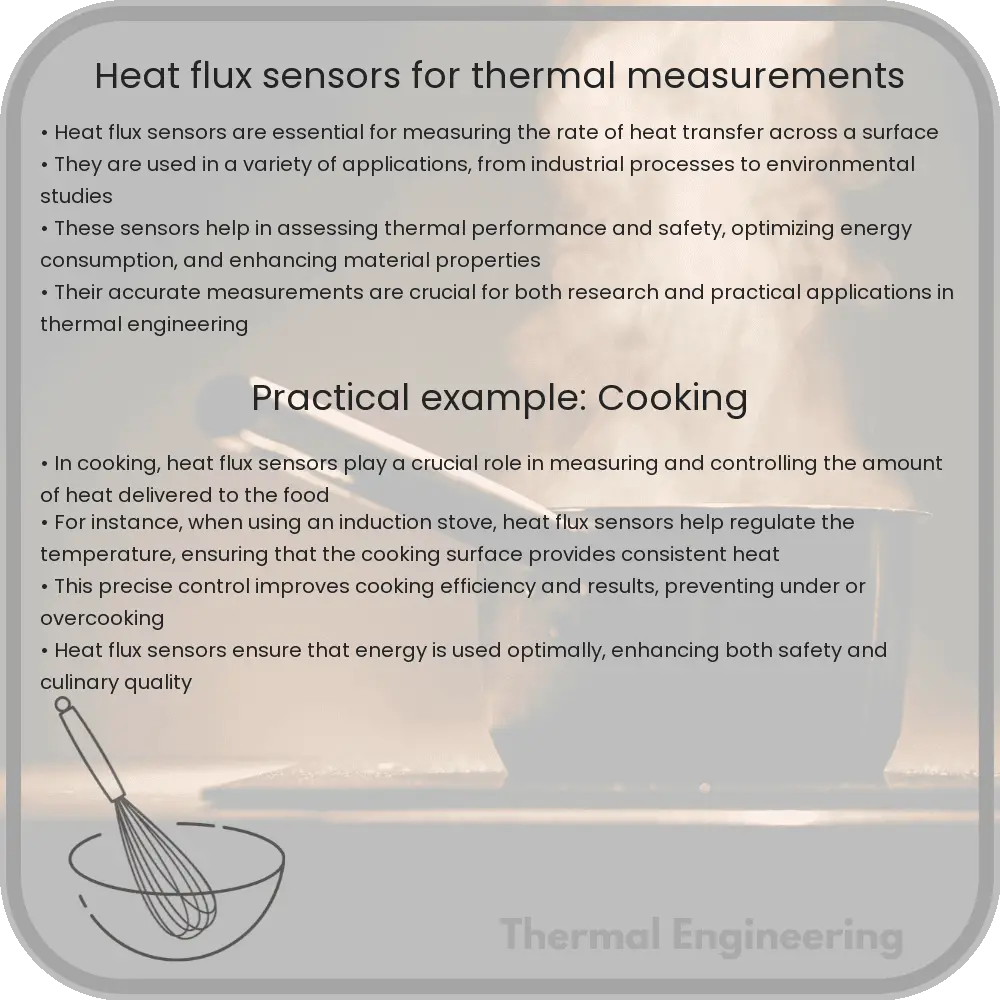
Heat flux sensors are critical components in various engineering and scientific applications where measuring the rate of heat transfer is essential. These devices enable precise monitoring of thermal properties in a wide range of environments, from industrial processes to environmental studies. Understanding how these sensors work, their types, and their applications can provide valuable insights into their practical utility.
What is Heat Flux?
Heat flux is a term used to describe the rate of heat energy transfer through a given surface area. It is commonly measured in watts per square meter (W/m2). The basic formula for calculating heat flux, \(\Phi\), is provided by Fourier’s Law of heat conduction:
\[ \Phi = -k \cdot \frac{\Delta T}{d} \]
where:
- \( k \) is the thermal conductivity of the material,
- \(\Delta T\) is the temperature difference across the material, and
- \( d \) is the thickness of the material.
Types of Heat Flux Sensors
There are several types of heat flux sensors, each suited to specific applications based on their sensitivity, range, and environmental compatibility:
- Gardner Fluxmeters: These use thermopile sensors to measure the heat absorbed or released in building materials.
- Calorimetric Sensors: Often used in calorimetry to measure the total amount of heat released or absorbed during a chemical reaction or physical process.
- Thermopile Sensors: These convert thermal energy into electrical energy and are typically used for non-contact temperature measurements in environments unsuitable for direct contact sensors.
Applications of Heat Flux Sensors
Heat flux sensors have diverse applications, reflecting their utility in monitoring and managing thermal processes:
- Environmental Studies: They monitor soil heat fluxes or study the effects of sunlight on surfaces, aiding climate research and agricultural planning.
- Building Analysis: Used in monitoring the energy efficiency of buildings, including heat loss and gain through walls, roofs, and foundations.
- Industrial Processes: Critical in processes such as steel making or glass production where temperature control is vital for product quality.
Advantages of Using Heat Flux Sensors
The primary benefits of using heat flux sensors include:
- Accuracy: They provide precise measurements, which are crucial for effective thermal management.
- Durability: Many heat flux sensors are designed to withstand harsh environments, making them ideal for industrial applications.
- Versatility: With various types available, they can be adapted for numerous applications across different industries.
Conclusion
Heat flux sensors are vital tools for understanding and managing heat transfer in both natural and industrial environments. Their ability to provide accurate, reliable measurements makes them indispensable in many fields, from environmental science to building management and industrial manufacturing. Whether you are a researcher, engineer, or industry specialist, understanding the function and applications of heat flux sensors can enhance your ability to manage complex thermal processes effectively.