Explore the dynamics of heat transfer in perovskite solar cells, its impact on their efficiency and longevity, and strategies for effective heat management.
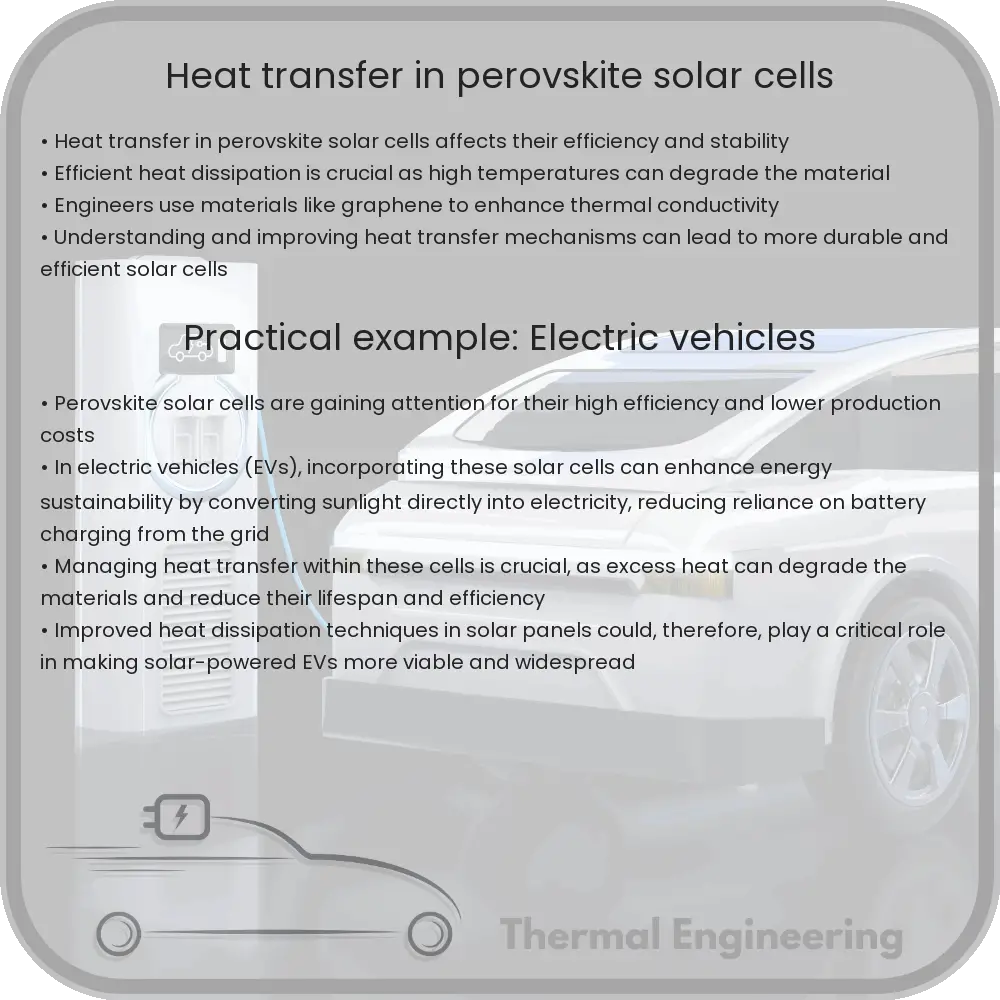
Understanding Heat Transfer in Perovskite Solar Cells
Heat transfer in perovskite solar cells is a crucial aspect that affects both their efficiency and longevity. This article explores how heat is generated and managed in these cells and what implications it has for solar energy technology.
What are Perovskite Solar Cells?
Perovskite solar cells are a type of photovoltaic that uses perovskite-structured materials as the light-harvesting active layer. These materials have become popular due to their excellent light absorption, charge-carrier mobilities, and more straightforward manufacturing processes compared to traditional silicon solar cells.
Sources of Heat in Perovskite Solar Cells
Heat generation in perovskite solar cells primarily comes from three sources:
- Non-radiative Recombinations: Defects in the perovskite material can lead to non-radiative recombination where excited electrons fall back into the valence band without emitting light. This lost energy is converted into heat.
- Absorption of Non-Useful Wavelengths: Sunlight contains a wide spectrum of light, but not all wavelengths are useful for electricity generation. The absorption of these non-ideal wavelengths leads to heat generation within the cell.
- Joule Heating: As current flows through the cell’s electrical circuits, some energy is lost as heat due to the resistance of the materials used.
Impacts of Heat on Efficiency and Stability
Heat can significantly impact the efficiency and longevity of perovskite solar cells in several ways:
- Efficiency Loss: Higher temperatures can lead to increased carrier recombination rates, reducing the voltage output and overall efficiency of the cell.
- Material Degradation: Perovskite materials are sensitive to high temperatures. Prolonged exposure to heat can lead to structural degradation, which diminishes the cell’s performance over time.
Heat Management Strategies
To mitigate the negative effects of heat build-up, several strategies are employed:
- Heat Dissipation: Design-related adjustments, such as the use of heat dissipating layers or materials that can spread and emit absorbed heat evenly and quickly.
- Thermal Design: Engineering the solar cell and panel design to improve air flow and heat escape, often integrating materials with high thermal conductivity.
- Material Improvement: Developing perovskite composite materials with enhanced thermal stability to withstand and operate efficiently under higher temperatures.
Future Directions
With ongoing research and development, improving heat resistance and management in perovskite solar cells continues to be a vital area of focus. Advances in material science and engineering hold the promise of making these cells more durable and efficient. Investigations into hybrid perovskite/non-perovskite layers, enhanced heat sinks, and new geometric designs for solar panels are current areas of interest that aim to improve the heat handling capacities of perovskite solar cells, potentially revolutionizing solar power efficiency and deployment.
Understanding and improving heat transfer in perovskite solar cells is essential for the advancement of solar technology. By enhancing heat management, we can potentially unlock higher efficiencies and longer lifespans for solar panels, making sustainable energy more accessible and effective.