Learn how boiling and condensation play vital roles in engineering for efficient heat transfer in systems like HVAC and power generation.
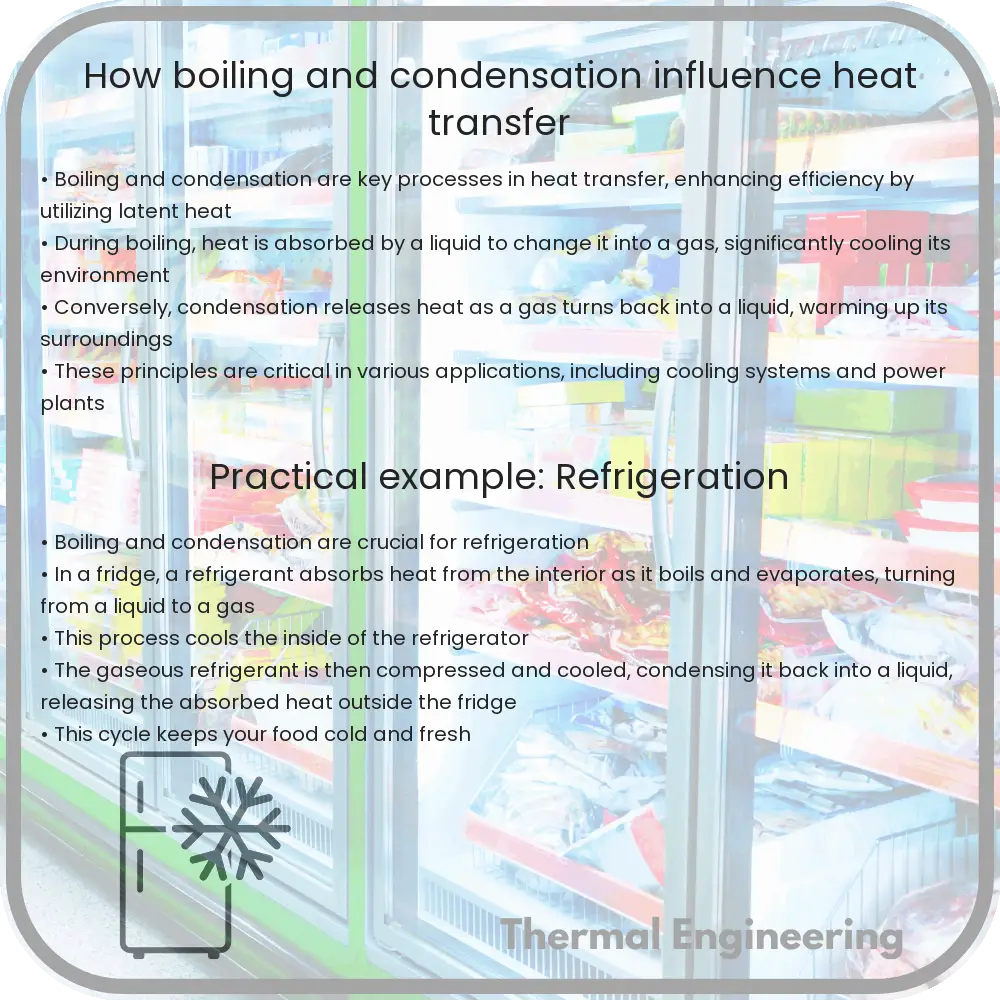
Understanding Heat Transfer: The Roles of Boiling and Condensation
Heat transfer is a fundamental concept in engineering that describes the movement of heat energy from one place to another. This can happen in various ways, including conduction, convection, and radiation. However, two less discussed but critically important mechanisms are boiling and condensation. These processes play essential roles in a myriad of engineering systems, from power plants to refrigeration and HVAC systems.
Boiling and Its Effect on Heat Transfer
Boiling occurs when a liquid reaches a temperature at which it turns into a vapor. This process usually happens at the liquid’s boiling point, which varies depending on the pressure of the environment. Boiling can be seen as a vigorous form of evaporation where heat energy is absorbed by the liquid to change its phase to gas.
- During boiling, the heat transfer is particularly effective because of the latent heat of vaporization. The latent heat is the energy required to change the phase of a substance from liquid to gas without changing its temperature.
- This energy absorption is mostly used to break the molecular bonds within the liquid, resulting in a phase transition to gas.
- In engineering applications, such as in boilers and cooling systems, boiling is used to quickly move large quantities of heat energy.
The classic equation for heat transfer during boiling is given by:
Q = m * Lv
where Q is the heat absorbed, m is the mass of the substance, and Lv is the latent heat of vaporization.
Condensation and Its Impact on Heat Transfer
Condensation is the inverse process of boiling. It occurs when a vapor loses enough heat energy to change into a liquid. This process usually happens at or below the boiling point, depending on the surrounding pressure. In the world of engineering, condensation is utilized to enhance heat transfer mechanisms, particularly in heating, ventilation, and air conditioning (HVAC) systems, as well as in power generation.
- In condensation, the latent heat released as the vapor changes back to liquid can be substantial, making it an efficient way of transferring heat from one fluid to another or to a condensing surface.
- The efficiency of condensation is especially pivotal in condensers used in thermal power plants, where steam condensed back into water can be reheated and recycled into the system, dramatically improving the system’s overall energy efficiency.
- Furthermore, proper management of condensation is crucial in preventing hardware damage due to moisture in industrial and electronic devices.
The basic equation for heat transfer during condensation is similar to boiling:
Q = m * Lc
where Q is the heat released, m is the mass of the substance, and Lc is the latent heat of condensation, typically similar in magnitude to the latent heat of vaporization.
Conclusion
Both boiling and condensation are pivotal in engineering applications for effective heat transfer. By harnessing these processes, engineers can design systems that not only maximize energy efficiency but also optimize performance in industrial operations. Understanding these mechanisms helps in the designing of more efficient thermal management systems that are crucial for energy conservation and management in various engineering fields.
By mastering the concepts of boiling and condensation, students and professionals can better design, operate, and improve systems in which these heat transfer processes are integral.