Learn about the key roles of hydraulic fluid in high-pressure systems, including its science-backed properties and diverse industrial applications.
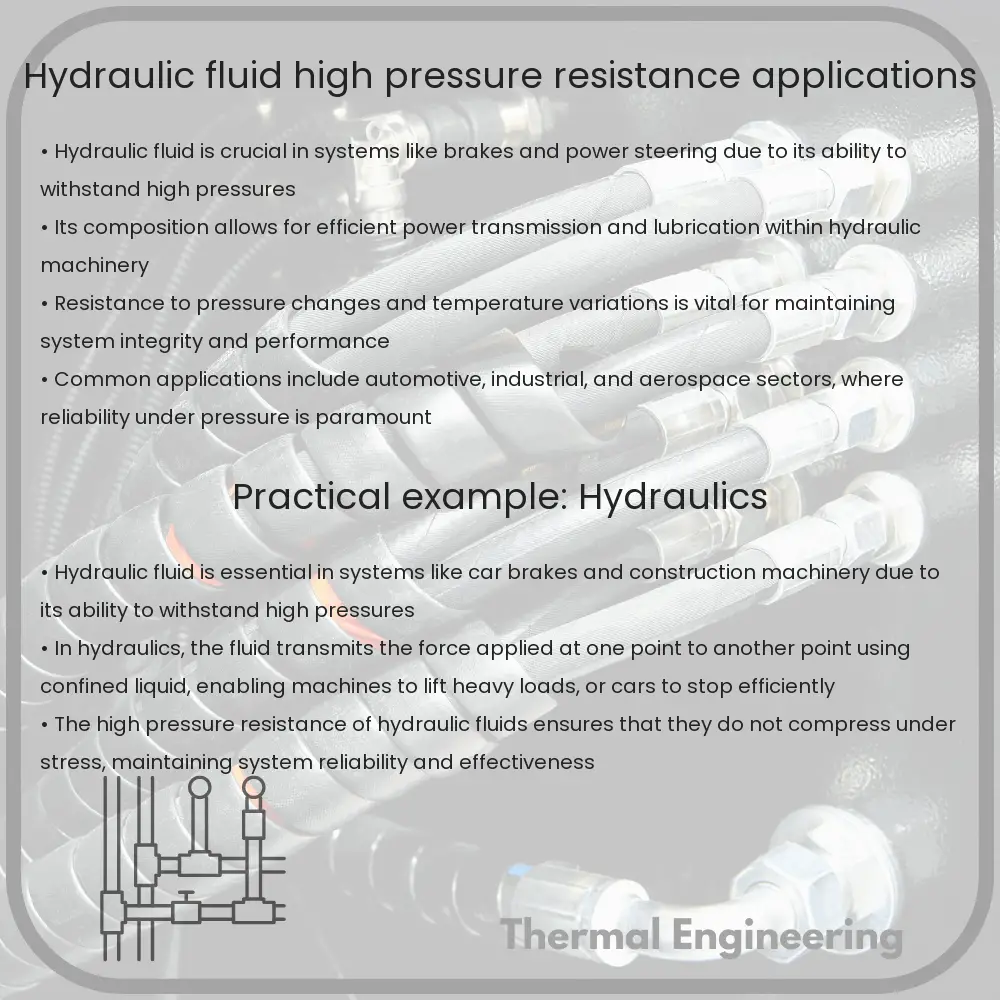
Understanding Hydraulic Fluid: High Pressure Resistance and Applications
Hydraulic fluid is the lifeblood of many mechanical systems. It plays a crucial role in the operation of hydraulic machinery by transferring power through pressure. Here, we will explore the science behind hydraulic fluid’s high-pressure resistance and its real-world applications.
The Science Behind High Pressure Resistance
Hydraulic fluids are specially formulated to withstand extreme pressures while maintaining consistent performance. The ability to resist high pressure is a result of their incompressible nature and viscosity. Viscosity, measured in centistokes (cSt), is essentially the thickness of a fluid. A higher viscosity implies a thicker fluid, which helps in maintaining film strength under high pressure, reducing wear and tear on hydraulic components.
- Incompressibility: Ideal hydraulic fluids are virtually incompressible, even under significant pressure. This property ensures efficient power transfer and precise control of the hydraulic system.
- Viscosity: The viscosity must be balanced to provide both lubrication and efficient fluid flow. Hydraulic fluids are selected based on their viscosity index (VI), which indicates their change in viscosity with temperature.
- Additives: Additives play a pivotal role in enhancing the properties of hydraulic fluids. Anti-wear additives, corrosion inhibitors, and antioxidants help in maintaining fluid integrity and system health even under high pressures.
Common Applications of High-Pressure Hydraulic Fluids
Hydraulic systems that operate under high pressure are integral to a variety of industrial, automotive, and aerospace applications:
- Manufacturing Machinery: Hydraulic presses, injection molding machines, and metal extrusion equipment all rely on hydraulic fluids to exert tremendous force smoothly and consistently.
- Automotive Systems: In automotive engineering, brake systems and clutch mechanisms use hydraulic fluids to ensure reliable, immediate response to driver inputs.
- Construction Equipment: Heavy-duty vehicles such as excavators, bulldozers, and cranes use hydraulic systems to perform lifting and digging operations that require massive amounts of force.
- Aerospace: In the aerospace industry, hydraulic systems control the operation of aircraft components such as landing gear, flaps, and brakes. These systems must work under extreme conditions and pressures flawlessly.
In conclusion, hydraulic fluid’s ability to resist high pressure is crucial for the efficient operation of various mechanical systems across industries. By understanding the properties that contribute to its performance, engineers can better design and maintain hydraulic systems that are both effective and reliable. Continuing advancements in fluid technology and additive chemistry are expected to further enhance the capabilities of hydraulic fluids, supporting even more demanding applications in the future.