An in-depth exploration of thermal barrier coatings (TBCs), covering their composition, functions, application methods, and future developments in engineering.
Understanding Thermal Barrier Coatings in Engineering
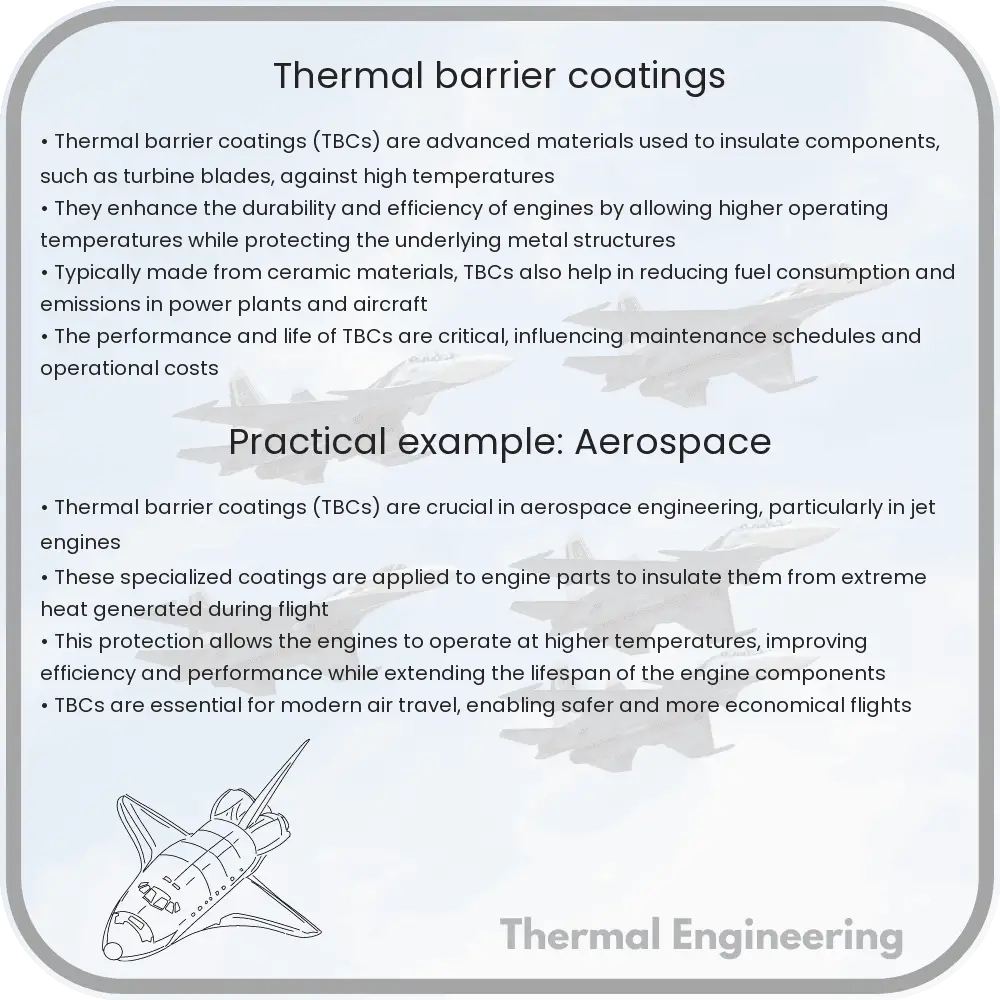
Thermal barrier coatings (TBCs) represent a crucial technology within the field of materials engineering, particularly known for their role in enhancing the durability and efficiency of gas turbines. These coatings are used to protect metallic parts from extreme temperatures, thereby extending their life and optimizing their performance in high-temperature environments.
The Composition and Function of Thermal Barrier Coatings
TBCs typically consist of a ceramic material that is deposited on a substrate, usually made of a superalloy. The most commonly used ceramic material is yttria-stabilized zirconia (YSZ), which is favored due to its low thermal conductivity, high stability at elevated temperatures, and good compatibility with underlying metallic substrates.
The main function of thermal barrier coatings is to insulate components, such as turbine blades and combustion chambers, from the hot gases produced during operation. By doing so, TBCs allow gas turbines to operate at higher temperatures, significantly improving their efficiency according to the Brayton cycle, which describes the relationship between temperature and efficiency in heat engines.
Application Methods
- Electron Beam Physical Vapor Deposition (EB-PVD): This technique is commonly used for depositing high-performance thermal barrier coatings. It involves vaporizing the ceramic material using an electron beam in a vacuum. The vapor then condenses on the substrate, forming a coherent layer.
- Air Plasma Spraying (APS): In APS, ceramic particles are heated to a molten state and then sprayed onto the substrate using a plasma torch. This method is faster and more cost-effective than EB-PVD, though it might result in coatings with higher porosity and lower thermal conductivity.
Thermal Expansion and Durability Challenges
One of the critical challenges in designing TBCs is the mismatch in thermal expansion coefficients between the ceramic coating and the metallic substrate. This differential can lead to thermal stresses that may cause the coating to spall or delaminate. Engineers must carefully choose materials and optimize coating thicknesses to mitigate these issues.
Durability of TBCs is also influenced by their resistance to oxidation and corrosion, particularly under cyclic temperature conditions, which mimic the start-up and shut-down phases of turbines. Continuous research and development are directed towards enhancing the toughness and adherence of these coatings to withstand such harsh operating conditions.
Future Outlook and Innovations
The future of thermal barrier coatings is focusing on finding alternative materials to YSZ due to its susceptibility to sintering at very high temperatures (above 1200°C). Research is ongoing into developing new ceramics with even lower thermal conductivities and higher phase stability. Materials such as gadolinium zirconates and multi-layered composite coatings are being studied, which could redefine the performance limits of high-temperature turbines.
Moreover, advancements in application techniques like Laser Engineered Net Shaping (LENS) and Chemical Vapor Deposition (CVD) are expected to further enhance the uniformity and adherence of TBCs, contributing to the overall efficiency and lifespan of turbine components.
In conclusion, thermal barrier coatings continue to play a pivotal role in the engineering of high-performance turbine engines, pushing the boundaries of temperature and efficiency to meet modern technological demands. The ongoing evolution of TBC materials and application techniques promises even greater improvements in the realms of energy production and aerospace propulsion.