Explore the diverse applications of thermal bistability in electronics, energy management, and memory storage for enhanced efficiency and control.
Understanding the Applications of Thermal Bistability
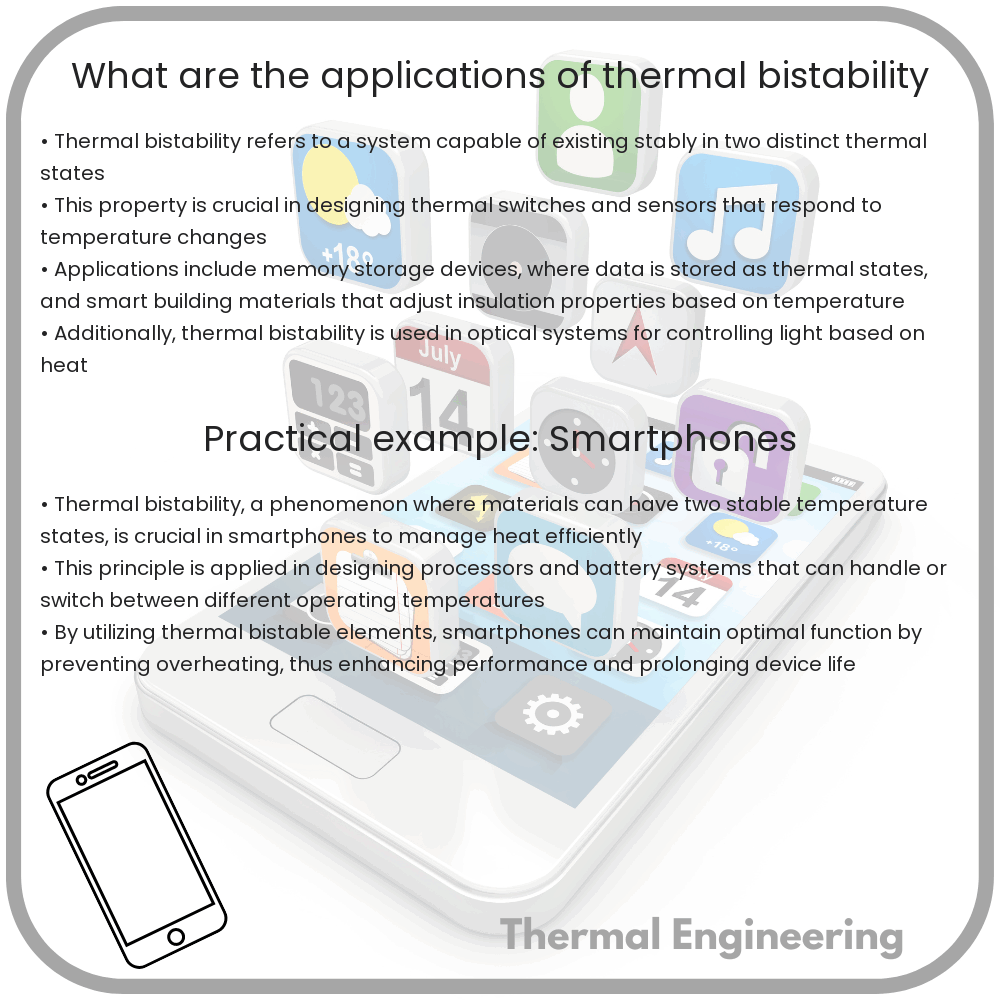
Thermal bistability is a phenomenon observed in certain materials where they can exist stably in two different temperature states under a fixed set of external conditions. This behavior is harnessed in various engineering applications, ranging from electronic circuits to thermal management systems. The applications of thermal bistability are predominant in domains that require precise control of temperature and energy efficiency.
Applications in Switching Devices
One of the most common applications of thermal bistability is in the creation of thermal switches. These devices can automatically switch between conductive and non-conductive thermal states. Thermal bistability allows these switches to operate without the need for additional sensors or external controls, making them ideal for use in environments where minimal electronic interference is necessary or in regions that are inaccessible.
- Electronic Circuits: Thermal bistable switches are used to protect circuits from overheating. When a certain temperature threshold is reached, the switch changes state to disrupt the circuit, preventing damage due to excessive heat.
- Aerospace Applications: In satellites and spacecraft, thermal switches regulate the temperature of critical components, ensuring that sensitive equipment operates within safe thermal bounds without the burden of complex electronic controls.
Energy Management Systems
Thermal bistability is also pivotal in developing energy-efficient systems for heating and cooling, particularly in buildings and automotive industries. Systems that exploit thermal bistable materials can use ambient temperature fluctuations to maintain comfortable temperature ranges with lower energy consumption.
- Smart Building Materials: Materials that exhibit thermal bistability are used in the construction of smart windows and insulation. These materials can help maintain the internal temperature of a building by becoming more or less insulating based on the outside temperature.
- Vehicular Temperature Control: In vehicles, bistable materials can help in maintaining a comfortable cabin environment by automatically adjusting insulation properties based on external and internal temperatures, thus enhancing fuel efficiency by reducing the load on air conditioning systems.
Memory Storage Devices
Another advanced application of thermal bistability is in the domain of memory storage technology. Phase change memory (PCM) devices use materials that can switch between amorphous and crystalline states – each having a different thermal conductivity – to represent binary data states.
- Data Stability: The bistable nature of phase change materials contributes to the stability of data stored, as the material will remain in either of its states until heated past a transition temperature.
- Energy Efficiency: Since bistable materials hold their state without power, PCM devices can offer significant energy savings over traditional dynamic RAM that requires continuous power.
Conclusion
Thermal bistability presents a unique set of properties leveraged across different engineering fields to achieve goals such as energy efficiency, safety, and environmental sustainability. Its ability to operate without external controls while providing stable switching characteristics or memory states underlines its importance in modern technological applications. As research continues, the scope of applications is likely to expand, embedding thermal bistability more deeply in future engineering solutions.