Facebook Instagram Youtube Twitter

Dosing Pump | Precise Chemical Metering & Treatment

Learn about dosing pumps, essential for precise chemical metering in various industries.
Dosing Pump | Precise Chemical Metering & Treatment

Understanding Dosing Pumps: Essential Tools for Precise Chemical Metering and Treatment

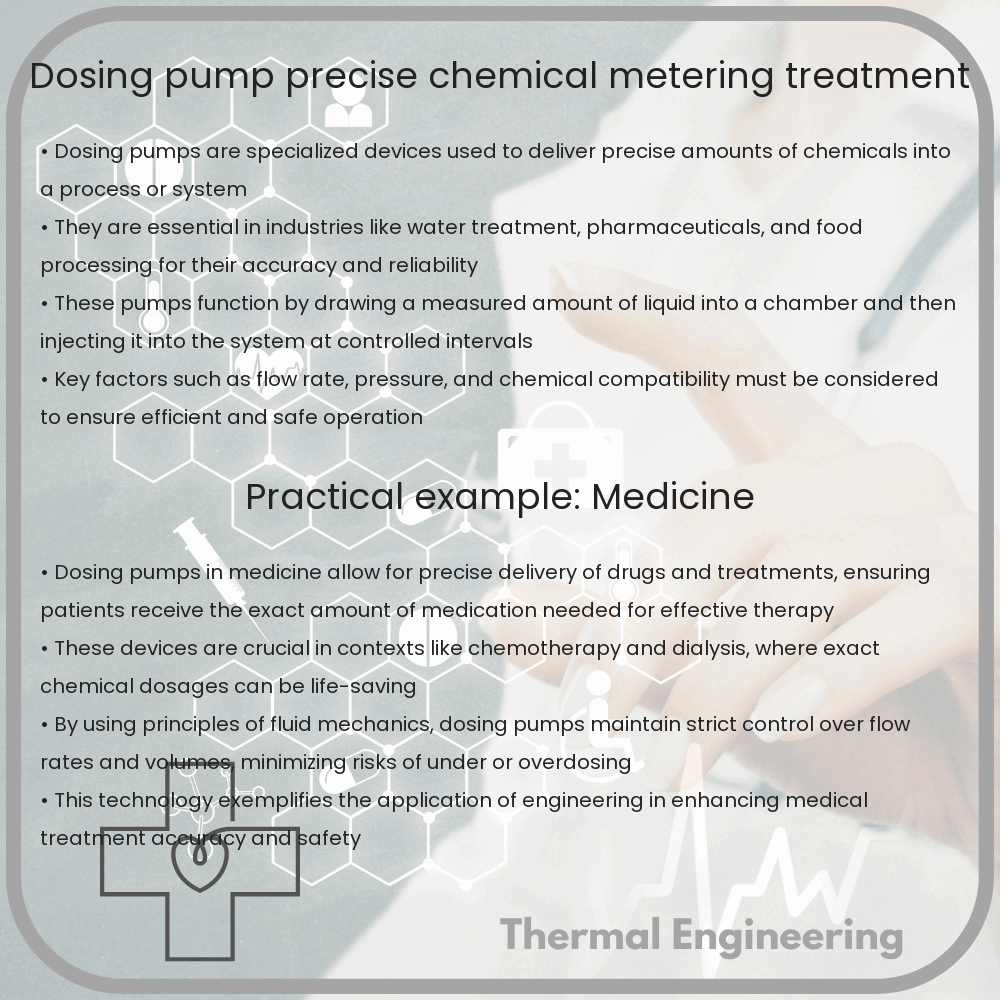
Dosing pumps, also known as metering pumps, are essential components in a variety of engineering fields where precise and controlled dosing of chemicals is required. These pumps are designed to deliver a very exact amount of a substance in a controlled flow rate to a specific process stream. This precision is crucial in applications such as water treatment, chemical processing, and pharmaceutical manufacturing.

How Dosing Pumps Work

A dosing pump functions by drawing a measured amount of liquid into its chamber and then injecting this volume into the pipe or tank where it is needed. The pump is generally operated by an electric motor or pneumatic actuator which controls the movement of a piston within a cylinder, thus determining the volume of the fluid dispensed.

The operation of a dosing pump involves several key components:

  • Pump Head: This contains the cylinder in which the piston operates.
  • Valves: These allow liquid to enter and exit the pump head. They are designed to only allow movement in one direction (non-return valves).
  • Control System: This may be as simple as a manual adjustment or as complex as a fully automated system integrated with the process plant’s central control system.

Dosing accuracy is affected by factors such as pump speed, back pressure, pump head design, and the nature of the liquid being pumped. Modern dosing pumps typically incorporate advanced technologies such as microprocessors for precise control and diaphragms for enhanced safety and efficiency.

Types of Dosing Pumps

There are several types of dosing pumps, each suited to different applications:

  1. Diaphragm Pumps: These are widely used due to their high level of accuracy and suitability for handling aggressive or hazardous chemicals without leakage.
  2. Peristaltic Pumps: These contain a flexible tube, which is compressed to move the liquid. This design minimizes contamination risk, making it ideal for sanitary applications like food processing or medical dosing.
  3. Piston Pumps: Typically offering higher pressures, these pumps are suitable for applications requiring precise injection into pressurized systems.

Applications of Dosing Pumps

Dosing pumps play a critical role across various industrial sectors:

  • Water Treatment: These pumps help in the precise dosing of disinfectants and coagulants in water treatment facilities to ensure safe drinking water.
  • Chemical Manufacturing: Ensuring proper mixing of chemicals by dosing accurate amounts to reactants.
  • Pharmaceuticals: They are critical in processes where precise amounts of fluids need to be added under sanitary conditions.
  • Food and Beverage: Dosing pumps are used to add flavors, preservatives, or other ingredients during processing.

Considerations for Choosing a Dosing Pump

When selecting a dosing pump, several factors should be considered to ensure optimal performance:

  • Chemical Compatibility: The materials of the pump should be compatible with the chemicals being dosed to avoid corrosion or degradation.
  • Flow Rate and Pressure Requirements: The pump must meet the specific flow rate and pressure demands of the application.
  • Control and Monitoring Needs: Depending on the application complexity, the level of control and monitoring can range from basic to highly sophisticated systems that connect to central process control networks.
  • Maintenance and Servicing: Ease of maintenance and the availability of replacement parts should be considered to minimize downtime.

In conclusion, dosing pumps are indispensable tools in modern industrial operations requiring precise chemical metering and treatment. Understanding the different types of pumps available and their specific applications helps in selecting the right pump that ensures both efficiency and safety in the process.

Jet Pump | Deep Well & Multiphase Fluid Extraction

Explore the functionality and applications of jet pumps in deep well and multiphase fluid extraction scenarios.

Jet Pump | Deep Well & Multiphase Fluid Extraction

Understanding Jet Pumps: Their Role in Deep Well and Multiphase Fluid Extraction

Jet pumps are versatile devices used in a variety of engineering applications, most notably in extracting fluids from deep wells and handling multiphase fluid mixtures. This hydraulic-based pump employs fluid mechanics principles to transfer fluid from one place to another, employing no moving parts within the well itself, which remarkably reduces maintenance needs compared to other pump types.

How Does a Jet Pump Work?

In its most basic form, a jet pump has three main components: the nozzle, the venturi, and the diffuser. The operating principle of a jet pump involves converting the kinetic energy of a ‘motive’ fluid to pressure energy, suitable for fluid transport. The process follows these steps:

  • The motive fluid (often water or another liquid) is accelerated to a high velocity through a nozzle.
  • This high-speed stream is then passed through a venturi tube—a tube that constricts in the middle creating a pressure differential.
  • The reduction in pressure at the throat of the venturi causes suction, drawing the target fluid (e.g., water from a well) into the venturi.
  • As the motive and suctioned fluids mix, they slow down and regain a higher pressure sufficient to be carried to the surface or across horizontal distances.

Applications in Deep Well Extraction

Jet pumps are particularly effective for deep well applications. They are commonly used to extract water from deep underground reservoirs. One significant advantage of using a jet pump for deep wells is its ability to operate above the ground, unlike submersible pumps that need to be submerged in the fluid. Here’s how jet pumps manage the extraction:

  • A foot valve is typically installed at the bottom of the well to prevent the backflow and maintain the suction pressure needed.
  • The jet pump, located above ground, sends the motive fluid down to a jet located near the water level in the well.
  • The high velocity of the motive fluid creates a vacuum that lifts the water through the riser pipe up to the ground level.

Handling Multiphase Fluids

Jet pumps are not limited to pumping a single phase of fluid; they are equally competent in handling multiphase flows – mixtures of gases, liquids, and sometimes solids. In oil and gas production, jet pumps are utilized for:

  • Extracting fluids from reservoirs containing a combination of oil, water, and gas.
  • Enhancing oil recovery by injecting water or gas to maintain reservoir pressure and improving the lift efficiency.

The ability to handle various fluid phases without the need for separate phase separation equipment before pumping makes jet pumps indispensable in scenarios where conditions are too harsh for more sensitive machinery.

Advantages and Limitations

Advantages: Jet pumps offer numerous benefits including:

  1. Simplicity of design and absence of moving parts below the surface, which minimizes maintenance.
  2. Capability to handle a variety of fluids and mixtures.
  3. Reliable operation and ease of installation, particularly in remote or hard-to-access locations.

Limitations: Despite their advantages, there are some limitations:

  1. Lower efficiency compared to some other pump types, particularly at great depths or high lift requirements.
  2. Dependency on a continuous supply of motive fluid, which can add to operation costs, especially if the motive fluid is not readily available.
  3. Susceptibility to issues like cavitation if not properly designed or operated within certain parameters.

In conclusion, jet pumps serve critical roles in deep well and multiphase fluid extraction with their robust and low-maintenance design. Understanding their operation and capabilities allows engineers to optimize the extraction processes and handle challenging fluid movement requirements efficiently.

Seal-Less Pump | Leak-Free Operation & Hazardous Fluids

Learn about seal-less pumps, designed to handle hazardous fluids securely without leakage, ensuring safety and efficiency in industrial environments.

Seal-Less Pump | Leak-Free Operation & Hazardous Fluids

Understanding Seal-Less Pumps: Ensuring Leak-Free Operation with Hazardous Fluids

Seal-less pumps are designed to provide reliable and secure management of liquids, especially in handling hazardous, toxic, or corrosive fluids. Unlike traditional pumps with dynamic seals that can wear out and leak over time, seal-less pumps use advanced technologies to eliminate the need for these seals, thereby reducing the chances of leakage and enhancing safety and efficiency in industrial applications.

How Do Seal-Less Pumps Work?

Seal-less pumps function by using magnetic couplings, canned motors, or other technologies that remove the need for a physical seal around the shaft that passes through the pump casing. These designs allow the pump to maintain the integrity of the fluid it is moving, without leaks, which is critical when handling dangerous or environmentally harmful fluids.

  • Magnetic Drive Pumps: These pumps use a magnetic coupling to transfer torque from the motor to the impeller. There’s no direct contact between the motor shaft and the fluid, as the impeller operates within a hermetically sealed chamber, thus preventing leaks.
  • Canned Motor Pumps: In these pumps, the motor and the pump are integrated into a single sealed unit, with the rotor of the motor enclosed in a can that acts as a static seal. This structure prevents fluid from leaking out of the pump enclosure.

Advantages of Seal-Less Pumps

The primary advantage of using a seal-less pump is its ability to securely handle hazardous, corrosive, or toxic fluids without risk of leakage or exposure. The benefits of these pumps extend beyond just safety:

  • Environmental Safety: By avoiding leaks, these pumps protect the environment from potential contamination.
  • Reduced Maintenance: Since there are no seals to maintain or replace, seal-less pumps often require less routine maintenance than conventional sealed pumps.
  • Cost Efficiency: While the initial investment in a seal-less pump may be higher, the long-term savings on maintenance and the prevention of product loss can be significant.

Applications of Seal-Less Pumps

Seal-less pumps are ideal for many industries where leakage could be costly or hazardous. Some of the typical applications include:

  • Chemical Processing: Handling aggressive, corrosive fluids safely.
  • Pharmaceuticals: Maintaining purity and preventing contamination of sensitive fluids.
  • Oil and Gas: Transferring flammable or toxic substances in both upstream and downstream processes.
  • Manufacturing: Circulating coolants and other industrial fluids without risk of leakages.

Choosing the Right Seal-Less Pump

When selecting a seal-less pump, it is crucial to consider several factors to ensure it meets the specific needs of your application:

  • Fluid Properties: The chemical compatibility, viscosity, and temperature of the fluid are essential factors that will determine the type of seal-less pump required.
  • Operational Conditions: The pressure and flow rate requirements of your system must be met by the pump.
  • Environmental and Safety Requirements: Consider any relevant regulations or safety standards that must be adhered to in your industry.

Seal-less pumps represent a significant advancement in pumping technology, offering robust solutions for industries that deal with hazardous fluids. By understanding their operation, advantages, and applications, businesses can make informed decisions about integrating these pumps into their systems for safer, more efficient operations.

High Temp Pump | Hot Liquid Transfer & Industrial Use

Learn about high temperature pumps, their designs, applications, and key features for transferring hot liquids in various industries.

High Temp Pump | Hot Liquid Transfer & Industrial Use

Understanding High Temperature Pumps for Hot Liquid Transfer in Industry

High temperature pumps are essential devices in many industrial processes where hot liquids need to be moved from one place to another. These pumps are specially designed to handle the rigors of high heat environments, transferring fluids such as molten salt, hot oil, and high-temperature water without degradation of the pump’s components. This article explores how these pumps work, their designs, and the applications they serve in various industries.

Types of High Temperature Pumps

  • Centrifugal Pumps: These are the most common type of high temperature pumps, using a rotating impeller to move liquid. Suitable for applications with large flow rates and moderate to low viscosity fluids.
  • Positive Displacement Pumps: Gear pumps, screw pumps, and rotary lobe pumps fall under this category. They are preferred for high viscosity fluids or when a precise volume of fluid is needed.
  • Magnetic Drive Pumps: These pumps utilize a magnetic coupling that transfers torque without direct contact, which minimizes the risk of leaks. Ideal for handling hazardous or corrosive high temperature fluids.

Key Design Features of High Temp Pumps

High temperature pumps incorporate several design features to withstand the harsh conditions in which they operate:

  1. Material Selection: Components are typically made of materials that can endure high temperatures, such as stainless steel, titanium, and high-grade alloys.
  2. Cooling Mechanisms: Many high temperature pumps include cooling systems to help maintain a safe operating temperature and prolong the lifespan of the pump.
  3. Sealing Solutions: Advanced sealing technologies prevent fluid leaks, critical in maintaining the safety and efficiency of the system, especially in pumps handling hot, hazardous liquids.

Applications of High Temperature Pumps in Industry

High temperature pumps find applications across a broad range of industries due to their ability to deal effectively with high heat and caustic materials:

  • Chemical Processing: Transfers high temperature fluids that are part of production processes, including acids, bases, and solvents.
  • Power Generation: Used in geothermal, nuclear, and coal-fired power plants to circulate hot water and steam.
  • Oil and Gas: Facilitates the movement of hot oils and other fluids in refining and processing applications.
  • Food and Beverage: Handles the transfer of hot oils and fluids used in cooking and processing applications.

Conclusion

Understanding how high temperature pumps operate and the pivotal role they play in industrial settings is crucial for engineers and technicians working in these environments. With their specialized designs and robust construction, high temperature pumps are indispensable in safely managing the transfer of hot liquids in numerous industrial scenarios. Choosing the right pump type and maintaining it properly ensures efficiency, safety, and longevity in any high-temperature application.

Cantilever Pump | Sump Pumping Without Submersion

Learn about cantilever pumps, vertical sump pumps that operate without submersion, designed for robust industrial applications.

Cantilever Pump | Sump Pumping Without Submersion

Understanding Cantilever Pumps: Sump Pumping Without Submersion

Cantilever pumps, often used in sump applications, offer a distinctive design compared to traditional submersible pumps. These pumps are specifically engineered to operate without being submerged in the liquid they are pumping, which brings about numerous practical benefits and operational efficiencies.

What is a Cantilever Pump?

A cantilever pump is a type of vertical pump that utilizes a cantilever design to support its impeller. The impeller, which is the rotating component that moves the fluid, is mounted on a long shaft with bearings located above the surface of the fluid. This setup eliminates the need for seals or bearings at the bottom of the pump, which are common in submersible pumps.

Key Components and Operation

  • Impeller: Mounted at the lower end of the shaft, it accelerates the fluid outward from the pump shaft.
  • Cantilever Shaft: Extends vertically and supports the impeller. It is designed to prevent deflection and vibration.
  • Bearings and Support Structure: Located above the fluid level to keep the shaft stable and reduce wear.
  • Drive Motor: Positioned at the top, it drives the impeller through a long shaft.

The operation of a cantilever pump begins with the activation of the drive motor, which rotates the impeller. As the impeller spins, it pushes liquid from the sump through a discharge pipe using centrifugal force. The absence of submerged bearings and seals reduces the risk of leakage and failure, making maintenance easier and extending the pump’s operational life.

Applications of Cantilever Pumps

  • Chemical Processing: Handling aggressive or hazardous liquids without risking leaks.
  • Waste Treatment: Pumping sludge or waste water with large solid content.
  • Mining and Mineral Processing: Dewatering mine shafts and pits where water may contain abrasive particles.
  • Food and Beverage Industry: Transferring viscous fluids and slurries without product contamination.

Advantages of Cantilever Pumps

  1. Reduced Maintenance: No submerged bearings or seals, which reduces the frequency and complexity of maintenance operations.
  2. Leak Prevention: Since the mechanical parts are above the fluid, these pumps are less prone to leaks, making them suitable for handling hazardous materials.
  3. Handling of Solids: Capable of pumping fluids with solid particles, as there are no delicate components like seals in the fluid.
  4. Variable Installation Depths: The length of the cantilever shaft can be adjusted according to the depth of the liquid, providing flexibility in installation.

Cantilever pumps are an essential tool in industries where reliability, safety, and maintenance ease are priorities. Their unique design allows them to handle challenging pumping tasks that might compromise submersible pumps, offering a robust solution for sump pumping needs.

Conclusion

Whether it’s processing aggressive chemicals in industrial settings, managing waste treatment, or dealing with abrasive materials in mining operations, the cantilever pump stands out as a versatile and secure choice. Its ability to perform efficiently without submersion makes it an innovative solution in the realm of pump technology, catering to a broad spectrum of heavy-duty applications.

Regenerative Turbine Pump | Low Flow, High Head

Learn about regenerative turbine pumps, specialized for high-head and low-flow applications in critical systems.

Regenerative Turbine Pump | Low Flow, High Head

Understanding the Regenerative Turbine Pump: Low Flow, High Head Applications

Regenerative turbine pumps are a type of centrifugal pump that cater to a niche market requiring low flow rates paired with high discharge pressures. These specialized pumps are essential in applications where precision and reliability are crucial under restrictive conditions.

Design and Operation

The design of regenerative turbine pumps differentiates them from more common centrifugal pumps. The key element of their design is the impeller, which features numerous radial blades on a disk. As fluid enters the pump, it is recirculated many times between the impeller blades and a ring-channel casing that surrounds the impeller, known as the “regenerative” action. This repetitive action imparts higher energy levels to the fluid, resulting in high discharge pressures at relatively lower flows.

Essentially, fluid particles pass through the impeller multiple times, gaining energy with each pass. This design allows the pumps to generate substantial head while maintaining a compact footprint, which is essential in space-constrained operations.

Key Characteristics and Advantages

  • High Head and Low Flow: Regenerative turbine pumps are specifically designed to achieve high heads (pressure) at low flow rates, making them indispensable in applications where this combination is required.
  • Pulse-Free Discharge: Unlike some positive displacement pumps, regenerative turbine pumps offer a virtually pulse-free flow, crucial in applications such as metering where consistency and precision are necessary.
  • Efficiency in Handling Gases: These pumps are remarkably efficient in handling fluids with gases, which is often challenging for traditional centrifugal pumps. This capability is particularly valuable in applications such as boiler feed pumps or condensate extraction pumps.
  • Compact Design: The unique design of regenerative turbine pumps allows for a smaller, more compact setup, which is beneficial in systems where space is a limiting factor.

Applications

Due to their specific characteristics, regenerative turbine pumps are found in several key industries:

  1. Boiler Feed Systems: Capable of handling high temperatures and pressures, these pumps are ideal for feeding water into boilers, ensuring the steady operation necessary for steam generation.
  2. Chemical Dosing: Their ability to deliver precise flow rates makes them perfect for applications where chemicals must be dosed in exact amounts.
  3. Condensate Extraction: These pumps are capable of handling the mix of liquid and gas found in condensate extraction processes in power generation.
  4. Hydraulic Systems Backup: They serve as reliable backups for hydraulic systems, capable of maintaining pressure when needed.

Limitations and Considerations

While regenerative turbine pumps offer distinct advantages, there are several limitations that need to be considered:

  • Sensitivity to Fluid Properties: These pumps are generally sensitive to fluid properties; variations in viscosity or the presence of large solid particles can affect performance significantly.
  • Erosion and Corrosion: High speeds and repetitive fluid cycles can lead to increased wear and tear, including erosion and corrosion, thus material selection and regular maintenance are crucial.
  • Cost: The specialized engineering and materials required for these pumps can make them more expensive than other types of pumps with similar capacity.

Conclusion

Regenerative turbine pumps are uniquely designed to address the challenges of high-head, low-flow applications across various industries. Their ability to render steady, pulse-free performance, while handling mixes of gases and liquids efficiently, positions them as invaluable assets in specific fields. However, the choice of using a regenerative turbine pump must be informed by a thorough understanding of the application’s requirements and potential challenges associated with these pumps. By choosing the appropriate pump, engineers can optimize performance and ensure reliability in critical systems.

Propeller Pump | Low Head, High Flow Water Movement

Explore the functionality and applications of propeller pumps for efficient water movement in various industries.

Propeller Pump | Low Head, High Flow Water Movement

Understanding Propeller Pumps: Low Head, High Flow Water Movement

Propeller pumps, commonly used for low head and high flow water movement, are a crucial component in agricultural, municipal, and industrial applications. These pumps are designed to efficiently handle large volumes of water at relatively low discharge pressures. Understanding how they operate, their benefits, and their common applications can help in selecting the right pump for specific needs.

How Propeller Pumps Work

Propeller pumps operate on a simple principle: a motor drives a propeller-like impeller in a casing, which accelerates the water flow through the pump. The design resembles a ship’s propeller, which pushes water axially – in the direction parallel to the pump shaft. This axial flow moves water through the pump and out into the discharge pipe. The impeller’s rotational speed and the angle of its blades determine the flow and head characteristics of the pump.

The pump’s efficiency largely depends on the design of the impeller and the casing. In order to minimize energy losses due to turbulence and eddies, the casing is designed to closely fit around the impeller blades. The flow passages are also streamlined to facilitate a smoother flow of water.

Advantages of Propeller Pumps

  • Efficient for High Volume: Propeller pumps are capable of moving large amounts of water, which is ideal for situations requiring rapid dewatering or large-scale water transfer.
  • Energy Efficient: They operate at a relatively high hydraulic efficiency when used within their optimal range, making them a cost-effective choice for many applications.
  • Low Maintenance: With fewer moving parts and a simple design, propeller pumps generally require less maintenance compared to other types of pumps.
  • Versatile: The flow rate and head can be adjusted by changing the rotational speed of the impeller or by using adjustable blade angles, providing flexibility in usage.

Applications of Propeller Pumps

  • Flood Control: Used extensively in areas prone to flooding, these pumps can rapidly move large volumes of water away from flood zones.
  • Irrigation: Propeller pumps are ideal for large-scale irrigation purposes, where high volumes of water are required over widespread areas.
  • Industrial Processes: In industries where large water circulation is necessary, such as in cooling systems or processing plants, propeller pumps are commonly employed.
  • Aquaculture: They are used for water exchange and circulation in large aquaculture systems to maintain an adequate oxygen supply and waste removal.

Selection and Installation Considerations

Choosing the right propeller pump requires an understanding of the specific application needs such as flow rate and head requirements. Additionally, the nature of the fluid (e.g., presence of solids, temperature, and chemical properties) should also influence the selection process.

It is also crucial to ensure that the installation site is suitable for the pump’s operation. The suction and discharge conditions need to be configured to prevent issues such as cavitation or excessive hydraulic loads on the pump’s components. Regular maintenance and monitoring can significantly extend the lifespan and performance of propeller pumps.

Conclusion

Propeller pumps are essential for operations requiring the movement of large volumes of water at low head. With advantages like high efficiency, ease of maintenance, and adaptability, they play a critical role in various fields, from agriculture to flood management. Understanding these pumps’ operational principles, advantages, and applications allows for informed decision-making in selecting and deploying the right pump for your needs.

Mixed Flow Pump | Compromise Between Axial & Radial

Learn about mixed flow pumps, hybrids in fluid mechanics that combine radial and axial flow elements for efficient fluid management.

Mixed Flow Pump | Compromise Between Axial & Radial

Understanding Mixed Flow Pumps: The Hybrid Approach in Fluid Mechanics

Mixed flow pumps represent a sophisticated engineering solution designed to harness the advantages of both axial and radial flow pumps. These pumps are crucial in applications where there is a need for moderate head and flow rates. This article explores the characteristics, construction, and applications of mixed flow pumps.

Concept and Design of Mixed Flow Pumps

A mixed flow pump is a centrifugal pump that combines features of both radial and axial flow pumps. In this type of pump, the fluid experiences both radial motion and axial propulsion, which results in a diagonal flow. Structurally, this means that the impeller discharges the fluid in a direction that is not purely perpendicular or parallel to the pump shaft, but rather at an angle in between.

The key component of a mixed flow pump is its impeller, which typically has fewer, larger blades than a radial flow pump. This design reduces the velocity of the fluid as it passes through while increasing the pressure, a compromise that brings unique advantages in terms of efficiency and operating capabilities.

Mathematical Performance Considerations

The performance of a mixed flow pump can be described using the Euler’s turbine equation:

\[ \Delta P = \rho g H = \rho U_2 (V_{\theta 2} – V_{\theta 1}) \]

where:

  • \(\Delta P\) is the change in pressure across the pump,
  • \(\rho\) is the density of the fluid,
  • \(g\) is the acceleration due to gravity,
  • \(H\) is the generated head,
  • \(U_2\) is the circumferential speed of the impeller at the outlet,
  • \(V_{\theta 2}\) and \(V_{\theta 1}\) are the tangential components of the absolute velocity of the fluid at the outlet and inlet of the rotor, respectively.

This equation helps in determining the added energy due to the pump based on the change in the velocity and direction of the fluid flow.

Advantages of Mixed Flow Pumps

  • Efficiency: They are more efficient than radial pumps in cases where a large volume of liquid needs to be pumped against a relatively low head.
  • Compact Design: Mixed flow pumps are more compact compared to axial pumps, making them suitable for installations where space is a constraint.
  • Versatility: These pumps can handle a wide range of fluids and are adaptable to both high-flow and medium-head applications.

Applications

Mixed flow pumps are used in a variety of applications, which include:

  • Irrigation and agriculture, for field water supply and irrigation systems,
  • Municipal water supply and wastewater treatments,
  • Power plants, for cooling water circulation,
  • Industrial processes, where large volumes of fluids are processed under moderate heads.

Conclusion

Mixed flow pumps present a valuable compromise between axial and radial flow designs, beneficial for situations where both high flow rates and moderate heads are required. Their unique design allows them to operate efficiently across a broad range of conditions, making them indispensable in various industrial, municipal, and agricultural settings. Understanding the basic principles behind mixed flow pumps can help in optimizing their application and achieving better performance and energy savings.

Thermal management of high-energy physics detectors

Learn about the essential role of thermal management in high-energy physics detectors to prevent overheating and ensure accurate results.

Thermal management of high-energy physics detectors

Understanding Thermal Management in High-Energy Physics Detectors

High-energy physics detectors are sophisticated tools used to observe and analyze particles produced by accelerators or occurring naturally in cosmic rays. A crucial aspect of ensuring their optimal performance and longevity is effective thermal management. This involves controlling the temperature within the detectors to prevent overheating, which can lead to noise, performance degradation, or even damage to sensitive electronic components.

Why is Thermal Management Important?

The operation of high-energy physics detectors often generates significant amounts of heat. This heat arises from the electrical power used by the detector’s electronics and from the energy deposited by particles interacting with the detector materials. Managing this heat is crucial because excessive temperature increases can adversely affect detector accuracy and reliability. Thermal expansion, for example, can misalign detector components critical to precise measurements, while semiconductor components in the detectors can suffer performance degradation or failure at high temperatures.

Techniques Used in Thermal Management

  • Active Cooling Systems: These systems involve the use of fluids to transfer heat away from the detector components. Cooling liquids are often circulated through channels embedded within or attached to the detector. The choice of coolant can vary based on its thermal conductivity and specific heat capacity, with common coolants including water, glycol-water solutions, and engineered fluids.
  • Heat Exchangers: These devices facilitate the transfer of heat from one medium to another. In the context of high-energy physics detectors, heat exchangers are used to transfer the absorbed heat from the coolant to another medium, often air or a secondary liquid circuit, which is then cooled externally.
  • Thermal Insulation: Reducing the heat that flows into the detector from its environment can aid in maintaining controlled temperatures. Insulation materials that have low thermal conductivity and specific heat are chosen to minimize the heat ingress.
  • Peltier Cooling: For precise temperature control at smaller scales, Peltier coolers are used. These electronic devices can transfer heat from one side of the device to the other, depending on the direction of the electric current, which can effectively cool or heat parts of the detector as necessary.

Challenges in Thermal Management

The primary challenge in thermal management of high-energy physics detectors is the balance between effective cooling and the physical and chemical stability of the cooling systems and materials used. For instance, coolants need to be non-corrosive and compatible with the detector materials. Additionally, the cooling system itself must not introduce significant mechanical stress or electromagnetic interference, both of which could alter the detector’s readings.

Moreover, space constraints within the detectors can restrict the size of cooling systems, complicating the design and implementation of effective thermal management strategies.

Future Directions

Advancements in materials science, such as the development of new high-conductivity materials or superfluids for more efficient heat transfer, are likely to play a key role in future thermal management strategies. Additionally, the integration of computational fluid dynamics (CFD) simulations in the design process enables more precise prediction and optimization of cooling performance, reducing the risk of overheating and maximizing detector performance.

Overall, effective thermal management remains a cornerstone in the design and operation of high-energy physics detectors, ensuring that these pivotal tools continue to provide reliable and precise data in various research fields.

Non-Clog Pump | Waste Water & Solids Handling

Learn about non-clog pumps, designed for efficient handling of wastewater and solids without clogging in various challenging environments.

Non-Clog Pump | Waste Water & Solids Handling

Understanding Non-Clog Pumps: Essential for Waste Water & Solids Handling

When it comes to managing waste water and solid disposals in municipal, industrial, and agricultural applications, non-clog pumps are invaluable. These pumps are specifically designed to handle materials that would typically clog other pump systems, ensuring an efficient and reliable flow of waste water and suspension of solids.

Design and Operation of Non-Clog Pumps

Non-clog pumps are a type of centrifugal pump, characterized by their ability to pass solid materials without clogging. Their design incorporates several unique features to combat the challenges posed by solids-laden media:

  • Larger Impeller Passages: The impellers of non-clog pumps have large, open channels that allow solids and fibrous materials to pass through without snagging or binding.
  • Volute Casing: The casing design is typically more robust and features a volute shape to efficiently handle heavy, solid-laden fluids.
  • Dynamically Balanced Impellers: These minimize vibrations and wear, which are crucial for maintaining the pump’s effectiveness and longevity in challenging environments.

Applications of Non-Clog Pumps

Non-clog pumps are extensively used in various applications where solid waste management is critical:

  1. Municipal Sewage Treatment: Handling raw sewage water that includes human waste, toilet paper, and other waste materials.
  2. Agriculture: Pumping slurry, manure, and other organic wastes in farming operations.
  3. Industrial: Used in chemical plants, food and beverage manufacturing, textile mills, and more, where pumps face viscous fluids and other solid residues.
  4. Flood Control: These pumps are crucial in quickly moving large volumes of water and mud that might contain branches, leaves, and other debris during floods.

Selection Criteria for Non-Clog Pumps

Selecting the right non-clog pump for a specific application involves considering several factors to ensure optimal performance and durability:

  • Solid Handling Capacity: The size and type of solids the pump can handle should match the application’s requirements.
  • Flow Rate: The required flow rate based on the volume of fluid and solids to be pumped.
  • Material of Construction: Depending on the application, the pump materials should be resistant to abrasion and corrosion.
  • Energy Efficiency: Considering the energy cost is essential, especially for applications requiring continuous pump operation.

Maintenance Tips for Non-Clog Pumps

Maintaining non-clog pumps is crucial for ensuring their longevity and efficiency in tough operational conditions:

  • Regular Inspection: Check for wear and tear, especially on the impeller and sealing elements.
  • Cleaning: Regularly clean the pump housing and impeller to prevent build-up which can affect performance.
  • Lubrication: Ensure that bearings and other moving parts are adequately lubricated according to the manufacturer’s recommendations.

Conclusion

Non-clog pumps are critical components in managing waste water and solids effectively across various industries and applications. Understanding their design, operation, and maintenance not only helps in selecting the right pump but also ensures sustainable and efficient handling of some of the most challenging waste management tasks.