Facebook Instagram Youtube Twitter

Hydrophobic Coatings | Water Resistance & Surface Protection

Explore the science, application methods, and uses of hydrophobic coatings in various industries to enhance material durability and water resistance.
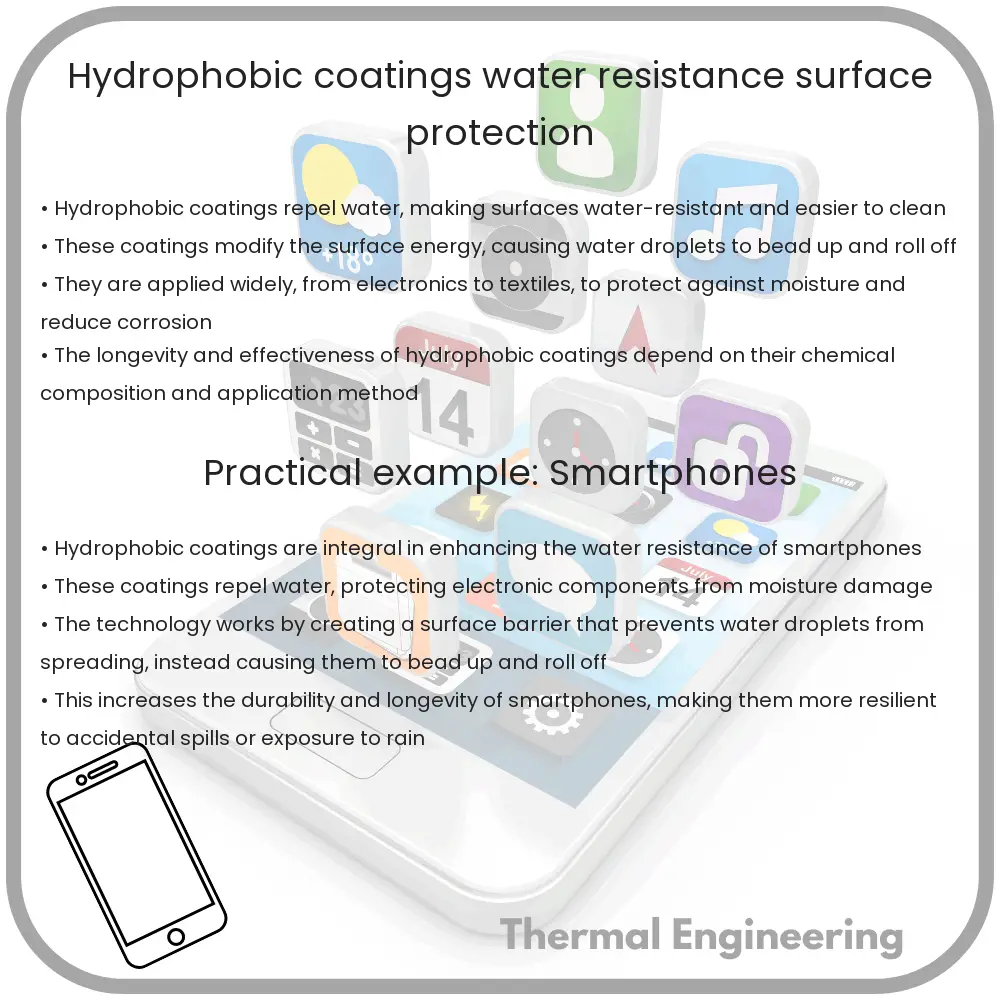
Hydrophobic Coatings | Water Resistance & Surface Protection

Understanding Hydrophobic Coatings: Principles and Applications

Hydrophobic coatings are a fascinating type of surface treatment used to provide water resistance and protect various materials from moisture-related damage. Derived from the Greek words ‘hydro’ (water) and ‘phobos’ (fear), hydrophobic surfaces effectively repel water, causing droplets to bead up and roll off with minimal contact. This article delves into the science behind hydrophobic coatings, how they are applied, and their myriad applications in everyday life and industry.

The Science of Hydrophobicity

At the microscopic level, hydrophobic coatings work by reducing the surface energy of the material they’re applied to. This modification changes the way water interacts with the surface. Typically, these coatings are made from materials such as silicones, fluoropolymers, or other polymers that have low surface energies, thereby preventing water molecules from spreading out and creating a sheet over the surface.

The efficacy of a hydrophobic coating is often measured by the contact angle of a water droplet on the surface. A higher contact angle (generally above 90 degrees) signifies greater hydrophobicity. Some surfaces are even engineered to be superhydrophobic, displaying contact angles greater than 150 degrees, thanks to the development of micro or nano-scale structures that increase air trapped beneath water droplets, enhancing water repellency even further.

Application Techniques

Applying hydrophobic coatings can be done through various methods depending on the substrate and desired durability of the coating:

  • Chemical Vapor Deposition (CVD): Uses vapor phase chemicals to create a thin film on substrates at elevated temperatures.
  • Spin Coating: A liquid solution is applied to a flat substrate which is then spun at high speeds to evenly distribute the coating.
  • Dip Coating: The substrate is dipped into a coating solution and withdrawn at a controlled speed to ensure an even coating layer.
  • Spray Coating: The coating material is sprayed onto the substrate using a spray gun or aerosol, suitable for larger or irregularly shaped surfaces.

Practical Uses of Hydrophobic Coatings

Hydrophobic coatings have broad applications across various industries:

  • Electronics: Used to protect electronic components and devices from water damage, thereby enhancing their durability and reliability.
  • Automotive: Applied on windshields and car bodies to improve visibility during rain and ease the cleaning process by preventing dirt and grime from adhering.
  • Textiles: Used in outdoor clothing gear to provide water resistance without affecting the fabric breathability.
  • Construction: Helps protect building materials from moisture and the growth of mold, algae, and other microbial entities.

Moreover, hydrophobic coatings are essential in energy sectors such as solar panels, where water droplets can reduce efficiency by blocking sunlight. Their application ensures that panels remain clean and dry, maintaining optimal performance.

Conclusion

Hydrophobic coatings represent a significant advancement in material science, offering a method to enhance the longevity and performance of products exposed to water. As research continues, the scope and efficiency of these coatings will likely improve, broadening their applicability in more innovative and environmentally sustainable ways. The ability to combine water-repelling properties with other functionalities such as anti-reflectiveness, self-cleaning abilities, and corrosion resistance will facilitate the development of next-generation materials that contribute to economic and technological progress.


Hydrodynamic Lubricants | Bearings, Gears & Efficiency

Explore the function and benefits of hydrodynamic lubricants in reducing friction and wear in bearings and gears for increased efficiency and durability.

Hydrodynamic Lubricants | Bearings, Gears & Efficiency

Understanding Hydrodynamic Lubricants: Their Role in Bearings and Gears

Hydrodynamic lubricants play a crucial role in the performance and longevity of various mechanical systems such as bearings and gears. These substances are designed to create a lubricating film that supports and separates moving surfaces, reducing friction and wear. This not only enhances efficiency but also contributes significantly to the reliability and durability of mechanical equipment.

How Hydrodynamic Lubrication Works

In hydrodynamic lubrication, a lubricant is interposed between two surfaces in relative motion, such as the surfaces of bearings or gears. When these surfaces move, the lubricant is dragged along and forms a pressure gradient due to the converging shapes of the moving parts. This pressure gradient, which increases with the viscosity of the lubricant and the speed of the moving surfaces, supports the load imposed on the surfaces and ensures they do not come into direct contact.

The resulting lubricant film has a thickness typically in the order of a few microns, sufficient to separate the surfaces and reduce the direct surface contact, thereby minimizing friction and wear. The efficiency of this type of lubrication depends on the velocity of the moving parts, the viscosity of the lubricant, and the geometry of the surfaces involved.

Importance of Hydrodynamic Lubricants in Bearings

  • Reduction of Friction: By minimizing direct surface contact, hydrodynamic lubricants significantly reduce friction in bearing operations, which can otherwise lead to overheating and premature failure.
  • Load Bearing Capacity: Hydrodynamic lubrication helps in distributing the load more evenly across the bearing surface, enhancing its load-bearing capacity.
  • Damping Vibration: Hydrodynamic films can also dampen vibrations, contributing to smoother operation and less noise.
  • Extending Lifespan: By reducing wear and tear, hydrodynamic lubricants can significantly extend the lifespan of bearings.

Impact on Gear Performance and Efficiency

  • Enhanced Durability: In gears, the hydrodynamic lubricant film protects the teeth from wear and scuffing, which are common issues in high-load applications.
  • Thermal Management: These lubricants help in dissipating heat generated by the meshing of gear teeth, thereby preventing thermal deformations and maintaining performance.
  • Improved Efficiency: Reduced friction between gear teeth leads to lower energy consumption and higher overall system efficiency.
  • Noise Reduction: Hydrodynamic lubricants contribute to quieter gear operations by cushioning the interaction between teeth.

Choosing the Right Hydrodynamic Lubricant

Factors to consider when choosing a hydrodynamic lubricant include:

  1. The Operating Environment: Temperature, humidity, and possible contamination sources must be considered as they significantly influence the performance of the lubricant.
  2. Viscosity: The right viscosity is vital for forming an adequate lubricant film. It often depends on operating conditions and the nature of the load involved.
  3. Lubricant Additives: Additives can enhance properties like anti-wear, anti-oxidation, and anti-foaming characteristics, further protecting mechanical components.
  4. Compatibility: The lubricant must be compatible with other materials in the system, including seals, to prevent damage and ensure system integrity.

Conclusion

Hydrodynamic lubricants are essential for ensuring the efficient and durable operation of mechanisms involving relative motion, such as bearings and gears. By properly selecting and maintaining these lubricants, you can significantly enhance the performance and lifespan of mechanical systems, thereby achieving better reliability and cost-efficiency in various engineering and industrial applications.

Microfluidics | Lab-on-a-Chip Technologies & Applications

Understanding microfluidics and lab-on-a-chip technologies: their principles, components, and wide-ranging applications in healthcare, research, and environmental monitoring.

Microfluidics | Lab-on-a-Chip Technologies & Applications

Introduction to Microfluidics and Lab-on-a-Chip Technologies

Microfluidics, a vital subfield of engineering and biotechnology, involves the manipulation and study of liquids at a remarkably small scale, typically micro to nanoliter volumes. The primary focus of microfluidics is on the behavior, precise control, and manipulation of fluids that are geometrically constrained to a small, typically sub-millimeter, scale. Lab-on-a-chip (LOC) technologies, which are a pivotal application of microfluidics, integrate one or several laboratory functions on a single chip of only millimeters to a few square centimeters in size.

Principles of Microfluidics

The key to understanding microfluidics lies in the unique physics that govern fluid behavior at such small scales. Surface tension, energy dissipation, and fluidic resistance dominate over other forces such as gravity. The Reynolds number, which indicates whether flow conditions are laminar (smooth) or turbulent, is typically low in microfluidic systems, resulting in predictable, manageable fluid flows.

Components and Materials

Microfluidic devices are commonly made from materials like polydimethylsiloxane (PDMS) due to its transparency, biocompatibility, and flexibility. Other materials such as glass or silicon are also used based on the application’s thermal and chemical requirements. Key components of microfluidic systems include channels, chambers, pumps, and valves, all integrated into the microscale device.

Applications of Lab-on-a-Chip Technologies

  • Medical Diagnostics: LOC devices can perform a variety of tests with drops of blood or saliva, providing quick and accurate diagnosis of diseases such as diabetes, cancer, or infectious diseases.
  • Pharmaceutical Research: Researchers use LOC systems for drug discovery and evaluation, significantly speeding up the process and reducing costs by minimizing the need for large quantities of chemicals or biological materials.
  • Environmental Monitoring: These devices find applications in monitoring environmental pollutants in air, water, or soil by analyzing small samples on-site, making the process faster and less labor-intensive.

Benefits and Challenges

Lab-on-a-chip devices offer numerous advantages, including reduced reagent consumption, lower costs, faster analysis, high throughput, and portability. However, challenges exist such as device integration, mass production, and ensuring durability and reliability under various operational conditions.

Future Perspectives

The future of microfluidics and lab-on-a-chip technologies promises even greater integration and miniaturization. Developments in materials science, nanotechnology, and 3D printing are poised to further revolutionize these platforms. The potential for these devices to interface with electronic and digital information systems could lead to new realms of application in telemedicine, real-time health monitoring, and fully integrated diagnostic systems.

As engineering and technology continue to evolve, microfluidic lab-on-a-chip technologies stand at the forefront of the miniaturization and integration trend in various scientific fields, transforming how we conduct experiments and apply scientific knowledge in real-world applications.

Flow Conditioners | Pipeline Efficiency & Fluid Handling

Learn about flow conditioners, devices enhancing pipeline fluid flow and measurement accuracy in industries like oil, gas, and water treatment.

Flow Conditioners | Pipeline Efficiency & Fluid Handling

Understanding Flow Conditioners in Pipeline Systems

Pipeline efficiency and optimized fluid handling are crucial in various industries such as oil and gas, water treatment, and chemical processing. A key component in achieving effective fluid flow in pipelines are flow conditioners. These devices play a significant role in enhancing the accuracy of flow measurement and the overall efficiency of fluid transport.

What are Flow Conditioners?

Flow conditioners are devices installed in pipelines to improve the flow profile of the fluid passing through them. They enhance the streamline of the flow, particularly in sections where disruptions such as bends, valves, or changes in pipe diameter occur. These disturbances can cause flow distortions and swirls that adversely affect the performance of flow meters and can lead to inaccurate flow measurements and reduced system efficiency.

How Do Flow Conditioners Work?

The main function of a flow conditioner is to eliminate or reduce flow disturbances that precede a flow meter within a pipeline system. This is commonly achieved by redistributing the fluid’s velocity across the pipe cross-section, which helps in minimizing flow turbulence and creating a more uniform flow profile.

Types of Flow Conditioners

  • Perforated Plate Flow Conditioners: These consist of a plate with multiple holes distributed in a specific pattern. The plate is placed perpendicular to the flow, breaking down larger flow structures into smaller, more uniform profiles.
  • Tube Bundle Conditioners: This type integrates a bundle of tubes that extend across the pipeline. The tubes act to streamline the flow, significantly reducing swirl and turbulence.
  • Mesh Conditioners: Made from woven mesh or wire, these conditioners break up the incoming flow into smaller streams, thus smoothing out disturbances.

Benefits of Using Flow Conditioners

  1. Increased Accuracy: By mitigating flow disturbances, flow conditioners enhance the accuracy of flow measurement instruments, crucial for process control and billing purposes.
  2. Enhanced System Efficiency: Uniform fluid flow reduces energy loss related to friction and turbulence, thereby improving the overall efficiency of the pipeline system.
  3. Reduced Wear and Tear: Smoother flow reduces the mechanical stress on pipelines and associated hardware, resulting in lower maintenance costs and extended equipment lifespan.

Application and Installation Considerations

When integrating flow conditioners into existing or new pipeline systems, several factors must be considered to ensure optimal performance:

  • Pipe Diameter: The size and type of the flow conditioner are highly dependent on the diameter of the pipe and the nature of the fluid flow.
  • Placement: Careful consideration must be given to the placement of the flow conditioner relative to other components like bends, elbows, or valves to maximize its efficacy.
  • Flow Meter Compatibility: The flow conditioner selected must be compatible with the type of flow meter used in the system to achieve accurate flow measurement.

Conclusion

Flow conditioners are pivotal in ensuring the efficient and effective handling of fluids within pipeline systems. By enhancing flow measurement accuracy and reducing operational challenges, they play an essential role in many industries reliant on precise and efficient fluid transport and processing. Understanding their types, functions, and installation considerations allows for better system design and operation, leading to improved industrial outcomes.

Boundary Layer Control Fluids | Aerodynamics & Efficiency

Boundary layer control in aerodynamics optimizes vehicle performance by managing the fluid layer at surfaces to reduce drag and enhance lift.

Boundary Layer Control Fluids | Aerodynamics & Efficiency

Understanding Boundary Layer Control in Fluid Dynamics for Enhanced Aerodynamics and Efficiency

Boundary layer control is a critical concept in the field of aerodynamics, focusing on the manipulation of the thin layer of fluid that forms near the surface of a moving object. This control has profound implications on reducing drag, improving lift, and enhancing the overall efficiency of various engineering systems including aircraft, cars, and turbines.

What is the Boundary Layer?

The boundary layer is the area of fluid directly next to the surface of an object moving through that fluid. Within this layer, the velocity of the fluid increases from zero (at the surface, adhering to the no-slip condition) to approximately 99% of the flow’s free-stream velocity, outside the boundary layer. The properties of this layer greatly influence the aerodynamic forces that the object experiences.

Types of Boundary Layers

  • Laminar Boundary Layer: Characterized by smooth and orderly fluid motion. The laminar layer offers low friction drag but can become unstable and transition to turbulent flow.
  • Turbulent Boundary Layer: Consists of chaotic and irregular fluid motion. This layer has higher skin-friction drag compared to laminar but can stick to the surface better, increasing lift and decreasing the likelihood of separation.

Methods of Boundary Layer Control

Engineers employ various techniques to control the boundary layer’s behavior to optimize performance:

  1. Suction: Removing fluid from the boundary layer through small holes or slots on the surface can delay or prevent transition to turbulence, thus reducing drag.
  2. Blowing: Injecting fluid into the boundary layer can energize the flow and prevent separation, especially useful at higher angles of attack in aircraft wings.
  3. Vortex Generators: Small, fin-like devices mounted on the surface can create vortices to mix high-energy outer flow with the boundary layer, helping to maintain attached flow and delaying separation.
  4. Surface Roughness: Specially designed rough surfaces or dimples can trigger early transition to a turbulent boundary layer, which sticks to the surface longer.

Mathematical Description of Boundary Layer

The behavior of boundary layers can be described using the Prandtl Boundary Layer Equations, a simplified form of the Navier-Stokes equations that assume the flow is steady, incompressible, and two-dimensional parallel to the surface. The main equation can be expressed as:

\\( \frac{\partial u}{\partial x} + \frac{\partial v}{\partial y} = 0 \\)

Here, \\(u\\) and \\(v\\) are the velocity components in the x and y directions, respectively. These equations help in analyzing how changes in velocity within the boundary layer influence drag and lift forces.

Practical Applications of Boundary Layer Control

Boundary layer control finds applications across various fields of engineering:

  • Aerospace: Improving the efficiency of aircraft wings and rotor blades by reducing drag and optimizing lift.
  • Automotive: Designing more aerodynamic cars that consume less fuel and emit fewer pollutants.
  • Marine: Reducing drag in marine vehicles, including submarines and boats, enabling faster and more fuel-efficient travel.
  • Wind Turbines: Enhancing the efficiency of wind turbine blades for better energy production.

Understanding and controlling the boundary layer is essential for the development of efficient, economically viable, and environmentally friendly transportation solutions. By employing sophisticated boundary layer control techniques, engineers can significantly enhance the performance of various systems, thereby contributing to sustainable engineering practices.

Conclusion

Boundary layer control is a fascinating and vital area of aerodynamics that plays a crucial role in enhancing the efficiency and performance of vehicles. Through strategic manipulation of this thin layer of fluid, significant advancements in energy efficiency and performance can be achieved, paving the way for more innovative and sustainable engineering solutions.

Supercritical CO2 | Extraction, Cleaning & Efficiency

Learn how Supercritical CO2, a state where CO2 exhibits both gas and liquid properties, revolutionizes extraction and cleaning industries with its efficiency and eco-friendliness.

Supercritical CO2 | Extraction, Cleaning & Efficiency

Understanding Supercritical CO2: Applications in Extraction, Cleaning, and Efficiency

Carbon dioxide (CO2) reaches a supercritical state when both temperature and pressure exceed its critical point of 31.1°C and 7.38 MPa, respectively. This state combines properties of both gases and liquids, creating a unique medium for various industrial processes. Supercritical CO2 is particularly valued for its efficiency, environmental friendliness, and safety in applications such as extraction and cleaning.

Supercritical CO2 in Extraction

Supercritical CO2 extraction is a preferred method for the isolation of active ingredients from plant materials and other organic substances. This technique is widely used in the food, pharmaceutical, and cosmetic industries.

  • Food Industry: It is used to decaffeinate coffee and tea and to extract flavors and fragrances from spices and flowers.
  • Pharmaceuticals: Supercritical CO2 efficiently extracts high-purity compounds for medicinal purposes, such as cannabinoids from cannabis.
  • Cosmetics: Essential oils and other natural ingredients are extracted from plants without the residue of harmful solvents.

The process involves passing supercritical CO2 through the raw material, where it dissolves and isolates the desired components. The extract is then separated from the CO2 when the mixture is depressurized and the CO2 returns to its gas form. This method is highly efficient, leaving minimal residue and allowing for the selective isolation of compounds.

Supercritical CO2 in Cleaning

Supercritical CO2 cleaning is an innovative technique used in precision cleaning applications, including semiconductor manufacturing and aerospace. It offers an effective alternative to traditional solvent-based cleaning methods.

  • Semiconductor Manufacturing: Supercritical CO2 removes residues and contaminants from sensitive electronic components without damaging them.
  • Aerospace: Used for cleaning various aerospace components, ensuring they meet strict cleanliness requirements without the use of hazardous chemicals.

This cleaning method leverages the low viscosity and high diffusivity of supercritical CO2. These properties allow it to penetrate small spaces and remove particulate and organic residues effectively. Because CO2 is chemically inert and non-toxic, it poses no chemical hazard to workers or the environment.

Efficiency and Environmental Impact

The efficiency of supercritical CO2 in both extraction and cleaning processes lies in its ability to achieve higher yields and purer end products. It eliminates the need for toxic chemical solvents, reducing waste and environmental impact. Additionally, CO2 is inexpensive, abundant, and can be recycled from industrial processes, further minimizing its ecological footprint.

  1. Cost-Effectiveness: Supercritical CO2 systems require lower operational costs over time compared to traditional solvent-based methods.
  2. Safety: The non-flammable and non-toxic nature of CO2 enhances safety in manufacturing environments.
  3. Sustainability: Using CO2 helps companies reduce their environmental impact and meet regulatory standards for green manufacturing practices.

As industries seek more sustainable and effective methods, supercritical CO2 technology appears poised for growth, driving innovations in cleaner, safer, and more efficient processing across multiple sectors.

Thermal modeling of battery systems

Learn about thermal modeling of battery systems, key for optimizing battery safety, efficiency, and longevity in tech applications like EVs.

Thermal modeling of battery systems

Understanding Thermal Modeling of Battery Systems

Thermal modeling of battery systems is crucial for the safety, efficiency, and longevity of batteries, especially in applications like electric vehicles (EVs) and large-scale energy storage. It involves the study and prediction of temperature changes and heat distribution within a battery system during various operating conditions. This article explores the basics and importance of thermal modeling in battery technology.

Why is Thermal Modeling Important?

Batteries are sensitive to temperature. Both excessive heat and extreme cold can adversely affect a battery’s performance, efficiency, and lifespan. Thermal modeling helps engineers design battery systems that can operate safely within the desired temperature range, thereby enhancing performance and safety. Furthermore, it is essential in preventing thermal runaway, a condition where an increase in temperature changes the conditions in a way that causes a further increase in temperature, often leading to catastrophic failures in battery systems.

The Basics of Thermal Modeling

  • Heat Generation: Batteries generate heat during operation due to internal resistance and electrochemical reactions. The amount of heat generated can be approximated by the equation Q = I2R, where I is the current, and R is the internal resistance.
  • Heat Transfer: Heat within a battery system is transferred by conduction, convection, and radiation. Conductive heat transfer can be modeled using Fourier’s law, which in one dimension is expressed as q = -k*A*(dT/dx), where k is the thermal conductivity, A is the area through which heat is transferred, and dT/dx is the temperature gradient.
  • Temperature Dependence: The performance of battery materials often depends on temperature, affecting parameters like internal resistance and thermal conductivity. These dependencies need to be included in the model to enhance its accuracy.

Approaches to Thermal Modeling

There are generally two approaches to thermal modeling of battery systems: lumped-parameter models and distributed-parameter models.

  • Lumped-Parameter Models: These models treat the battery as a uniform object with averaged properties. They are simpler and require less computational power but are less accurate when dealing with large or complex battery systems.
  • Distributed-Parameter Models: These models consider spatial variations in temperature and other properties within the battery. They are more complex and computationally intensive but provide a detailed temperature profile which is crucial for designing safer and more efficient battery systems.

Software and Tools for Thermal Modeling

Several commercial and open-source software tools are available for thermal modeling of battery systems. These include:

  1. ANSYS: A comprehensive tool that provides detailed thermal simulations alongside mechanical and electrical analyses.
  2. COMSOL Multiphysics: Known for its ability to solve coupled multiphysics problems, it is widely used for thermal analyses in batteries.
  3. Matlab/Simulink: Often used for its extensive library of prebuilt functions and ease of use in modeling and simulating system-level dynamics.

Conclusion

Thermal modeling plays a vital role in the design and operation of battery systems. By predicting how batteries heat up and react to different thermal conditions, engineers can develop safer and more efficient batteries. Whether for small electronic devices or large-scale industrial applications, understanding and applying the principles of thermal modeling is fundamental to enhancing battery technology.

Viscoelastic Fluids | Stress Response & Material Science

Learn about viscoelastic fluids, substances combining liquid and solid properties crucial in various scientific and engineering applications.

Viscoelastic Fluids | Stress Response & Material Science

Understanding Viscoelastic Fluids

Viscoelastic fluids are fascinating substances that exhibit properties of both liquids and solids, making them an important area of study in material science and engineering. These materials can flow like a liquid under certain conditions and behave like a solid under others. This dual-nature primarily arises due to their molecular structure and the context of their stress response.

Stress Response in Viscoelastic Fluids

Viscoelasticity is primarily characterized by time-dependent strain. Unlike purely elastic materials (which return instantly to their original form once the stress is removed) or purely viscous fluids (which continuously deform under a constant load), viscoelastic materials exhibit a combination of both behaviors depending on the rate and duration of applied force.

There are two fundamental concepts to understand when discussing the stress response of viscoelastic fluids:

  • Creepling: Under constant stress, viscoelastic materials exhibit a slow, continuous deformation over time, a behavior known as creepling.
  • Relaxation: When they are rapidly deformed and held at a constant strain, their stress gradually decreases due to relaxation.

Mathematically, the viscoelastic behavior can be described using complex models that incorporate both elastic (spring) and viscous (dashpot) elements. The most common models are:

  1. Maxwell Model: Describes a viscoelastic material with a single spring and dashpot in series. It emphasizes viscous flow and relaxation behaviors.
  2. Kelvin-Voigt Model: Represents the material through a spring and dashpot in parallel, focusing on immediate elastic response and delayed viscous behavior.

Applications in Material Science

Viscoelastic fluids are crucial in various engineering applications due to their unique properties. Some of the common applications include:

  • Polymers and Plastics: Many polymers exhibit viscoelastic properties, which are important in product design and manufacturing processes.
  • Lubricants: Their ability to exhibit both solid-like and fluid-like properties makes them excellent for use as lubricants in mechanical systems.
  • Biomedical Engineering: Viscoelastic materials play a crucial role in developing prosthetics, contact lenses, and other biomedical devices.
  • Damping Materials: Used in structures to dampen vibrations and absorb energy, improving stability and performance.

Understanding the behavior of viscoelastic fluids opens a door to innovative applications in modern technology. Their study not only advances material science but also leads to development in various engineering fields, enhancing the capability and durability of products.

Conclusion

Viscoelastic fluids represent a unique intersection of physics and engineering. By combining aspects of both solids and liquids, they challenge our traditional views of material behavior. As research continues, the potential applications of these materials expand, paving the way for new technological advancements.

Non-Newtonian Fluids | Unique Properties & Applications

Learn about Non-Newtonian fluids, substances whose viscosity changes under stress, impacting areas from protective gear to culinary arts.

Non-Newtonian Fluids | Unique Properties & Applications

Understanding Non-Newtonian Fluids: Unique Properties and Applications

Non-Newtonian fluids are fascinating substances that defy the typical flow characteristics exhibited by water and most simple liquids, which are called Newtonian fluids. Named after Isaac Newton, who first formulated the principles describing the flow of fluids, Non-Newtonian fluids differ in that their viscosity (resistance to flow) can change under different conditions such as stress, strain, or shear rate.

Characteristics of Non-Newtonian Fluids

Non-Newtonian fluids can be categorized mainly into two types based on their behavior under stress: shear-thinning and shear-thickening. Shear-thinning fluids, also known as pseudoplastics, decrease in viscosity with an increase in shear rate. Conversely, shear-thickening fluids increase their viscosity under the application of stress or shear. There are also more complex types such as thixotropic, which become less viscous over time under stress, and rheopectic, which thicken over time when stressed.

The intriguing behavior of non-Newtonian fluids is often modeled using various rheological equations, such as the power law model for shear thinning and thickening:
\[ \eta = k \cdot \dot{\gamma}^{(n-1)} \] where \( \eta \) is the viscosity, \( k \) is the flow consistency index, \( \dot{\gamma} \) is the shear rate, and \( n \) is the flow behavior index. When \( n<1 \), the fluid exhibits shear-thinning properties, and when \( n>1 \), it exhibits shear-thickening properties.

Applications of Non-Newtonian Fluids

  • Protective Gear: One of the most widely recognized applications of shear-thickening non-Newtonian fluids is in the development of protective sportswear and military armor. These fluids are incorporated into the fabric of the gear (often referred to as liquid armor), allowing it to remain soft and flexible under normal conditions but harden upon impact, thus absorbing shock and dissipating energy.
  • Medical Devices: Non-Newtonian gels are used in some medical devices such as prosthetics and drug delivery systems, where controlled flow can enhance performance and user comfort.
  • Automotive Industry: Dilatant fluids find use in the automotive sector in devices such as shock absorbers, where the fluid helps in damping oscillations and vibrations more effectively compared to traditional Newtonian fluids.
  • Culinary Innovations: In culinary, non-Newtonian behaviors are exploited to improve the texture and consistency of various food products. Shear-thinning properties are particularly valuable in sauces and gravies as they become thinner when stirred and thicken when stationary.

Conclusion

Non-Newtonian fluids represent a unique intersection of physics and materials science, showcasing fascinating properties that challenge our traditional understanding of how liquids behave. Their adaptability in behavior under different conditions has made them indispensable in several industrial and consumer applications, ranging from everyday products to advanced engineering systems. Enhancing our understanding and utilization of these fluids will undoubtedly lead to innovations across various fields.

Rheology Modifiers | Viscosity Control & Industrial Use

Learn about rheology modifiers, substances crucial for adjusting liquid flow properties in industries like cosmetics, food, and more, controlling viscosity for better product performance.

Rheology Modifiers | Viscosity Control & Industrial Use

Understanding Rheology Modifiers and Their Role in Viscosity Control

Rheology modifiers, often referred to as viscosity modifiers or thickeners, are substances used to adjust the flow properties of liquids. They are crucial in various industrial applications, from paints and coatings to food production and cosmetics. By controlling the viscosity, these modifiers not only influence the ease of processing and application of products but also affect their stability and performance.

How Rheology Modifiers Work

The primary function of rheology modifiers is to alter the viscosity of a fluid, making it thicker or thinner as required. Viscosity, a measure of a fluid’s resistance to gradual deformation by shear stress or tensile stress, is a key property in determining how a liquid behaves during pouring, spreading, or mixing. Rheology modifiers work by interacting with the fluid’s molecular structure. They may increase viscosity by creating a network of molecules that impedes flow or decrease viscosity by reducing intermolecular forces.

Types of Rheology Modifiers

  • Associative Thickeners: These are typically used in water-based formulations, such as latex paints and personal care products. They work by forming weak bonds with the liquid’s polymer chains, increasing viscosity.
  • Inorganic Thickeners: Examples include clays and silicas, which swell in the presence of water. These are common in cosmetics and pharmaceuticals.
  • Cellulose Derivatives: Derivatives like hydroxyethyl cellulose are used frequently in food and paint industries. They thicken by forming a gel-like network within the fluid.
  • Synthetic Polymers: Polymers such as polyacrylates are used in a variety of applications, from automotive lubricants to concrete.

Industrial Applications of Rheology Modifiers

Rheology modifiers find applications in virtually every sector that involves fluid products. Some of the key applications include:

  1. Paints and Coatings: Modifiers control the spreadability and prevent sagging and dripping, ensuring a smooth application and finish.
  2. Food Industry: They are used to improve texture and consistency in products like sauces, dressings, and desserts.
  3. Cosmetics: In products like creams and lotions, rheology modifiers help achieve the desired thickness and flow characteristics, influencing both aesthetics and performance.
  4. Pharmaceuticals: They ensure that suspensions and emulsions maintain uniformity and stability, crucial for dosage accuracy and drug efficacy.

The Science Behind Viscosity Control

The manipulation of viscosity using rheology modifiers is governed by principles of both chemistry and physics. Adjustments to viscosity are typically measured using rheometers, which evaluate the flow under various conditions. The equation commonly used to express viscosity (η) is:

η = τ / γ̇

where τ (tau) is the shear stress and γ̇ (gamma dot) is the shear rate. The relationship between shear stress and shear rate helps determine whether a fluid behaves as a Newtonian or non-Newtonian fluid, which in turn influences the choice of rheology modifier.

Conclusion

Rheology modifiers play an essential role in the production and performance of many products across different industries. By understanding and controlling viscosity, manufacturers can ensure product quality, ease of use, and consumer satisfaction. As industries continue to evolve, the development of new and improved rheology modifiers will remain a key area of research and innovation.