Facebook Instagram Youtube Twitter

Quenching Oil | Heat Treatment, Properties & Selection

Learn about quenching oil’s role, properties, types, and selection in metal heat treatment processes to enhance strength and hardness.
Quenching Oil | Heat Treatment, Properties & Selection

Quenching Oil: A Critical Component in Heat Treatment

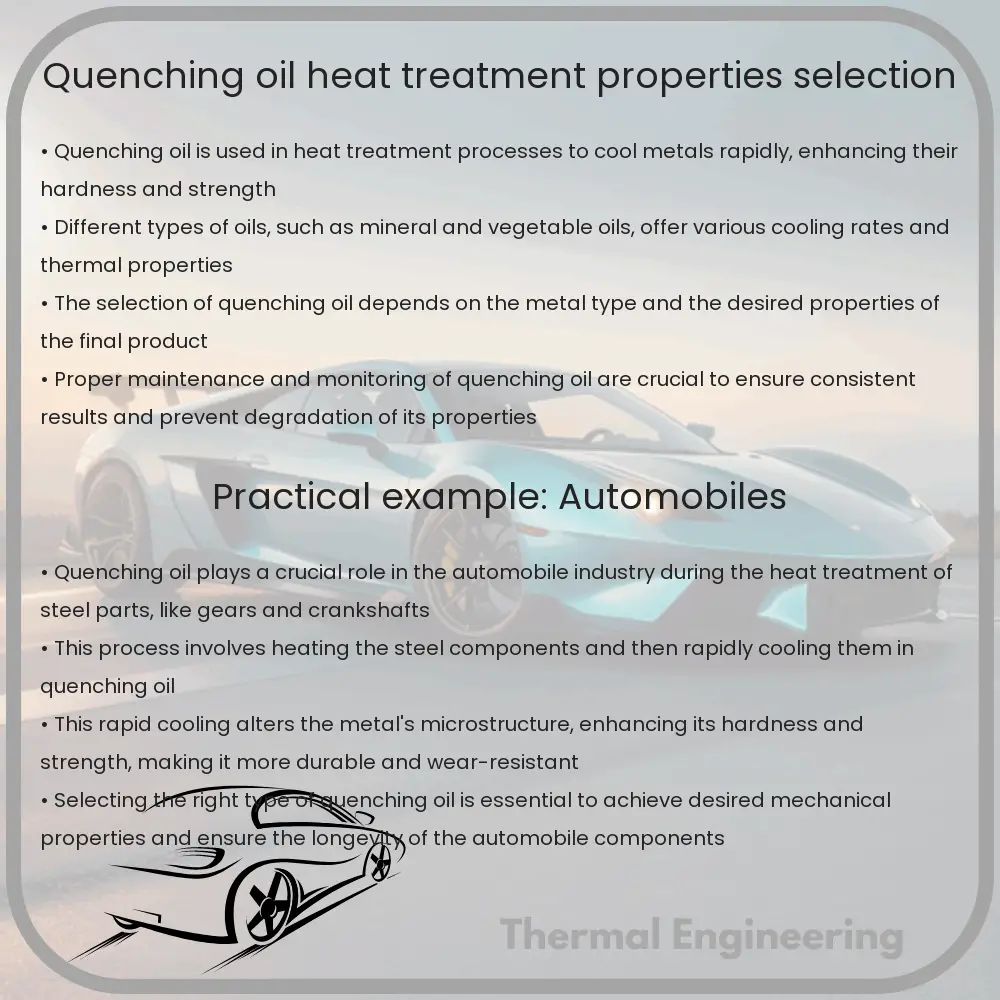
Quenching oil plays a vital role in the heat treatment of metals, a process commonly employed to alter the physical and sometimes chemical properties of a material. This method is mainly used to increase the hardness and strength of metal alloys such as steel, by heating to a specific temperature and then rapidly cooling it in a quenching medium.

Understanding the Quenching Process

During heat treatment, the quenching step follows the heating and soaking phases. The metal is rapidly cooled using various media, including water, air, or oil. Quenching oil is particularly important for controlling the cooling rate and minimizing distortions and stresses in complex components.

Properties of Quenching Oils

Quenching oils are selected based on properties that influence their performance, including:

  • Viscosity: The viscosity of the oil affects heat transfer efficiency. Oils with the right viscosity facilitate adequate cooling rates and reduce the formation of vapors, which can cause uneven cooling.
  • Flash Point: This is the temperature at which the oil emits enough vapor to ignite in air. Higher flash points increase safety in heat treating operations.
  • Wetting Ability: Good wetting properties ensure the oil comes into better contact with the metal surface, allowing for more efficient cooling.
  • Thermal Stability: A thermally stable quenching oil can withstand high temperatures without breaking down, maintaining performance across repeated cycles.

Types of Quenching Oils

There are several types of quenching oils available, each suited to specific types of metals and desired outcomes:

  • Mineral Oils: These are petroleum-based and are commonly used due to their good oxidative stability and low cost.
  • Synthetic Oils: Typically used for higher temperature applications, they offer cleaner operations and longer life, though at a higher cost.
  • Vegetable Oils: These are an environmentally friendly alternative, offering fast cooling rates comparable to mineral oils.

Selection Criteria for Quenching Oils

Selecting the right quenching oil requires considering various factors to achieve the desired metal properties:

  1. Compatibility: The quenching oil should be compatible with the metal type and the specific heat treatment process.
  2. Cooling Rate: Different metals and desired hardness levels require specific cooling rates, which should match the oil’s cooling characteristics.
  3. Volume and Throughput: The amount of metal being quenched and the speed of the process should be supported by the oil’s capacity to dissipate heat.
  4. Operational Safety: High flash point oils are preferable to minimize the risk of fire in operational settings.
  5. Environmental and Health Considerations: Non-toxic, biodegradable oils may be required depending on regulations and workplace safety standards.

Conclusion

Quenching oil is crucial for achieving the desired mechanical properties in heat-treated metals. Understanding its properties, types, and selection criteria allows engineers to optimize the outcomes of their heat treatment processes, ensuring components meet the required specifications while maintaining safety and efficiency.

Gear Oil | Lubrication, Viscosity & Gear Protection

Learn about gear oil, its crucial role in lubricating gears, reducing friction, and enhancing machinery efficiency across various industries.

Gear Oil | Lubrication, Viscosity & Gear Protection

Introduction to Gear Oil

Gear oil is a crucial component in any mechanical system involving gears. It is used to lubricate gears, which helps in reducing friction and wear between them, ultimately enhancing the longevity and efficiency of the entire machine. Understanding the properties of gear oil, such as its lubrication abilities, viscosity, and how it protects gears, is essential for ensuring optimal performance of machinery in various fields, including automotive, industrial, and aviation sectors.

Lubrication Mechanism of Gear Oil

Lubrication in gear systems serves to create a thin film between the contact surfaces of the gears. This film reduces direct metal-to-metal contact, minimizing friction and wear. Gear oil accomplishes this through several key properties:

  • Adhesion: Gear oil is formulated to cling to metal surfaces, ensuring a consistent lubrication layer even under high temperatures and pressures.
  • Load Carrying Capacity: High pressure additives in gear oils form protective layers on the gear surfaces to bear the excessive loads without causing damage to the gears.
  • Heat Dissipation: By absorbing and dissipating the heat generated from friction, gear oil helps in maintaining an optimal operating temperature in the gear system.

Viscosity of Gear Oil

Viscosity is arguably the most important characteristic of gear oil. It refers to the thickness of the oil and its resistance to flow, which can significantly affect the lubrication quality and energy efficiency of the gear system. The viscosity of gear oil is selected based on factors like operating temperature, gear type, load, and speed. Typically, high viscosity oils are used for high load and low-speed conditions, whereas low viscosity oils are suitable for high speed and lower load applications.

Gear Protection and Gear Oil

Gear oils are enhanced with various additives to protect gears from various types of wear and damage:

  • Anti-wear Additives: These additives form a protective film on gear surfaces to prevent wear from high loads and shocks.
  • Extreme Pressure (EP) Additives: Containing compounds like sulfur-phosphorus, these additives provide additional protection under extreme pressure conditions, preventing metal-to-metal contact and subsequent damage.
  • Corrosion Inhibitors: Gear oils contain inhibitors that protect against rust and corrosion, especially in harsh environmental conditions.
  • Oxidation Stabilizers: These help in extending the life of the oil by preventing it from breaking down under high temperatures.

Choosing the Right Gear Oil

Selecting the appropriate gear oil requires understanding the specific needs of your gear system. Factors to consider include:

  • Operating Conditions: Temperature, load, and speed influence the viscosity and additive requirement.
  • Gear Type: Different types of gears like spur, helical, or planetary might need different oils.
  • Manufacturer’s Specifications: Always check the equipment manufacturer’s recommendations for compatible oil types and viscosity grades.

In conclusion, proper selection and maintenance of gear oil are essential for the performance and durability of gear systems. Understanding its properties like viscosity and the role of additives can lead to better maintenance practices and machinery efficiency.

Coolant Fluid | Engine Cooling, Types & Maintenance

Learn about the crucial role of coolant fluid in maintaining optimal engine temperature, exploring its types, functions, and maintenance.

Coolant Fluid | Engine Cooling, Types & Maintenance

Understanding Coolant Fluid: Essential for Engine Cooling

Keeping an engine operating at an optimal temperature is crucial for maintaining its efficiency and longevity. The primary fluid responsible for this is known as coolant or antifreeze. Coolant fluid plays a critical role in engine cooling systems by absorbing heat from the engine and dissipating it through the radiator. In this article, we will explore the types of coolants, their importance, and maintenance practices.

Types of Coolant Fluids

Coolant fluids are typically a mixture of water and antifreeze compounds. There are several types of antifreeze, each with distinct characteristics and advantages:

  • IAT (Inorganic Acid Technology): One of the oldest types of antifreeze, IAT contains inorganic acids and silicates. This coolant is usually green and needs to be changed more frequently, about every 2 years or 24,000 miles.
  • OAT (Organic Acid Technology): OAT coolants use organic acids and are generally more robust in terms of corrosion protection, allowing them to last longer. These are often colored orange or yellow and can last up to 5 years or 150,000 miles before requiring a change.
  • HOAT (Hybrid Organic Acid Technology): Combining the best of IAT and OAT, HOAT coolants offer excellent protection against corrosion and have an extended life, typically changing every 5 years or 150,000 miles. They may be colored differently, such as yellow, turquoise, pink, or blue, depending on the manufacturer.
  • Si-OAT (Silicated Organic Acid Technology): A variation on HOAT that includes silicates for added aluminum protection, commonly used in European vehicles.

Importance of Coolant in Engine Cooling

The primary task of coolant fluid is to transfer heat and prevent the engine from overheating. However, its responsibilities extend beyond just temperature regulation:

  • Corrosion Prevention: Coolants are formulated with additives that protect the engine and cooling system components from corrosion and scaling.
  • Boil-over Protection: Increasing the boiling point of the liquid, antifreeze helps prevent the engine from boiling over, especially under high-stress or high-temperature conditions.
  • Freeze Protection: In colder climates, the antifreeze properties of coolant prevent the fluid from freezing, which could otherwise lead to catastrophic engine damage.

Maintenance of Cooling System and Coolant Fluid

Maintaining the coolant fluid and the entire cooling system is vital for engine health. Here are some key maintenance tips:

  • Regular Checks: Regularly check the coolant level and top up if necessary. It’s important to ensure that the system is not leaking.
  • Flush and Replace: Follow the manufacturer’s guidelines on when to replace the coolant. Generally, flushing and replacing the coolant every 30,000 to 50,000 miles is recommended.
  • Use the Correct Type: Always use the type of coolant recommended by your vehicle’s manufacturer. Mixing different types of coolant can lead to reduced effectiveness and potential engine damage.

By understanding different types of coolants, their functions, and proper maintenance practices, you can significantly enhance the efficiency and lifespan of your vehicle’s engine. Ensure to check and replace the coolant periodically to keep the engine running smoothly and prevent overheating.

Transformer Oil | Electrical Insulation & Cooling Uses

Learn about transformer oil, also known as insulating oil, essential for electrical insulation and cooling in transformers.

Transformer Oil | Electrical Insulation & Cooling Uses

What is Transformer Oil?

Transformer oil, also known as insulating oil, is a crucial component in most electrical transformers. Its primary roles are to provide electrical insulation and to serve as a coolant to dissipate heat generated within transformers. Transformer oils are primarily mineral oil-based but can also be made from synthetic or natural esters.

Properties of Transformer Oil

The effectiveness of transformer oil depends on several key properties:

  • Electrical Insulation: High dielectric strength is essential to prevent any unwanted current flow between conducting parts.
  • Thermal Conductivity: Good thermal conductivity is vital for efficiently transferring heat away from the transformer’s core and windings.
  • Chemical Stability: Resistance to oxidation and degradation ensures that the oil maintains its properties over time.
  • High Flash Point: A high flash point reduces the risks of fire and explosions under high temperature conditions.

Role of Transformer Oil in Electrical Insulation

One of the primary uses of transformer oil is to enhance the electrical insulation of power transformers. By filling up the spaces between the internal parts of the transformer, the oil minimizes the occurrence of corona discharge and arc formation. Dielectric strength, which is the maximum electric field that the oil can withstand without breaking down, is a critical factor here. It’s typically measured in kV/mm (kilovolts per millimeter).

Cooling Function of Transformer Oil

In addition to its insulation properties, transformer oil plays a critical role in the cooling process of transformers. Transformers generate significant amounts of heat during operation, and controlling this heat is crucial for performance and longevity. The oil circulates within the transformer, absorbs the heat produced by the core and coils, and transfers it to the radiator where it is dissipated into the surrounding environment.

Types of Transformer Oil

There are several types of transformer oils used in the industry today:

  • Mineral Oil: Most commonly used transformer oil, derived from refining crude oil.
  • Synthetic Oils: Manufactured chemically and tend to have better oxidation resistance and lower environmental impact.
  • Bio-based Oils: Derived from vegetable oils, these are biodegradable and environmentally friendly but may have lower oxidative stability.

Maintenance and Testing

Regular maintenance and testing of transformer oil are essential for ensuring the health and efficiency of transformers. Tests include:

  • Dissolved Gas Analysis (DGA): Helps detect gases produced by decomposition, indicating potential issues like overheating or arcing.
  • Dielectric Breakdown Voltage: Measures the voltage at which the oil loses its insulating properties.
  • Water Content: Excess water can reduce the insulating properties of the oil and promote corrosion.
  • Acidity Test: Determines the level of acids in the oil, which can indicate oxidation and degradation.

Conclusion

Transformer oil is a vital component in the operation and maintenance of many types of electrical transformers. Its role in electrical insulation and cooling ensures that transformers run smoothly and efficiently. With proper maintenance, testing, and management, transformer oil can help extend the lifespan and enhance the performance of electrical transformers.

Cutting Fluid | Metalworking, Lubrication & Types

Learn about the essential role and types of cutting fluids in metalworking, their functions, selection criteria, and environmental impacts.

Cutting Fluid | Metalworking, Lubrication & Types

Understanding Cutting Fluids in Metalworking

Cutting fluids are vital in the metalworking industry, primarily used to cool and lubricate cutting tools and the workpieces they shape. This not only extends the tool’s life but also improves the finishing of the metal, while reducing the overall thermal and mechanical wear during the machining process.

Functions of Cutting Fluids

Cutting fluids perform several critical functions:

  1. Lubrication: They reduce the friction between the cutting tool and the workpiece, minimizing tool wear and energy consumed in the cutting process.
  2. Cooling: They help in dissipating the heat generated during the cutting process, protecting both the machine tool and the workpiece from thermal damage.
  3. Chip Removal: As a coolant, cutting fluids help in flushing away the chips from the cutting area, thus preventing re-cutting of chips, which can degrade the surface finish.
  4. Corrosion Prevention: Many cutting fluids have anti-rust properties that protect both the workpiece and the machine from corrosion.

Types of Cutting Fluids

There are several categories of cutting fluids, each designed for specific types of operations and metals:

  • Soluble Oils: These emulsify in water and are typically used in dilutions with large quantities of water. This type of fluid is versatile, economical, and provides good cooling properties.
  • Synthetic Fluids: Made from chemical compounds that do not contain oils, synthetics offer excellent cooling capabilities and are less likely to cause skin irritations. They are often used in high-speed machining operations.
  • Semi-Synthetics: A blend of soluble oils and synthetic fluids, semi-synthetics provide a balance between lubrication and cooling, suitable for a diverse range of machining operations.
  • Straight Oils: Used undiluted, these are non-emulsifiable and are composed mainly of mineral or vegetable oils, often with additives to enhance performance. Ideal for heavy-duty machining, straight oils provide superior lubrication but lesser cooling capabilities.

Selection Criteria for Cutting Fluids

Choosing the right cutting fluid depends on several factors:

  • Type of material being machined: Different materials have different compatibility and requirements. For example, aluminum may react with certain coolants, whereas stainless steel might require fluids with excellent lubricity.
  • Machining operation: The complexity and severity of the operation influence fluid selection. For instance, grinding might need different fluid properties compared to turning or milling.
  • Environmental and health impact: Modern practices lean towards the use of eco-friendly and less hazardous fluids to reduce environmental impact and safeguard operator health.
  • Economic factor: The overall cost, including the initial price, maintenance, and disposal, must be considered.

Environmental Considerations and Trends

Environmental sustainability in metalworking fluids is becoming increasingly important. The industry trends are leaning toward formulations that are free from harmful chemicals such as chlorinated paraffins and phenols. Furthermore, advances in technology are producing biodegradable and less toxic cutting fluids, aimed at not only protecting the environment but also improving workplace health standards.

In conclusion, the appropriate selection and management of cutting fluids is crucial in metalworking for optimized operational efficiency, cost management, and minimal environmental footprint. As technologies evolve, so too do the formulations of these essential fluids, accommodating a wide array of metalworking applications while aiming for sustainability.

Hydraulic Fluid | High Pressure Resistance & Applications

Learn about the key roles of hydraulic fluid in high-pressure systems, including its science-backed properties and diverse industrial applications.

Hydraulic Fluid | High Pressure Resistance & Applications

Understanding Hydraulic Fluid: High Pressure Resistance and Applications

Hydraulic fluid is the lifeblood of many mechanical systems. It plays a crucial role in the operation of hydraulic machinery by transferring power through pressure. Here, we will explore the science behind hydraulic fluid’s high-pressure resistance and its real-world applications.

The Science Behind High Pressure Resistance

Hydraulic fluids are specially formulated to withstand extreme pressures while maintaining consistent performance. The ability to resist high pressure is a result of their incompressible nature and viscosity. Viscosity, measured in centistokes (cSt), is essentially the thickness of a fluid. A higher viscosity implies a thicker fluid, which helps in maintaining film strength under high pressure, reducing wear and tear on hydraulic components.

  • Incompressibility: Ideal hydraulic fluids are virtually incompressible, even under significant pressure. This property ensures efficient power transfer and precise control of the hydraulic system.
  • Viscosity: The viscosity must be balanced to provide both lubrication and efficient fluid flow. Hydraulic fluids are selected based on their viscosity index (VI), which indicates their change in viscosity with temperature.
  • Additives: Additives play a pivotal role in enhancing the properties of hydraulic fluids. Anti-wear additives, corrosion inhibitors, and antioxidants help in maintaining fluid integrity and system health even under high pressures.

Common Applications of High-Pressure Hydraulic Fluids

Hydraulic systems that operate under high pressure are integral to a variety of industrial, automotive, and aerospace applications:

  1. Manufacturing Machinery: Hydraulic presses, injection molding machines, and metal extrusion equipment all rely on hydraulic fluids to exert tremendous force smoothly and consistently.
  2. Automotive Systems: In automotive engineering, brake systems and clutch mechanisms use hydraulic fluids to ensure reliable, immediate response to driver inputs.
  3. Construction Equipment: Heavy-duty vehicles such as excavators, bulldozers, and cranes use hydraulic systems to perform lifting and digging operations that require massive amounts of force.
  4. Aerospace: In the aerospace industry, hydraulic systems control the operation of aircraft components such as landing gear, flaps, and brakes. These systems must work under extreme conditions and pressures flawlessly.

In conclusion, hydraulic fluid’s ability to resist high pressure is crucial for the efficient operation of various mechanical systems across industries. By understanding the properties that contribute to its performance, engineers can better design and maintain hydraulic systems that are both effective and reliable. Continuing advancements in fluid technology and additive chemistry are expected to further enhance the capabilities of hydraulic fluids, supporting even more demanding applications in the future.

Thermal Fluid | Heat Transfer, Efficiency & Uses

Learn about thermal fluids, their roles in heat transfer processes, and their efficiency and applications in various industries.

Thermal Fluid | Heat Transfer, Efficiency & Uses

Understanding Thermal Fluids: Heat Transfer, Efficiency, and Uses

Thermal fluids, also known as heat transfer fluids, play a crucial role in transferring heat in a wide range of industrial processes. These fluids help in maintaining temperature by absorbing, transporting, and releasing heat in systems designed for thermal processing. The efficiency of heat transfer, the properties of thermal fluids, and their applications are fundamental in engineering fields ranging from chemical manufacturing to renewable energy systems.

The Basics of Heat Transfer with Thermal Fluids

The primary function of thermal fluids is to facilitate the movement of heat without requiring the fluid itself to undergo a phase change (from liquid to gas or vice versa). This characteristic minimizes the energy loss and maximizes efficiency in thermal systems. Heat transfer with thermal fluids can occur through three primary mechanisms: conduction, convection, and radiation.

  • Conduction: This is the process of heat transfer through direct molecular contact. Heat is transferred from the hotter part of the fluid to a cooler part without actual movement of the fluid particles.
  • Convection: In convection, the thermal fluid transfers heat as it moves. This movement can be caused by external forces (like a pump) or by natural convection due to density differences within the fluid caused by temperature gradients.
  • Radiation: Thermal radiation is the transfer of heat by electromagnetic waves. It can occur in thermal fluids when they are heated to high temperatures and can transfer heat even through empty space.

The rate of heat transfer in thermal fluids can be described mathematically by the equation:

Q = m * Cp * ΔT

where:

  • Q is the heat transferred (in Joules)
  • m is the mass flow rate of the fluid (in kilograms per second)
  • Cp is the specific heat capacity of the fluid (Joules per kilogram per degree Celsius)
  • ΔT is the temperature difference across the fluid system (in degrees Celsius)

Efficiency Considerations

Efficiency in the use of thermal fluids is primarily dependent on minimizing heat loss and maximizing the effective transfer of thermal energy. Key factors affecting efficiency include:

  • Thermal Conductivity: Fluids with higher thermal conductivity can transfer heat more efficiently.
  • Specific Heat Capacity: Fluids with a high specific heat capacity can store more thermal energy, leading to better regulation of system temperatures.
  • Viscosity: Lower viscosity generally promotes better heat transfer as it enhances the fluid’s ability to flow and convect heat.

Common Uses of Thermal Fluids

Thermal fluids are utilized in numerous applications where precise temperature control is necessary:

  1. Chemical Processing: Thermal fluids provide the necessary heat for chemical reactions and processing without contaminating the products.
  2. Plastics and Rubber Manufacturing: Used to control the heat in molds and presses.
  3. Power Generation: They play a critical role in both conventional and renewable power plants, including solar thermal and geothermal stations.
  4. Food and Beverage Industry: They are used for heating or cooling in the production and preservation processes.
  5. Pharmaceuticals: Precise temperature control critical in drug manufacture and formulation is maintained using heat transfer fluids.

The choice of a thermal fluid is dependent on the specific thermal properties required, the operational temperature range, the compatibility with system materials, and safety or environmental considerations.

In conclusion, thermal fluids are indispensable in industries where heat plays a critical role in processes. Understanding their properties and mechanisms helps optimize their use, leading to enhanced efficiency and effectiveness in thermal systems.

Brake Fluid | High Boiling Point, Safety & Types

Learn about the critical role of brake fluid in automotive safety, its required high boiling point, types like DOT 3, DOT 4, and others, and best practices for maintenance.

Brake Fluid | High Boiling Point, Safety & Types

Understanding the Importance of Brake Fluid in Automotive Safety

Brake fluid is a critical component of a vehicle’s braking system, playing a vital role in the overall safety and performance of the car. This fluid transfers the force created by a driver pressing the brake pedal directly onto the wheel hub, slowing or stopping the vehicle. This article explores why brake fluid must have a high boiling point, the implications for safety, and the common types of brake fluids used in vehicles.

Why Must Brake Fluid Have a High Boiling Point?

The braking process generates a substantial amount of heat due to friction between the brake pads and rotors. Brake fluid must withstand these high temperatures without boiling; otherwise, it can lead to brake failure. If the brake fluid boils, it produces vapor bubbles within the system, which are compressible unlike the fluid itself. This leads to a condition known as brake fade, where the brake pedal feels spongy, and the effectiveness of the braking system is significantly reduced.

Thus, a high boiling point is essential for maintaining the reliability and effectiveness of the brake system under all operating conditions, including heavy braking and high temperatures.

Types of Brake Fluid

Brake fluids are categorized into several types based on their chemical composition and boiling points:

  • DOT 3: Typically glycol-ether based and has a lower boiling point than other types. Its boiling points are around 205°C (401°F) dry and 140°C (284°F) wet.
  • DOT 4: Also glycol-ether based but contains borate esters for higher boiling points, typically around 230°C (446°F) dry and 155°C (311°F) wet.
  • DOT 5: Silicone-based, not hygroscopic (does not absorb moisture), with boiling points around 260°C (500°F) dry. However, it is not compatible with DOT 3 and DOT 4 systems.
  • DOT 5.1: Glycol-ether based like DOT 3 and DOT 4 but with higher performance specs, with boiling points about 270°C (518°F) dry and 190°C (374°F) wet.

Each type of brake fluid has distinct properties and suitability, depending on the vehicle’s requirements and the expected operating conditions.

Choosing the Right Brake Fluid

The selection of the right brake fluid depends on several factors including the vehicle type, the expected temperature range, and manufacturer recommendations. High-performance vehicles, which are more likely to experience extreme temperatures, typically require fluids like DOT 4 or DOT 5.1, which offer higher boiling points to prevent brake fading.

It is also critical to note that mixing different types of brake fluids can adversely affect their performance and may lead to brake system failure. Therefore, always check the vehicle’s owner manual or consult with a professional mechanic to ensure the correct type of brake fluid is used.

Safety Considerations and Maintenance

Regular maintenance of the brake system and periodic replacement of the brake fluid are crucial for safe driving. Over time, brake fluid absorbs moisture, which can lower its boiling point and reduce braking effectiveness. Most vehicle manufacturers recommend replacing brake fluid every 1 to 2 years, although this can vary based on the vehicle make and model, and driving conditions.

Ultimately, understanding the importance of brake fluid’s high boiling point and its types helps in choosing the right product that ensures maximum safety and longevity of your vehicle’s braking system.

Remember, maintaining your vehicle’s brake system and regularly checking the brake fluid can prevent potential failures and keep you safe on the road.

Liquid Fluorine | Rocket Fuel, High-Energy Applications

Understand the role of liquid fluorine as a powerful oxidizer in rocket fuels, emphasizing its energetic reactions and strict safety requirements.

Liquid Fluorine | Rocket Fuel, High-Energy Applications

Liquid Fluorine in Rocket Fuels and High-Energy Applications

Liquid fluorine stands out as a formidable player in the field of rocket propulsion and other high-energy applications. Its high electronegativity and reactivity make it an ideal oxidizer in rocket fuel formulations, particularly when seeking efficiency and power in space launch systems.

Properties of Liquid Fluorine

Liquid fluorine is a pale yellow corrosive fluid characterized by its vigorous reactivity and ability to release a large amount of energy upon combustion. At atmospheric pressure, fluorine becomes a liquid at approximately -188 degrees Celsius (-306.4 degrees Fahrenheit). Its chemical formula is F2.

As one of the most electronegative elements, fluorine has a unique ability to accept electrons from other elements, which is a desirable characteristic in rocketry where rapid and energetic reactions are necessary. Despite its powerful advantages, the handling of fluorine demands stringent safety protocols due to its high toxicity and reactivity with many materials, including glass and metals.

Use of Fluorine in Rocket Propellants

Fluorine’s role in rocket fuel is primarily as an oxidizer, a component which donates oxygen to allow the fuel (or propellant) to burn. In rocketry, a common setup might involve the combination of liquid fluorine with a hydrocarbon (like methane) or hydrogen. These combinations take advantage of fluorine’s ability to support quick, hot burns, leading to high thrust and efficiency—a crucial requirement for the immense energy needed to propel rockets into outer space.

  • Hydrogen/Fluorine (H2/F2) rockets produce a high specific impulse, indicating efficient fuel usage and thrust creation.
  • Methane/Fluorine (CH4/F2) rockets also demonstrate highly energetic reactions suitable for various launch applications.

Rockets using liquid fluorine are observed to have exhaust velocities up to 4,500 meters per second (14,764 feet per second), providing the high thrust necessary for launching heavy payloads or achieving fast accelerations.

Safety and Challenges

WARNING: Fluorine’s reactivity also poses significant safety risks.

Handling and storage of fluorine are critical challenges due to its aggressive reactivity with many common materials. Upon exposure to air, fluorine can spontaneously ignite, generating toxic and corrosive byproducts such as hydrofluoric acid. As such, special equipment made of materials like nickel or copper-nickel alloys, which can resist fluorine attack, are often employed in systems dealing with liquid fluorine.

The toxicity of fluorine demands rigorous safety protocols, including extensive containment and robust emergency procedures in the event of leakage. This high maintenance cost and operational complexity can deter its use, favoring less reactive, though sometimes less efficient, alternatives.

Applications Beyond Rocketry

Liquid fluorine, considering its high energy density, finds applications beyond rocket propulsion, including:

  1. Nuclear energy applications, where it acts as a fluoride in molten salt reactors (MSRs).
  2. Specialized chemical synthesis processes, making use of its ability to form compounds with nearly all other elements.

Despite its challenges, the compelling performance benefits keep liquid fluorine in the repertoire of materials considered for advanced propulsion technologies and other high-energy needs.

In summary, liquid fluorine is a key component in rocket propellants and other high-energy applications because of its incredible ability to release energy efficiently and rapidly. However, the challenges associated with handling and its toxic nature limit its use to contexts where its high energy release properties are essential, and safety measures can be stringently applied. The future of liquid fluorine in high-energy applications remains a subject of keen interest as technology evolves to better manage its risks and harness its formidable properties.

Liquid Phosphorus | Safety Matches, Fertilizers, and Pesticides Uses

Explore the critical role of liquid phosphorus in safety matches, fertilizers, and pesticides, highlighting its applications and safety measures.

Liquid Phosphorus | Safety Matches, Fertilizers, and Pesticides Uses

Understanding Liquid Phosphorus: Versatile Applications in Safety Matches, Fertilizers, and Pesticides

Phosphorus, a highly reactive non-metal, plays a crucial role in various industrial and agricultural applications. Notably, its liquid form is instrumental in the production of safety matches, fertilizers, and pesticides. This article explores how liquid phosphorus is utilized across these essential products, highlighting its importance and the safety measures needed when handling it.

Liquid Phosphorus in Safety Matches

Safety matches, which are an everyday essential in many households, rely heavily on phosphorus for their ignition. Traditionally, the strike-anywhere matches consisted of white phosphorus, which was later found to pose significant health risks. Modern safety matches have since adopted a safer approach, using red phosphorus located on the striking surface of the matchbook or box.

  • Match Composition: The matchstick typically contains an oxidizing agent like potassium chlorate, with red phosphorus and powdered glass on the striking surface. When the match is struck, the friction and heat convert a small amount of red phosphorus to white phosphorus vapor. This, in its highly reactive form, ignites the potassium chlorate, producing the flame.
  • Safety Concerns: By isolating phosphorus on the striking surface and converting it away from its more dangerous white form, modern safety matches are significantly safer to use, reducing the risk of accidental ignition or health hazards from phosphorus exposure.

Liquid Phosphorus in Fertilizers

Phosphorus is also a key nutrient in agricultural fertilizers, vital for plant growth and development. In fertilizers, phosphorus is often used in a liquid form, which allows for more precise application and rapid absorption by plants.

  • Phosphorus Role in Plants: It is a component of DNA, RNA, ATP (adenosine triphosphate), and phospholipids. Phosphorus supports energy transfer within plants, improving growth and overall health.
  • Application: Liquid phosphorus fertilizers are applied directly to the soil or foliage. This method helps to reduce wastage and environmental runoff compared to granular fertilizers, promoting more sustainable farming practices.

Liquid Phosphorus in Pesticides

Phosphorus-based compounds are also prevalent in pesticides, including insecticides and herbicides. These pesticides often employ phosphorus in a liquid form to enhance the efficacy and manageability of the applications.

  • Pesticides Function: Phosphorus-containing pesticides generally work by disrupting the energy pathways or the nervous systems of pests, proving effective against a wide range of agricultural pests and invasive species.
  • Safety Precautions: While phosphorus-based pesticides are effective, they must be handled with care. Exposure to these chemicals can be hazardous to human health and the environment, necessitating strict adherence to usage guidelines and protective measures during application.

Conclusion

Liquid phosphorus serves as a versatile component in safety matches, fertilizers, and pesticides, each playing distinct roles that leverage the unique properties of phosphorus. While the benefits of liquid phosphorus are clear, it is fundamental for users to adhere to safety protocols to minimize any risks associated with its use. Through responsible management and application, liquid phosphorus continues to contribute significantly to modern conveniences and agricultural productivity.