Facebook Instagram Youtube Twitter

Advanced thermal sensors for IoT

Explore the role of advanced thermal sensors in enhancing IoT applications through improved monitoring and energy management.

Advanced thermal sensors for IoT

Advanced Thermal Sensors for IoT

The integration of advanced thermal sensors into the Internet of Things (IoT) represents a significant step forward in our ability to monitor and control environmental conditions in a myriad of applications. From smart homes to industrial automation, the precision and efficiency provided by these sensors play a crucial role in enhancing system functionalities and improving energy management.

Understanding Thermal Sensors

Thermal sensors, devices that detect temperature changes and convert them into data, are vital in monitoring the ambient temperature, object temperature, or both. There are primarily two types of thermal sensors used in IoT: contact sensors, such as thermocouples and thermistors, and non-contact sensors, like infrared sensors.

  • Thermocouples: These are types of contact sensors that measure temperature based on the voltage generated at the junction of two different metals when exposed to heat.
  • Thermistors: Another type of contact sensor, which varies its resistance with temperature. Useful for precise temperature measurements over a smaller range.
  • Infrared Sensors: Non-contact sensors that detect infrared radiation to infer the temperature of an object’s surface. They are ideal for moving or inaccessible objects.

Technological Enhancements in IoT Thermal Sensors

Recent advancements in sensor technology have significantly boosted the performance of thermal sensors in IoT applications. These enhancements include:

  • Miniaturization: Smaller sensors are being developed, which are more energy-efficient and less intrusive within the environment they monitor.
  • Increased Sensitivity and Accuracy: New materials and designs have improved the sensitivity and accuracy of thermal sensors, enabling them to detect smaller changes in temperature.
  • Better Integration: Modern thermal sensors are easier to integrate with other IoT components due to standardized communication protocols and interfaces.
  • Improved Energy Efficiency: Advances in materials science have led to sensors that require less power, thus extending the lifetime of battery-powered devices.

Applications of Thermal Sensors in IoT

Thermal sensors are used in a diverse range of IoT applications, each benefiting from the unique attributes of these devices:

  • Smart Homes: In residential settings, thermal sensors are used to optimize heating and cooling systems, contributing to energy savings and improved home comfort.
  • Healthcare: Wearable devices equipped with thermal sensors monitor body temperature continuously, providing critical data for healthcare providers.
  • Industrial Automation: In factories, thermal sensors help monitor machine health, by detecting overheating parts that could lead to failures, thus predicting maintenance needs.
  • Environmental Monitoring: These sensors are used in weather stations, oceanography, and wildlife studies to collect data on environmental temperatures.

Future Trends

The future of thermal sensors in IoT looks promising with ongoing developments geared towards higher accuracy, integration capabilities, and intelligence. The trend is moving towards smarter sensors equipped with built-in processing capabilities that can perform data analysis at the sensor level to provide real-time insights.

Such advancements are paving the way for more autonomous and efficient systems, which can predict and react autonomously to changing environmental conditions, making technologies not just responsive but truly adaptive.

As IoT continues to evolve, the role of advanced thermal sensors as critical components in both everyday and industrial applications is set to grow, shaping the future of smart environments and intelligent systems management.

3 Types of Eccentric Disc Pumps for Gentle Fluid Handling

Learn about eccentric disc pumps, ideal for gentle fluid handling in food, pharmaceuticals, and cosmetics industries.

3 Types of Eccentric Disc Pumps for Gentle Fluid Handling

Understanding Eccentric Disc Pumps for Gentle Fluid Handling

Eccentric disc pumps, also known as rotary disc pumps, are a type of positive displacement pump known for their ability to handle fluids gently, making them highly suitable for industries like food, pharmaceuticals, and cosmetics. These pumps are designed to minimize shear and agitation, thus preserving the integrity of delicate fluids and ingredients. Here, we’ll explore three common types of eccentric disc pumps and discuss their specific applications and benefits.

1. Single-End Eccentric Disc Pumps

Single-end eccentric disc pumps consist of a single rotating disc mounted eccentrically (off-center) within a cylindrical casing. As the disc rotates, it generates chambers of varying volumes that sequentially fill and empty, moving the fluid through the pump. This type of pump is highly effective for handling low to medium viscosity fluids and is prized for its efficiency and simplicity.

  • Low Shear Operation: The gentle handling is ideal for fluids that are sensitive to agitation.
  • Self-priming: These pumps can handle varying suction conditions, making them versatile for different setups.
  • Hygienic Design: Often constructed from stainless steel, they are easy to clean and maintain, adhering to sanitary standards required in food and pharmaceutical industries.

2. Double-End Eccentric Disc Pumps

Double-end eccentric disc pumps feature two sets of discs and cylinders, opposed and synchronized. This design balances the forces exerted by the rotating discs, leading to smoother and more stable pump operation with less vibration. This type is particularly beneficial for higher capacity and pressure applications.

  • Enhanced Stability: The balanced design reduces stress on pump components, extending the operational lifespan.
  • Increased Flow Rate: The dual chambers double the flow rate compared to single-end pumps under similar conditions.
  • Reduced Vibration: Balancing the mechanical forces allows these pumps to operate more quietly and with reduced vibration, a critical factor in sensitive manufacturing environments.

3. Seal-less Magnetic Drive Eccentric Disc Pumps

Seal-less magnetic drive eccentric disc pumps combine the benefits of eccentric disc pump technology with a magnetic coupling that replaces the traditional mechanical seal. This design eliminates the risk of leaks, which is crucial when handling hazardous or highly valuable fluids.

  • Leak-Free Operation: The magnetic drive ensures that there is no direct connection between the motor shaft and the pump’s internals, preventing leaks.
  • Corrosion Resistant: Often built with corrosion-resistant materials, these pumps can handle aggressive chemicals without degradation.
  • Low Maintenance: The absence of seals reduces the need for frequent maintenance and replacements.

In conclusion, the type of eccentric disc pump selected often depends on specific application needs such as the nature of the fluid, required hygiene levels, and flow rate needs. Industries dealing with delicate or valuable fluids find these pumps particularly effective for maintaining the quality and integrity of their products during processing and handling.

Applications Across Industries

Eccentric disc pumps are used across a variety of fields, reflecting their versatility and ability to meet specific needs of different industries:

  1. Food and Beverage: Handling syrups, sauces, and other viscous ingredients gently to preserve flavor and texture.
  2. Pharmaceuticals: Transporting active pharmaceutical ingredients (APIs) without degradation or loss of efficacy.
  3. Cosmetics: Managing lotions and creams with consistent care to maintain homogeneity and product quality.

By choosing the appropriate eccentric disc pump type, industries can significantly boost their production efficiency while ensuring the highest quality of their products.

5 Types of Ion Thrusters for Spacecraft Propulsion

Learn about ion thrusters, advanced space propulsion systems using electric fields to ionize and accelerate propellants, enhancing fuel efficiency for long missions.

5 Types of Ion Thrusters for Spacecraft Propulsion

Introduction to Ion Thrusters

Ion thrusters represent a revolutionary shift in propulsion technology for space exploration. Unlike conventional chemical rockets that burn fuel, ion thrusters use electricity to ionize a propellant like xenon, producing charged particles. These ions are then accelerated by electric fields to create thrust. The result is a highly efficient, albeit low-thrust, engine perfect for long-duration missions in outer space where fuel economy is critical.

Types of Ion Thrusters

Several types of ion thrusters have been developed, each incorporating unique mechanisms to generate and utilize ions for propulsion. Here, we explore five significant types:

  • Electrostatic Ion Thrusters
  • Electromagnetic Ion Thrusters
  • Electrothermal Ion Thrusters
  • Field Emission Electric Propulsion (FEEP)
  • Colloid Ion Thrusters

1. Electrostatic Ion Thrusters

Electrostatic ion thrusters, also known as gridded ion thrusters, are the most common type. They work by ionizing a noble gas (usually xenon) and using a series of grids with high voltage to accelerate the ions. The thrust is generated as the ions are expelled at high velocities, up to 90,000 m/s. The NASA Dawn spacecraft utilized this technology to explore Vesta and Ceres in the asteroid belt.

2. Electromagnetic Ion Thrusters

Also known as Hall Effect Thrusters (HET), these devices leverage an electromagnetic field to ionize propellant and accelerate ions. A magnetic field perpendicular to the electric field traps electrons, which then collide with the propellant atoms to ionize them. The ions are then pushed out by the electric field, creating thrust. Hall thrusters are known for their relatively high thrust efficiency and have been used in various satellites and interplanetary missions.

3. Electrothermal Ion Thrusters

Electrothermal thrusters, such as the Resistojet, operate by electrically heating the propellant to increase its thermal energy, thus creating higher exhaust velocities when expelled through a nozzle. While not strictly ion thrusters as the others, they are sometimes grouped under the same category due to their use of electrical power and similar applications in space propulsion.

4. Field Emission Electric Propulsion (FEEP)

FEEP thrusters are a form of micro-propulsion that utilizes the field emission properties of liquid metal (typically cesium or indium) to generate ions. A high electric field at a sharp emitter tip induces ionization and field emission, producing a pure ion beam for propulsion. Due to their ability to provide very precise thrust levels, FEEPs are ideal for small satellite attitude control and formation flying.

5. Colloid Ion Thrusters

Colloid thrusters use a colloidal solution (typically a suspension of charged nanoscale particles) expelled through an emitter. By applying a high voltage, these particles are ionized and accelerated, providing thrust. Similar to FEEP, colloid thrusters offer highly fine control of thrust and are primarily used for precise maneuvering of small spacecraft.

Conclusion

Ion thrusters are a cornerstone of modern spacecraft propulsion, offering longer mission durations and reduced fuel needs compared to traditional rocket technology. With the variety of types available, scientists and engineers can select a propulsion system best suited to a specific mission’s requirements, paving the way for more ambitious exploration of our solar system and beyond.

10 Types of Plunger Pumps for High Pressure Cleaning

Learn about the types and uses of plunger pumps in high pressure cleaning applications across various industries.

10 Types of Plunger Pumps for High Pressure Cleaning

Introduction to Plunger Pumps in High Pressure Cleaning

Plunger pumps, often used in high pressure cleaning applications, play a crucial role in various industries, including automotive, construction, and manufacturing. Known for their ability to generate high pressure, these pumps facilitate effective cleaning by removing dirt, grime, and other contaminants from surfaces. In this article, we explore ten types of plunger pumps commonly used for high pressure cleaning tasks.

1. Triplex Plunger Pumps

Triplex plunger pumps have three plungers, making them a popular choice due to their balanced and smooth flow of water. They provide a consistent and high-pressure output, ideal for heavy-duty cleaning tasks in industrial settings.

2. Duplex Plunger Pumps

Duplex plunger pumps contain two plungers. These pumps offer a reliable pressure output with a slightly less smooth flow compared to triplex pumps but are more efficient than single plunger pumps, making them suitable for medium-duty cleaning applications.

3. Quintuplex Plunger Pumps

Quintuplex plunger pumps feature five plungers, which further smoothens the flow and increases the pressure consistency. They are used in applications requiring very high pressure and an extremely steady flow, such as in oil and gas industries.

4. Stainless Steel Plunger Pumps

Stainless steel plunger pumps are highly resistant to corrosion and wear, making them ideal for handling harsh chemicals or saltwater in cleaning processes. Their durability ensures long-term performance in challenging environments.

5. Brass Plunger Pumps

Brass plunger pumps are commonly used for less aggressive cleaning tasks. Brass has natural corrosion-resistant properties but is softer than stainless steel, making these pumps suitable for applications where chemical aggressiveness is moderate.

6. Direct Drive Plunger Pumps

Direct drive plunger pumps connect directly to the motor or engine, reducing the complexity of the system and minimizing power loss. This type ensures a compact design and is favored for portable cleaning systems.

7. Belt Drive Plunger Pumps

Belt drive plunger pumps use a belt-and-pulley system to connect the motor and the pump, which helps isolate them from the heat and vibration produced by the engine. This type is preferred for prolonged operations as it enhances the durability of the pump.

8. Variable Pressure Plunger Pumps

Variable pressure plunger pumps allow the operator to adjust the pressure output according to the cleaning requirement. This flexibility makes them particularly useful in applications where different materials or contamination levels are encountered.

9. High-Temperature Plunger Pumps

High-temperature plunger pumps are designed to handle hot water, making them ideal for cleaning tasks that require sanitization or the removal of grease and oil, which can be more effectively dissolved at higher temperatures.

10. Explosion-Proof Plunger Pumps

Explosion-proof plunger pumps are engineered to operate in potentially explosive environments by preventing any internal or external sparks. These are essential in industries like petrochemicals, where flammable substances are prevalent.

Conclusion

Plunger pumps for high pressure cleaning come in various designs and materials to suit different industrial needs. Choosing the right plunger pump depends on factors such as the nature of the cleaning task, the type of contaminants, the required pressure, and environmental conditions. With the right plunger pump, businesses can enhance their cleaning efficiency and ensure the longevity of their equipment.

9 Types of Darrieus Wind Turbines for Efficient Energy Capture

Learn about Darrieus wind turbines, vertical axis turbines effective in various wind conditions, suitable for urban and residential use.

9 Types of Darrieus Wind Turbines for Efficient Energy Capture

Understanding Darrieus Wind Turbines: 9 Variants for Efficient Energy Capture

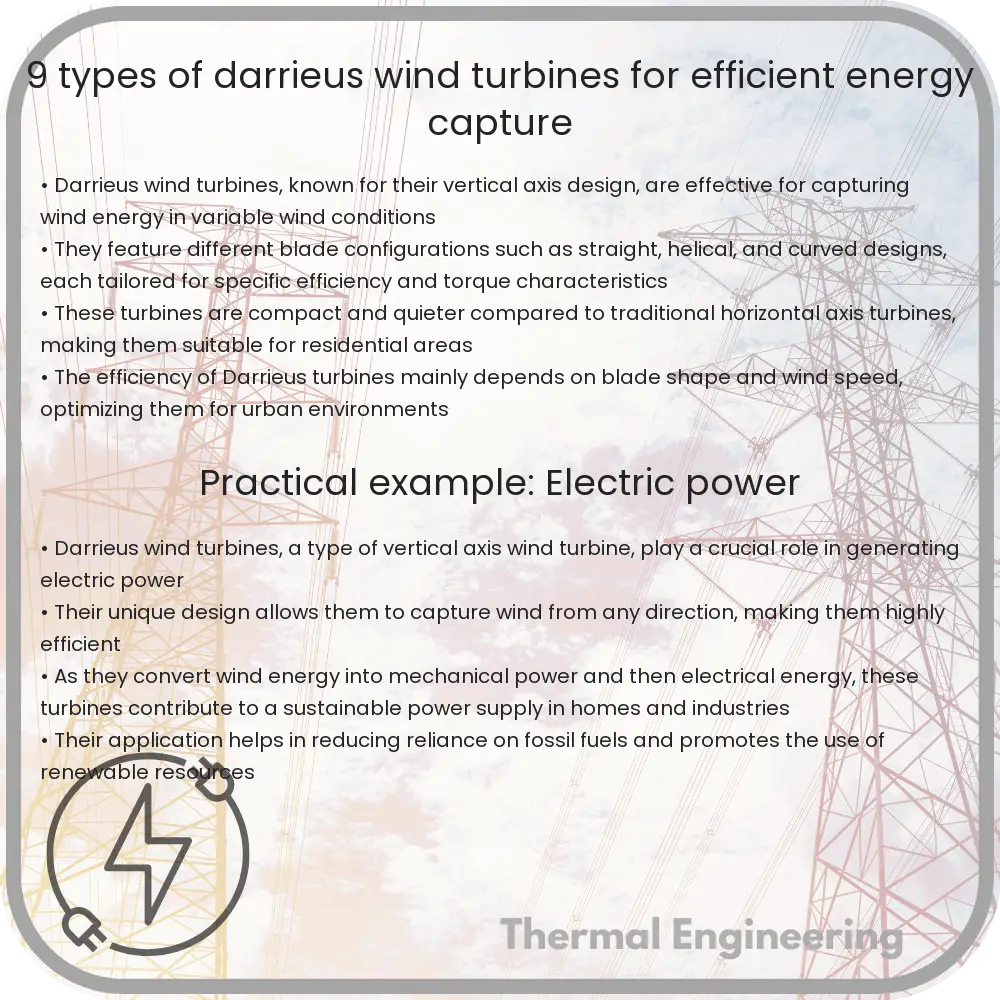
Darrieus wind turbines, named after the French engineer Georges Darrieus who patented the design in 1931, are a type of vertical axis wind turbine (VAWT) known for their ability to capture wind energy from any direction. Unlike the more common horizontal axis wind turbines (HAWTs), Darrieus types do not need to be oriented toward the wind to be effective. This characteristic combined with a lower noise profile and ground-level gearbox and generator makes Darrieus turbines particularly suitable for residential and urban environments. Here we explore nine different types of Darrieus wind turbines that highlight the versatility and innovation in vertical axis wind turbine technology.

Variants of Darrieus Wind Turbines

  • Classic Darrieus Turbine: Often called the “eggbeater” turbine due to its distinct vertical blades that resemble an eggbeater, this classical form of the Darrieus design comprises curved blades that connect at both the top and bottom of a vertical rotor.
  • Giromill: A subtype of the classic Darrieus, the Giromill features straight, instead of curved, blades. This adjustment simplifies manufacturing processes and cost but usually provides lower efficiency due to different aerodynamic properties.
  • Cycloturbine: The cycloturbine variant includes adjustable blade pitch, allowing for optimal angle settings throughout its operation to maximize energy capture efficiency, especially beneficial in fluctuating wind conditions.
  • Delta-Turbine: Specifically modified for high-torque operations, the delta turbine incorporates a triangular configuration which helps stabilize the structure, minimizing the vibrations typically associated with VAWTs.
  • Helical Darrieus Turbine: Featuring a twisted blade design, the helical variant reduces the pulsating torque seen in traditional Darrieus designs which makes for smoother operation and less stress on the turbine’s components.
  • Hi-VAWT: The Hi-Vertical Axis Wind Turbine modifies the classical Darrieus with an H-shaped structure where the generator is placed at the center of the crossbar, making maintenance easier and improving operational stability.
  • Vortex Darrieus Turbine: Designed to enhance the vortex behavior at the blade tips, this model strategically intensifies local air velocities and energy extraction but requires precise engineering to avoid structural issues due to increased loads.
  • Blade Tip Power System (BTPS): This concept includes small turbines at the tip of each blade of a standard Darrieus turbine. These mini turbines help in capturing the energy from high-speed tip vortices, normally lost in traditional designs.
  • Hybrid Darrieus-Savonius Turbine: This design integrates the low-torque kick-start ability of a Savonius turbine with the high-efficiency operation of a Darrieus turbine to create a hybrid that operates effectively across a broader range of wind conditions.

Each of these variants offers different benefits and challenges, which make them suitable for distinct applications based on local wind profiles, cost considerations, and space limitations. Innovations in Darrieus wind turbine designs continue to evolve, addressing existing efficiency and durability challenges while making sustainable energy more accessible worldwide.

The adaptability and aesthetic flexibility of Darrieus wind turbines have made them a preferred choice in both urban landscapes and remote areas. By selecting the appropriate variant, communities and businesses can harness the power of the wind more effectively and reliably, contributing to the growth of renewable energy solutions.

4 Types of Hydrostatic Pumps for Controlled Fluid Power

Learn about hydrostatic pumps: their types, functions, and applications in hydraulic systems.

4 Types of Hydrostatic Pumps for Controlled Fluid Power

Understanding Hydrostatic Pumps

Hydrostatic pumps, essential components in hydraulic systems, are used to convert mechanical energy into hydraulic energy. This energy transformation involves the movement and pressure of fluids, and these pumps can be broadly categorized into four main types. Knowing how each type operates can help in choosing the right pump for specific applications, ranging from industrial machinery to automotive systems. Here’s a closer look at the four primary types of hydrostatic pumps.

1. Gear Pumps

Gear pumps are among the simplest and most common types of hydrostatic pumps. They operate using two interlocking gears that pressurize the fluid by carrying it around the casing from the inlet side to the outlet side. These pumps are categorized into two types:

  • External gear pumps, which utilize two external gears and
  • Internal gear pumps, featuring an external and an internal gear.

One major advantage of gear pumps is their durability and ease of maintenance. However, they are not suitable for handling high-pressure applications compared to other types of hydrostatic pumps.

2. Vane Pumps

Vane pumps feature a slotted rotor that spins inside of a cam that is typically oval-shaped. As the rotor spins, the vanes slide in and out of the slots, maintaining contact with the walls of the cam, thus trapping and transporting fluid through the pump. The flexibility in vane adjustment allows this type of pump to maintain high efficiency across a variety of fluid viscosities and pressures. Here are some additional details:

  • They offer even flow and quiet operation.
  • Due to their design, these pumps can handle large volumes of fluid at relatively lower pressures.

3. Piston Pumps

Piston pumps are known for their ability to operate under higher pressure conditions than gear or vane pumps. These pumps use a series of reciprocating pistons driven by a cam to pressurize the fluid. Depending on their construction, piston pumps can be either:

  • Axial piston pumps or
  • Radial piston pumps.

Axial piston pumps use pistons that are aligned parallel to the drive shaft, whereas radial piston pumps have pistons arranged perpendicularly to the drive shaft. The design allows these pumps to be very efficient and effective at very high pressures, making them ideal for heavy-duty hydraulic systems.

4. Screw Pumps

Screw pumps use one or more screws to move fluids along the screw axis. This type of hydrostatic pump is characterized by its smooth, pulsation-free flow, making it ideal for applications requiring a steady fluid flow without turbulence. Key features include:

  • Capability to handle high viscosity fluids,
  • Low maintenance needs, and
  • Good high-pressure capabilities.

In conclusion, the choice of a hydrostatic pump will largely depend on factors such as the operating pressure, the fluid’s viscosity, flow rate requirements, and overall system reliability needs. Each type of pump brings unique strengths making it suitable for specific applications within diverse fields such as manufacturing, automotive, and aviation industries.

8 Types of Internal Combustion Engines for Various Applications

Understand the different types of internal combustion engines, including gasoline, diesel, rotary, and hybrid, along with their specific applications.

8 Types of Internal Combustion Engines for Various Applications

8 Types of Internal Combustion Engines for Various Applications

Internal combustion engines (ICEs) are the powerhouse behind most of the world’s vehicles and many types of machinery. These engines operate on the basic principle of igniting a fuel-air mixture to produce energy in the form of motion. Despite all operating on similar foundational principles, there are numerous variations tailored for different applications. Here we explore eight common types of internal combustion engines and their typical uses.

1. Gasoline Engines

Gasoline engines, also known as petrol engines outside of North America, are among the most widely used types of ICEs, particularly in cars, motorcycles, and light aircraft. They utilize spark ignition (SI) technology where a spark plug ignites the fuel-air mixture.

2. Diesel Engines

Diesel engines distinguish themselves from gasoline engines by using compression ignition technology — the fuel ignites due to the high temperature generated by compressing air in the combustion chamber, without the need for a spark. Diesel engines are known for their efficiency and durability, making them preferred choices for heavy vehicles like trucks and buses, as well as for machinery and power generators.

3. Rotary Engines

The Wankel engine, commonly known as the rotary engine, employs a radically different design where a triangular rotor orbits in an epitrochoidal motion inside an oval-like chamber. This engine is compact and lightweight, offering high power-to-weight ratios, which makes it ideal for sports cars like those made famous by Mazda.

4. Turbocharged Engines

Turbocharged engines utilize a turbine driven by the engine’s exhaust gases to force extra air into the combustion chamber, boosting efficiency and power output. They are found in various applications from personal cars to aircraft and ships, providing the benefits of a larger engine while keeping the unit small and efficient.

5. Jet Engines

Also known as gas turbines, jet engines propel most commercial and military aircraft. They work by pulling air into the engine, compressing it, mixing it with fuel and igniting the mixture; the resulting high-speed blast of hot gas generates thrust.

6. Two-Stroke Engines

Two-stroke engines complete a power cycle with two strokes of the piston during only one crankshaft revolution. This design allows for high power and high efficiency in a compact space, making these engines popular in motorcycles, chainsaws, and outboard motors.

7. Four-Stroke Engines

Four-stroke engines make up a significant portion of car and truck engines. They operate with four piston movements (intake, compression, power, and exhaust) to complete a single engine cycle, providing a balance of power, efficiency, and emissions control.

8. Hybrid Engines

Hybrid engines combine the characteristics of internal combustion engines and electric motors. They can switch between or combine the two power sources depending on the operating conditions, which enhances fuel efficiency and reduces emissions. These are primarily used in hybrid vehicles like those produced by Toyota and Honda.

The selection of an internal combustion engine for a particular application depends on several factors including efficiency needs, power requirements, environmental regulations, and cost implications. Innovations continue to evolve, pushing the boundaries of what these powerful machines can do.

7 Types of Savonius Wind Turbines for Low-Speed Wind Conditions

Learn about Savonius wind turbines, their unique designs, and applications for efficient low-speed wind energy conversion.

7 Types of Savonius Wind Turbines for Low-Speed Wind Conditions

Introduction

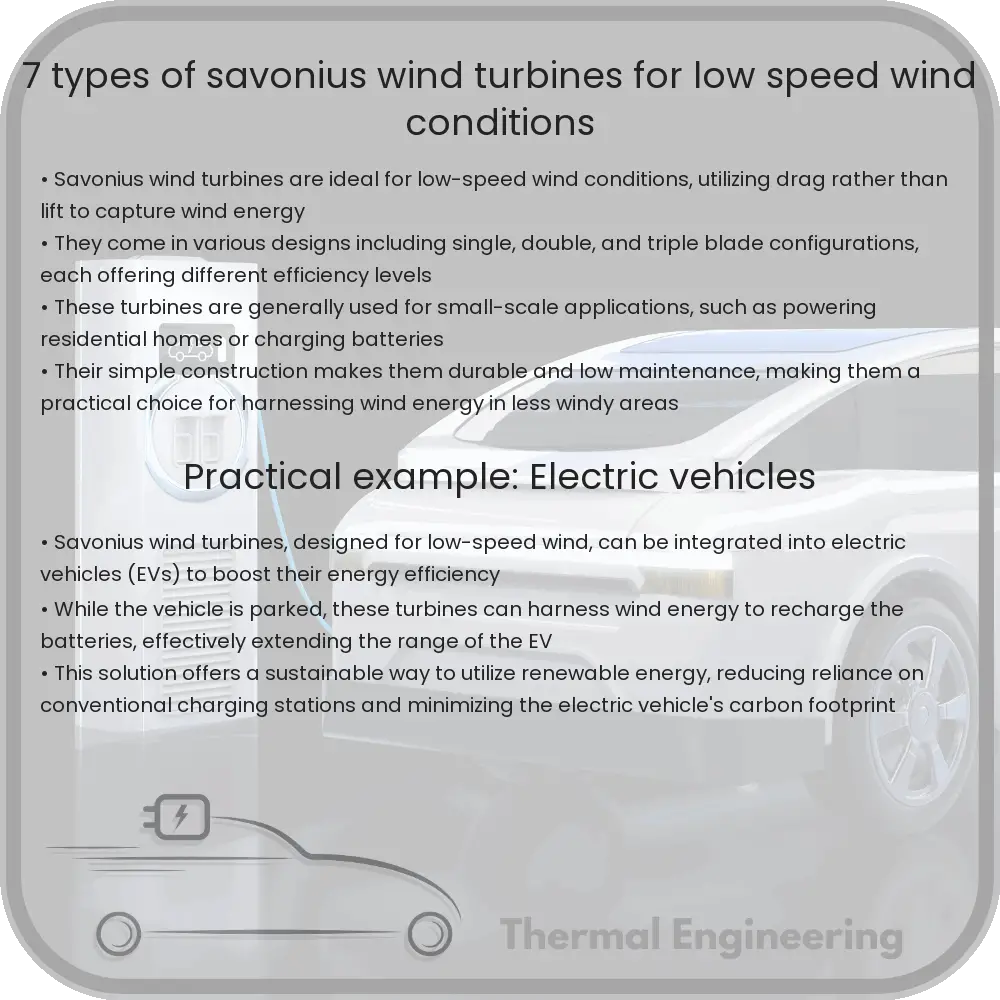
Wind energy is a crucial component of the global renewable energy strategy. One effective design suitable for low-speed wind conditions is the Savonius wind turbine. Unlike traditional turbines, the Savonius model uses drag, not lift, to capture wind energy, making it ideal for areas with low wind speeds. This article explores seven types of Savonius wind turbines and their unique applications.

1. Traditional Savonius Wind Turbine

The traditional Savonius turbine features a simple construction with two or three scoops that are bent in a semi-circular shape. These scoops rotate around a vertical axis, making them omni-directional, which means they do not need to face the wind to be effective. This design is particularly favored for its ease of construction and low maintenance requirements.

2. Mini Savonius Wind Turbine

Mini Savonius turbines are scaled-down versions of the traditional design. They are commonly used in residential areas and for educational purposes. Despite their small size, they are quite efficient at converting the energy from low-speed winds into electricity, making them an excellent choice for urban environments where wind speeds are typically lower.

3. Helical Savonius Wind Turbine

The helical or twisted Savonius turbine features blades that spiral along the axis. This design reduces the pulsation in the rotational speed during operation, leading to a smoother torque output and increased efficiency. It is particularly useful in irregular wind conditions and is aesthetically pleasing, which adds to its popularity in urban settings.

4. Multiple-Stage Savonius Wind Turbine

Multiple-stage Savonius turbines stack several Savonius rotors vertically to increase the capture area and hence the power output. This configuration can be customized according to the height restrictions and wind conditions of a particular site. It’s especially effective in locations where ground space is limited but vertical space is plentiful.

5. Roof Mounted Savonius Wind Turbine

Roof mounted Savonius turbines are an innovative solution for integrating wind energy systems into buildings without requiring additional land space. These turbines can be installed on the roofs of commercial or residential buildings, where they utilize the wind flow altered by the building structure to generate energy.

6. VAWT with Deflectors

This variation of the Savonius turbine includes strategically placed deflectors to channel wind more effectively into the turbine. Deflectors enhance the wind speed entering the turbine, thereby increasing its overall efficiency. This adaptation is particularly beneficial in environments where wind directions are highly variable.

7. Hybrid Savonius and Darrieus Wind Turbine

Combining the features of both Savonius and Darrieus turbines, the hybrid model aims to maximize energy capture from low-speed winds. The Savonius components provide high torque at low wind speeds, while the Darrieus sections contribute to higher rotational speeds. This combination allows for better overall performance across varying wind conditions.

Conclusion

Savonius wind turbines, with their robust design and suitability for low-speed wind conditions, offer a versatile solution for harnessing wind energy. By understanding the different types of Savonius turbines available, stakeholders can select the most appropriate design to meet their specific energy production needs and environmental conditions. As advancements in technology continue to evolve, the efficiency and applications of Savonius turbines are expected to expand, contributing more significantly to renewable energy portfolios around the world.

12 Types of Mechanical Vacuum Pumps for Industrial Use

Explore 12 common types of mechanical vacuum pumps used in various industrial applications, detailing their mechanisms and benefits.

12 Types of Mechanical Vacuum Pumps for Industrial Use

12 Types of Mechanical Vacuum Pumps for Industrial Use

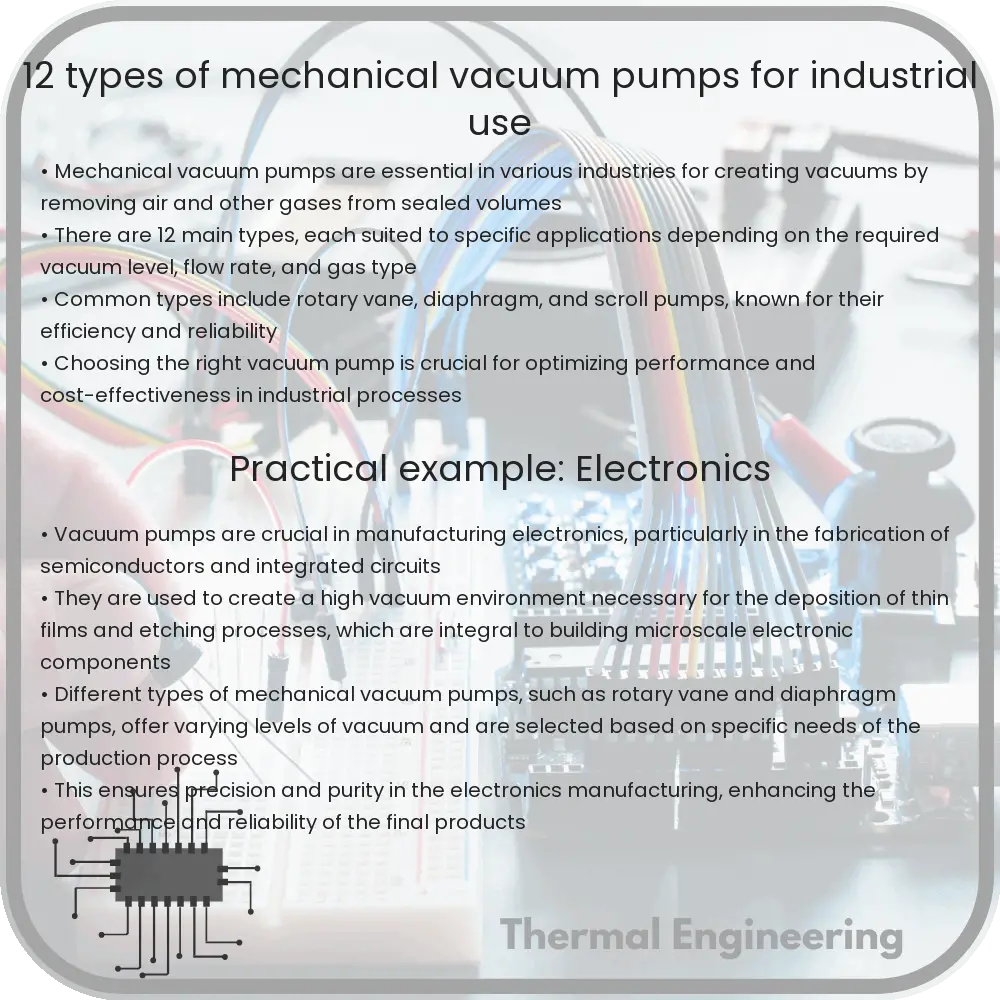
Vacuum pumps are an essential component in various industrial processes. These devices create, improve, and maintain vacuum in an enclosed space. Different types of vacuum pumps are used depending on the required vacuum quality, volumetric flow rate, and nature of the application. Here, we explore 12 common types of mechanical vacuum pumps used in industrial settings.

1. Positive Displacement Pumps

Positive displacement pumps repeatedly expand a cavity, allowing gases to flow in from the chamber, seal off the cavity, and exhaust it to the atmosphere. Common types include:

  • Rotary Vane Pump: This pump consists of a rotor with longitudinal vanes sliding in slots which rotate inside a cavity. As the rotor turns, the vanes create sealed chambers that compress and move the gas towards the outlet.
  • Liquid Ring Pump: A ring of liquid acts as a piston to achieve compression. This type of pump is praised for its simplicity and reliability in handling wet gases.
  • Diaphragm Pump: Uses a diaphragm that moves up and down to create a vacuum. Ideal for clean, dry, and relatively low-capacity applications.

2. Momentum Transfer Pumps

Momentum transfer pumps, also known as molecular pumps, use high-speed jets of dense fluid or high-speed rotating blades to knock gas molecules out of the chamber. They include:

  • Turbomolecular Pump: Utilizes a series of angled blades that rotate at high speeds to effectively push gas molecules out of the pump.
  • Diffusion Pump: Utilizes jets of oil or mercury vapor to capture and drive gas molecules from the vacuum side to the exhaust side.

3. Regenerative Pumps

Also known as side channel pumps, these create a vacuum by regenerating air molecules through a multi-blade impeller’s rotation at high speeds.

  • Regenerative Blower: Often used when moderate vacuum is sufficient, and where contamination from oil or other substances must be avoided.

4. Entrapment Pumps

These pumps capture gas molecules on a surface within the vacuum system via processes like sorption and condensation. They are typically used for creating ultra-high vacuums.

  • Cryopumps: Utilize extremely cold temperatures to condense gases into a solid or liquid state, trapping them.
  • Getter Pumps: Use reactive materials that chemically bind or adsorb gases.
  • Ion Pumps: Use a high magnetic field to ionize gas molecules and capture them on a solid surface.

5. Scroll Pumps

Scroll pumps feature two interleaved spiral-shaped scrolls, where one is fixed and the other moves in small orbits, progressively compressing the gas pockets.

6. Screw Pumps

Screw pumps use two meshed screws that rotate to move and compress gases from the inlet to the outlet side of the pump.

7. Wankel Pumps

This is a type of rotary pump where a rotor in the shape of a symmetric lobe rotates within an oval cavity.

8. Lobe Pumps

Lobe pumps are similar to rotary pumps but use lobed rotors instead of vanes to move the gas. Used in applications requiring high flow rates.

9. Claw Pumps

Claw pumps operate with two claw-shaped rotors rotating in opposite directions to compress the gas. They are robust and operate dry, without the need for oil sealing or lubrication.

10. Roots Blower (Roots Pump)

Also known as a rotary lobe pump, it is widely used for mid-range vacuum level applications. It operates by pumping fluid with a pair of meshing lobes against a chamber wall.

11. Piston Pump

Utilizes a piston moving backward and forward in a cylinder to compress and move gas. It’s suitable for applications requiring high-pressure ratios.

12. Gear Pumps

These use the meshing of gears to pump fluid by displacement and are more commonly used for hydraulic fluid applications but can be designed for high vacuum environments.

Each vacuum pump type offers different characteristics making them suitable for various industrial applications, from manufacturing and processing to research and development. Understanding the operational mechanics and advantages of each can significantly improve selection and application in specific industrial processes.

6 Types of HCCI Engines for Efficient Combustion

Learn about Homogeneous Charge Compression Ignition (HCCI) engines, a blend of gasoline and diesel technologies enhancing efficiency and reducing emissions.

6 Types of HCCI Engines for Efficient Combustion

Understanding Homogeneous Charge Compression Ignition (HCCI) Engines

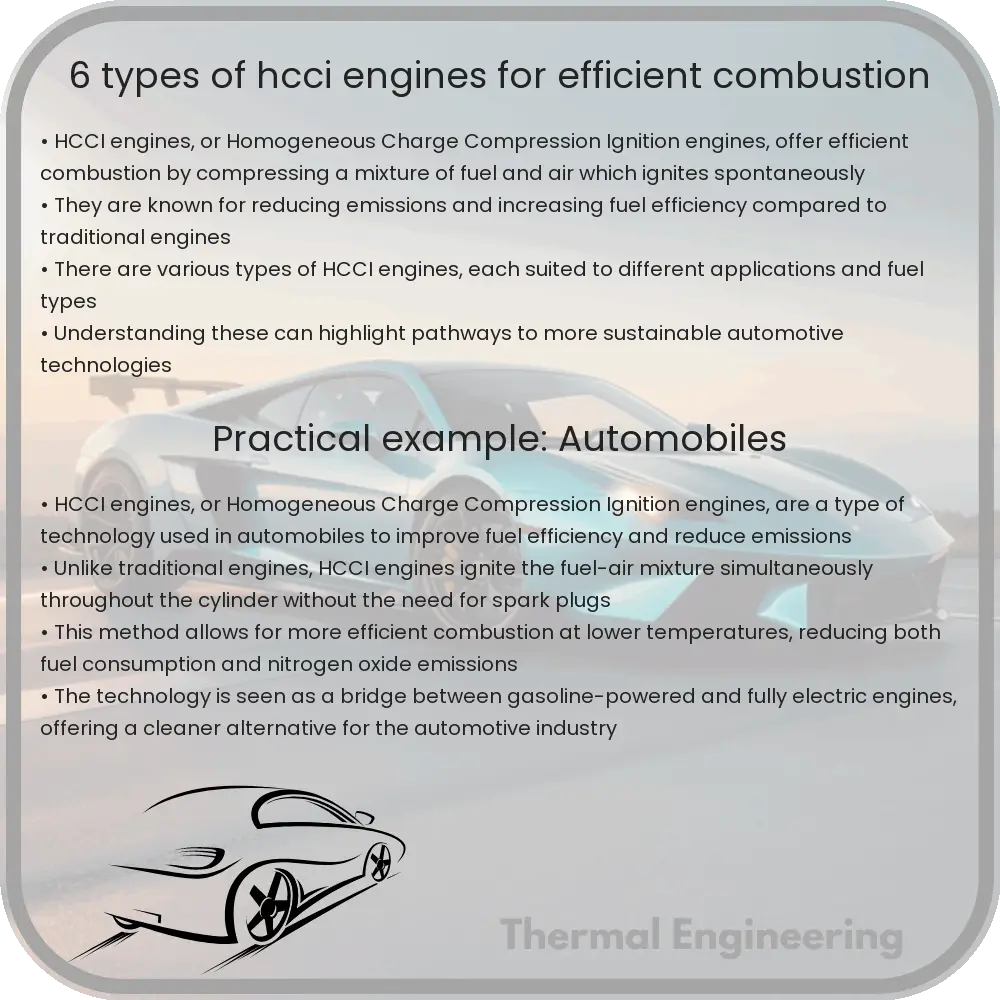
Homogeneous Charge Compression Ignition (HCCI) engines represent a significant advancement in combustion technology. These engines combine characteristics of gasoline engines (spark ignition, SI) and diesel engines (compression ignition, CI), aiming to improve efficiency and reduce emissions. In an HCCI engine, a mixture of fuel and air is compressed to the point of ignition without the need for a spark plug. This article explores six distinct types of HCCI engines that enhance efficient combustion.

1. Traditional Gasoline-Based HCCI Engines

These engines utilize standard gasoline, similar to what is used in conventional SI engines. The key difference is in the engine’s ability to compress the gasoline-air mixture to a point where it ignites spontaneously. Gasoline-based HCCI engines often employ variable valve timing and other controls to manage the combustion process, making them more adaptable to different operating conditions.

2. Diesel-Based HCCI Engines

While traditional diesel engines use direct injection and high compression to ignite the fuel, diesel-based HCCI engines premix the air and diesel fuel before compression, leading to a cleaner and more controlled combustion process. These engines can significantly reduce nitrogen oxide (NOx) and particulate matter (PM) emissions compared to conventional diesel engines.

3. Ethanol and Other Alcohol-Based HCCI Engines

Alcohols like ethanol have higher octane ratings and a greater resistance to engine knock, making them advantageous for HCCI combustion. Ethanol-based HCCI engines benefit from the fuel’s properties by achieving higher efficiency and lower carbon monoxide (CO) and hydrocarbon (HC) emissions relative to gasoline HCCI systems.

4. Natural Gas HCCI Engines

Natural gas, primarily consisting of methane, provides a high octane fuel source which is ideal for spontaneous ignition in HCCI engines. These engines are particularly appealing for commercial fleet vehicles due to the abundance and lower cost of natural gas, coupled with significant emission reductions.

5. Dual-Fuel HCCI Engines

Dual-fuel HCCI engines employ a combination of two different fuels, which usually include a primary high-octane fuel like gasoline or natural gas, and a secondary direct-injected high-cetane fuel such as diesel. This setup allows for greater control over the ignition and combustion processes, enhancing engine efficiency and reducing emissions across various operating conditions.

6. Hybrid HCCI Engines

Integrating HCCI technology with electric hybridization leads to hybrid HCCI engines. These engines use electric motors to assist the engine during low power demands, allowing the HCCI engine to operate more frequently within its optimal efficiency range. This type of engine is particularly efficient in stop-and-go traffic, substantially reducing both fuel consumption and emissions.

In conclusion, HCCI technology presents a promising pathway to achieving higher engine efficiencies and reduced pollutant emissions. Each type of HCCI engine offers distinct advantages and is suited to different applications, making HCCI a versatile and environmentally friendly option in the landscape of internal combustion engines.