Facebook Instagram Youtube Twitter

7 Types of Peristaltic Pumps for Precise Fluid Handling

Learn about the seven types of peristaltic pumps and their applications in precise fluid handling across various industries.

7 Types of Peristaltic Pumps for Precise Fluid Handling

7 Types of Peristaltic Pumps for Precise Fluid Handling

Peristaltic pumps, often utilized in applications requiring sterile, precise fluid handling, employ a unique mechanism that uses compression to transport fluids along a flexible tube. These pumps are popular in medical, laboratory, and industrial settings due to their ability to handle sensitive fluids without contamination. The design ensures that the fluid only contacts the tube, not the pump mechanism, thus ensuring purity and maintaining the integrity of the fluid.

This article explores seven types of peristaltic pumps, highlighting their characteristics and typical applications.

1. Fixed Speed Peristaltic Pumps

Fixed speed peristaltic pumps operate at a constant speed, providing a steady flow rate. These pumps are ideal for simple transfer applications where precise control of the flow rate is not critical. Their simplicity makes them cost-effective and easy to maintain.

2. Variable Speed Peristaltic Pumps

Variable speed pumps offer control over the flow rate by adjusting the motor speed. This feature is crucial in applications requiring precise dosing and when the fluid characteristics may change over time. Variable speed models are particularly useful in research and development labs where flexibility in operation is required.

3. High-Pressure Peristaltic Pumps

Designed to handle higher pressure differentials, these pumps can move fluids in situations where greater force is necessary. High-pressure peristaltic pumps are typically used in industrial applications such as chemical processing or water treatment plants, where they might need to counter substantial resistance in the system.

4. Low-Flow Peristaltic Pumps

Low-flow pumps are tailored for applications requiring precise metering of minute volumes, such as in pharmaceutical production or microfluidic setups. These pumps provide exceptional accuracy in low-volume transfers, crucial for maintaining the efficacy and quality of sensitive chemicals and drugs.

5. Multi-Channel Peristaltic Pumps

Multi-channel peristaltic pumps feature several independent channels that can operate concurrently, each handling a different fluid without cross-contamination. These are invaluable in complex laboratory experiments or medical applications where multiple fluids must be managed simultaneously while maintaining isolation between them.

6. Explosion-Proof Peristaltic Pumps

Specially designed with safety features that prevent sparks and reduce static, explosion-proof peristaltic pumps are used in environments prone to flammability, such as handling volatile organic compounds. These pumps ensure safe operation in potentially explosive atmospheres by adhering to rigorous safety standards.

7. Sanitary Peristaltic Pumps

Sanitary peristaltic pumps are designed for applications that require stringent hygiene standards, such as food and beverage production or certain pharmaceutical processes. They are constructed from materials compliant with industry standards such as FDA-approved tubing, ensuring that all parts of the pump coming into contact with the product can be easily cleaned or sterilized.

In conclusion, peristaltic pumps are versatile devices capable of handling a variety of fluid transfer tasks with precision. Whether for simple fluid transfer or complex, multi-fluid handling in a controlled environment, there is a peristaltic pump designed to meet the task. Understanding the specific requirements of your application is crucial in selecting the appropriate type of peristaltic pump.
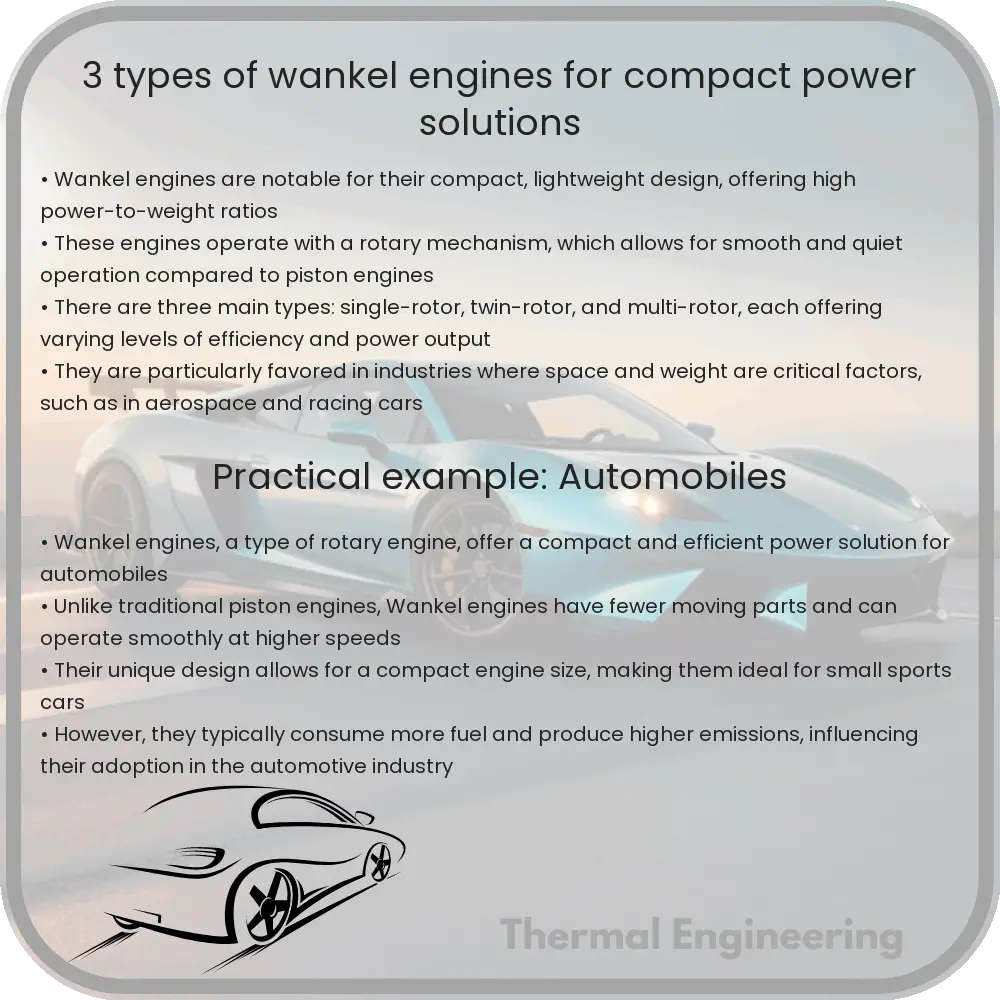
3 Types of Wankel Engines for Compact Power Solutions

Dive into the world of Wankel engines, a unique rotary internal combustion engine known for its compact design and high power-to-size ratio, used in various high-performance vehicles.

3 Types of Wankel Engines for Compact Power Solutions

Understanding the Wankel Engine: Three Varieties for Compact Power Solutions

The Wankel engine, named after its inventor Felix Wankel, is a type of internal combustion engine that uses an eccentric rotary design to convert pressure into rotating motion. Unlike the more common reciprocating piston engines, Wankel engines are known for their compact design, smooth operation, and high power output relative to their size. They are commonly used in automobiles, motorcycles, and even in some aircraft. This article explores three distinct types of Wankel engines, highlighting their unique characteristics and applications.

1. Single-Rotor Wankel Engine

The single-rotor Wankel engine is the simplest form of this engine type. It consists of a single triangular rotor that revolves inside an epitrochoidal-shaped housing. The rotor has three apexes, each compressing air and fuel mixture in separate chambers formed as the rotor turns.

  • Advantages: Its simplicity leads to lower manufacturing costs and reduced maintenance requirements. The compact and lightweight nature of the single-rotor design makes it ideal for small, high-performance vehicles like motorcycles and small sports cars.
  • Disadvantages: The single-rotor engine tends to have lower torque compared to multiple rotor engines and can suffer from higher fuel consumption and emissions.

2. Twin-Rotor Wankel Engine

Expanding on the single-rotor design, the twin-rotor Wankel engine uses two rotors in a single housing. This configuration allows for increased displacement without significantly increasing the physical size of the engine, thus maintaining the compactness while providing more power and smoother operation.

  • Advantages: Improved torque and power over the single-rotor design and reduced vibration due to the more balanced rotational dynamics. This setup is commonly used in performance and sports cars, such as the famous Mazda RX-7 and RX-8.
  • Disadvantages: Increased complexity and cost over single-rotor designs. The twin-rotor configuration can also lead to higher fuel consumption and emissions.

3. Three-Rotor Wankel Engine

The three-rotor Wankel engine offers an even greater increase in power and torque, suitable for high-performance applications. By adding a third rotor to the design, this engine type further enhances the balance and smooth operation while providing a substantial power boost.

  • Advantages: Higher power output and smoother operation, making it ideal for competitive racing cars and high-performance sports cars. An example of this is the Mazda 20B engine found in some models of Mazda race cars.
  • Disadvantages: This is the most complex and expensive Wankel engine type. It also struggles with the same fuel efficiency and emissions issues as the other types, making it less suitable for everyday road use.

In conclusion, Wankel engines offer unique advantages for compact power solutions, providing various options tailored to differing needs from motorcycles to high-performance sports cars. Though they face challenges with fuel efficiency and emissions, ongoing developments continue to refine these remarkable engines.

9 Types of Diesel Engines for Transportation and Power

Learn about the nine different types of diesel engines used in transportation and power generation, differentiated by design and application.

9 Types of Diesel Engines for Transportation and Power

Understanding the Different Types of Diesel Engines for Transportation and Power

Diesel engines are renowned for their efficiency and durability, making them a popular choice for both transportation and power generation applications. Here, we explore nine types of diesel engines, each characterized by unique features that make them suitable for different tasks. Whether in ships, trucks, or stationary power plants, these engines play a critical role in powering the modern world.

Main Types of Diesel Engines

1. Inline Engines

Inline diesel engines have cylinders arranged in a straight line, typically ranging from 3 to 6. This straightforward design makes them easier to manufacture and maintain. Common in smaller trucks and cars, inline engines are appreciated for their balance between power output and compactness.

2. V-Type Engines

V-type diesel engines feature a design where the cylinders are aligned in two separate banks, forming a ‘V’. This configuration allows for more cylinders in a smaller footprint, enhancing power output without significantly increasing engine size. V-engines are widely used in medium to heavy-duty vehicles and large marine vessels.

3. Flat Engines

Flat, or boxer, engines position cylinders horizontally in two opposing banks. This layout offers a lower center of gravity and can contribute to a more balanced vehicle dynamics. Flat diesel engines are uncommon but can be found in specialized applications where vehicle stability is paramount.

4. Single Cylinder Engines

As the name suggests, single cylinder diesel engines have only one cylinder. They are simple, economical, and used in smaller machinery including motorcycles, small agricultural equipment, and generators.

5. Opposed-Piston Engines

This engine type utilizes two pistons per cylinder, working in opposite directions. This unique design eliminates the need for cylinder heads, which can reduce weight and complexity. Opposed-piston engines are noted for their efficiency and are often used in maritime and stationary applications.

6. W-Type Engines

For applications demanding extremely high power, W-type engines provide an effective solution. They consist of three banks of cylinders configured to form a ‘W’ shape. This type is generally used in high-performance luxury cars and some commercial vehicles.

7. Rotary Engines

Although not common, rotary diesel engines (different from Wankel rotary engines) utilize a rotating combustion chamber, which offers smooth operation and a compact design. They can be advantageous in applications requiring small, lightweight engines with a high power-to-weight ratio.

8. Two-Stroke Engines

In a two-stroke diesel engine, the cycle is completed in just two strokes of the piston (one crankshaft revolution). This allows for greater power output from the same size engine when compared to a four-stroke counterpart. Two-stroke diesels are primarily found in large applications such as ships and stationary power plants.

9. Four-Stroke Engines

The most common type among diesel engines, four-stroke engines complete one power cycle over four piston strokes. This includes induction, compression, power, and exhaust strokes. Due to their efficiency and emissions control, four-stroke diesels dominate automotive, trucking, and large industrial applications.

Conclusion

Each type of diesel engine offers specific advantages that make it suitable for particular applications. From efficient single-cylinder engines for small machinery to powerful V and W engines for vehicles and boats, the diversity in diesel engine technology ensures that there is an engine type optimized for virtually any need in transportation and power generation.

Thermal challenges in space habitats

Master the complexities of thermal management challenges in space habitats, focusing on radiation, insulation, and advanced engineering solutions.

Thermal challenges in space habitats

Understanding Thermal Challenges in Space Habitats

Creating and maintaining human-friendly environments in space habitats poses numerous engineering challenges. One of the most significant is managing the thermal environment to ensure it is suitable for human life. Extreme temperatures in space, both hot and cold, can be detrimental to both the structures themselves and the inhabitants within.

The Vacuum of Space and Temperature Control

In space, the absence of an atmosphere means there is no medium for heat convection, which is a primary mode of heat transfer on Earth. This unique environment creates specific challenges for thermal management in space habitats:

  • Radiation: In space, heat transfer occurs mostly through radiation. Space habitats must have surfaces that can efficiently radiate heat to maintain internal temperatures.
  • Solar Heating: Objects in space directly exposed to the Sun can reach temperatures as high as 120 degrees Celsius. Conversely, areas in shadows or facing away from the Sun can plummet to minus 100 degrees Celsius or lower.

Materials and Design for Thermal Control

To combat these issues, engineers use advanced materials and design techniques:

  • Insulative Materials: Highly insulative materials are used to prevent both loss and gain of heat, thereby stabilizing the internal environment.
  • Thermal Coatings: Special coatings reflect solar radiation and enhance thermal emission, helping to manage the heat from solar exposure.
  • Heat Pipes and Radiators: These are crucial for dissipating heat from the habitat. Heat pipes transport heat from hot areas to radiators, which then radiate the heat away into space.

Thermal Modeling and Simulation

Engineering space habitats requires precise calculations and simulations to predict and control thermal behaviors:

  • Computational Fluid Dynamics (CFD): This tool helps simulate the flow of heat due to radiation in a vacuum, crucial for designing effective thermal control systems.
  • Thermal Modelling Software: Software such as SINDA/FLUINT and THERMICA are used to predict how heat will behave in various conditions and to design thermal systems accordingly.

Challenges and Innovations

Despite advancements, several challenges remain:

  • Maintenance and Reliability: Space habitats must sustain their thermal control systems over long periods, often with minimal maintenance capabilities.
  • External Damage: Micrometeoroids and orbital debris pose threats to external thermal control systems by potentially damaging surfaces and insulation.
  • Energy Efficiency: Space habitats must be energy efficient, requiring systems that do not consume excessive power.

In conclusion, thermal control in space habitats involves a combination of advanced materials, sophisticated simulation tools, and innovative engineering solutions. As technologies advance and our ambitions for space exploration grow, the designs of thermal control systems will continue to evolve, addressing new challenges and pushing the boundaries of what’s possible in space habitats.

11 Types of Lobe Pumps for Sanitary Processes

Learn about the different types of lobe pumps used in sanitary processes across food, pharmaceutical, and cosmetic industries.

11 Types of Lobe Pumps for Sanitary Processes

Understanding Lobe Pumps in Sanitary Processes

Lobe pumps are widely used in industries requiring high standards of hygiene, such as food and beverage, pharmaceutical, and cosmetic industries. Their design allows for efficient handling of viscous fluids, slurries, and pastes while maintaining product integrity. Lobe pumps fall into several categories, each tailored for specific applications and performance requirements in sanitary processes. Let’s explore 11 types of lobe pumps commonly used in these contexts.

Types of Lobe Pumps

  • Single Lobe Pumps: These pumps feature a single rotor and are known for their simple construction. They are suitable for low viscosity fluids and are relatively easy to clean and maintain.
  • Bi-Wing Lobe Pumps: These pumps utilize two lobes shaped like wings. They are typically used for transferring medium viscosity fluids and offer a good balance between efficiency and gentle handling of the product.
  • Tri-Lobe Pumps: Tri-lobe pumps are equipped with three lobes, providing a smoother flow compared to bi-wing pumps. This type is preferred for its reduced pulsation and better handling of higher viscosity fluids.
  • Multi-Lobe Pumps: With four or more lobes, multi-lobe pumps are designed for applications demanding high efficiency and minimal shear. They are excellent for delicate products that require gentle handling to maintain their structure and consistency.
  • Scroll Lobe Pumps: These pumps use scroll-shaped lobes, enhancing the smoothness of the pumping action. Scroll lobe pumps are ideal for sanitary processes where low shear and high hygiene are critical.
  • Helical Lobe Pumps: Featuring a helical, screw-like rotor design, these pumps are well-suited for handling thick, viscous products. They provide an efficient and uniform flow while minimizing damage to the processed materials.
  • Sanitary Lobe Pumps: Specifically designed for the highest hygiene standards, sanitary lobe pumps have highly polished surfaces and are constructed from food-grade materials. They often include design features that allow full clean-in-place (CIP) capabilities.
  • Stainless Steel Lobe Pumps: Manufactured entirely from stainless steel, these pumps offer excellent corrosion resistance and are favored in corrosive environments or when handling aggressive fluids.
  • Vertical Lobe Pumps: These are designed with a vertical orientation to save space and facilitate maintenance without the need to remove piping connections. They are particularly useful in cramped installation spaces.
  • High-Pressure Lobe Pumps: For applications requiring high operating pressures, high-pressure lobe pumps are engineered to withstand significant stress while maintaining efficiency and flow rate.
  • Customizable Lobe Pumps: Many manufacturers offer customizable options, allowing specific alterations like varying lobe profiles, materials, and motor configurations to meet unique process requirements.

Applications of Lobe Pumps in Sanitary Processes

Lobe pumps are integral to numerous sanitary processes. In the food industry, they are used for transferring dairy products, sauces, and pastes. Pharmaceutical applications often involve the gentle handling of sensitive fluids like vaccines and serums. In the cosmetics industry, lobe pumps facilitate the processing of creams and lotions, ensuring that these delicate products are handled without contamination.

Conclusion

Understanding the different types of lobe pumps and their specific uses in sanitary processes is crucial for selecting the right pump for your application. Each lobe pump type offers unique benefits tailored to handling various viscosities and maintaining high levels of hygiene. Whether for food, pharmaceutical, or cosmetic production, the proper lobe pump ensures efficient, safe, and cost-effective operations.

6 Types of Turboprop Engines for Efficient Aircraft Propulsion

Delve into the world of turboprop engines, exploring six types with unique designs and performance characteristics for aircraft propulsion.

6 Types of Turboprop Engines for Efficient Aircraft Propulsion

Understanding Turboprop Engines: 6 Varieties for Efficient Aircraft Propulsion

Turboprop engines are a type of aircraft powerplant that combines the aerodynamic efficiency of propellers with the power of turbine engines. Commonly used in smaller regional, cargo, and specialized aircraft, these engines are celebrated for their fuel efficiency and reliability in short to medium-haul flights. In this article, we will explore six types of turboprop engines that stand out due to their design and performance characteristics.

1. Free Turbine Engines

In a free turbine engine, also known as a split shaft, the propeller is not directly connected to the main engine shaft that houses the compressor and power turbines. Instead, it is driven by a separate turbine through a reduction gearbox. This configuration allows the propeller and the engine core to operate independently, optimizing performance and making it ideal for applications requiring variable propeller speeds independent of the engine speed.

2. Fixed Shaft Turbine Engine

Fixed shaft turbine engines, or single shaft engines, feature a design where the propeller is connected directly to the engine shaft. As a result, the propeller speed is directly tied to the engine’s RPM, simplifying the design but also limiting operational flexibility. These engines are typically lighter and cheaper than free turbine designs, making them suitable for lighter, less complex aircraft.

3. Compound Turboprop Engines

Compound turboprop engines enhance the basic turboprop design by harnessing exhaust gases for additional thrust. Besides the mechanical power transmitted to the propeller, these engines use a jet nozzle to provide thrust from the exhaust. This dual approach offers improved performance at higher speeds, making compound turboprops ideal for aircraft that operate across a wide range of speeds.

4. Contra-Rotating Turboprop Engines

These unique engines utilize a set of two coaxial propellers that rotate in opposite directions. By counteracting the rotational forces of each other, contra-rotating propellers can significantly reduce or eliminate the effects of engine torque, improving aircraft stability and increasing the efficiency of the propellers.

5. Turboshaft Engines Adapted for Aircraft

While turboshaft engines are primarily designed for helicopters, they can be adapted for fixed-wing aircraft, especially in vertical take-off and landing (VTOL) applications. These adaptations typically focus on optimizing the engine for better fuel efficiency at the different operational speeds of fixed-wing aircraft compared to helicopters.

6. Geared Turboprop Engines

Geared turboprop engines incorporate a reduction gearbox that decouples the turbine’s optimal rotational speed from that of the propeller. This allows the turbine to operate at its most efficient RPM while permitting the propeller to rotate at a speed that maximizes aerodynamic efficiency. Such configurations are useful in reducing fuel consumption and enhancing overall performance.

Conclusion

Turboprop engines represent a diverse class of aviation powerplants that provide a flexible and efficient solution for many types of aircraft. From free turbines to geared and compound configurations, each type offers specific advantages tailored to particular operational requirements and aircraft characteristics. Understanding the differences among these engine types not only highlights the ingenuity behind modern air propulsion technologies but also aids in selecting the right engine for specific aviation needs.

10 Types of Screw Pumps for Multiphase Fluid Transport

Comprehensive guide on screw pumps, detailing 10 types used for transporting multiphase fluids in various industries.

10 Types of Screw Pumps for Multiphase Fluid Transport

Understanding Screw Pumps: 10 Types for Multiphase Fluid Transport

Screw pumps are a type of positive displacement pump used widely in industries for transporting multiphase fluids — a mixture of liquid and gas. They operate by capturing fluid between screw threads and moving it along the screw axis as the screws rotate, thus generating flow. Based on the design and configuration, screw pumps can handle a variety of materials, from oil and gas to chemicals and wastewater. In this article, we explore ten common types of screw pumps utilized for these purposes.

Single Screw Pumps

Also known as progressive cavity pumps, these feature a single helical rotor that moves within a double-helical elastomer-lined stator. This type is well-suited for handling viscous fluids or slurries with solid particles.

Twin Screw Pumps

Twin screw pumps contain two intermeshing screws that trap the fluid and move it axially without significant pulsation. These pumps are commonly used for high flow rates and can manage fluid with varying viscosity and temperature.

Triple Screw Pumps

In a triple screw pump, the central screw is driven by the motor and the other two screws are driven by the fluid when it moves. They are used primarily for clean, lubricating fluids like fuels and oils.

Multiple Screw Pumps

This category includes screw pumps with more than three screws. The design is similar to the triple screw pump but can handle larger flow rates and pressures, making them ideal for heavy-duty applications in oil and gas industries.

Vertical Screw Pumps

Oriented vertically, these pumps are used for pumping fluids from deep wells or sumps. Their vertical configuration helps in saving space and allows for deeper fluid columns.

Horizontal Screw Pumps

Horizontal screw pumps are used when the fluid source or the storage is situated horizontally. They are easier to inspect and maintain compared to vertical pumps.

Sealed Screw Pumps

Designed with a seal to prevent leaks, sealed screw pumps are used for transporting hazardous or toxic fluids, providing an added layer of safety in chemical processing or oil refineries.

Sealless Magnetic Drive Screw Pumps

These pumps utilize magnetic couplings instead of traditional seals to eliminate leakage risks completely. They are preferred for handling highly corrosive or environmentally hazardous fluids.

Heated Screw Pumps

Equipped with heating mechanisms, these pumps maintain the temperature of viscous or semi-solid fluids to facilitate easier movement and prevent solidification in the pump.

Sanitary Screw Pumps

Constructed with materials and finishes suitable for sanitary applications, these pumps are used in food, beverage, and pharmaceutical industries where hygiene and easy cleanability are paramount.

Screw pumps offer a versatile solution for handling multiphase fluids in a wide range of industrial applications. Their ability to handle varying viscosities and types of materials makes them indispensable in many sectors, including oil and gas, chemical, and food industries. Understanding the specific characteristics and advantages of different types of screw pumps can help in selecting the right pump for your application.

4 Types of Pelton Turbines for High-Head Hydro Sites

Learn about Pelton turbines, their design variations, and applications in high-head hydroelectric systems.

4 Types of Pelton Turbines for High-Head Hydro Sites

Understanding Pelton Turbines for High-Head Hydroelectric Sites

Pelton turbines, also known as Pelton wheels, are commonly used in high-head hydroelectric systems where the available water source has a relatively high hydraulic head and low flow rate. Their design allows them to operate efficiently under such conditions, converting the hydraulic energy of water into mechanical energy which is then used to generate electricity. Here, we explore four types of Pelton turbines and how they differ based on their design and application.

Single-Jet Pelton Turbines

Single-jet Pelton turbines are characterized by a single water jet that impinges water onto the turbine wheel. This type of Pelton turbine is typically used for smaller installations where the water flow rate is limited. The simplicity in their design makes them cost-effective and easier to maintain. The key to their efficiency lies in the precise alignment of the jet directed at the buckets on the circumference of the wheel, maximizing the impact and therefore the energy transfer.

Multiple-Jet Pelton Turbines

In medium to large-scale hydropower projects where higher power output is required, multiple-jet Pelton turbines are preferred. These turbines feature several water jets directed at the same wheel, allowing for a more uniform distribution of force and reducing the mechanical stress on the turbine. By splitting the water into several jets, these turbines can operate more effectively at varying flow rates, enhancing their flexibility in power generation.

Horizontal Shaft Pelton Turbines

Horizontal shaft Pelton turbines have their rotor mounted horizontally. This configuration is well-suited for applications where the installation space is restricted horizontally. The ease of access to the shaft and other mechanical components makes maintenance tasks more straightforward, potentially reducing downtime and maintenance costs. Horizontal turbines are also beneficial in balancing the load distribution across the wheel, leading to enhanced operational stability.

Vertical Shaft Pelton Turbines

Contrasting with horizontal designs, vertical shaft Pelton turbines feature a rotor that is mounted vertically. This arrangement is advantageous for sites with limited vertical space but adequate horizontal clearance. The vertical setup helps in minimizing the footprint of the turbine, making it ideal for narrow but tall powerhouses. Additionally, the vertical alignment can aid in a more natural flow of water through the system, potentially improving the efficiency of the energy conversion process.

Each of these Pelton turbine types is designed to match specific operational requirements and site conditions in high-head hydropower projects. By understanding the differences and advantages of each type, engineers can select the most appropriate turbine design to maximize the efficiency and effectiveness of a hydroelectric power generation system.

5 Types of Gas Turbines for Energy Generation

Learn about the role and types of gas turbines in energy generation, from aircraft-derivative to microturbines.

5 Types of Gas Turbines for Energy Generation

Understanding Gas Turbines for Energy Generation

Gas turbines play a pivotal role in energy generation, known for their efficiency and capability to use a variety of fuels. These machines convert natural gas or other fuels into mechanical energy, which then drives a generator to produce electricity. Here, we explore five fundamental types of gas turbines used across various industries for power generation.

1. Aircraft-Derivative Gas Turbines

Aircraft-derivative gas turbines are adapted from jet engines to meet the demands of power generation and mechanical drives. These turbines are favored for their high power-to-weight ratio, compact design, and rapid start-up capabilities. They are commonly used in situations where quick, reliable power is needed, such as in emergency power supply or peak-load power plants.

2. Heavy-Duty Gas Turbines

Heavy-duty gas turbines are robust and designed for continuous use in the electric power generation sector. They are engineered to handle large capacities, making them suitable for baseload power generation. Besides electricity, these turbines also contribute to cogeneration, where both electricity and heat are simultaneously produced, enhancing overall efficiency.

3. Industrial Gas Turbines

Slightly smaller than heavy-duty models, industrial gas turbines are utilized in various applications, including small power plants and as mechanical drives for industrial processes. These turbines are versatile in terms of size, ranging from a few megawatts to hundreds of megawatts. Their flexibility makes them ideal for a range of industrial uses beyond power generation, such as powering compressors and large pumps.

4. Aeroderivative Gas Turbines

A subset of aircraft-derivative turbines, aeroderivative gas turbines are specifically modified for non-aviation applications, including marine propulsion and high-speed trains. They are particularly valued for their efficiency and quick start capabilities, which are critical in supporting grid stability and integrating renewable energy sources which may be intermittent.

5. Microturbines

Microturbines are small-scale turbines designed for lower capacity applications, typically ranging from 30 kilowatts to 200 kilowatts. They are an excellent choice for small businesses, residential complexes, or remote locations where large power infrastructure is impractical. Due to their compact size, they can operate in places inaccessible to larger models and are often used in combined heat and power (CHP) configurations to maximize efficiency.

Conclusion

Gas turbines are a fundamental component of modern energy generating systems, tailored to meet specific operational needs across different sectors. From the compact microturbines to the powerful heavy-duty types, these engines support a wide range of power generation requirements, contributing significantly to the efficiency and reliability of energy supply worldwide.

8 Types of Piston Engines for Vehicles and Machinery

Learn about piston engines, including inline, V-type, flat, and rotary engines, and their roles in vehicles and machinery.

8 Types of Piston Engines for Vehicles and Machinery

Introduction to Piston Engines

Piston engines, also known as reciprocating engines, are a type of internal combustion engine that have been pivotal in the development of vehicles and machinery. These engines operate by converting the pressure into rotating motion through a series of systematic movements of pistons inside cylinders. The diversity in designs and operational principles leads to various types of piston engines, each tailored for specific applications. Here, we explore eight common types of piston engines used in vehicles and machinery.

1. Inline Engines

An inline engine, commonly referred to as a straight engine, arranges all of its cylinders in a single row without any offset. Typically found in smaller to medium-sized cars, this engine configuration is prized for its simplicity and smooth operation. Inline engines can vary in size from small three-cylinder versions to larger six-cylinder types.

2. V-Type Engines

V-type engines position their cylinders in two separate planes or ‘banks’, angled in a V-shape. This configuration allows for a more compact engine design, making it suitable for vehicles where space is at a premium. V-engines are popular in performance cars and large vehicles, with variations including V6, V8, V10, and V12 types.

3. Flat Engines

Also known as boxer or horizontally opposed engines, flat engines have cylinders positioned horizontally in pairs. This design offers a lower center of gravity and a more balanced weight distribution, which improves vehicle stability and handling. Flat engines are commonly used in sports cars and are famously employed by brands such as Porsche and Subaru.

4. Rotary Engines

Rotary engines, or Wankel engines, stand out due to their unique design that replaces conventional pistons with a rotor. This engine delivers smooth power output and has fewer moving parts, which can reduce mechanical complexity. Though less fuel-efficient and more emission-prone than their piston counterparts, rotary engines have found a niche in sports cars, most notably used by Mazda.

5. Diesel Engines

Diesel engines, named after Rudolf Diesel, operate under the principle of compression ignition. Air is compressed to a high degree, heating it up significantly, and then fuel is injected, which ignites due to the high temperature. Diesel engines are more efficient than gasoline engines and are typically used in heavier vehicles such as trucks, buses, and in industrial machinery.

6. Two-Stroke Engines

Two-stroke engines complete a power cycle with two strokes of the piston during only one crankshaft revolution. This design allows for a higher power output from a smaller engine size but at the cost of increased emissions. Two-stroke engines are commonly found in motorcycles, chainsaws, and outboard motors.

7. Four-Stroke Engines

Four-stroke engines complete the power cycle in four piston strokes: intake, compression, power, and exhaust. This type is more common in cars, motorcycles, and other higher-efficiency applications. The four-stroke engine tends to be cleaner and more efficient than the two-stroke engine but is typically larger and heavier.

8. Turboprop Engines

While primarily used in aviation, turboprop engines are a form of gas turbine engine that drive a propeller through a reduction gearbox. They are not typical reciprocating piston engines but are included here due to their application in propeller-driven aircraft and some industrial equipment like power generators.

Conclusion

The variety of piston engine types illustrates the diverse approaches engineers have taken to solve the problem of converting fuel into mechanical energy. Each engine type offers specific advantages and is suited to particular applications, reflecting the richness of engineering innovation in the quest for efficiency, performance, and suitability for different uses.