Facebook Instagram Youtube Twitter

10 Types of Flame Detectors in Fire Safety Systems

Comprehensive guide on various flame detectors used in fire safety systems, emphasizing their applications, benefits, and specific detection capabilities.

10 Types of Flame Detectors in Fire Safety Systems

Introduction to Flame Detectors in Fire Safety Systems

Flame detectors play a critical role in enhancing safety in various environments by providing early detection of flames, thus preventing potential large-scale fires. These devices are essential in industrial, commercial, and residential settings where the risk of fire is significant. Flame detectors are designed to respond to the presence of a flame, triggering an alarm system and enabling prompt firefighting response. There are several types of flame detectors, each tailored to different applications and sensitivity requirements.

Types of Flame Detectors

Understanding the different types of flame detectors can help in selecting the right kind for a specific environment. Here are ten common types:

  1. Ultraviolet (UV) Flame Detectors: These detectors pick up the UV radiation emitted almost instantaneously when a flame is present. UV flame detectors are highly sensitive and can detect flames within 3-4 milliseconds, making them suitable for areas where speed of detection is crucial.
  2. Infrared (IR) Flame Detectors: Operating by sensing the infrared spectral band of a flame, these detectors can differentiate between legitimate flames and other sources of infrared light, such as sunlight. They are less prone to false alarms compared to UV detectors.
  3. UV/IR Flame Detectors: Combining both UV and IR technologies, these detectors offer improved false alarm immunity by confirming the presence of a flame only when both UV and IR wavelengths are detected.
  4. IR Array Flame Detectors: These use an array of infrared sensors to create a detailed image of the area being monitored, allowing for accurate flame detection and even providing location information.
  5. Visual Flame Detectors: Utilizing high-resolution video and advanced image processing algorithms, visual flame detectors can identify characteristics of flames such as shape and movement, enhancing detection accuracy.
  6. Fiber Optic Flame Detectors: These detectors use fiber optic cables to monitor light wavelengths specific to flames, offering the benefits of remote sensing and the ability to monitor multiple locations with a single system.
  7. Triple IR (IR3) Flame Detectors: IR3 detectors analyze three specific wavelengths in the IR spectrum to improve the detection of flame signals over longer distances and through obstacles like glass.
  8. Thermal Imaging Flame Detectors: These detectors utilize thermal imaging to detect changes in temperature associated with fires. They are effective in environments where other types of flame detection might be obstructed or less effective.
  9. Multispectrum Infrared Flame Detectors: By monitoring several different wavelengths within the infrared spectrum, multispectrum IR detectors provide superior false alarm immunity and can detect a wider variety of flame types.
  10. Hydrogen Flame Detectors: Specifically designed to detect flames from hydrogen fires, these detectors are crucial in environments where hydrogen is used or produced, as hydrogen flames are nearly invisible to the naked eye and other types of detectors.

Conclusion

Choosing the right type of flame detector depends on several factors including the environment, the materials present, and the required response time. Each type of detector has its specific strengths, making it well-suited for certain conditions and applications. By understanding the operational principles and detection capabilities of each type of flame detector, safety engineers and system integrators can implement the most effective fire detection systems to safeguard property and lives.

4 Types of Thermal Imaging Cameras for Inspection and Security

Learn about thermal imaging cameras, their types, and applications in security and inspections.

4 Types of Thermal Imaging Cameras for Inspection and Security

Introduction to Thermal Imaging Cameras

Thermal imaging cameras are essential tools used in a variety of fields such as security, firefighting, industrial maintenance, and building inspection. These devices detect heat emitted by objects and convert it into an image visible to the human eye. By doing so, they provide valuable information that is not visible through standard imaging processes. This article explores four common types of thermal imaging cameras, focusing on their applications in inspection and security.

Handheld Thermal Cameras

Handheld thermal cameras are the most familiar and widely used type of thermal imaging device. They are portable, easy to use, and designed to fit comfortably in the hand, making them ideal for on-the-spot inspections and security patrols. These cameras often come equipped with a range of features such as adjustable focus, varying image modes, and connectivity options for data storage and analysis. Users can point the camera at an object, area, or scene to capture thermal data, which is particularly useful for identifying heat leaks in buildings, overheating components in electrical and mechanical systems, or intruders in low-light conditions.

Drone-Mounted Thermal Cameras

Drone-mounted thermal cameras have revolutionized aerial inspections and surveillance. By combining the mobility of drones with the capabilities of thermal imaging, these cameras can access hard-to-reach areas such as rooftops, power lines, and large industrial complexes. They are particularly valuable in scenarios where safety or accessibility is a concern, providing thermal data from a safe distance. Applications include monitoring solar panels for defective cells, inspecting wind turbines for mechanical issues, and surveilling large areas for security purposes.

Fixed-Mount Thermal Cameras

Fixed-mount thermal cameras are installed in a stationary position and often used in continuous monitoring applications. These cameras are typically found in sensitive or critical environments where constant surveillance is necessary. Common examples include perimeters of secure facilities, assembly lines, and critical infrastructure sites. Fixed-mount thermal cameras can be integrated into existing security systems to provide round-the-clock thermal data, helping detect unauthorized entries, ensuring perimeter security, and monitoring machinery for any signs of overheating or potential failures.

Handheld Scope-Mounted Thermal Cameras

Scope-mounted thermal cameras are specifically designed to be attached to a rifle or similar equipment. These are predominantly used by law enforcement and military personnel for operations in dark or smoke-filled environments. The thermal scope allows operators to see clearly in complete darkness, providing heat signatures of living objects and aiding in accurate targeting. In addition to tactical applications, scope-mounted thermal cameras are also used in wildlife management and hunting, giving users the ability to track animal heat signatures during night-time hours.

Conclusion

Thermal imaging cameras are invaluable tools in both inspection and security fields, each type designed to meet specific requirements and environments. From handheld devices for general use to sophisticated drone- and fixed-mounted systems for advanced applications, these cameras ensure safety, efficiency, and security across various industries. Understanding the different types of thermal imaging cameras and their uses helps professionals choose the right equipment for their specific needs, enhancing their ability to detect problems, monitor scenarios, and respond effectively.

12 Types of Chillers for Industrial Cooling Solutions

This article provides an overview of 12 different types of chillers used in industrial cooling, explaining their functions, applications, and benefits.

12 Types of Chillers for Industrial Cooling Solutions

12 Types of Chillers for Industrial Cooling Solutions

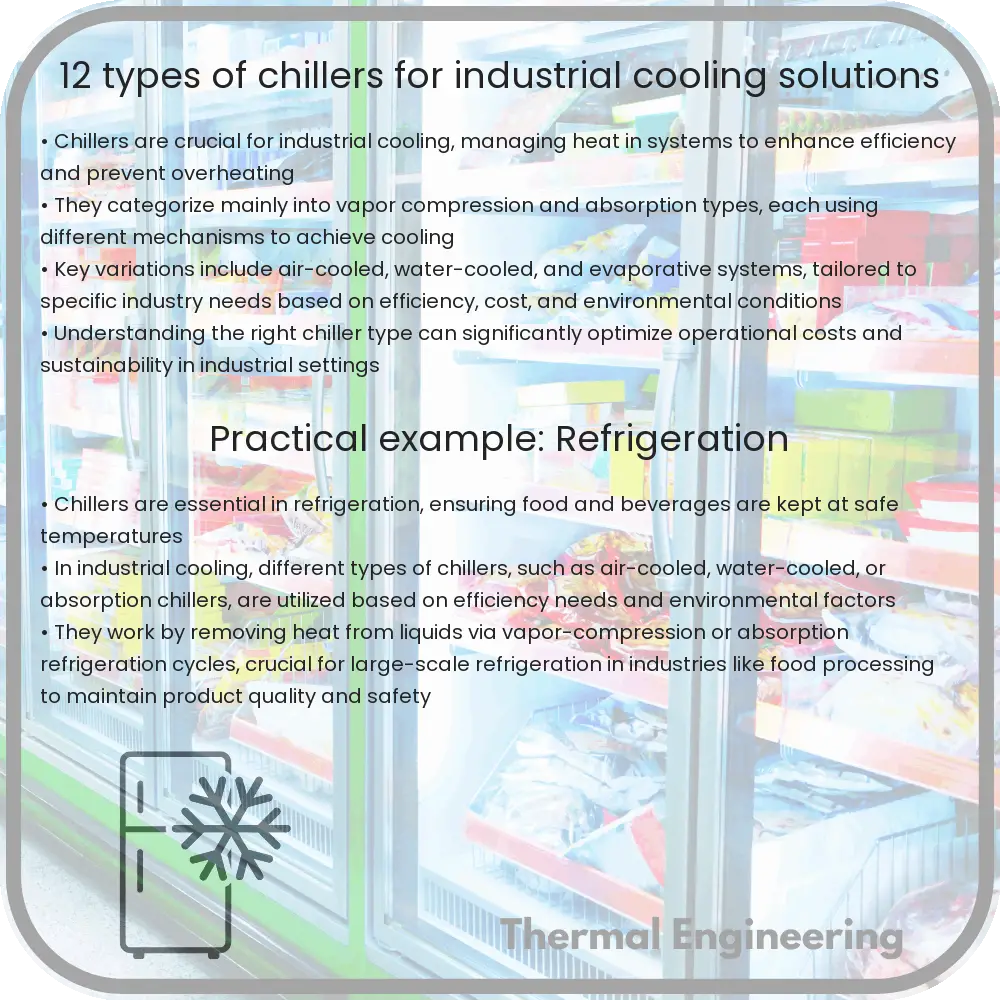
Chillers are critical components in the HVAC (Heating, Ventilation, and Air Conditioning) systems, especially within various industrial applications such as manufacturing, data centers, and commercial buildings. They help in removing heat from a liquid via a vapor-compression or absorption refrigeration cycle. This article explores 12 types of chillers, each suited for specific industrial cooling solutions.

Vapor Compression Chillers

Vapor compression chillers are the most common type, using mechanical energy to drive the refrigeration cycle.

  • Air-Cooled Chillers: These chillers expel heat by passing the refrigerant through condenser coils and using fans to cool the coils. They are generally used in smaller or medium installations where space constraints exist.
  • Water-Cooled Chillers: In water-cooled chillers, heat is expelled to a water line instead of the air. This type requires a cooling tower and is typically more efficient than air-cooled chillers, making them ideal for large industrial applications.
  • Evaporative Condensed Chillers: These combine the features of air-cooled and water-cooled chillers. They use less water than traditional water-cooled systems by employing evaporative technology to enhance heat dissipation.
  • Centrifugal Chillers: Utilizing a centrifugal impeller to compress the refrigerant, these chillers are suitable for large cooling applications and are known for their efficiency at high cooling capacities.
  • Screw Chillers: Screw chillers use one or two helical rotors to compress the refrigerant. They are robust and can operate efficiently under varying conditions, suitable for both commercial and industrial settings.
  • Scroll Chillers: These chillers employ one or two spiral scrolls to compress the coolant. Scroll chillers are known for their low noise, high efficiency, and reliability, suitable for medium-sized applications.

Absorption Chillers

Absorption chillers use heat as a source of energy to drive the refrigeration cycle, differentiating them from vapor compression chillers which use mechanical energy.

  • Single-Effect Absorption Chillers: These use a single generator and are driven typically by low to medium temperature heat sources. They are less efficient than double-effect chillers but have lower operational costs.
  • Double-Effect Absorption Chillers: Utilizing two generators, these chillers achieve higher efficiencies by using high-temperature heat sources.
  • Triple-Effect Absorption Chillers: These are the most efficient among absorption chillers, employing three generators. They are complex and costly but offer the highest efficiency for large-scale industrial applications.

Specialty Chillers

These chillers are designed for specific applications that go beyond the general industrial or commercial cooling needs.

  • Glycol Chillers: These use glycol mixed with water as the coolant, which provides anti-freeze properties ideal for subzero cooling applications.
  • Reciprocating Chillers: These chillers use a piston-driven compressor, making them suitable for applications where high reliability and maintainability are crucial.
  • Portable Chillers: Compact and moveable, these chillers can be utilized in applications where temporary or localized cooling is needed. They offer flexibility and convenience.
  • Medical Chillers: These are precision chillers designed specifically to meet the stringent cooling requirements of medical devices and equipment.

Each type of chiller offers distinctive features and benefits, making them suitable for various industrial cooling applications. When choosing a chiller type, factors such as efficiency, cost, space, and specific cooling needs must be considered to ensure optimal performance and energy conservation.

3 Types of Oil Coolers for Engine and Hydraulic Systems

Explore the functions, types, and selection criteria of oil coolers in mechanical systems.

3 Types of Oil Coolers for Engine and Hydraulic Systems

Introduction to Oil Coolers

Oil coolers are vital components used in various mechanical systems, such as engine and hydraulic systems, to regulate the temperature of the oil and maintain optimal operating conditions. Excessive heat can degrade oil quality, leading to inefficient system performance and potential failure. Understanding the different types of oil coolers can help in selecting the right cooler for specific applications.

Types of Oil Coolers

There are three primary types of oil coolers commonly used in engine and hydraulic systems: air-cooled oil coolers, water-cooled oil coolers, and plate-type oil coolers. Each type has its unique design and operation suited for specific thermal management needs.

Air-Cooled Oil Coolers

Air-cooled oil coolers, often used in automotive engines and hydraulic machines, utilize air to remove excess heat from the oil. These coolers typically feature a series of thin fins that increase the surface area over which heat dissipation can occur. As air passes over these fins, it absorbs the heat from the oil, thereby cooling it before it cycles back into the engine or hydraulic system.

  • Advantages: Simplicity in design, cost-effectiveness, and ease of installation.
  • Disadvantages: Relatively less efficient in high-temperature environments or in applications with limited airflow.

Water-Cooled Oil Coolers

Water-cooled oil coolers, also known as liquid-to-liquid coolers, use water or coolant from the vehicle’s radiator to cool the oil. These coolers typically involve the use of coils or a shell-and-tube design, where hot oil flows on one side, and coolant flows on the reverse side, allowing heat exchange between the two fluids.

  • Advantages: Higher cooling efficiency, particularly suitable for applications with high thermal loads.
  • Disadvantages: More complex and often more costly to maintain due to potential for leaks or corrosion.

Plate-Type Oil Coolers

Plate-type oil coolers consist of multiple stacked plates that create a large surface area to facilitate effective heat transfer. Oil and coolant pass through alternate channels, and heat is exchanged as the fluids traverse the adjoining plates. This design is compact and highly efficient, making it ideal for use in tight spaces.

  • Advantages: Compact design, high heat dissipation efficiency, and effective operation in small spaces.
  • Disadvantages: Potential clogging issues, usually more expensive to produce.

Choosing the Right Oil Cooler

When selecting an oil cooler for either engine or hydraulic applications, it is essential to consider several factors such as the operating environment, space availability, cooling efficiency requirements, and budget. Each type of oil cooler offers distinct advantages and limitations, making them suitable for different applications.

In conclusion, the right oil cooler can significantly enhance the performance and longevity of engine and hydraulic systems. By understanding the characteristics and benefits of air-cooled, water-cooled, and plate-type oil coolers, engineers and technicians can make informed choices that match their specific cooling needs.

6 Types of Thermal Mass Flow Meters for Gas Measurement

Learn about thermal mass flow meters, essential devices for precise gas flow measurement in various industries.

6 Types of Thermal Mass Flow Meters for Gas Measurement

Introduction to Thermal Mass Flow Meters

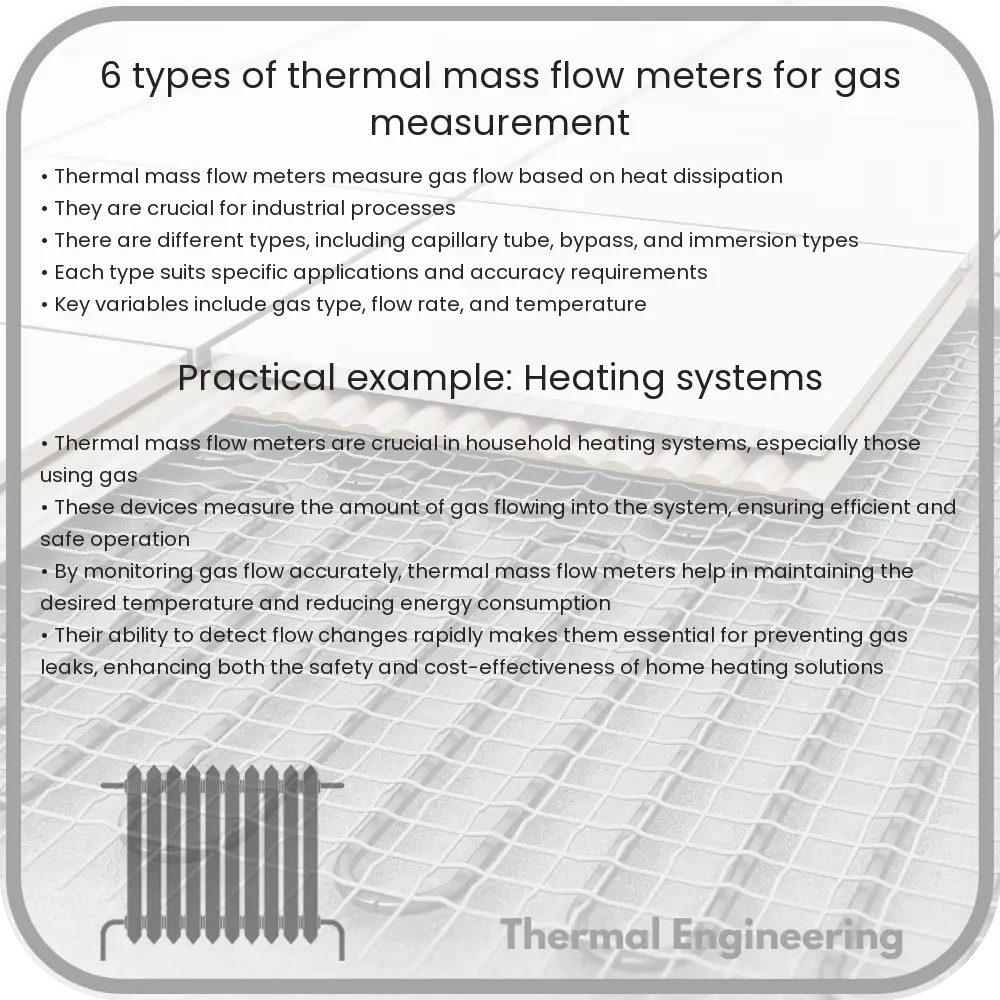
Thermal mass flow meters are essential devices used in various industries for the precise measurement of gas flow. Unlike other flow meters that measure the volumetric flow rate of a fluid, thermal mass flow meters measure the mass flow rate. This allows users to obtain direct readings of the mass flow without the need for additional temperature and pressure compensation. Thermal flow meters are particularly beneficial for applications involving gases where constant flow measurement is critical for optimal performance and safety.

How Thermal Mass Flow Meters Work

Thermal mass flow meters operate based on the principle of heat transfer. These devices typically consist of two sensors: a flow sensor placed in the path of the flowing gas and another sensor that measures the ambient temperature of the gas. The flow sensor is heated to a predetermined temperature above the ambient. As gas flows past this heated sensor, it carries away some of the heat. The amount of heat lost is directly proportional to the mass flow rate of the gas. By measuring this temperature difference and compensating for the ambient temperature, the device can accurately calculate the mass flow rate of the gas.

Types of Thermal Mass Flow Meters

1. Capillary Tube Thermal Mass Flow Meter

Capillary tube flow meters consist of a small diameter tube through which the gas passes. The heat is applied to the tube, and the temperature sensors are placed at specific points along the tube to measure the heat loss. This type is well-suited for low to medium flow rates and is highly accurate for these ranges.

2. Immersion Thermal Mass Flow Meter

Also known as an insertion thermal mass flow meter, this type is designed to be inserted directly into a wide pipe or duct. They are ideal for large-scale industrial applications where gas flows in large volumes. Their design allows them to be used in pipes with diameters significantly larger than those suitable for capillary tubes.

3. Inline Thermal Mass Flow Meter

Inline thermal mass flow meters are integrated directly into the pipeline, providing precise measurements for a wide range of flow rates. These meters are common in both industrial and laboratory settings due to their high accuracy and reliability.

4. Bypass Thermal Mass Flow Meter

In bypass thermal mass flow meters, a portion of the gas is diverted through a bypass line where the flow measurement takes place. This design allows the main flow to remain largely undisturbed while still providing accurate flow measurements, especially suitable for high flow rate applications.

5. Multi-Point Thermal Mass Flow Meter

Multi-point meters have several sensing points, typically inserted at various depths within a flow stream. This setup provides an average flow measurement which is particularly useful in large ducts or uneven flow profiles where single-point measurements might be insufficient.

6. Hot Wire Anemometers

Although primarily used for velocity measurements, hot wire anemometers indirectly measure mass flow by detecting the cooling effect of gas moving past a heated wire. They are highly sensitive and responsive, making them suitable for applications requiring fast response times and minimal flow disturbances.

Conclusion

Thermal mass flow meters are versatile tools in measuring gas mass flow rates across diverse applications. From laboratories to heavy industries, the different types of thermal mass flow meters cater to specific needs, ensuring precise and reliable measurements. Understanding the various types and their operation helps in selecting the right meter for specific applications, ultimately enhancing efficiency and safety in processes involving gas flows.

8 Types of Pyrometers for High-Temperature Monitoring

Learn about pyrometers, instruments designed for precise high-temperature measurement in industrial settings.

8 Types of Pyrometers for High-Temperature Monitoring

Understanding Pyrometers: 8 Types for High-Temperature Monitoring

Pyrometers are specialized instruments designed to measure high temperatures, typically in environments where conventional thermometers cannot function effectively. These devices are crucial in a variety of industrial applications such as metallurgy, manufacturing, and processing of materials where precise temperature monitoring is a priority. Here, we explore eight different types of pyrometers that cater to various high-temperature measurement needs.

1. Optical Pyrometer

An optical pyrometer, or radiation pyrometer, measures temperature from the visible radiation emitted by hot objects. The basic working principle is based on Planck’s Law, which describes the intensity of radiation as a function of temperature. Operators typically match the brightness of the target with an internal calibrated lamp to estimate the temperature visually.

2. Infrared (IR) Pyrometer

Infrared pyrometers calculate temperature by detecting infrared radiation emitted by an object. This type doesn’t require direct contact with the object, making it suitable for measuring moving targets or any surfaces that are difficult to reach. IR pyrometers are popular in industries that require rapid temperature measurements from a safe distance.

3. Fiber Optic Pyrometer

Fiber optic pyrometers are designed for environments where electromagnetic interference (EMI) might affect the accuracy of other types of pyrometers. By using a fiber optic cable to transmit radiation signals to a detector, these pyrometers eliminate the direct exposure of electronic components to high-temperature areas, thus providing highly accurate readings without EMI issues.

4. Two-Color Pyrometer

Two-color pyrometers, also known as ratio or dual-wavelength pyrometers, measure the temperature based on the ratio of radiation emitted at two different wavelengths. This method compensates for emissivity variations and partial view obstructions, which makes it highly effective in measuring the temperatures of metals and non-greybody materials.

5. Brightness Pyrometer

Brightness pyrometers are a type of single-wavelength optical pyrometer that focuses on the intensity of radiation at a particular wavelength to determine temperature. While simpler than two-color pyrometers, they require proper adjustment of emissivity settings to provide accurate readings.

6. Multispectral Pyrometer

This type measures temperature by analyzing radiation across multiple wavelengths. Multispectral pyrometers provide a more comprehensive analysis of an object’s emissive properties, which enhances temperature measurement accuracy in complex industrial environments.

7. Quartz Pyrometer

The quartz pyrometer utilizes a quartz rod that changes in optical transparency as it is heated. The degree of transparency is then used to deduce the temperature of the object being measured. This type of pyrometer is particularly useful in harsh conditions where other sensors might fail.

8. Thermocouple Pyrometer

Thermocouple pyrometers feature a junction of two different metals that produce a temperature-dependent voltage, which can be converted into a temperature reading using the Seebeck effect. While technically a direct contact method, these can be used to measure extremely high temperatures reliably.

Each type of pyrometer has its unique set of capabilities and limitations, making them suitable for specific applications and environments. Selecting the right pyrometer is critical for achieving accurate and reliable temperature measurements, which is essential for quality control and safety in any high-temperature industrial operation.

11 Types of Steam Turbines for Electricity Generation

Learn about the 11 different types of steam turbines used for efficient electricity generation in various power systems.

11 Types of Steam Turbines for Electricity Generation

Understanding the 11 Types of Steam Turbines for Electricity Generation

Steam turbines are a pivotal component in electricity generation, known for converting high-pressure steam’s kinetic energy into mechanical energy, which then drives electrical generators. This article explores the various types of steam turbines used in power stations around the world.

1. Impulse Turbines

Impulse turbines are characterized by the fact that the steam’s pressure is converted to velocity completely in the nozzles prior to reaching the rotor. These are typically used in applications requiring high-speed operation with lower pressure steam.

  • Single-stage Impulse Turbines: Use a single row of blades; they are used for small scale applications.
  • Multi-stage Impulse Turbines: Have multiple sets of nozzles and rotors that help in handling higher power requirements.

2. Reaction Turbines

In reaction turbines, both the rotor and stator blades act as nozzles. Steam expands as it passes through both, contributing to thrust as it imparts forces along the direction of flow.

  • Single-stage Reaction Turbines: These consist of a single rotor blade ring and typically function in low-pressure environments.
  • Multi-stage Reaction Turbines: Comprise several stages of rotor and stator blades, suitable for higher efficiency and larger scale power generation.

3. Condensing Turbines

These turbines exit steam in a partially condensed state, typically operating under vacuum at the exhaust. This maximizes the energy extraction and improves overall turbine efficiency.

4. Non-Condensing (Back-pressure) Turbines

Such turbines exhaust steam back into the process or the atmosphere at a pressure above the atmospheric pressure. They are ideal for cogeneration as both power and heat are utilized.

5. Extraction Turbines

Extraction steam turbines allow steam extraction at one or more stages between the high and low pressure sections of the turbine, suited for process heating at various pressures.

6. Induction Turbines

Induction turbines introduce additional steam at intermediate stages to produce extra power and control the mass flow rate throughout the turbine.

7. Regenerative Turbines

These utilize steam bled from various stages to preheat the boiler’s feedwater, which improves the efficiency of the cycle by reducing the required heating in the boiler.

8. Reheat Turbines

Reheat turbines enhance efficiency by reheating the steam between high-pressure and intermediate pressure stages during expansion.

9. Combined Cycle Turbines

In combined cycle systems, a gas turbine and a steam turbine are used in tandem to improve overall plant efficiency. The waste heat from the gas turbine is used to generate steam to power the steam turbine.

10. Cogeneration Turbines

Cogeneration or Combined Heat and Power (CHP) systems utilize the turbine exhaust to provide heat or steam for industrial processes, besides generating electricity.

11. Nuclear Steam Turbines

These are specifically designed to handle the steam generated by nuclear reactors. Nuclear steam turbines are typically very large and are tailor-made to suit the specific requirements of the nuclear power plant.

Each type of turbine offers distinct advantages and is chosen based on specific power generation needs, energy efficiency goals, and operational conditions. Understanding these variations helps in optimizing the design and operation of power generation facilities for enhanced performance and sustainability.

5 Types of Solar Thermal Collectors for Hot Water and Power

Learn about solar thermal collectors, their types like flat plate, evacuated tube, and others, and their applications in energy solutions.

5 Types of Solar Thermal Collectors for Hot Water and Power

Introduction to Solar Thermal Collectors

Solar thermal collectors are devices that capture solar energy and convert it into heat. This heat can then be used for various applications such as heating water, powering turbines for electricity production, and space heating. They are an effective way to harness renewable energy from the sun, reducing dependence on fossil fuels and decreasing greenhouse gas emissions. In this article, we’ll explore five primary types of solar thermal collectors commonly used for hot water and power generation.

1. Flat Plate Collectors

Flat plate collectors are among the most common types of solar thermal systems used for domestic hot water heating. These collectors consist of an insulated, weatherproofed box containing a dark absorber plate under one or more transparent or translucent covers. Water or heat-conductive fluid passes through tubes attached to the absorber plate, heating up as it moves. This design is simple, efficient, and suitable for residential or light commercial applications where temperatures up to 200°F are adequate.

2. Evacuated Tube Collectors

Evacuated tube collectors feature multiple cylindrical tubes, which house absorber plates inside. These tubes are evacuated of air, creating a vacuum that acts as an excellent insulator. This setup minimizes heat loss, making evacuated tube collectors more efficient than flat plate collectors, especially in colder climates. They can operate effectively even under gray skies and can be used for domestic hot water, space heating, and cooling purposes.

3. Parabolic Trough Collectors

Parabolic trough collectors consist of a linear parabolic reflector that focuses the sun’s energy onto a receiver pipe located at the reflector’s focal point. The concentrated solar energy heats the fluid flowing through the pipe. This technology is primarily used in industrial applications and large-scale power generation because it can achieve higher temperatures (up to 750°F), suitable for generating electricity through a steam turbine.

4. Fresnel Collectors

Fresnel collectors are similar to parabolic troughs but use flat or slightly curved mirrors segmented to focus sunlight onto a central receiver tube. These mirrors are cheaper to fabricate and install than full parabolic troughs and allow for more compact designs. Fresnel collectors are versatile in application, being used both for direct steam generation and combined heat and power solutions.

5. Solar Dish/Engine Systems

Solar dish/engine systems are point-focus collectors that track the sun using a dish-shaped parabolic reflector. They concentrate sunlight by a factor of 1,000 or more, making them extremely efficient for converting solar energy into heat and subsequently into electricity. The heat drives a Stirling engine or a steam turbine connected to an electric generator. These systems are highly efficient but typically used in specialized applications like remote off-grid locations or space applications due to their intricate tracking systems and high cost.

Conclusion

Solar thermal collectors are a crucial component of renewable energy architecture, offering diverse applications from simple water heating to complex power generation systems. Each type of solar collector has specific characteristics that make it suitable for different climatic conditions and use cases. By understanding the various types of collectors and their applications, stakeholders can make informed decisions about integrating solar thermal technology into their energy solutions.

7 Types of Heat Recovery Steam Generators (HRSG)

Learn about Heat Recovery Steam Generators (HRSG), their types, and applications in power generation and industrial processes.

7 Types of Heat Recovery Steam Generators (HRSG)

Understanding Heat Recovery Steam Generators (HRSG)

Heat Recovery Steam Generators (HRSGs) are critical components in the power generation and industrial processes, where they capture heat from hot gas streams, often from gas turbine exhaust, to generate steam efficiently. This steam is typically used for additional power generation in turbines, or for various industrial processes. Depending on their configuration and the specific requirements of the application, HRSGs come in different types, each with unique features and advantages. Here, we explore seven common types of HRSGs.

1. Horizontal Drum Units

Horizontal drum HRSGs feature drums that are placed horizontally. This design is commonly used in smaller units where space constraints are not a significant issue. They are simpler in design and generally cost less than other types. The natural circulation of water and steam flow helps in reducing pump requirements, which lowers operating costs.

2. Vertical Drum Units

In contrast to horizontal units, vertical drum HRSGs have drums that are oriented vertically. This configuration is beneficial in tight spaces where the footprint needs to be minimized. Vertical drum HRSGs are preferred in applications involving high-pressure and temperature steam. They facilitate better steam quality and reduce the risk of steam carryover.

3. Once-Through Units

Once-Through HRSGs (OTSG) do not use drums. Instead, they operate by feeding water directly through the boiler tubes, which turns into steam as it absorbs heat from the hot gases. An advantage of OTSGs is their ability to rapidly adjust to changes in steam demand, making them suitable for applications with highly variable loads. They are often used in combined cycle power plants.

4. Modular HRSGs

Modular HRSGs consist of several pre-assembled modules that can be easily transported and installed at the site. This pre-fabrication means the construction time at the actual location is significantly reduced. Modular HRSGs are especially useful in projects with limited site fabrication facilities or in remote locations.

5. Reheat Units

Reheat HRSGs have additional capabilities to reheat the steam after it expands through the high-pressure stage of a steam turbine. This reheating process increases the thermal efficiency of the cycle by allowing the steam to expand through additional stages of the turbine. Reheat HRSGs are particularly advantageous in high-efficiency power stations.

6. Cogeneration HRSGs

Cogeneration HRSGs are designed to maximize the production of both electricity and useful thermal energy from the same energy source. These are typically used in industries where both power and heat are required for processes. The configuration can vary depending on the precise thermal and power needs of the application.

7. Fresh Air Fired HRSGs

These HRSGs are unique in that they can operate even when the gas turbine is shut down. They have an integrated burner that can heat clean air to generate steam. Especially useful during maintenance periods of gas turbines, or when additional steam is needed, fresh air fired HRSGs provide high flexibility in operations.

Each type of HRSG is tailored for specific operational needs, whether it’s for power generation, industrial use, or both. By understanding the differences and applications of these HRSGs, one can better optimize their process or power generation capabilities, contributing to overall efficiency and sustainability.

4 Types of Heat Sinks for Electronic Device Cooling

Learn about the role and types of heat sinks in electronic device cooling, including stamped, extruded, machined, and forged options.

4 Types of Heat Sinks for Electronic Device Cooling

Understanding Heat Sinks: An Essential Component for Electronic Device Cooling

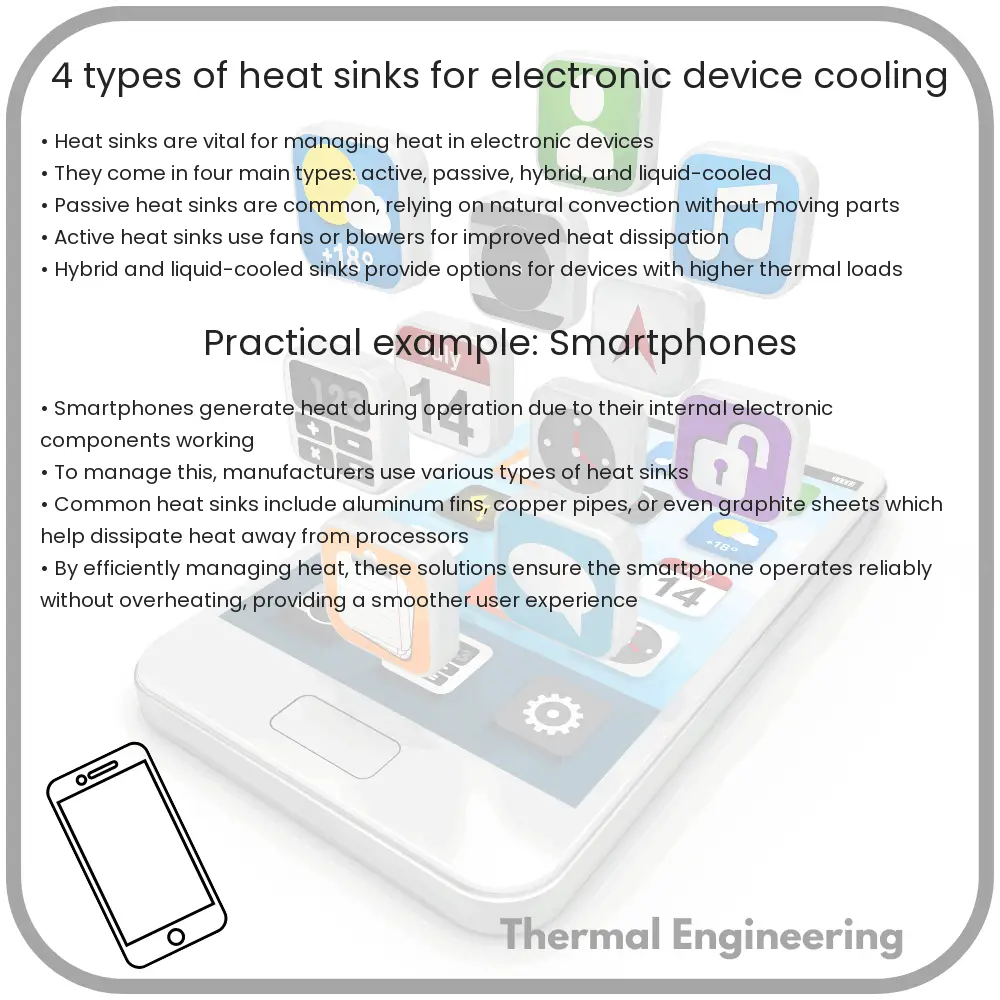
Heat sinks play a critical role in managing the heat generated by electronic devices. By efficiently dissipating unwanted thermal energy, they maintain the device’s operation within safe temperature limits, enhancing performance and extending lifespan. This article explores four common types of heat sinks used in electronic cooling, each suited to different types of applications and thermal demands.

1. Stamped Heat Sinks

Stamped heat sinks are made from metals such as aluminum or copper using a stamping process. Simple and cost-effective, they are commonly found in consumer electronics where moderate cooling is sufficient. These heat sinks usually feature a flat base with an array of thinly stamped fins. Despite their lower thermal conductivity compared to other types, they are suitable for low power applications such as voltage regulators, RAM modules, and low-power CPUs.

2. Extruded Heat Sinks

Extruded heat sinks are one of the most popular and versatile types. The process involves pushing heated metal through a shaped die to form elongated fins. Aluminum, owing to its good balance of conductivity and cost, is typically used. Extruded heat sinks can be easily customized in terms of fin density, shapes, and thickness, making them ideal for mid-range power applications in computer CPUs, LED lighting, and power transistors. The effectiveness of these heat sinks can be enhanced by increasing fin surface area and optimizing airflow around the fins.

3. Machined Heat Sinks

Machined heat sinks are created through processes such as milling, turning, or CNC machining, allowing for complex and intricate designs. This type provides the highest level of detail and is excellent for applications requiring precise dimensions and high performance. These are particularly useful for high power electronics and situations where the heat sink must fit into a small or irregularly shaped area. Due to the labor-intensive process, machined heat sinks are more expensive but offer superior cooling capabilities through optimization of fin geometry and surface finish.

4. Forged Heat Sinks

Forged heat sinks involve compressing metal to form a dense, high-strength end product. Forging improves the thermal conductivity by aligning the metal grains, which enhances heat dissipation. These heat sinks are used in rugged applications such as industrial machines and high-performance computing where durability and high thermal conductivity are paramount. Forged heat sinks can be designed with pin fins or radial fin structures to maximize air contact and improve cooling performance.

Choosing the Right Heat Sink

Selecting the appropriate type of heat sink depends on various factors including thermal requirements, space constraints, budget, and specific application needs. For instance, stamped and extruded heat sinks are more cost-effective for consumer electronics, while machined and forged options are better suited for high-performance and specialized equipment. Understanding these distinctions helps in making an informed decision to ensure efficient heat management in electronic devices.

By balancing factors such as cost, size, thermal conductivity, and manufacturing complexity, engineers can select the most suitable heat sink type to enhance the performance and durability of electronic systems.