Facebook Instagram Youtube Twitter

9 Types of Industrial Ovens for Heat Treatment Processes

Learn about the various types of industrial ovens used in heat treatment processes, from batch to infrared ovens.
9 Types of Industrial Ovens for Heat Treatment Processes

Understanding 9 Types of Industrial Ovens for Heat Treatment Processes

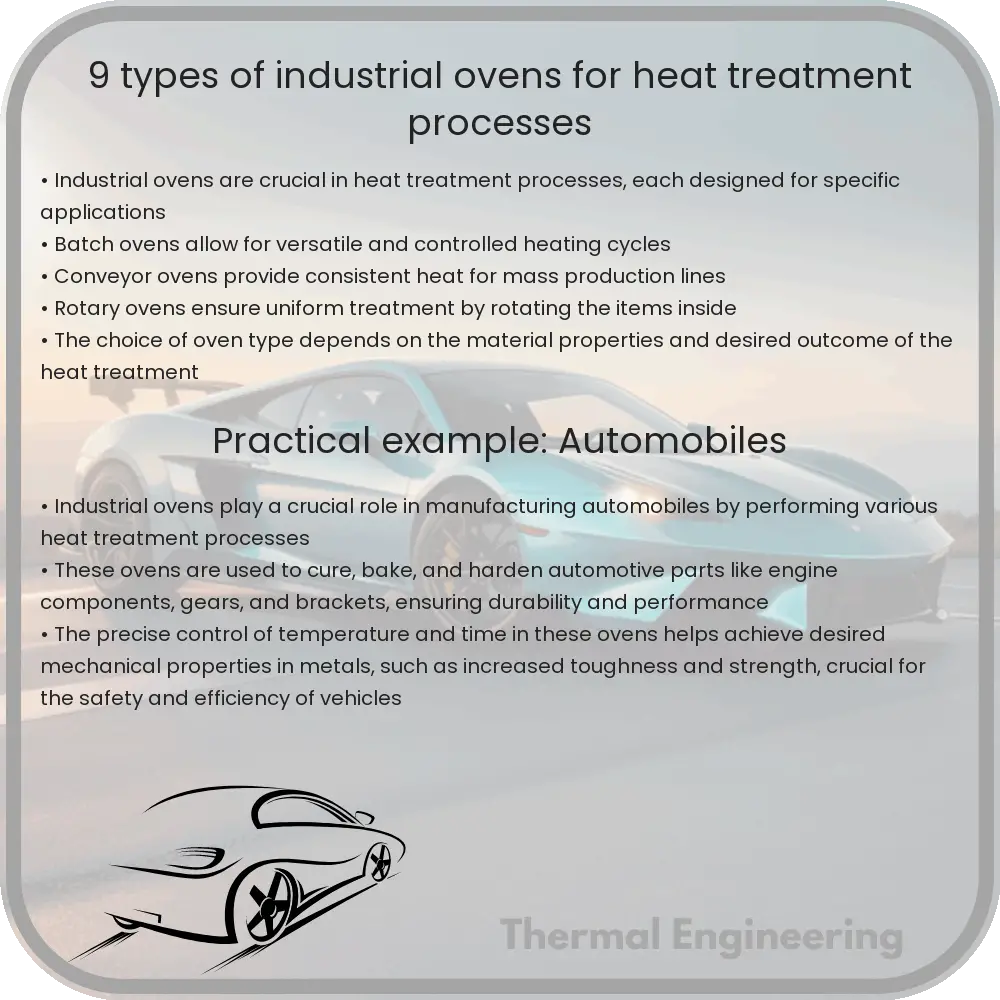
Industrial ovens are essential tools in many manufacturing processes where heat treatment is required. These ovens are used to alter the physical, and sometimes chemical, properties of a material. Here, we explore nine common types of industrial ovens used for heat treatment, each suited to specific tasks and materials.

1. Batch Ovens

Batch ovens are versatile and commonly used in industrial settings where different heat treatment processes are carried out intermittently. Materials or products are loaded into the oven, processed, and then removed before a new batch is introduced. This type of oven is ideal for curing, drying, aging, and other heat treatments at various temperatures.

2. Conveyor Ovens

Conveyor ovens allow for continuous processing, making them suitable for mass production. Products move through the oven on a conveyor belt, ensuring consistent treatment across large volumes of products. They are often used in the food industry, as well as for drying, curing, or heat-treating metals and plastics.

3. Drying Ovens

Drying ovens precisely remove moisture from the materials inside. They are widely used in the paint industry to remove solvents from coatings and in the electronics industry to remove moisture from components before further processing.

4. Curing Ovens

Curing ovens are designed to cause a chemical reaction in a material once a specific temperature is reached. They are commonly used for curing painted or coated surfaces, adhesives, and composites, ensuring that the finished products are hard and durable.

5. Annealing Ovens

Annealing ovens are used to heat materials, typically metals or glass, and then allow them to cool slowly to remove internal stresses and improve ductility. This heat treatment process is crucial for materials that need to be soft enough to undergo further machining or shaping.

6. Tempering Ovens

Following processes like hardening, tempering ovens are used to decrease the brittleness of metals. Materials are heated to a temperature below their critical point, held at this temperature, and then cooled. This procedure improves the toughness of the product.

7. Vacuum Ovens

Vacuum ovens operate in a vacuum environment where air and other gases are removed from the processing chamber. This type of oven is used in delicate processes where oxidation needs to be avoided, such as in electronics and aerospace applications.

8. Clean Room Ovens

Used in environments where contamination must be minimized, clean room ovens support processes such as baking, drying, and curing in semiconductor manufacturing, biotechnology, and pharmaceutical industries.

9. Infrared Ovens

Infrared ovens use infrared radiation to heat objects directly without heating the surrounding air. This efficient method is quick and can be precisely controlled. It is ideal for processes like drying paint quickly or heating plastics.

Conclusion

Understanding the different types of industrial ovens helps in selecting the right oven for a specific heat treatment process. Each type offers distinct advantages, depending on the material properties and the desired outcome of the heat treatment process. Proper selection ensures not only efficiency but also product quality and process reliability.

8 Types of Combustion Analyzers for Boiler Efficiency

Learn about combustion analyzers used to optimize boiler efficiency, reduce emissions, and ensure safety in various applications.

8 Types of Combustion Analyzers for Boiler Efficiency

Understanding Boiler Efficiency Through Combustion Analyzers

Boilers are critical components for heating systems in industries, power plants, and residential structures. To ensure they operate efficiently and minimize environmental impact, maintaining optimal combustion is essential. This is where combustion analyzers come into play. They are designed to measure and help adjust the combustion process in boilers and furnaces. Here are eight types of combustion analyzers that are frequently used to assess boiler efficiency:

1. Oxygen (O2) Analyzers

Oxygen analyzers measure the percentage of O2 in the exhaust gases. By determining the oxygen level, technicians can adjust the air-to-fuel ratio to achieve efficient combustion, which leads to energy savings and reduced emissions. Monitoring O2 levels helps prevent either too rich or too lean combustion, which can be inefficient or even harmful.

2. Carbon Dioxide (CO2) Analyzers

Carbon dioxide levels in the flue gases are a direct indicator of combustion efficiency. A higher concentration of CO2 usually signifies better efficiency as more fuel is burned completely. CO2 analyzers help in determining the optimum combustion at which the maximum possible fuel is converted into usable energy, reducing wastage and emissions.

3. Carbon Monoxide (CO) Analyzers

Monitoring carbon monoxide is crucial as it indicates incomplete combustion. High CO levels suggest that not all the fuel is being burned completely, which not only wastes fuel but also creates dangerous emissions. CO analyzers are vital in tuning the burners to reduce CO levels and enhance fuel efficiency.

4. Nitrogen Oxides (NOx) Analyzers

Nitrogen oxides are harmful pollutants, and their emission needs to be controlled. NOx analyzers help measure the levels of nitrogen oxides in the flue gases, which is essential for complying with environmental regulations and for implementing nitrogen control technologies effectively.

5. Sulfur Dioxide (SO2) Analyzers

Similar to NOx, sulfur dioxide is another crucial pollutant emitted during combustion, especially when burning sulfur-containing fuels. SO2 analyzers determine the concentration of sulfur dioxide in the exhaust, aiding in adjusting the combustion process or in the installation of appropriate scrubbers.

6. Combustible Analyzers

These analyzers detect the presence of potentially hazardous explosive gases in the flue. The presence of such gases can indicate serious safety issues. Combustible analyzers are important for preventing accidents and for ensuring that the combustion is complete.

7. Efficiency Analyzers

Efficiency analyzers typically combine several measurements like O2, CO2, and temperature to calculate the overall efficiency of the boiler. These devices play an integral role in energy management and in identifying heat loss or unnecessary fuel consumption.

8. Multigas Analyzers

Multigas analyzers can measure multiple gases like O2, CO, CO2, NOx, and SO2 simultaneously. These devices provide a comprehensive analysis of the combustion process and are particularly useful for adjusting the boiler operation to achieve optimal performance and compliance with environmental standards.

Understanding the different types of combustion analyzers and their applications in boiler efficiency can significantly help in optimizing fuel usage, reducing operational costs, and minimizing environmental impact. Regularly using these analyzers forms a crucial part of boiler maintenance and management strategies.

10 Types of Temperature Controllers for Process Industries

Explore different types of temperature controllers used in process industries, from PID to cryogenic models, for optimal safety and efficiency.

10 Types of Temperature Controllers for Process Industries

10 Types of Temperature Controllers for Process Industries

Temperature control is a pivotal aspect of modern industrial processes, ensuring product quality, safety, and energy efficiency. From chemical processing to food production, temperature controllers regulate heating and cooling, optimizing operations and preventing equipment damage. Here’s an overview of ten prevalent types of temperature controllers used in process industries.

1. On-Off Controllers

The simplest form of temperature control, on-off controllers, operate by switching the heat source on or off once the temperature crosses a set threshold. It is often used for applications where precise temperature control is not critical.

2. PID Controllers

Proportional-Integral-Derivative (PID) controllers are the most versatile type of temperature controller. They calculate an error value as the difference between a measured temperature and a desired setpoint. The controller attempts to minimize the error by adjusting the process control inputs. PID controllers are used when precise temperature control is essential and can manage systems with varying characteristics.

3. Proportional Controllers

Proportional controllers adjust the output to the heater or cooler in proportion to the error between the setpoint and the process temperature. Unlike PID controllers, they do not account for error history or potential future errors, leading to a steady state error called ‘offset’.

4. Multi-Loop Controllers

Multi-loop controllers are used when multiple temperatures need to be controlled simultaneously. Each loop operates independently, managing different parts of the process. This type is suitable for large, complex processes such as power generation or petrochemical refining.

5. PLC-Based Controllers

A Programmable Logic Controller (PLC) based system provides flexibility and functionality for complex control strategies. PLCs can handle multiple input and output arrangements, controlling several process variables—including temperature—as part of a broader automated system.

6. Solid State Relay Controllers

Solid state relay (SSR) controllers use semiconductor devices to switch the heating elements under control. These are particularly appreciated in applications requiring rapid switching and precision due to their fast response times and durability.

7. Distributed Control System (DCS) Based Controllers

DCS-based controllers are employed in large-scale industrial environments needing high reliability and complex control networking. These systems integrate temperature control functions with other process variables within a singular control architecture.

8. Thyristor Controllers

Thyristors control electrical power through phase angle firing methods and are often used in electric heating applications where high currents are involved. They provide finer control over heat output by adjusting the voltage applied to the heating element.

9. Thermal Mass Flow Controllers

Used primarily in gas heating applications, thermal mass flow controllers integrate temperature control with flow rate regulation, ensuring consistent heat treatment processes irrespective of variations in gas supply conditions.

10. Cryogenic Temperature Controllers

Designed specifically for very low temperature applications, cryogenic controllers are used in processes such as frozen food processing or in scientific experiments that require maintaining substances at extremely low temperatures.

Each type of temperature controller has its advantages and limitations, making certain types more suitable for specific applications. The selection depends on factors such as the required precision, speed, complexity of the process, and environmental conditions. Understanding the properties and functionalities of different temperature controllers can significantly enhance the efficiency, safety, and cost-effectiveness of industrial operations.

5 Types of Thermoelectric Generators for Waste Heat Recovery

Learn about thermoelectric generators (TEGs) and their role in converting waste heat into electricity across various applications.

5 Types of Thermoelectric Generators for Waste Heat Recovery

Introduction to Thermoelectric Generators for Waste Heat Recovery

Thermoelectric generators (TEGs) are devices that convert heat directly into electricity using the Seebeck effect. They are becoming increasingly popular for waste heat recovery applications, allowing industries to improve efficiency and reduce energy consumption by harvesting energy that would otherwise be lost. This article explores five types of thermoelectric generators employed to harness waste heat effectively.

1. Bulk Thermoelectric Generators

Bulk thermoelectric generators are the most traditional form of TEGs, made from solid pieces of thermoelectric materials. These devices typically use bismuth telluride or lead telluride. The primary advantage of bulk TEGs is their robustness and high reliability over a broad temperature range. They are commonly used in automotive and industrial applications where large amounts of waste heat are generated.

2. Micro Thermoelectric Generators

Micro thermoelectric generators are designed for applications with smaller heat sources or where space and weight are critical considerations. These generators use microfabrication techniques to create miniature TEG units. Micro TEGs are ideal for portable and wearable technology, enabling the recovery of body heat or small-scale industrial processes.

3. Flexible Thermoelectric Generators

Flexible thermoelectric generators are an innovative adaptation, where the thermoelectric material is incorporated into a flexible substrate. This adaptability allows the TEGs to be used on uneven surfaces or integrated into clothing as wearable technology. Though not as efficient as their rigid counterparts, their versatility opens up numerous new applications, particularly in health monitoring and consumer electronics.

4. Thin Film Thermoelectric Generators

Thin film thermoelectric generators utilize thermoelectric materials deposited in thin layers onto a substrate. These types of TEGs can be produced using cost-effective manufacturing processes similar to those used in semiconductor production. Thin film TEGs are suitable for applications requiring high precision and integration density, such as in microprocessors and other compact electronics where waste heat is available.

5. Quantum Well Thermoelectric Generators

Quantum well thermoelectric generators employ the principles of quantum mechanics to enhance thermoelectric performance. These generators use multiple quantum wells that confine charge carriers to two-dimensional planes, increasing the Seebeck coefficient and hence the overall efficiency of the device. While still at a comparatively early stage of development, quantum well TEGs hold promise for high-efficiency heat-to-electricity conversion.

Conclusion

Each type of thermoelectric generator offers distinct advantages depending on the specific requirements of the application, including temperature range, size constraints, and power needs. As technology progresses, the efficiency and applications of TEGs expand, promising significant contributions towards sustainable energy solutions by efficiently utilizing waste heat. Continued advancement in material science and manufacturing techniques will further enhance the viability and performance of these fascinating devices.

9 Types of Thermal Fluid Heaters for Process Heating

An overview of nine common types of thermal fluid heaters used in industrial process heating.

9 Types of Thermal Fluid Heaters for Process Heating

9 Types of Thermal Fluid Heaters for Process Heating

Thermal fluid heaters are an essential component in various industrial applications where uniform heating is required. These systems utilize thermal fluids to transfer heat to the necessary parts of the process. Understanding the different types of thermal fluid heaters can help in selecting the right one for specific industrial needs. Here, we explore nine common types of thermal fluid heaters used in process heating.

1. Electric Thermal Fluid Heaters

Electric thermal fluid heaters use electric elements to heat the fluid, providing a clean and efficient source of heat. These are particularly suitable for small to medium applications where pollution or flue gas restrictions are in place.

2. Gas-Fired Thermal Fluid Heaters

These heaters use natural gas or other flammable gases as the fuel to heat the thermal fluid. Gas-fired heaters are known for their high efficiency and fast heating capabilities, making them ideal for large-scale operations.

3. Oil-Fired Thermal Fluid Heaters

Using oil as a fuel, these heaters are similar to gas-fired types but are often used where gas may not be available. They can be slightly less efficient than gas-fired heaters but are valued for their robust performance under varying operational conditions.

4. Biomass Thermal Fluid Heaters

Biomass heaters burn renewable organic materials like wood chips, pellets, or agricultural waste to heat the thermal fluid. They are seen as a sustainable option and are popular in industries looking to reduce their carbon footprint.

5. Coal-Fired Thermal Fluid Heaters

These are traditional heaters that use coal as the primary fuel. They are generally used in industries where coal is an economical choice. However, due to environmental concerns, their use is declining in many regions.

6. Indirect Fired Heaters

Indirect fired heaters use a secondary fluid to transfer heat to the primary thermal fluid. This design avoids combustion byproducts mixing with the thermal fluid. It’s useful in sensitive applications where fluid contamination must be avoided.

7. Solar Thermal Fluid Heaters

Leveraging solar energy, these heaters use solar panels to gather heat and transfer it to the thermal fluid. They are highly sustainable but depend significantly on the availability of sunlight.

8. Waste Heat Recovery Heaters

Waste heat recovery units utilize the excess heat from industrial processes or equipment to heat the thermal fluid. This type of heater is highly efficient and can significantly reduce energy costs by recycling heat that would otherwise be lost.

9. Portable Thermal Fluid Heaters

These are compact and mobile heaters designed for temporary heating needs or where fixed heating installations are not feasible. They are often used in construction sites and temporary processing units.

Conclusion

Thermal fluid heaters are vital in many industries like chemical processing, oil and gas, textiles, and plastics manufacturing. Each type of thermal fluid heater offers unique features and benefits, making it essential to choose the right one based on specific heating requirements, cost, efficiency, and environmental impact. By understanding the various options available, businesses can optimize their process heating needs effectively and sustainably.

6 Types of Infrared Heaters for Efficient Heating Solutions

Learn about infrared heaters, their types like ceramic and quartz, and their efficient heating applications for various environments.

6 Types of Infrared Heaters for Efficient Heating Solutions

Understanding Infrared Heaters: An Efficient Heating Solution

Infrared heaters are a popular choice for efficient heating, as they work by emitting infrared radiation that directly heats objects and people within its path. Unlike traditional heating systems that heat the air, infrared heaters provide direct, immediate warmth, making them both energy-efficient and effective. There are several types of infrared heaters available, each suited to different applications and environments.

Types of Infrared Heaters

1. Near Infrared (Short Wave or IR-A)

Near infrared heaters, also known as short wave or IR-A heaters, operate at high temperatures and emit a light that is slightly visible (a reddish glow). They are commonly used in industrial applications, outdoor heating, and in processes that require intense, direct heat such as in some manufacturing processes.

2. Medium Wave Infrared Heaters

Medium wave infrared heaters are suitable for both indoor and outdoor settings. They operate at lower temperatures compared to near infrared heaters and emit a softer glow. Common applications include heating in workshops, patios, and garages, offering a good balance between efficiency and comfort.

3. Far Infrared (Long Wave or IR-C)

Far infrared heaters, or long wave heaters, produce no visible light and provide heat that feels similar to the warmth of the sun. These heaters are particularly popular in residential settings for room heating and in spaces requiring gentle, sustained warmth. They are highly valued for their ability to heat efficiently without disrupting the ambiance of the space.

4. Ceramic Infrared Heaters

Ceramic infrared heaters use ceramic elements to emit far infrared radiation. These heaters are commonly used in household and office environments because they offer a very efficient and even distribution of heat. They are also employed in industrial processes where controlled heating is crucial.

5. Quartz Infrared Heaters

Quartz infrared heaters contain an element encased in a quartz glass tube. The quartz element enhances the intensity of the heat emitted, making these heaters suitable for spaces that require quick and intense heating. Applications include outdoor dining areas and commercial spaces that need rapid heat recovery.

6. Carbon Infrared Heaters

Carbon infrared heaters use carbon fibers encased in tubes to produce infrared heat. These heaters are known for their efficiency, emitting heat that penetrates more deeply than other infrared heaters. They are ideal for applications that benefit from deep, penetrating warmth, such as therapeutic settings and some industrial processes.

Choosing the Right Infrared Heater

The selection of an infrared heater depends largely on the context and specific needs of the space. Factors such as the size of the area, the desired intensity of the heat, exposure to environmental elements, and the presence of sensitive equipment or materials can influence which type of infrared heater is best suited for a particular situation.

Infrared heating technology offers efficient solutions across a variety of applications, from industrial and commercial to residential settings. Understanding the different types of infrared heaters helps in choosing the most effective and economical heating solution for your needs.

3 Types of Thermal Switches for Temperature Control

Learn about thermal switches, essential for controlling temperatures in devices, featuring types like bimetallic, fluid expansion, and electronic switches.

3 Types of Thermal Switches for Temperature Control

Understanding Thermal Switches

Thermal switches are crucial components in various devices where temperature control is essential. They are designed to respond to temperature changes by opening or closing an electrical circuit. This functionality is widely used in appliances, HVAC systems, and industrial machinery to protect equipment and enhance safety by preventing overheating or maintaining a specific temperature range. There are several types of thermal switches available, each suitable for different applications based on their mechanism and response to temperature changes.

1. Bimetallic Thermal Switches

Bimetallic thermal switches operate based on the principle of differential thermal expansion. These switches consist of two metals with different thermal expansion coefficients bonded together. As temperature changes, the differential expansion of the metals causes the bimetallic strip to bend. This bending action either opens or closes the electrical circuit.

  • Advantages: Simple design, reliable, and cost-effective. They function without the need for any external power source.
  • Disadvantages: These switches have a slow response time and might not be suitable for precise temperature control requirements.

2. Fluid Expansion Thermal Switches

Fluid expansion thermal switches utilize a sealed bellows or diaphragm filled with a fluid that expands or contracts with temperature changes. The expansion of the fluid exerts pressure on the diaphragm, which then moves to open or close the circuit. These switches can be designed to react to specific temperature thresholds quite accurately.

  • Advantages: They provide more precise temperature control and can be configured for narrow temperature ranges.
  • Disadvantages: More complex and expensive than bimetallic switches, and they may require maintenance due to fluid leakage risks.

3. Electronic Thermal Switches

Electronic thermal switches use sensors coupled with electronic circuits to detect temperature changes. Commonly, they incorporate thermistors or resistance temperature detectors (RTDs) to sense the temperature. The electronic circuit processes the sensor input and acts on a predefined threshold by opening or closing a solid-state relay or other electronic switching mechanism.

  • Advantages: High accuracy, repeatability, and the ability to handle rapid temperature changes. They can also be integrated into more complex digital control systems.
  • Disadvantages: Generally, they require a power source, are more expensive, and more susceptible to electromagnetic interference than other types of thermal switches.

Conclusion

Choosing the right type of thermal switch depends on specific application requirements such as temperature range, response speed, cost, and system integration needs. Bimetallic switches are suited for general applications where cost and simplicity are crucial, while fluid expansion switches fit applications requiring precise control. For high-tech systems requiring accuracy and integration with digital controls, electronic thermal switches are preferred. Understanding these options helps in selecting the most appropriate thermal switch for effective and efficient temperature management in any system.

5 Types of Thermodynamic Vent Systems for Gas Release

Explore the functionalities and applications of thermodynamic vent systems for safe gas release in industrial settings.

5 Types of Thermodynamic Vent Systems for Gas Release

Understanding Thermodynamic Vent Systems for Gas Release

Thermodynamic vent systems are crucial in various industrial applications, particularly for safe and efficient gas release in environments like chemical plants, refineries, and power stations. These systems are designed to control the pressure and temperature of gases, preventing equipment damage and enhancing operational safety. Here, we explore five types of thermodynamic vent systems that play a vital role in handling gas emissions.

1. Pressure Relief Valves (PRVs)

Pressure Relief Valves are one of the most common types of safety devices found in industrial settings. They automatically release gas when the pressure within a vessel exceeds the valve’s design threshold. This release prevents potential damage or explosions that could occur from overpressure conditions. PRVs are commonly used in boilers, gas storage tanks, and pipelines.

2. Vacuum Relief Valves

Vacuum relief valves are designed to admit gas into a system when the internal pressure drops below the atmospheric pressure, preventing a vacuum that could damage the system’s structure. These are essential in tank systems where liquid extraction can significantly reduce internal pressure, potentially causing structural collapse.

3. Pilot Operated Relief Valves (PORVs)

A Pilot Operated Relief Valve is a type of pressure relief valve where the major relieving action is controlled by the pressure in a pilot valve rather than by direct spring pressure. This design allows for more accurate control over the opening and closing of the valve, which is beneficial in systems where precise pressure maintenance is critical. PORVs are particularly useful in gas processing systems where variances in pressure can affect the quality or safety of the processed product.

4. Safety Relief Valves

Safety relief valves are essential for both liquid and gas systems, designed to open at a preset pressure and temperature. They combine the functions of a pressure relief valve with the ability to respond to excessive system temperature. Safety relief valves are crucial in preventing overpressure and overheating, particularly in systems like steam boilers.

5. Bursting Discs

Bursting discs are not technically valves but serve a similar purpose in pressure relief. These devices are designed to rupture at a predetermined pressure, providing an instant and effective way to relieve pressure. Bursting discs are often used in conjunction with relief valves, serving as a fail-safe: if the valve fails to open, the disc will burst at a slightly higher pressure, ensuring the system’s safety. They are commonly used in situations where a rapid pressure release is necessary to avert a crisis.

Each of these thermodynamic vent systems plays a crucial role in maintaining safety and efficiency in industrial operations. By understanding their functionalities and applications, engineers and operators can implement the most appropriate systems to meet specific operational needs, thus ensuring both safety and performance optimization.

Temperature effects on hydraulic fracturing

Explore how temperature affects hydraulic fracturing efficiency, impacting fluid viscosity, rock brittleness, and chemical reactions.

Temperature effects on hydraulic fracturing

Understanding the Impact of Temperature on Hydraulic Fracturing

Hydraulic fracturing, often referred to as “fracking,” is an engineering process used to extract oil and gas from rock formations deep underground. This method has significantly increased the accessibility of hydrocarbons trapped in shale formations and contributed to a boom in oil and gas production. A critical aspect that influences the efficiency and success of hydraulic fracturing is temperature. The temperature of the rock formation, the fracturing fluids, and the surface environment all play pivotal roles in how effectively this process can be conducted.

The Role of Temperature in Hydraulic Fracturing

Temperature deeply influences various physical and chemical properties of materials and fluids used in hydraulic fracturing, impacting both the process and the outcome.

  • Viscosity of Fracturing Fluids: The viscosity of the fluids used in fracking, which often include water, sand, and chemicals, is highly sensitive to temperature. Higher temperatures generally decrease the viscosity of these fluids, allowing them to flow more easily through the rock. Conversely, lower temperatures increase fluid viscosity, potentially hindering the fluid flow and thereby affecting the efficiency of the fracture propagation.
  • Rock Brittleness: Rock brittleness is a crucial factor for successful fracturing; it determines how easily a rock can fracture. Temperature variation affects the brittleness of the rock. In general, colder temperatures can make rocks more brittle and easier to fracture. However, excessive cold can also lead to undesirable rock behavior.
  • Chemical Reactions: The chemical reactions that take place between fracturing fluids and rock formations can be influenced by temperature fluctuations. Some reactions may speed up with an increase in temperature, potentially affecting the integrity of the shale and the performance of the proppants used to keep fractures open.

Temperature Control in Hydraulic Fracturing Operations

Maintaining an optimal temperature during hydraulic fracturing operations is essential for maximizing the efficiency and effectiveness of the extraction process. Operators often use various strategies to manage temperature effects:

  1. Choice of Fracturing Fluids: Engineers select fluid compositions that are tailored to perform under specific temperature conditions anticipated in the geological formation.
  2. Heating or Cooling Systems: In environments with extreme temperatures, either heaters or coolers are used to regulate the temperature of the fracturing fluids before injection.
  3. Real-time Monitoring and Adjustment: Advanced monitoring technologies allow for real-time tracking of temperature and other critical parameters. Adjustments can be made on the fly to adapt to unexpected changes in formation temperature.

Case Studies and Practical Implications

Several case studies have demonstrated the importance of temperature management in hydraulic fracturing. For instance, in colder climates like Canada’s oil sands, special measures are often necessary to ensure that fracturing fluids do not freeze or become too viscous, thus hampering flow and effectiveness. Conversely, in hot climates, such as in some Middle Eastern oil fields, high ambient temperatures can lead to rapid increases in fluid temperatures, which may reduce fluid viscosity too much and affect the transport of sand within the fluid.

Conclusion

Temperature plays a significant and multifaceted role in hydraulic fracturing. Understanding and managing temperature effects are crucial for optimizing this complex engineering process. Through the correct choice of materials, the use of technology for monitoring and controlling temperature, and the application of well-planned operational strategies, the challenges posed by temperature variations can be effectively managed, leading to more efficient and successful hydraulic fracturing operations.

7 Types of Heat Sealers for Packaging Applications

Learn about the different types of heat sealers used in packaging applications to seal plastics and other materials efficiently.

7 Types of Heat Sealers for Packaging Applications

Understanding the Different Types of Heat Sealers for Packaging Applications

Heat sealers are essential tools in the packaging industry, used to seal various types of packaging materials, primarily plastics. They work by applying heat and pressure to melt the plastic, thereby creating airtight seals that prevent the contents from exposure to air, moisture, and contaminants. There are several types of heat sealers available, each suited for different packaging needs and materials. Here, we explore seven common types of heat sealers used in packaging applications.

1. Impulse Heat Sealers

Impulse heat sealers are one of the most popular types of sealers used for lightweight and medium-weight materials like polyethylene and polypropylene bags. These devices heat up only when the sealing arm is lowered onto the bag, which helps save energy. The sealer delivers a quick impulse of heat, melts the plastic together, and then cools down immediately, making it ideal for low to moderate volume packaging operations.

2. Continuous Band Sealers

Continuous band sealers are ideal for sealing thermoplastic materials at high speeds, which makes them suitable for high-volume packaging operations. These machines continuously move the bag through a conveyor system where it is sealed by heating elements. They can handle various bag sizes and are often used in industries such as food, agriculture, and pharmaceuticals.

3. Hand Sealers

Hand sealers are manually operated and are great for small-scale or occasional sealing tasks. They are portable, affordable, and simple to use, requiring the operator to press the sealing arm against the bag. Hand sealers are typically used for poly bags and are popular in small businesses and residential settings.

4. Foot Sealers

Foot sealers allow the operator to keep both hands free to handle the product being sealed, which can enhance productivity. These devices are operated by a foot pedal, providing better control and support, especially for heavy or large packages. They are commonly used in mid- to high-volume applications.

5. Automatic Sealers

Automatic sealers are designed for continuous, high-efficiency operations where minimal human intervention is desired. These machines automatically feed the material, seal it, and sometimes even trim the excess plastic. They are perfect for industries requiring consistent, high-speed sealing such as food packaging and electronics.

6. Vacuum Sealers

Vacuum sealers not only seal bags but also remove the air inside them prior to sealing. This process extends the shelf life of food products and protects sensitive components from atmospheric damage in industrial applications. Vacuum sealers typically require specific types of vacuum bags but are essential for preserving perishable goods.

7. Specialty Sealers

This category includes a variety of sealers designed for specific materials or applications, such as medical pouch sealers or sealers for heavy-duty laminates. Specialty sealers often meet precise industry standards and regulations, ensuring that packaging is compliant and secure for sensitive or hazardous materials.

In conclusion, choosing the right type of heat sealer depends on your specific needs, including the type of material being sealed, the speed of operations, and the scale of production. Whether for individual use, small businesses, or industrial applications, there’s a heat sealer designed to meet the challenge effectively and efficiently.