Facebook Instagram Youtube Twitter

3 Types of Heat Pumps for Sustainable Heating and Cooling

Explore the efficiency and environmental benefits of heat pumps, essential for sustainable heating and cooling in modern buildings.
3 Types of Heat Pumps for Sustainable Heating and Cooling

Understanding Heat Pumps: Sustainable Solutions for Heating and Cooling

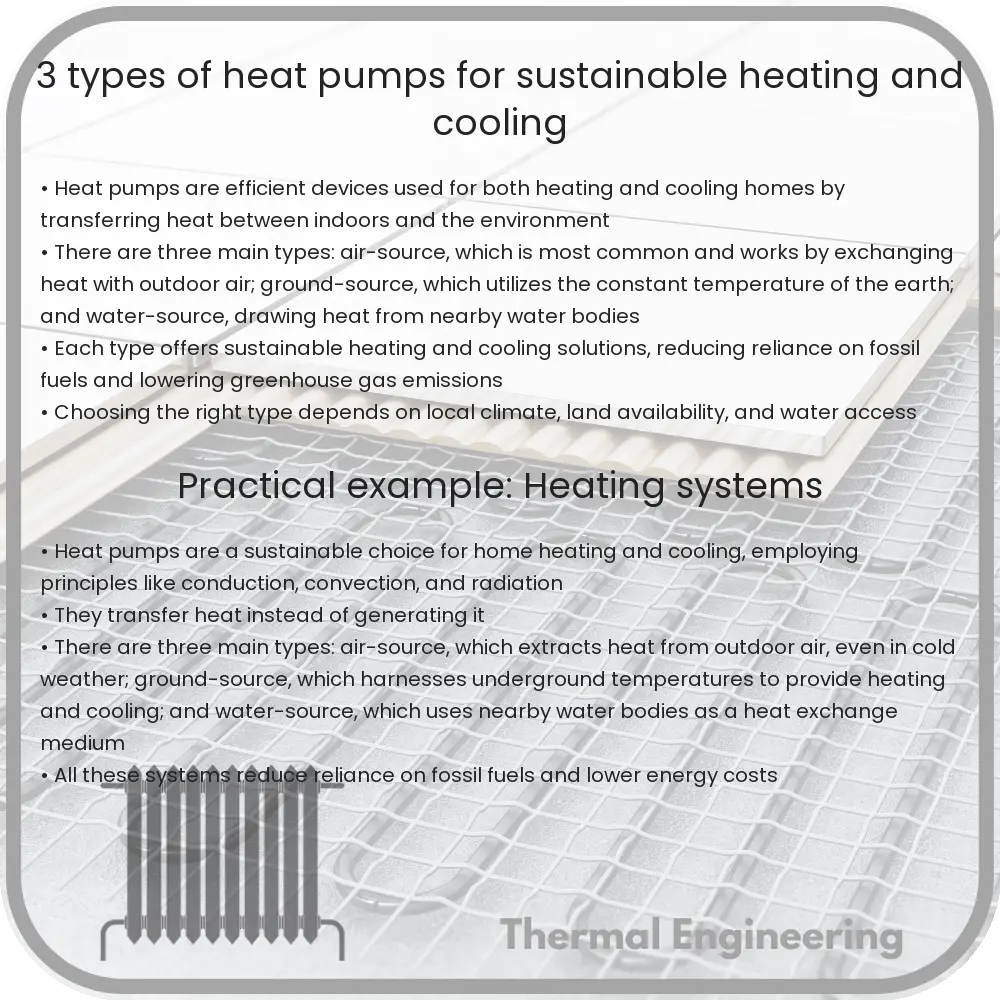
Heat pumps are an essential component of modern sustainable building practices, offering efficient heating and cooling by transferring heat rather than generating it directly. This capability not only makes heat pumps an environmentally friendly choice but also a cost-effective one. They come in various types designed to suit different climatic conditions and building requirements. Let’s explore three common types of heat pumps: Air Source Heat Pumps, Water Source Heat Pumps, and Ground Source Heat Pumps.

Air Source Heat Pumps (ASHPs)

Air Source Heat Pumps are among the most widely used heat pumps due to their simplicity and cost-effectiveness. They extract heat from the outdoor air even in cold temperatures. An ASHP consists of two main components: a condenser placed inside the building and an evaporator located outside. During winter, the ASHP extracts heat from the outside air and transfers it inside. Conversely, in summer, the process reverses, allowing the ASHP to cool the building by removing heat from the interior.

  • Advantages: Easy to install and less expensive than other types of heat pumps. They require minimal ground space and are suitable for a wide range of properties.
  • Disadvantages: Efficiency can decrease in extremely cold climates and may require supplemental heating. They can also be noisier than other types of heat pumps.

Water Source Heat Pumps (WSHPs)

Water Source Heat Pumps operate on a similar principle to ASHPs but use water as the heat exchange medium instead of air. WSHPs are typically used in buildings located near a body of water, such as lakes, rivers, or ponds. These heat pumps pump water through a closed loop submerged in the water source, extracting heat in winter for heating and discharging heat in summer for cooling.

  • Advantages: More consistent performance year-round due to the moderate temperature of water sources compared to air.
  • Disadvantages: The installation can be more complex and expensive, requiring access to a suitable water source and sometimes environmental permits.

Ground Source Heat Pumps (GSHPs)

Also known as geothermal heat pumps, Ground Source Heat Pumps use the earth’s relatively stable underground temperature to provide heating, cooling, and hot water. The system involves a network of pipes, known as a ground loop, buried in the ground near the building. The loop contains a mixture of water and antifreeze, which absorbs underground heat and transfers it to the heat pump and then into the building.

  • Advantages: Extremely efficient and can reduce energy use by 30%-60%, lower maintenance costs, and have a lifespan of as much as 50 years for the underground components.
  • Disadvantages: High initial installation costs are often prohibitive, and significant yard space is needed for the ground loop system.

Heat pumps represent a pivotal technology in the push towards reducing carbon emissions and achieving energy efficiency in buildings. Whether you choose an air, water, or ground source system, a heat pump offers a compelling alternative to traditional heating and cooling systems, playing a crucial role in sustainable development.

6 Types of Condensers in Thermal Power Plants

Learn about the different types of condensers used in thermal power plants, including surface, jet, and evaporative condensers, and their roles in enhancing efficiency.

6 Types of Condensers in Thermal Power Plants

Understanding the Types of Condensers in Thermal Power Plants

In thermal power plants, condensers play a crucial role in converting steam from turbines back into liquid water. This process is vital as it enhances the efficiency of the power plant by allowing the steam to be reused. Condensers help in maintaining a low pressure at the exhaust of the steam turbine, which significantly improves the thermodynamic efficiency of the system. Here, we explore six common types of condensers used in thermal power plants and their distinctive features.

1. Surface Condensers

Surface condensers are widely used in thermal power plants. In these types of condensers, steam and cooling water do not mix directly. The steam flows over the outer surface of the tubes within which the cooling water is circulated. The primary advantage of surface condensers is that they prevent boiler water contamination, leading to cleaner and more efficient steam cycles. They typically feature large heat transfer areas and are used extensively in large power plants.

2. Jet Condensers (Direct Contact Type)

Jet condensers, also known as direct contact type condensers, bring the exhaust steam and cooling water into direct contact. This interaction typically occurs in a cone or a series of plates where the cooling water is sprayed directly into the steam, causing condensation. These condensers are appreciated for their simplicity and low capital cost. There are sub-types within jet condensers:

  • Low level jet condenser: All the components are installed at a lower level, and the condensate is required to be pumped out.
  • High level jet condenser: Installed at a higher level, it utilizes gravity to discharge the condensate naturally.
  • Barometric or ejector condenser: Featuring a long vertical discharge pipe, this design uses atmospheric pressure and gravity to aid in the discharge of condensate.

3. Evaporative Condensers

Evaporative condensers combine air and water cooling. In these units, the cooling water is sprayed on the coils through which the steam passes. Simultaneously, air is blown through the condenser to evaporate the water, removing heat from the system. This type is particularly effective in areas where water supply is limited and provides efficient cooling by utilizing the latent heat of vaporization of water.

4. Regenerative Condensers

Regenerative condensers enhance the thermal efficiency by using the heat absorbed during the condensation process to preheat the feedwater entering the boiler. This heat recovery process not only conserves energy but also significantly improves the overall efficiency of the plant. The design and operational complexity of these condensers are higher, but they offer substantial long-term benefits.

5. Air-Cooled Condensers

Unlike other types that rely on water for cooling, air-cooled condensers use air. These are essentially made up of finned tubes over which air is blown or forced, thereby condensing the steam inside the tubes. This type is particularly useful in regions where water resources are scarce. However, their efficiency depends highly on the ambient air conditions.

6. Water-Cooled Condensers

These condensers use water as the primary cooling medium. The water absorbs the heat from the steam, causing it to condense. The heated water is then either cooled for reuse or discharged as waste. Water-cooled condensers are effective but require a continuous and ample supply of cooling water, making them less suitable for areas with water shortages.

Conclusion

Choosing the right type of condenser for a thermal power plant depends on several factors including local environmental conditions, water availability, space constraints, and efficiency requirements. Understanding the different types of condensers and their operations helps in optimizing the design and operation of thermal power plants, thus enhancing their performance and sustainability.

8 Types of Refrigeration Units for Commercial Use

Guide to eight common types of commercial refrigeration units and their uses in various industries.

8 Types of Refrigeration Units for Commercial Use

8 Types of Refrigeration Units for Commercial Use

Refrigeration is critical in various sectors, including food service, pharmaceuticals, and agriculture, for preserving and storing products at optimal temperatures. For enterprises seeking efficient and reliable cooling solutions, understanding the different types of commercial refrigeration units is essential. Each type serves a particular purpose and comes with its own set of benefits. Here’s a guide to the eight common types of refrigeration units used in commercial settings.

1. Reach-In Refrigerators and Freezers

Reach-in refrigerators and freezers are among the most common refrigeration units found in nearly every commercial kitchen. Designed for easy access to food products, these units have one or more doors that staff can open to retrieve ingredients quickly. They are ideal for storing perishable goods at consistent temperatures.

2. Walk-In Coolers and Freezers

For businesses that require more storage space than provided by reach-in units, walk-in coolers and freezers are an excellent option. These large refrigeration systems are constructed on-site and can be customized to fit the available space and specific temperature needs. They are widely used in restaurants, grocery stores, and warehouses.

3. Display Refrigerators

Display refrigerators are designed to showcase merchandise while keeping it at a safe temperature. These are commonly found in cafes, bakeries, and convenience stores. The glass doors or open fronts allow customers to view and access the products easily, helping to boost sales.

4. Undercounter Refrigerators

Undercounter refrigerators offer space-saving solutions for tight spaces. They can be fitted under counters (as the name suggests), providing easy access to ingredients in a small footprint. These units are ideal for bars, small cafes, and food trucks.

5. Bar Refrigeration

Bar refrigeration units include back bar coolers, beer dispensers, and wine coolers, specifically designed to cool beverages. These units typically come with features like adjustable shelves, glass doors, and internal lighting to enhance display aesthetics and functionality.

6. Merchandiser Refrigerators

Merchandiser refrigerators are similar to display refrigerators but are typically larger and exclusively geared towards retail environments. These units have powerful lighting and clear doors to enhance product visibility, driving impulse purchases in grocery or convenience stores.

7. Prep Tables

Prep tables combine a work surface with refrigerated storage below, providing a convenient space to prepare meals while keeping ingredients fresh. These are essential in pizza shops, sandwich shops, and any setting where quick assembly of ingredients is necessary.

8. Blast Chillers

Blast chillers are specialized refrigeration units designed to quickly lower the temperature of food. By rapidly cooling food items, these chillers effectively reduce the risk of bacterial growth, making them an essential unit in commercial kitchens that prioritize food safety.

Choosing the right refrigeration unit for a business depends not only on the type of products it stores but also on the space available, the volume of goods, and specific industry requirements. By understanding the different types of refrigeration units and their applications, businesses can make informed decisions that ensure efficiency and compliance with safety standards.

4 Types of Thermocouples for High-Temperature Measurement

Learn about thermocouples, their types, composition, and applications for high-temperature measurement in industrial settings.

4 Types of Thermocouples for High-Temperature Measurement

Understanding Thermocouples for High-Temperature Measurement

Thermocouples are a widely used type of temperature sensor for measurement and control and are particularly common in industrial settings. These devices consist of two different types of wires, joined at one end, which produce a voltage when heated that can be correlated directly to temperature. Thermocouples are favored for their ability to measure a wide range of temperatures, especially high temperatures. Below, we explore four key types of thermocouples used in high-temperature applications.

1. Type K Thermocouple (Nickel-Chromium/Nickel-Alumel)

  • Composition: This type consists of a nickel-chromium alloy wire (chromel) and a nickel-alumel alloy wire.
  • Temperature Range: -270°C to +1372°C (-454°F to 2501°F).
  • Applications: Due to its reliability and precision within a vast range of temperatures, Type K is extensively used in ovens, furnaces, and other industrial processes.
  • Advantages: It is relatively inexpensive, widely available, and provides strong accuracy and repeatability in measurements above 0°C.

2. Type J Thermocouple (Iron/Constantan)

  • Composition: It uses iron and constantan (a copper-nickel alloy) wires.
  • Temperature Range: -210°C to +1200°C (-346°F to 2192°F).
  • Applications: Commonly used for vacuum, oxidizing, reducing, and inert atmospheres, but the presence of iron limits its usage in high-humidity environments due to rusting.
  • Advantages: Good sensitivity (approximately 50 µV/°C), making it suitable for a variety of applications.

3. Type S Thermocouple (Platinum Rhodium/Platinum)

  • Composition: Comprised of platinum-rhodium (10% rhodium) and pure platinum.
  • Temperature Range: Up to +1768°C (+3214°F).
  • Applications: Typically used in bio-pharmaceutical processing and in kilns for firing ceramics due to its high level of stability and accuracy under severe environments.
  • Advantages: Highly stable and suitable for very high temperatures with good repeatability.

4. Type R Thermocouple (Platinum Rhodium-13%/Platinum)

  • Composition: This thermocouple type has a similar make-up to Type S but uses a slightly higher percentage of rhodium in the platinum-rhodium alloy wire.
  • Temperature Range: -50°C to +1768°C (-58°F to 3214°F).
  • Applications: High-temperature applications in industrial and laboratory environments.
  • Advantages: Provides very accurate readings and good stability at high temperatures, and is less susceptible to contamination compared to Type S.

To ensure accuracy and longevity of a thermocouple, it is crucial to choose the right type based on the specific environment and temperature range of the application. In addition, installation considerations such as the length of the thermocouple wires, the type of thermowell used, and proper calibration are vital to get precise temperature measurements.

In conclusion, understanding the properties and appropriate usages of different thermocouple types is essential for effective high-temperature measurement, ensuring both the safety and efficiency of industrial processes.

10 Types of Heat Exchangers for Efficient Heat Transfer

Explore various heat exchangers like shell and tube, plate, and spiral types that enhance energy efficiency and reduce industrial costs.

10 Types of Heat Exchangers for Efficient Heat Transfer

10 Types of Heat Exchangers for Efficient Heat Transfer

Heat exchangers are critical components in industrial, residential, and environmental systems, allowing for the efficient transfer of heat between two or more fluids. By selecting the right type of heat exchanger, industries can maximize energy efficiency, reduce costs, and enhance system performance. Below, we explore ten types of heat exchangers commonly used across various applications.

1. Shell and Tube Heat Exchanger

One of the most common types, the shell and tube heat exchanger, consists of a series of tubes, one set carrying the hot fluid while the other carries the cold fluid. The tubes are encased in a shell where heat transfer occurs. The design is versatile and suitable for high-pressure applications.

2. Plate Heat Exchanger

Plate heat exchangers are made up of multiple thin, slightly separated plates that have very large surface areas and fluid flow passages for heat transfer. This setup is known for its high heat transfer efficiency, compact size, and lower cost.

3. Air Cooled Heat Exchanger

Utilizing ambient air to cool the fluid, air cooled heat exchangers are typically used when a cooling water source is not available. They are commonly seen in vehicle radiators and air conditioning systems.

4. Double Pipe Heat Exchanger

This type is one of the simplest forms of heat exchangers, consisting of one pipe within another. One fluid flows through the inner pipe and the other flows through the annular space between the two pipes, facilitating heat transfer. They are used for applications requiring a small amount of heat transfer.

5. Plate and Shell Heat Exchanger

Combining elements of plate heat exchangers and shell and tube, this type provides high heat transfer efficiency with a compact size. It can operate under high temperatures and pressures, making it suitable for challenging industrial applications.

6. Spiral Heat Exchanger

A spiral heat exchanger consists of a pair of plates rolled into a spiral. This design allows handling of tough fluids that might clog or foul other types of exchangers. Additionally, they offer a high heat transfer efficiency and are easy to clean.

7. Finned Tube Heat Exchanger

Finned tube exchangers enhance heat transfer by increasing the surface area on the tube’s exterior. These types of exchangers are often used in applications involving gas where the heat transfer coefficient of the gas side is generally lower than the liquid side.

8. Microchannel Heat Exchanger

These involve small channels through which the heat transfer fluid flows. Their compact size and enhanced heat transfer capabilities make them suitable for applications like refrigeration, air conditioning systems, and automotive cooling.

9. Graphite Heat Exchanger

Known for their corrosion resistance, graphite heat exchangers are employed in handling corrosive materials. They are most commonly used in industries involving acids and corrosive substances.

10. Condensers and Evaporators

While technically functioning as specific applications of heat exchangers, condensers and evaporators are crucial in thermal systems. Condensers are used to convert vapor into liquid (releasing heat), and evaporators are used for the opposite process (absorbing heat).

In summary, understanding the different types of heat exchangers and their applications can drastically improve the decision-making in system design, ensuring energy-efficient and cost-effective solutions.

5 Types of Thermal Regenerators in Industrial Applications

Learn about thermal regenerators, devices that enhance energy efficiency by recovering heat from exhaust gases in various industrial processes.

5 Types of Thermal Regenerators in Industrial Applications

Introduction to Thermal Regenerators

Thermal regenerators are devices used in various industrial applications to recover heat from exhaust gases. They temporarily store the heat from the hot gases and then transfer it to the incoming colder air or gas stream, improving energy efficiency and reducing operational costs. Different types of regenerators are employed depending on the specific requirements of the application. Here, we explore five common types of thermal regenerators utilized in industry.

1. Fixed Bed Regenerators

Fixed bed regenerators consist of a stationary matrix made out of materials like metal or ceramic, which has good heat storage capacity. Hot exhaust gases pass through the matrix, transferring their heat to the material. Once sufficiently heated, the flow is reversed, allowing cold incoming gases to absorb the heat from the matrix. Fixed bed regenerators are commonly used in applications where gas flow can be periodically reversed, making them ideal for cyclic operations.

2. Rotary Regenerators

Also known as rotary heat exchangers or Ljungström regenerators, rotary regenerators are characterized by a large rotating wheel or disk coated with a heat-absorbing material. As the wheel rotates, one segment passes through the hot exhaust stream, absorbing heat, while another segment moves into the incoming cooler stream, releasing the stored heat. This continuous rotation allows for a near-continuous exchange of heat. Rotary regenerators are highly efficient and are commonly used in power generation and large-scale HVAC systems.

3. Falling Bed Regenerators

Falling bed regenerators involve the motion of solid particles, typically ceramic or metal, which fall through a hot gas stream, capturing heat as they descend. These heated particles are then lifted and allowed to fall through a cooler, incoming gas stream, thereby transferring the heat to this stream. This type of regenerator is particularly suited for processes where solid particles can also serve as catalysts, such as in certain chemical manufacturing processes.

4. Fluidized Bed Regenerators

In fluidized bed regenerators, a bed of small solid particles is suspended within a stream of gas. The gas both heats and agitates the particles, effectively fluidizing them. Heat is transferred to the particles, which is then transferred to a cooler gas stream passing through the bed. Fluidized bed regenerators are used in applications requiring high rates of heat transfer and are common in chemical processing and combustion processes.

5. Spray Regenerators

Spray regenerators utilize a liquid, typically water, which is sprayed into a hot gas stream. The water absorbs heat from the gas, partially evaporating in the process. The heated water vapor or mist is then directed to heat the incoming gas stream. Spray regenerators are not as common as the other types but are used in specific situations where adding humidity to the incoming gas is beneficial and where other regenerative methods might be impractical.

Conclusion

Thermal regenerators play a crucial role in enhancing energy efficiency in industrial applications. The choice of regenerator depends on factors such as the nature of the gas streams, the required heat transfer efficiency, and the physical layout of the plant. By selecting the appropriate regenerator type, industries can significantly reduce energy costs and contribute to environmental conservation.

7 Types of Boilers Used in Power Generation

Learn about seven key types of boilers used in power generation, each tailored for specific performance and efficiency needs.

7 Types of Boilers Used in Power Generation

7 Types of Boilers Used in Power Generation

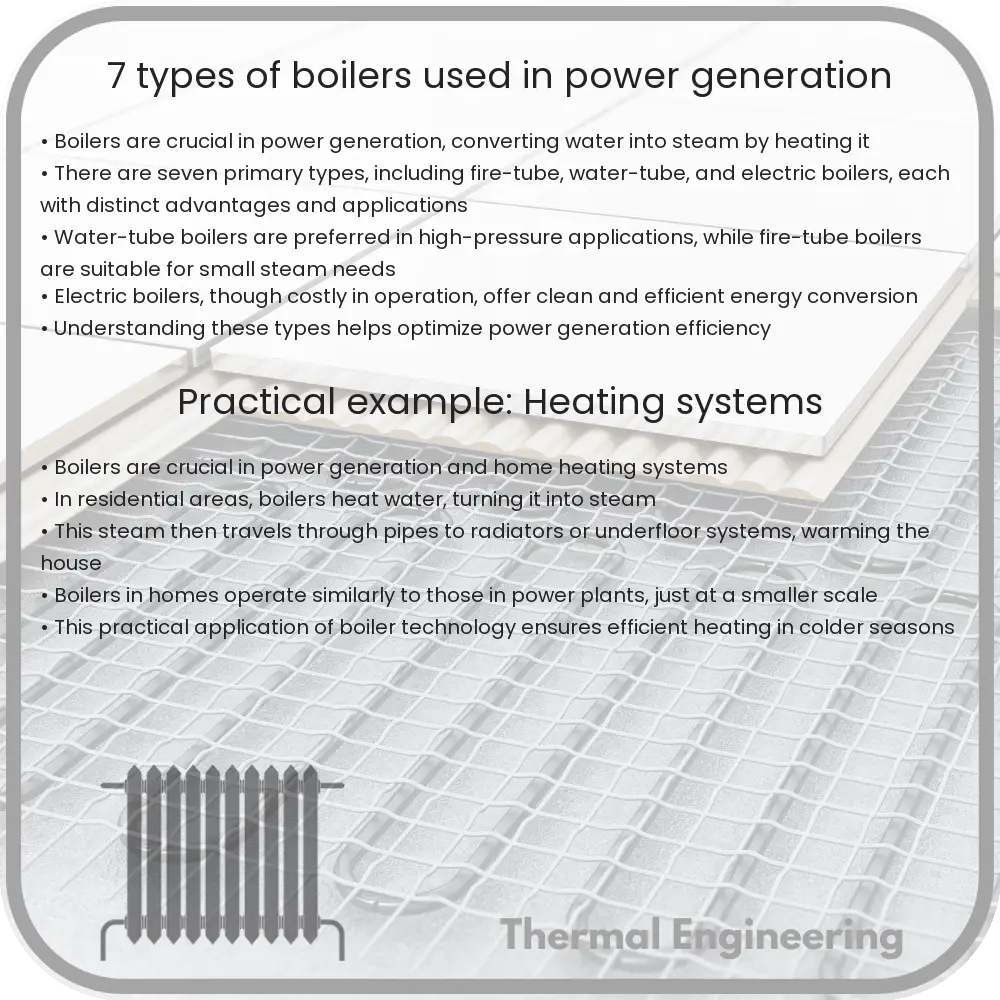
Boilers are fundamental to power generation, converting water into steam which then drives turbine generators to produce electricity. Various types of boilers have been developed to suit different requirements and operating conditions. Here, we discuss seven prominent boiler types used in the power generation industry. Each boiler type exhibits unique features tailored for specific functionalities and energy efficiency.

1. Fire-Tube Boiler

In fire-tube boilers, hot gases pass through one or more tubes, which run through a sealed container of water. The heat from the gases is transferred through the walls of the tubes by thermal conduction, heating the water and ultimately creating steam. This type of boiler is typically used in lower-pressure applications.

2. Water-Tube Boiler

Unlike fire-tube boilers, in water-tube boilers, water flows inside the tubes and is heated by external combustion gases that envelope the tubes. This design is suitable for high-pressure applications and large power outputs because water-tube boilers are able to produce steam at higher pressures and rates.

3. Packaged Boiler

These are small water-tube boilers, generally used when demand is not very high and space is limited within the plant. They come packaged from the manufacturer with all the components needed for the operation, making them easy to transport and install.

4. Stoker Fired Boiler

Stoker-fired boilers were a popular choice in the 20th century, particularly for residential heating. Coal is burned on a grate, which allows air to pass up through it, facilitating combustion. These boilers are more adaptable to different types of fuel and are known for their robust operation.

5. Pulverized Fuel Boiler

Most commonly used in large power plants, pulverized fuel boilers finely grind coal into a powder form. This allows it to burn more efficiently as air and fuel interact closely together. The finely ground coal powder is blown into the combustion chamber and burns at high temperature.

6. Fluidized Bed Boiler

An innovative type of boiler, the fluidized bed boiler, uses the principle of fluidized bed combustion to enhance the heat output and thermal efficiency. It features furnaces that contain very small particles of, for example, limestone or sand, which are suspended in an upward flowing stream of hot air and combustion gases. This setup allows for excellent heat transfer and efficiency.

7. Heat Recovery Steam Generator (HRSG)

This type of boiler is used predominantly in combined cycle power plants. These boilers are designed to recover heat from the exhaust of gas turbines, increasing overall efficiency. HRSGs produce steam by harnessing heat waste, which could otherwise be lost, from the gas turbine exhaust.

Each type of boiler plays a crucial role in power generation, their design and operational characteristics geared towards optimizing efficiency, performance, and longevity. Understanding these differences helps in selecting the appropriate boiler for each power generation application.

8 Types of Heat Transfer Coefficients and Their Calculation

Learn about heat transfer coefficients, essential for designing efficient thermal systems, and explore their calculation methods.

8 Types of Heat Transfer Coefficients and Their Calculation

Understanding Heat Transfer Coefficients

Heat transfer coefficients play a crucial role in engineering applications, helping to quantify the rate at which heat energy is transferred between surfaces or fluids differing in temperature. Understanding and calculating these coefficients is essential for designing efficient heating, cooling, and insulation systems. This article explores eight types of heat transfer coefficients and their calculation methods.

1. Overall Heat Transfer Coefficient (U)

The overall heat transfer coefficient represents the total resistance to heat transfer, encompassing conduction, convection, and radiation across a composite wall or heat exchangers. It is calculated by:

  • Identifying the individual heat transfer coefficients and the thermal resistances of different layers.
  • Calculating the reciprocal of the sum of all resistances. The formula is:

    U = 1 / (1/h1 + dk/K + 1/h2)

    where h1 and h2 are the surface heat transfer coefficients, dk is the thickness of the layer, and K is the thermal conductivity.

2. Convective Heat Transfer Coefficient (h)

Convective heat transfer coefficient is used to calculate the rate at which heat is transferred from a solid surface to a fluid or from a fluid to a fluid. Different scenarios use various empirical correlations based on Nusselt number (Nu), Reynolds number (Re), and Prandtl number (Pr). A common formula for forced convection is:

Nu = 0.023 * Re0.8 * Pr0.4

Here, h = Nu * k / L where k is the thermal conductivity of the fluid and L is the characteristic length.

3. Film Heat Transfer Coefficient

This coefficient refers to the heat transfer at the interface of a fluid and a solid surface under the influence of a thin fluid layer or “film. The calculation is similar to the convective heat transfer coefficient but typically applies to scenarios like condensation or boiling where a film is formed.

4. Radiative Heat Transfer Coefficient (hr)

Radiative heat transfer coefficient quantifies the rate of thermal radiation exchange between bodies. It depends on factors like the Stefan-Boltzmann constant and emissivity. The formula is:

hr = ε * σ * (T14 – T24) / (T1 – T2)

where ε is the emissivity, σ is the Stefan-Boltzmann constant, and T1, T2 are the absolute temperatures of the bodies.

5. Individual Heat Transfer Coefficient

This refers to the heat transfer coefficient of a single phase of matter, either in a mixture or in a single-phase system, where interactions with other phases are not considered.

6. Local Heat Transfer Coefficient

Local heat transfer coefficient varies over the surface of the heat exchanger or contact surface. It is crucial for understanding heat transfer distributions and is often determined through empirical or numerical analysis in localized regions.

7. Average Heat Transfer Coefficient

This coefficient is the mean value of the local heat transfer coefficients over a defined area or volume. It provides a simplified overall heat transfer rate, useful for basic engineering calculations when detailed local variations are less critical.

8. Mass Transfer Coefficient

Although not directly a heat transfer coefficient, the mass transfer coefficient is analogous in mass transfer operations. It is used to calculate the rate of mass transfer from one phase to another, which can be critical in heat transfer processes involving phase change.

Each type of heat transfer coefficient serves a different function and requires distinct calculation methods. Selecting the appropriate type and accurately calculating it are fundamental for the successful design and operation of thermal systems in engineering.

12 Types of Thermodynamic Potentials and Their Uses

Learn about thermodynamic potentials, key concepts in energy system analysis, used in chemistry and engineering.

12 Types of Thermodynamic Potentials and Their Uses

Understanding Thermodynamic Potentials and Their Various Types

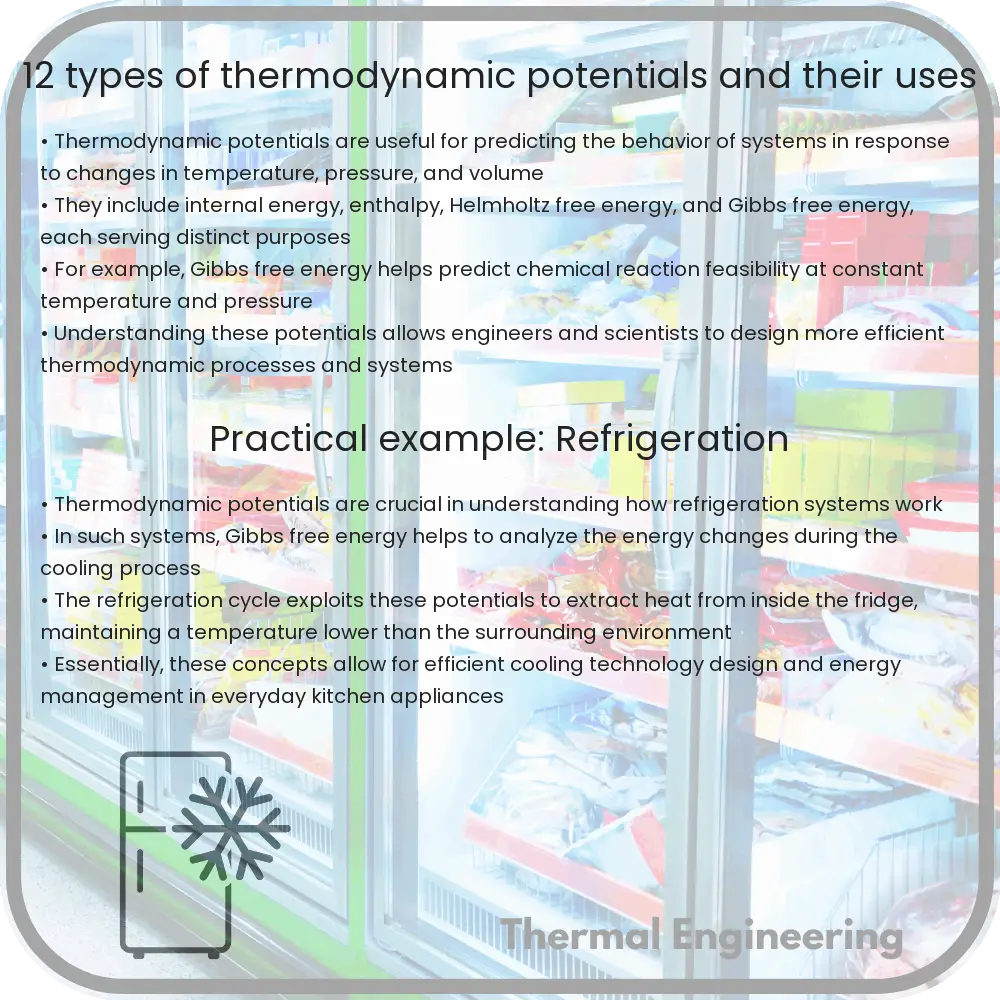
Thermodynamic potentials are essential concepts in the field of thermodynamics and physical chemistry, providing valuable insights into energy transformations and equilibrium within physical systems. These potentials are particularly useful in applications ranging from chemical reactions to phase changes and condition monitoring in various engineering systems. This article will explore the 12 types of thermodynamic potentials and their specific uses in different contexts.

1. Internal Energy (U)

Internal Energy (U) is the most fundamental thermodynamic potential, which includes the total energy contained within a system. It is the sum of all kinetic and potential energies of the molecules in the system. The internal energy can be used to analyze closed systems where no matter is transferred, only energy in the form of work or heat.

2. Enthalpy (H)

Enthalpy (H) is defined as H = U + PV, where P is the pressure and V is the volume of the system. It is particularly useful in processes that occur at constant pressure, such as chemical reactions in open-air scenarios. Enthalpy changes are involved in measuring heat transfer during phase changes and chemical reactions under constant pressure.

3. Helmholtz Free Energy (F)

Helmholtz Free Energy (F) is described by the equation F = U – TS, where T represents temperature and S entropy. This potential is critical for studying systems at constant temperature and volume. It determines whether a process is spontaneous, with decreasing F indicating a favourable or spontaneous process.

4. Gibbs Free Energy (G)

Gibbs Free Energy (G) is given by G = H – TS. It is one of the most important potentials in chemistry and chemical engineering because it allows the analysis of chemical reactions and phase changes at constant temperature and pressure, common conditions in many practical applications. A decrease in G during a process signals spontaneity.

5. Landau Potential (Ω)

Landau Potential, or Grand Potential (Ω), is calculated as Ω = U – TS – μN, where μ represents the chemical potential, and N the number of particles. It is extremely useful in statistical mechanics and scenarios where the particle number can vary, such as in open systems connected to a particle reservoir.

Others

In addition to these five primary thermodynamic potentials, there are additional derivatives used for more specific or complex situations. These include:

  • Massieu Function (ψ): ψ = -F / T, useful in scenarios where entropy needs to be derived from Helmholtz energy.
  • Planck Potential: This is a lesser-known potential used in special theoretical circumstances.
  • Grand Canonical Enthalpy: A derivative that combines properties of Gibbs and Grand Potential for open systems at constant pressure.
  • Other canonical potentials: These are used in specific thermodynamic contexts and obtained by Legendre transformations of the main potentials.

Practical Applications

These thermodynamic potentials are crucial in various engineering disciplines including chemical engineering, materials science, mechanical engineering, and environmental engineering. They help engineers design more efficient chemical processes, HVAC systems, engines, and even predict the behavior of novel materials under different environmental conditions.

Understanding the specific conditions and characteristics of each thermodynamic potential allows scientists and engineers to select the most appropriate model for their specific application, leading to innovations and advancements in technology and materials management.

In summary, thermodynamic potentials are indispensable tools in the analysis of energy systems. They provide the foundation for much of our modern technological society, from industrial manufacturing processes to energy systems and beyond.

9 Types of Cooling Curves in Material Science

Explore the nine types of cooling curves in material science, essential for analyzing phase transitions and thermal behaviors as materials solidify.

9 Types of Cooling Curves in Material Science

Understanding the 9 Types of Cooling Curves in Material Science

Cooling curves are vital tools in material science, used to understand the thermal properties and phase transitions of different materials as they cool from a liquid to a solid. These curves provide insights into the crystallization, solidification processes, and overall thermal behavior of metals, polymers, and other materials. Here we explore nine types of cooling curves commonly recognized in material science.

1. Pure Metal (Single Component System)

A pure metal displays a simple cooling curve, where the temperature decreases steadily until it reaches the melting point. At this point, the temperature remains constant until the entire material solidifies, before resuming a steady temperature decline. This plateau represents the latent heat of fusion being released.

2. Eutectic System

In a eutectic system, two or more components solidify simultaneously at a constant temperature lower than the melting points of each individual component. This system shows a sharp halt in temperature decline, indicating a eutectic reaction, before cooling resumes.

3. Peritectic System

A peritectic system involves a reaction between a liquid and a solid phase to form a different solid phase at a specific temperature and composition. The cooling curve shows a plateau or slight inflection point at the peritectic temperature, indicating the phase transformation.

4. Monotectic System

This system’s curve represents a cooling process where a liquid phase separates into a different liquid and a solid phase. The cooling curve shows a distinct halt at the monotectic temperature, marking the phase separation.

5. Syntectic System

Syntectic systems, or syntectic reactions, involve the crystallization from the liquid of two phases simultaneously. The cooling curve for a syntectic system exhibits a plateau, similar to eutectic systems, but typically at a temperature different than that of a simple eutectic point.

6. Dichotomy System

A less common system where the material separates into two distinct solid phases, each with different properties. The cooling curve may show multiple plateaus or steps as each phase transitions at different temperatures.

7. Continuous Cooling

Used to simulate real-world cooling conditions, continuous cooling curves don’t hold at a specific temperature but show how a material solidifies under non-isothermal conditions. These curves are crucial for understanding real material behavior outside laboratory conditions.

8. Hypercooling (Undercooling)

In hypercooling, the material’s temperature drops below its normal solidification point without solidifying, due to lack of nucleation sites or other kinetic factors. The cooling curve initially dips below the expected plateau and then rapidly transitions when crystallization finally begins.

9. Differential Cooling

Differential cooling occurs when different parts of a material cool at different rates due to varying environmental conditions or material characteristics. The cooling curve can exhibit variations and requires analysis of local thermal gradients to properly interpret.

Conclusion

Cooling curves are foundational in material science for predicting and understanding material properties and behaviors during the solidification process. Each type of cooling curve provides specific insights into the physical changes occurring within the material, helping scientists and engineers design materials with desired properties and performance.

By studying these curves, engineers can tailor cooling processes to optimize material structure and properties, crucial for applications ranging from aerospace to consumer electronics.