Facebook Instagram Youtube Twitter

5 Types of Thermal Stress Analysis in Structures

Learn about thermal stress analysis in engineering, examining how temperature changes impact structural integrity and material stress.
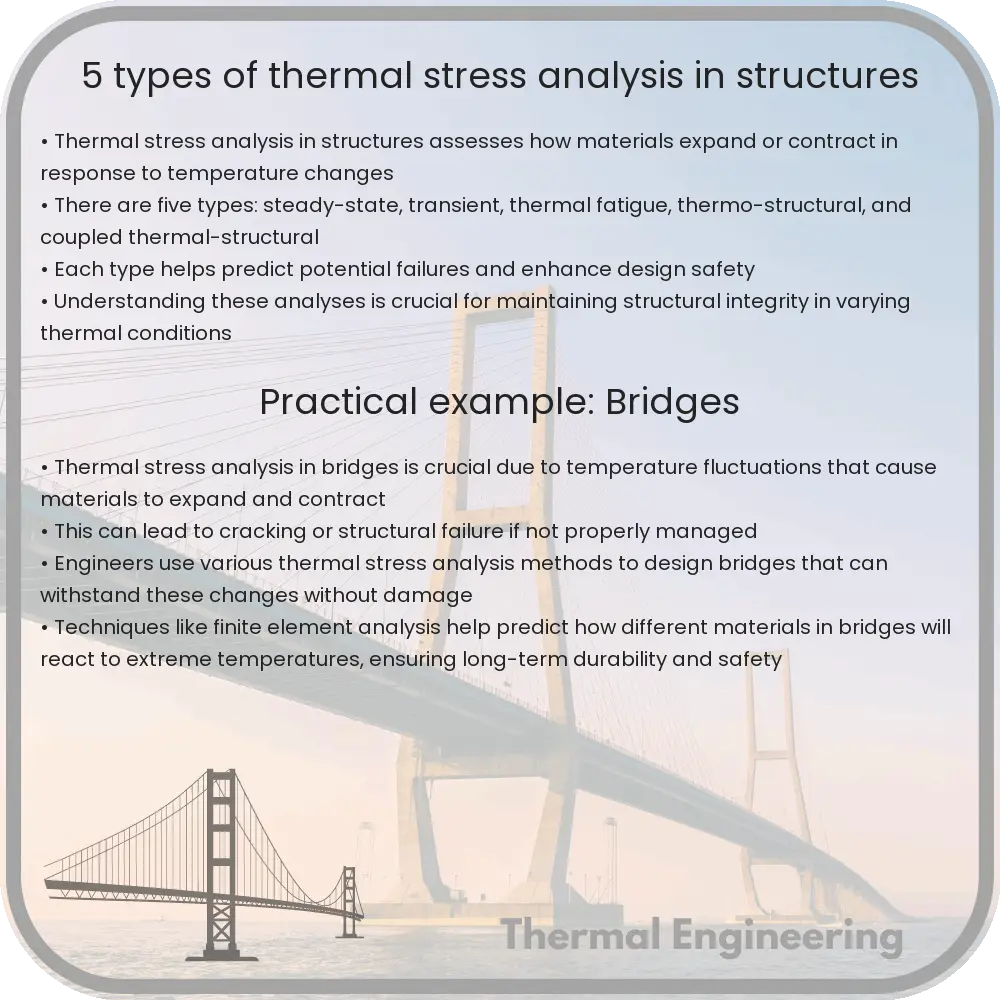
5 Types of Thermal Stress Analysis in Structures

Understanding Thermal Stress Analysis in Structures

Thermal stress analysis in structures is a crucial aspect of engineering that involves studying the effects of temperature changes on materials and their structural integrity. Temperature variations can cause materials to expand or contract, which can lead to stress and potential failure if not properly managed. In this article, we will explore five common types of thermal stress analysis that engineers use to ensure the safety and stability of structures.

1. Steady-State Thermal Analysis

Steady-state thermal analysis is used to examine the effects of constant temperature on a structure over a long period. This type of analysis assumes that the temperature distribution throughout the structure has become stable and does not change with time. Engineers use this analysis to determine the thermal stresses that occur due to permanent temperature conditions, ensuring the structure can withstand these stresses indefinitely.

2. Transient Thermal Analysis

In contrast to steady-state analysis, transient thermal analysis looks at how structures react to changes in temperature over time. This method is essential for assessing the structural response to varying thermal loads, such as those experienced during day-night cycles or seasonal changes. The analysis helps predict how quickly a structure responds to temperature changes and the potential for thermal stress accumulation that could lead to fatigue or failure.

3. Thermo-elastic Analysis

Thermo-elastic analysis combines the principles of thermal analysis with elasticity theory. It is used to evaluate the deformation and stress in a structure due to both thermal effect and mechanical loads. This type of analysis is particularly useful in scenarios where thermal loads and mechanical loads interact, such as in metal beams exposed to sunlight while supporting mechanical loads.

4. Thermal Fatigue Analysis

Thermal fatigue analysis focuses on the failure potential of materials subjected to repetitive thermal cycling. This technique is critical in industries where equipment or components are heated and cooled repeatedly, such as in power plants or automotive engines. Engineers study the number of cycles a material can withstand before failure and design structures to endure these conditions without degrading their integrity.

5. Coupled Thermal-Structural Analysis

Coupled thermal-structural analysis is a comprehensive approach that considers both thermal effects and structural responses simultaneously. This method is essential for complex simulations where heat transfer might affect structural properties, and vice versa. Engineers use coupled analysis to accurately predict how structures behave under real-world thermal conditions, leading to more robust and reliable design solutions.

Each of these thermal stress analysis types serves a specific function in safeguarding the integrity and functionality of structures under varying temperatures. By utilizing these analyses, engineers can design structures that not only meet safety standards but also remain functional and durable under diverse environmental conditions.

Heat transfer enhancements in nuclear reactors

Explore heat transfer enhancements in nuclear reactors for improved efficiency and safety.

Heat transfer enhancements in nuclear reactors

Understanding Heat Transfer Enhancements in Nuclear Reactors

Heat transfer is a critical aspect of nuclear reactor design and operation, impacting efficiency, safety, and longevity. In this article, we will explore how engineers enhance heat transfer within nuclear reactors to optimize their performance and ensure safety standards are met.

Basics of Heat Transfer in Nuclear Reactors

Nuclear reactors generate heat through nuclear fission—the process where the nucleus of an atom splits into smaller parts, releasing a significant amount of energy. Efficiently managing this heat is essential for generating electricity and maintaining the structural integrity of the reactor.

Heat transfer in nuclear reactors primarily happens through conduction, convection, and radiation. Enhancements in heat transfer focus on improving these mechanisms to increase the reactor’s thermal efficiency and safety.

Heat Transfer Enhancement Techniques

Engineers employ various techniques to enhance heat transfer in nuclear reactors. These include:

  • Using Heat Transfer Coatings: Special coatings are applied to fuel cladding and other internal surfaces to improve heat transfer rates. These coatings can reduce thermal resistance and enhance the heat conduction pathway from the fuel to the coolant.
  • Optimizing Coolant Flow: The coolant flow rate and pattern are optimized to maximize heat absorption from the reactor core. Advanced computational models help in designing coolant channels that ensure the most effective heat transfer.
  • Increasing Surface Area: Increasing the surface area over which heat transfer occurs can significantly enhance the efficiency of the heat exchange process. This can be achieved by incorporating fins or other extended surfaces on heat exchangers.
  • Implementing Nanofluids: Nanofluids, which are fluids containing nanoparticles, can be used as coolants. These particles significantly increase the thermal conductivity of the fluid, thus enhancing heat transfer.

Impact of Enhanced Heat Transfer

The enhancement of heat transfer in nuclear reactors has several beneficial impacts:

  1. Increased Efficiency: Better heat transfer leads to more efficient steam generation, which can increase the electrical output of the power plant.
  2. Enhanced Safety: Efficient heat removal from the reactor core reduces the risk of overheating and potential meltdowns, thus enhancing the overall safety of the nuclear reactor.
  3. Extended Reactor Life: By reducing thermal stresses on the reactor components, enhanced heat transfer can contribute to longer operational lives of reactors.

Challenges and Future Directions

While enhancing heat transfer within nuclear reactors presents many benefits, it also poses challenges. These include the cost of implementing new technologies, potential impacts on reactor operations, and the reliability and durability of new materials and designs.

Future research in this field is likely to focus on developing more advanced materials and technologies, such as superconducting materials or innovative coolant compounds, that can operate under extreme conditions while providing superior heat transfer capabilities.

As nuclear power continues to be a critical component of the global energy mix, advancements in heat transfer technologies will play a key role in ensuring these facilities are both efficient and safe.

4 Types of Latent Heat Applications in Technology

Understanding Latent Heat: Key to advancements in refrigeration, power generation, thermal storage, and desalination technology.

4 Types of Latent Heat Applications in Technology

Understanding Latent Heat and Its Applications in Technology

Latent heat, a fundamental concept in thermodynamics, refers to the heat absorbed or released by a substance during a change in its state (e.g., solid to liquid or liquid to gas) without a change in temperature. This process is pivotal in numerous technological applications that impact daily life and industrial processes. Here, we explore four significant applications of latent heat in technology.

1. Refrigeration and Air Conditioning Systems

  • Phase Change: In refrigeration, latent heat is exploited during the phase changes of the refrigerant, typically between liquid and gaseous states. Here, the refrigerant absorbs heat when it evaporates (changes from liquid to gas), cooling the surroundings.
  • Heat Exchange: This absorbed heat is subsequently released as the refrigerant condenses back to a liquid. This cycle is fundamental in air conditioners, freezers, and refrigerators to maintain desired temperature settings.

2. Power Generation

  • Steam Turbines: In power plants, particularly those that are steam-driven, latent heat plays a crucial role. Water is heated to form steam, which then expands and pushes against the blades of a turbine to generate electricity.
  • Efficiency Improvements: The capturing and recycling of latent heat in steam significantly enhances the efficiency of power generation systems, reducing fuel consumption and emissions.

3. Thermal Energy Storage

  • Storage Efficiency: Utilizing the concept of latent heat, thermal energy storage systems can operate more efficiently. By storing energy in materials as latent heat, these systems can manage heat without a significant change in temperature, proving effective in balancing energy supply and demand.
  • Applications: This technology is used in solar energy systems and can be integral in managing the variability of energy supply, including during non-daylight hours.

4. Desalination Plants

  • Saltwater to Freshwater: Latent heat is also critical in desalination processes where saltwater is converted into freshwater. The phase change of water (from liquid to vapor and then back to liquid) is pivotal in removing salt from seawater.
  • Energy Consumption: Efficiently managing the latent heat during these phase changes can lead to reduced energy consumption in desalination plants, making it a more viable option for producing potable water.

Through these applications, it is evident that the principles of latent heat are not only foundational in understanding thermodynamics but also essential in advancing current technologies. These systems show how engineering continuously leverages natural processes in innovative ways to solve practical problems, from how we cool our homes to how we generate energy and produce fresh water.

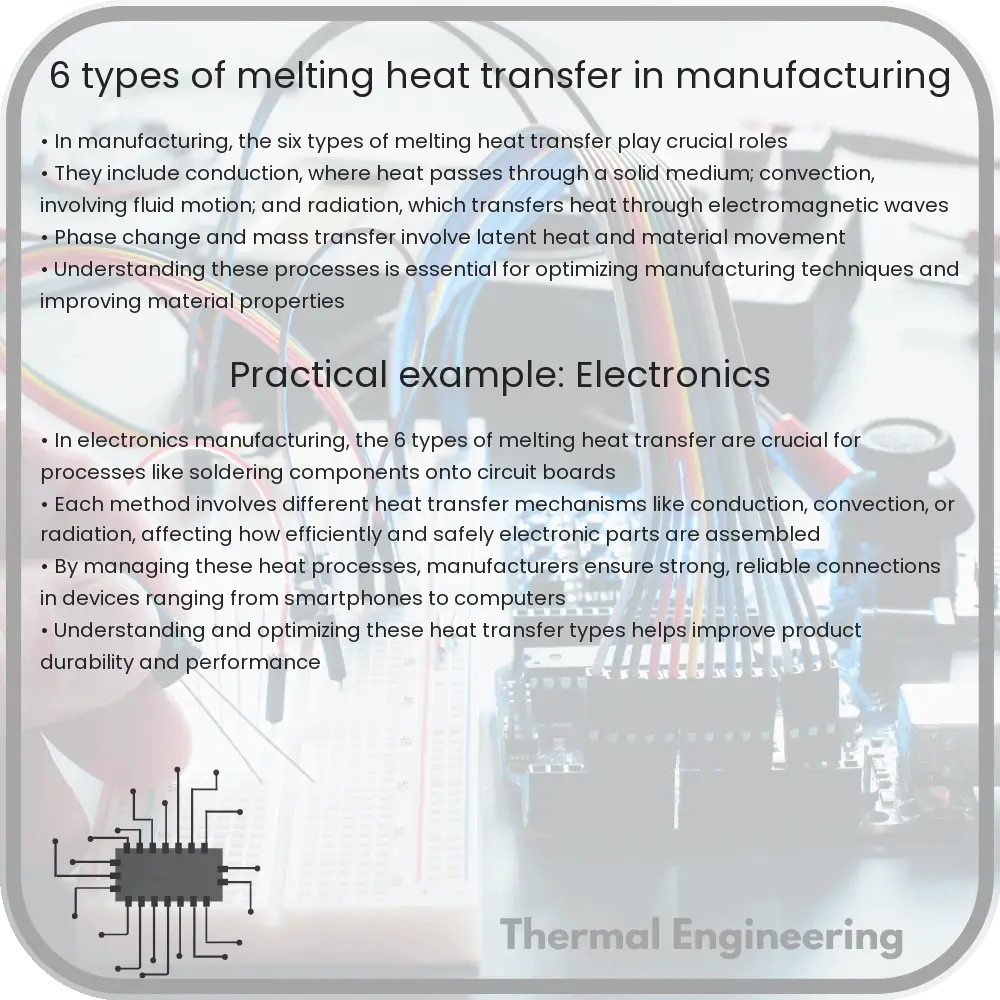
6 Types of Melting Heat Transfer in Manufacturing

Explore the different types of melting heat transfer techniques used in manufacturing, including conduction, convection, radiation, induction, dielectric, and microwave melting processes.

6 Types of Melting Heat Transfer in Manufacturing

Understanding Heat Transfer in Manufacturing: 6 Types of Melting Processes

Heat transfer plays a crucial role in manufacturing, particularly in processes involving melting. This transformation is fundamental in shaping materials into desired forms or properties. Here, we explore six prominent types of melting heat transfer techniques commonly used in manufacturing settings.

1. Conduction Melting

Conduction melting occurs when heat is transferred through direct contact between materials. One material, typically solid, is heated and transfers its heat to another, leading to melting. This method is highly efficient in scenarios where materials are in close proximity and heat can be steadily maintained over time.

  • Applications: Metal casting, soldering, and welding.

2. Convection Melting

Convection melting involves the transfer of heat through a fluid medium, which could be either liquid or gas. This method is essential when the material to be melted is surrounded by a fluid being heated, causing the material itself to melt due to the fluid’s increased temperature.

  • Applications: Glass making, and melting of metals in furnaces where the heat source is indirect.

3. Radiation Melting

Radiation involves heat transfer through electromagnetic waves without involving physical contact or an intervening medium. Materials absorb this radiated energy and increase in temperature, leading to melting.

  • Applications: Steel manufacturing and in processes where materials are sensitive to contamination from direct contact.

4. Induction Melting

Induction melting uses electromagnetic induction to produce heat within the material itself. An alternating magnetic field induces currents in the material, generating internal heat and causing the material to melt.

  • Applications: Precision melting of metals like silver, gold, and steel in controlled environments.

5. Dielectric Melting

Dielectric melting is utilized primarily with insulating materials, where an electric field causes internal heating because of dielectric losses. This approach is specific to materials that can polarize under an electric field.

  • Applications: Melting of specific thermoplastics and other polymers.

6. Microwave Melting

Microwave melting is similar to dielectric melting but specifically employs microwave radiation to heat up materials. Microwaves cause polar molecules in the material to vibrate and generate heat, which in turn melts the material.

  • Applications: Processing of ceramics, glass, and various composite materials.

Each of these melting heat transfer methods has its own set of applications, advantages, and considerations. By understanding these mechanisms, engineers can choose the most effective technique based on the material properties and the desired outcome of the manufacturing process.

10 Types of Isothermal Processes in Gases

Learn about isothermal processes in gases, where temperature remains constant during system changes, essential in various engineering fields.

10 Types of Isothermal Processes in Gases

Understanding Isothermal Processes in Gases

An isothermal process in thermodynamics is a change in a system, in which the temperature remains constant. This occurs typically in systems involving gases where the system’s temperature is maintained through heating or cooling. Understanding different types of isothermal processes helps grasp how they are applied in various engineering disciplines like chemical engineering, mechanical engineering, and refrigeration. Here are 10 types of isothermal processes commonly encountered in gases:

1. Isothermal Compression in Refrigeration Cycles

  • In refrigeration cycles, isothermal compression helps maintain the refrigerant at a constant temperature while it is being compressed by external work. This process is crucial for the efficiency of refrigeration and air-conditioning systems.

2. Isothermal Expansion in Heat Engines

  • Ideal heat engines, such as the Carnot engine, utilize isothermal expansion to convert thermal energy into work. Here, the gas expands in a controlled manner at constant temperature, producing work against an external pressure.

3. Isothermal Gas Injection in Petroleum Engineering

  • Used to maintain pressure in a reservoir, isothermal gas injection involves injecting gas at a constant temperature into an oil well to improve oil recovery through enhanced oil recovery methods.

4. Isothermal Gas Lifting

  • This technique helps to increase the flow rate of fluids from a well. Injected gas reduces the overall fluid density in the tubing, allowing the fluid mixture to flow out of the well at constant temperature.

5. Isothermal Storage of Compressed Gases

  • Storing gases like hydrogen and natural gas in tanks at constant temperature is essential to maintain gas integrity and volume. This process is vital for applications in fuel storage and transport.

6. Isothermal Battery Systems

  • In advanced battery technologies, maintaining isothermal conditions during discharge and charge cycles can improve performance and longevity by avoiding thermal imbalances.

7. Molecular Sieve Regeneration in Isothermal Process

  • Molecular sieves used to dry gas streams are regenerated under constant temperature conditions. This allows for the efficient removal of absorbed fluids without thermal degradation of the sieve material.

8. Isothermal Chemical Reactors

  • Certain chemical reactions require maintaining the reactants and products at constant temperature for optimal reaction rates and yield. Isothermal reactors control the temperature to achieve these conditions.

9. Isothermal Fermentation

  • In biochemical engineering, maintaining isothermal conditions during fermentation processes ensures uniform growth rates and metabolic activity, which is crucial for product consistency.

10. Laboratory Experiments and Calibration

  • Various scientific experiments and calibration processes require gas behavior to be studied under constant temperature conditions to ensure accurate results and standards.

Conclusion

The concept of isothermal processes in gases encompasses a wide range of applications across many fields of engineering and science. Understanding these processes is crucial for designing systems that efficiently utilize the physical properties of gases, thereby enhancing performance and conserving energy. Whether in theoretical designs or practical applications, grasping the fundamentals of isothermal processes proves indispensable.

7 Types of Heat Transfer in Microelectronics

Explore fundamental methods of heat transfer in microelectronics, including conduction, convection, radiation, and more, crucial for device efficiency and longevity.

7 Types of Heat Transfer in Microelectronics

Understanding Heat Transfer in Microelectronics

Heat transfer in microelectronics is a critical aspect of the design and functioning of electronic devices. Effective heat management ensures reliability and longevity in devices such as computers, smartphones, and telecommunications equipment. Here we explore seven fundamental methods of heat transfer relevant to the field of microelectronics.

1. Conduction

Conduction is the transfer of heat through a solid material without the movement of the material itself. This type of heat transfer is governed by Fourier’s Law:

q = -k * A * (dT/dx)

where q is the heat transfer rate, k is the thermal conductivity of the material, A is the area through which heat is being transferred, and dT/dx is the temperature gradient. In microelectronics, conduction occurs within the semiconductor material itself and in the conductive paths connecting different components.

2. Convection

Convection is the transfer of heat by the physical movement of a fluid, which can be a gas or a liquid. In electronics, this usually involves the air surrounding the device. Natural convection occurs due to density differences resulting from temperature gradients, whereas forced convection is caused by external mechanisms, such as fans or pumps, aiding in the heat transfer.

3. Radiation

Radiation involves the transfer of heat through electromagnetic waves. Every object emits infrared radiation depending on its temperature, according to the Stefan-Boltzmann law:

q = εσA(T4 – T04)

Here, ε is the emissivity of the surface, σ (the Stefan-Boltzmann constant) is 5.67 × 10⁻⁸ W/m2K4, A is the area, and T and T0 are the temperatures of the object and the surroundings, respectively. Components in microelectronics, like CPUs, can dissipate heat through radiation, albeit usually less significantly than conduction and convection.

4. Phase Change

Phase change materials (PCMs) are employed in microelectronics to absorb heat efficiently during phase transitions, such as from solid to liquid. The latent heat of fusion absorbed during this phase change can significantly help in managing temperature spikes in high-performance devices.

5. Heat Pipes

A heat pipe employs phase change and thermal conductivity to transfer heat from one point to another. It typically consists of a sealed pipe filled with a liquid. Heat input at one end vaporizes the liquid, and the vapor travels to the cooler end where it condenses, releasing latent heat. The liquid then returns to the hot end by capillary action within a wick or by gravity, thus continuing the cycle.

6. Thermoelectric Cooling

Thermoelectric coolers use the Peltier effect to create a heat flux between the junction of two different types of materials. A Peltier cooler can be used in microelectronics to provide spot cooling for components that generate significant heat.

7. Micromachined Thermal Management Systems

Advanced thermal management in microelectronics sometimes involves micromachined structures, including microchannels. These are small channels etched into substrates that carry coolant directly to high-heat areas. Micromachining allows precise control over flow and efficient heat removal from localized heat sources.

Each of these methods offers distinct advantages and limitations, and commonly, the best thermal management systems will involve a combination of several techniques tailored to the specific constraints and requirements of the electronic device in question.

3 Types of Thermodynamic Optimization in Design

Learn about thermodynamic optimization in engineering design, focusing on improving system efficiency and reducing environmental impact.

3 Types of Thermodynamic Optimization in Design

Introduction to Thermodynamic Optimization in Design

Thermodynamics plays a critical role in engineering, particularly when it comes to optimizing the design of systems that involve heat and energy transfer. Effective thermodynamic optimization not only improves the efficiency and performance of systems but also minimizes the use of resources and reduces environmental impact. This article explores three key types of thermodynamic optimization used in engineering design: energy efficiency optimization, exergy analysis, and entropy generation minimization.

1. Energy Efficiency Optimization

Energy efficiency optimization focuses on reducing the energy consumption of a system while maintaining or improving its output. This type of optimization is crucial in industries ranging from automotive to HVAC (Heating, Ventilation, and Air Conditioning) systems. Engineers use various strategies to enhance energy efficiency, such as improving the thermal insulation of buildings, utilizing more efficient components like high-efficiency boilers or LED lighting, and adopting advanced control strategies that intelligently manage energy use.

  • Improvement of component selection, such as using energy-efficient motors.
  • Optimization of system operation procedures, including the timing and scale of energy use.
  • Integration of renewable energy sources.

2. Exergy Analysis

Exergy analysis is a thermodynamic technique used to quantify the quality of energy within a system. Unlike energy which is conserved, exergy measures the useful work potential of a system and is destroyed when energy transformations occur. By analyzing exergy losses, engineers can identify where energy degradations happen and redesign systems to minimize these losses, leading to more efficient and sustainable designs.

Exergy analysis helps engineers focus on the causes of inefficiency rather than the effects, allowing for more targeted interventions. These may include:

  • Redesigning components to reduce energy transformations that result in high exergy destruction.
  • Recycling or reclaiming wasted energy, for instance, using waste heat recovery systems.
  • Modifying process parameters to approach ideal conditions that maximize exergy retention.

3. Entropy Generation Minimization

Entropy generation minimization (EGM) is a strategy used to design more thermodynamically efficient systems by minimizing irreversible losses. Every process that generates entropy, such as heat transfer, fluid friction, or chemical reactions, leads to energy being dispersed in less useful forms. By minimizing these processes, systems can be designed to be not only more energy-efficient but also more reliable and durable.

Key approaches in entropy generation minimization include:

  • Optimizing flow geometries and materials to reduce friction and turbulence.
  • Enhancing heat transfer effectiveness through better design of heat exchangers.
  • Minimizing the distance and temperature difference across which heat transfer occurs to reduce thermal resistance.

Conclusion

Thermodynamic optimization in engineering design takes various forms, each tailored to specific goals such as improving energy efficiency, maximizing energy utility, and minimizing energetic losses. By applying principles of energy efficiency, exergy analysis, and entropy generation minimization, engineers are able to craft systems that not only meet operational standards but also contribute to environmental sustainability. Understanding and implementing these optimization techniques is vital for the advancement of engineering solutions in the face of increasing energy demands and ecological considerations.

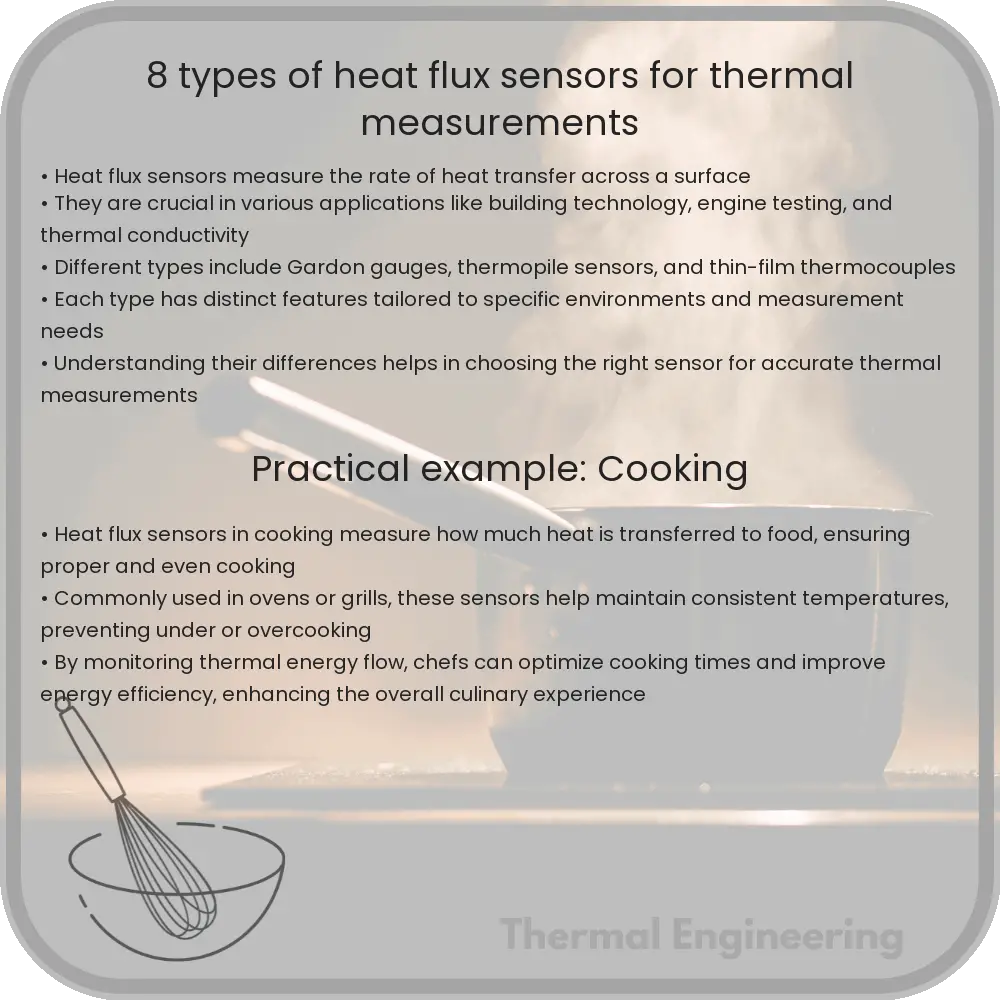
8 Types of Heat Flux Sensors for Thermal Measurements

Learn about heat flux sensors, essential tools for measuring the rate of heat transfer across surfaces in various applications.

8 Types of Heat Flux Sensors for Thermal Measurements

Introduction to Heat Flux Sensors

Heat flux sensors are essential tools used to measure the rate of heat transfer through a surface per unit area. These instruments are crucial in various engineering and scientific applications, from studying thermal properties of materials to monitoring industrial processes. Understanding the different types of heat flux sensors helps in selecting the right sensor for specific applications.

Types of Heat Flux Sensors

There are several types of heat flux sensors, each suited for different applications based on their working principle, construction, and sensitivity. Here, we will explore eight common types of these sensors.

  1. Gardner Sensors: These sensors use a thin layer of thermally conductive material placed between two temperature-measuring devices. They are typically used in environments where the heat flux is relatively low.
  2. Schmidt-Boelter Sensors: Widely used in fire testing and heat transfer studies, these sensors consist of a water-cooled calorimeter that measures high heat flux levels. They provide accurate measurements even under rapid changing conditions.
  3. Capacitance Type Sensors: These sensors measure heat flux through changes in capacitance caused by temperature differences across a dielectric material. They are useful in applications where minimal sensor thickness is crucial.
  4. Thin-Film Thermopile Sensors: These consist of thermocouples arranged in a series or parallel configuration to detect temperature difference across a thin film. Their design allows for high sensitivity and fast response time, making them suitable for both laboratory and industrial applications.
  5. Gradient Heat Flux Sensors: Using the principle of thermal gradients, these sensors calculate heat flux by measuring temperature variation across a known distance. They are often used in studies involving soil or building materials.
  6. Calorimetric Sensors: These sensors operate by measuring the heat absorbed or released by a material. Calorimetric sensors are particularly effective in applications requiring the measurement of total heat transfer over time.
  7. Optical Sensors: Using infrared or other radiation methods, optical sensors can measure heat flux without direct contact with the heat source. This non-invasive approach is ideal for sensitive or inaccessible surfaces.
  8. Acoustic Sensors: These innovative sensors use the speed of sound within a medium to infer changes in thermal conductivity and, thus, heat flux. Though less common, they offer unique advantages in specific applications like gaseous environments.

Applications of Heat Flux Sensors

Heat flux sensors find applications across various fields. In building physics, they help assess insulation effectiveness and identify heat losses. In the aerospace industry, they monitor thermal protection systems to ensure they maintain their protective qualities under extreme conditions. Environmental studies use these sensors for monitoring soil heat flux, which is important for understanding and predicting changes in climate and soil composition.

Conclusion

Selecting the appropriate type of heat flux sensor is crucial for obtaining reliable and accurate measurements in any thermal analysis. Each type offers distinct advantages and limitations, making them suited for specific environments and applications. By understanding the different types of heat flux sensors, engineers and researchers can effectively apply this technology to improve safety, efficiency, and innovation in various domains.

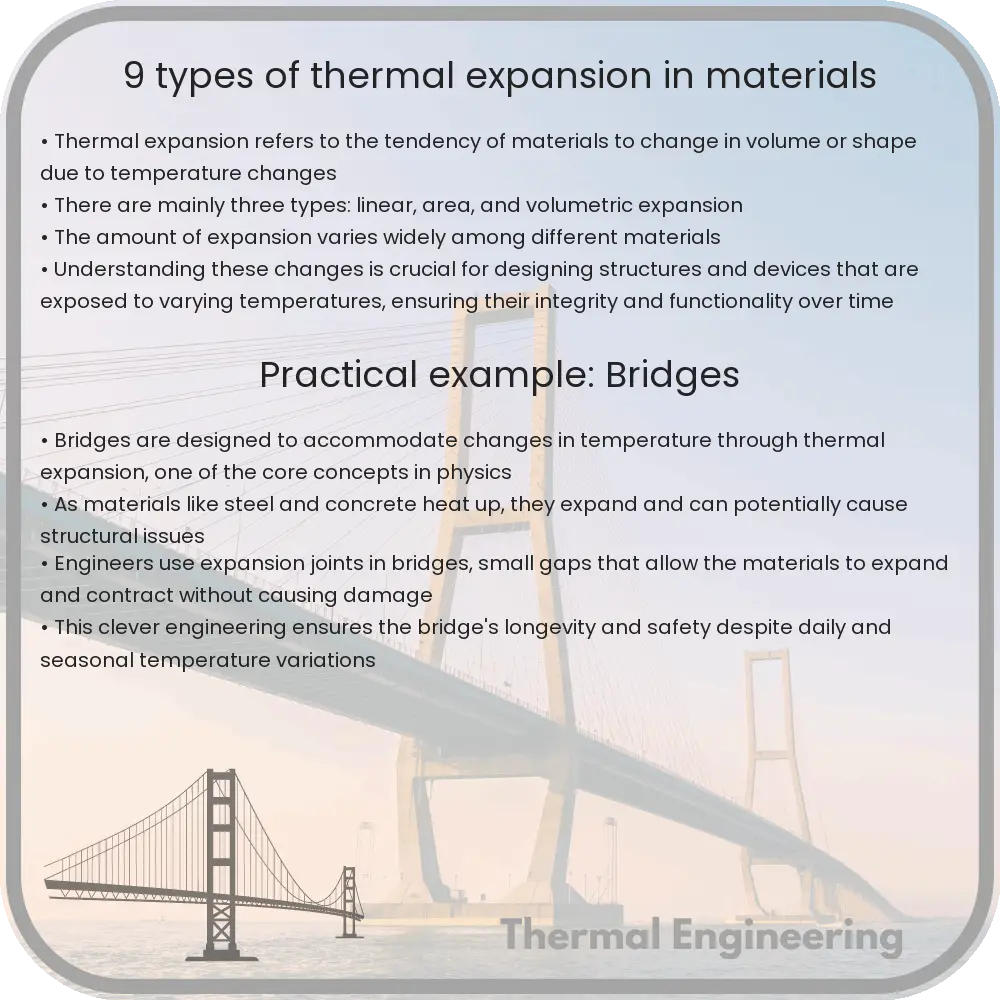
9 Types of Thermal Expansion in Materials

Learn about thermal expansion, the process by which materials change in size with temperature fluctuations, key in many engineering and construction applications.

9 Types of Thermal Expansion in Materials

Understanding Thermal Expansion in Materials

Thermal expansion refers to the way in which a material changes in shape, area, and volume in response to a change in temperature. This physical process is critical in engineering and construction, as it affects everything from the structural integrity of buildings to the performance of mechanical systems. Different materials exhibit different types of thermal expansion, and understanding these variations is key to selecting the right material for a specific application. Here, we will explore nine types of thermal expansion commonly observed in materials.

Types of Thermal Expansion

  1. Linear Expansion

    Linear expansion refers to the change in length of a material as it heats up. Most materials expand linearly with an increase in temperature, and this is quantified by the linear expansion coefficient, typically denoted as α. The change in length (ΔL) can be calculated using the formula:
    ΔL = α * L0 * ΔT
    where L0 is the original length and ΔT is the temperature change.

  2. Area Expansion

    As materials heat up, not only do their lengths change, but their surface areas increase as well. This phenomenon is known as area expansion. The change in area (ΔA) can be expressed as:
    ΔA = 2α * A0 * ΔT
    where A0 is the original area. This type of expansion applies primarily to two-dimensional surfaces.

  3. Volume Expansion

    Volume expansion is the change in volume of a material due to temperature increase. It is particularly relevant for liquids and gases but occurs in solids as well. The change in volume (ΔV) can be estimated by:
    ΔV = β * V0 * ΔT
    where V0 is the original volume and β is the coefficient of volume expansion, typically around three times the linear expansion coefficient for solids.

  4. Anisotropic Expansion

    In anisotropic materials, the rate of expansion varies depending on the direction. This is often seen in crystals and composite materials, where the molecular structure influences how the material expands in different directions.

  5. Isotropic Expansion

    Contrary to anisotropic expansion, isotropic expansion occurs uniformly in all directions. Many metals and glass exhibit isotropic behaviors when subjected to temperature changes.

  6. Negative Thermal Expansion

    Some materials exhibit a decrease in volume with an increase in temperature. This unusual behavior, known as negative thermal expansion (NTE), is rare but can be observed in materials like zirconium tungstate (ZrW2O8).

  7. Superficial Expansion

    This type of expansion refers to the increase in the surface dimension of a material. It is a broader category that includes any form of expansion affecting the surface, including both linear and area expansions.

  8. Moisture Induced Expansion

    Although not strictly due to thermal effects, moisture induced expansion is temperature related as it involves the expansion of a material due to absorption of moisture, which can be influenced by temperature. This is particularly significant in materials like wood and concrete.

  9. Bimetallic Expansion

    Seen in bimetallic strips used in thermostats, this type of expansion occurs when two metals expand at different rates under thermal stress, causing the material to bend. The curvature can be used to convert temperature changes into mechanical displacement.

Each type of thermal expansion has its own set of challenges and applications in engineering and design. By understanding these different types, engineers can make informed decisions when choosing materials for construction, manufacturing, and other industrial applications, ensuring safety, efficiency, and performance under varying environmental conditions.

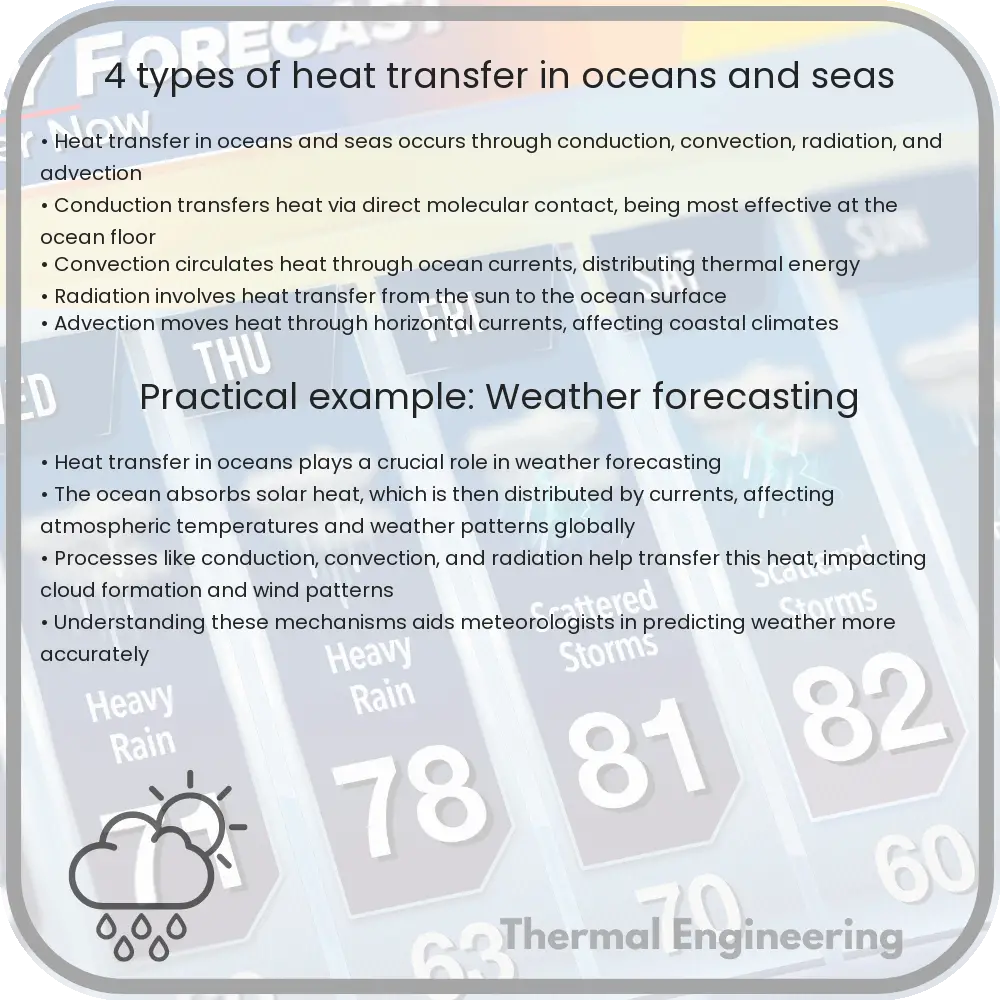
4 Types of Heat Transfer in Oceans and Seas

Learn how heat transfer in oceans and seas via conduction, convection, radiation, and advection affects global climate and marine ecosystems.

4 Types of Heat Transfer in Oceans and Seas

Understanding Heat Transfer in Oceans and Seas

Heat transfer in oceans and seas is a fundamental aspect of understanding global climate systems, ocean currents, and weather patterns. There are four primary types of heat transfer mechanisms that play crucial roles in how heat is moved through these large bodies of water. These mechanisms are conduction, convection, radiation, and advection. Each type of heat transfer has unique characteristics that help explain the distribution of temperature and influence marine environments.

1. Conduction

Conduction is the process of heat transfer through direct contact. In the oceans, this occurs when water molecules at different temperatures come into contact with each other. Warmer water molecules vibrate more vigorously and transfer some of their kinetic energy to cooler neighboring molecules. Although conduction is generally slower in water than in solid materials, it still plays an integral role in the heat balance within the ocean layers.

2. Convection

Convection involves the movement of heat by the physical movement of fluid itself. In seas and oceans, convection currents are driven by the heating and cooling of water, combined with the effects of Earth’s rotation and other environmental factors. Warm water tends to rise because it is less dense, while cooler water sinks. This process can create convection currents that can distribute heat throughout different layers of the ocean. Convection is primarily responsible for the vertical movement of heat within the waters.

3. Radiation

Radiation refers to the transfer of energy through electromagnetic waves. In the context of oceans and seas, solar radiation is the most significant source. The sun radiates its energy through space to the Earth’s surface, including the oceans. Water absorbs this solar energy, which warms the surface layer. This energy is then gradually transferred downward within the ocean, though much of it is re-radiated back into the atmosphere or transferred to the poles.

4. Advection

Advection is the horizontal movement of heat by the flow of a fluid. In oceans, this is seen as large-scale movements of water masses, commonly known as ocean currents. These currents, such as the Gulf Stream in the Atlantic or the Kuroshio in the Pacific, carry warm waters from equatorial regions toward the poles and cold waters from the poles toward the equator. Advection plays a key role in regulating global climate by redistributing heat across the planet.

In conclusion, understanding the four types of heat transfer in oceans and seas—conduction, convection, radiation, and advection—provides insights into marine and atmospheric sciences. These heat transfer processes not only play crucial roles within the local marine environments but also affect global weather patterns and climate change dynamics. Knowing how these processes function helps scientists predict changes in Earth’s climate and informs conservation and management efforts for marine ecosystems.