Facebook Instagram Youtube Twitter

Advanced cooling techniques in fusion reactors

Exploring innovative cooling solutions critical for managing extreme temperatures in fusion reactors, ensuring safe and efficient energy production.
Advanced cooling techniques in fusion reactors

Advanced Cooling Techniques in Fusion Reactors

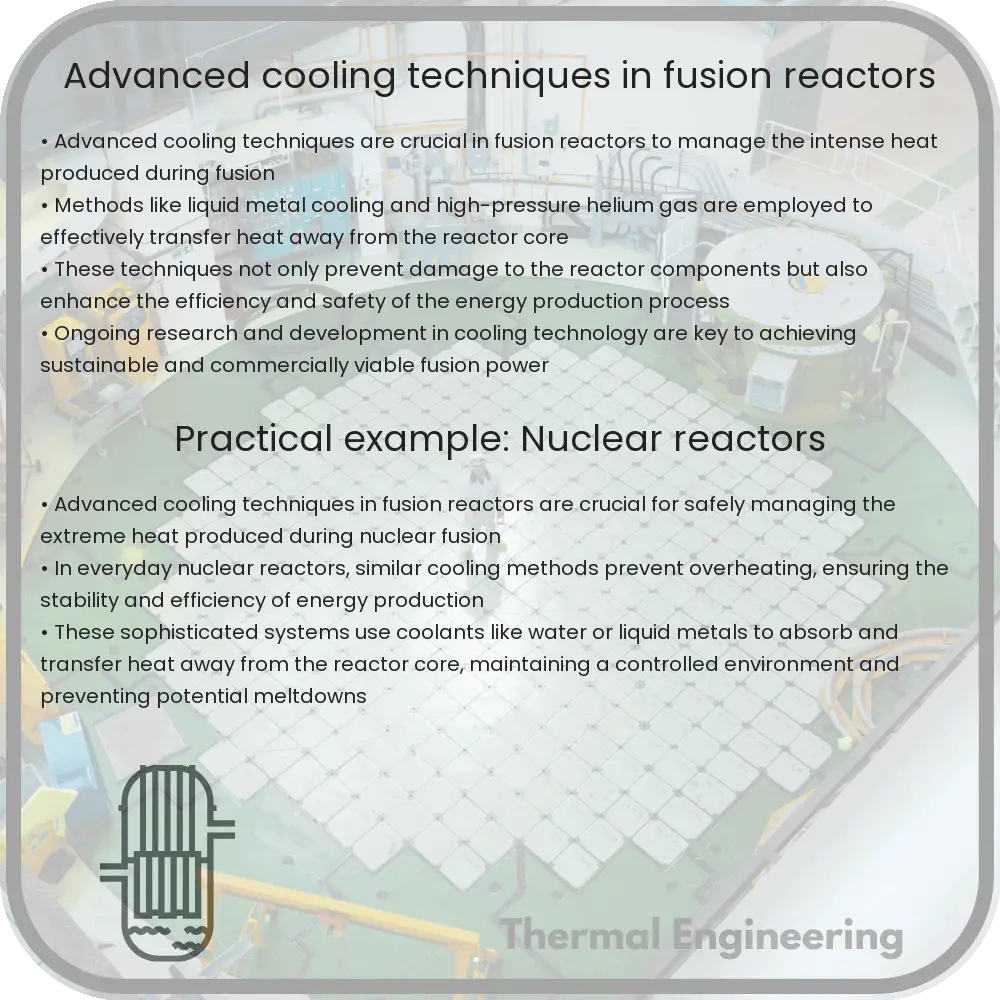
Fusion reactors represent the cutting edge of energy technology—a potential source of nearly limitless, clean energy. As such, mastering the engineering challenges of fusion power is crucial. One critical area is the development of advanced cooling systems to manage the extreme temperatures and energy production. Let’s explore the key cooling techniques currently being developed for fusion reactors.

Understanding Thermal Loads in Fusion Reactors

Fusion reactors, such as those based on the tokamak or stellarator design, operate at temperatures higher than those found in the sun’s core. These extreme temperatures are necessary to achieve plasma conditions where hydrogen isotopes can fuse, releasing enormous amounts of energy. Managing this heat is essential not only for the reactor’s safety but also for its efficiency and longevity.

1. Water Cooling Systems

The most traditional method of removing heat from any high-energy system is water cooling, and fusion reactors are no exception. Water cooling systems circulate water around the reactor core, absorbing heat which is then transferred away from the reactor, often converting it into steam to drive turbines for electricity generation.

  • Advantages include technological maturity and high heat capacity.
  • Challenges include potential for water to become radioactive and limitations in the maximum achievable heat transfer rates compared to the heat generated.

2. Liquid Metal Cooling

Given the limitations of water cooling, research has turned to liquid metals like lithium or lithium-lead alloys. Liquid metals can handle higher temperatures and offer superior heat transfer capabilities.

  • They function both as a coolant and a protective layer for the reactor walls.
  • They capture neutrons from the fusion reaction and help breed tritium, one of the fuel sources used in fusion reactors.

3. Divertor Technology

The divertor is a critical component in many fusion reactors, designed to handle the extreme heat flux and manage waste material produced in the fusion process. It acts by diverting and cooling down the unwanted byproducts of fusion away from the core of the plasma.

  • Advanced materials like tungsten and carbon composites are often used for their high melting points and thermal conductivity.
  • Innovative designs are continually being tested in conditions simulating the internal environment of a fusion reactor.

4. Magnetic Confinement and Cooling

Magnetic confinement plays a dual role in fusion reactors: maintaining the shape and stability of the plasma and aiding in the heat management. By strategically designing the magnetic field, the hottest parts of the plasma can be kept away from reactor walls, thus reducing the thermal stress.

5. Radiative Cooling Techniques

Radiative cooling involves the emission of heat through radiation. In a fusion reactor, certain materials can be introduced to the plasma where they emit radiation, thereby cooling the core. This technique is useful for controlling edge plasma and divertor temperatures.

  • Molybdenum and neon are examples of materials used for their radiative properties.

Challenges and Future Directions

While significant advancements have been made in these cooling technologies, many challenges remain. Managing thermal loads while maintaining the efficiency and longevity of the reactor components continues to be a focal point of research. Future breakthroughs in material science and engineering are expected to pave the way for more effective and sustainable cooling solutions in fusion technology.

In summary, advanced cooling techniques in fusion reactors are a vital area of focus in the quest for sustainable energy. By continued innovation and testing, these systems will enable the safe and efficient operation of fusion reactors, heralding a new era of clean energy.


How does thermal shock resistance improve material design

Learn about thermal shock resistance, a key property in material engineering that affects the durability and performance of materials in rapid temperature changes.

How does thermal shock resistance improve material design

Understanding Thermal Shock Resistance in Material Design

Thermal shock resistance is a crucial aspect of material engineering, greatly influencing the development and selection of materials across various industries such as aerospace, automotive, and ceramics. The capability of a material to withstand rapid temperature changes without deteriorating is what defines its thermal shock resistance. This characteristic is especially vital in applications where materials are subjected to harsh thermal gradients, potentially leading to failure.

Factors Influencing Thermal Shock Resistance

  • Thermal Conductivity: Materials with high thermal conductivity can quickly distribute thermal energy, reducing temperature gradients that contribute to thermal stress.
  • Thermal Expansion Coefficient: A lower coefficient of thermal expansion (CTE) minimizes the dimensional changes that occur with temperature fluctuations, thereby enhancing resistance to thermal shock.
  • Material Strength: Higher mechanical strength and fracture toughness help materials withstand the stresses induced by thermal shock.
  • Elastic Modulus: Materials with a lower elastic modulus can absorb more mechanical energy during thermal stress, potentially reducing the likelihood of cracking.

Equation Governing Thermal Shock Resistance

The resistance to thermal shock can quantitatively be appreciated by the following equation:

\[ R = \frac{\sigma \sqrt{a}}{\alpha E} \]

Where:

  1. \( \sigma \) is the material strength (tensile strength)
  2. \( a \) is the thermal diffusivity
  3. \( \alpha \) is the coefficient of thermal expansion
  4. \( E \) is the Young’s modulus or elastic modulus

This equation illustrates that increasing material strength \(\sigma\), thermal diffusivity \(a\), and reducing the coefficient of thermal expansion \(\alpha\) and Young’s modulus \(E\) can significantly enhance a material’s thermal shock resistance.

Real-World Applications of Thermal Shock Resistant Materials

Materials designed to withstand rapid temperature changes are used in a variety of applications:

  • Ceramics in Aerospace: Space shuttle tiles that can withstand extreme temperatures when entering and leaving the earth’s atmosphere.
  • Engine Components: Turbocharger rotors and exhaust manifolds made from materials like silicon nitride that resist thermal shock during abrupt changes in engine temperatures.
  • Cookware: Borosilicate glass used in bakeware that doesn’t crack under sudden temperature changes from oven heat to room temperature.
  • Metallurgical Processes: Refractories that line furnaces must resist thermal shock to avoid cracking under the cycling temperatures of operational shut-downs and start-ups.

Beyond Conventional Materials

Research continues to focus not only on improving existing materials but also on developing new composites and nanomaterials with superior thermal shock properties. Such advancements are aimed at pushing the boundaries of traditional engineering solutions, catering to more demanding applications in technology and industry.

Understanding and enhancing thermal shock resistance is thus a key to innovating material design — allowing for more resilient, efficient, and longer-lasting materials in high-performance environments.

Differential Scanning Calorimetry (DSC)

Learn about Differential Scanning Calorimetry (DSC), a technique measuring energy changes in materials during heating or cooling.

Differential Scanning Calorimetry (DSC)

Understanding Differential Scanning Calorimetry (DSC)

Differential Scanning Calorimetry (DSC) is a thermoanalytical technique widely used in both research and industry to measure the amount of energy absorbed or released by a sample as it is heated, cooled, or held at a constant temperature. It is particularly useful in studying phase transitions, such as melting and crystallization, as well as for characterizing polymers, pharmaceuticals, and in food processing.

How does DSC work?

The basic principle behind DSC is relatively straightforward. The device measures the heat flow into or out of a sample compared to a reference under the same conditions. Essentially, both the sample and reference are subjected to identical thermal cycles, but any difference in heat flow between them is recorded. This differential in heat flow is indicative of physical or chemical changes in the sample.

Components of DSC

  • Sample and Reference Pans: Small pans, typically made of aluminum, hold the sample and reference. The choice of pan material can vary based on the temperature range and reactivity of the sample.
  • Heating/Cooling System: This system controls the temperature of the sample and reference, relying on precise and controlled changes to ensure accurate measurements.
  • Detector: It measures the difference in energy input between the sample and reference. Any deviation in energy between the sample and the reference is detected and recorded as a peak or a trough on the DSC trace.

Key Measures and Interpretation

When a sample undergoes a thermal transition such as melting, the energy required to change the phase of the material appears as an endothermic peak in a DSC curve. Conversely, exothermic reactions, such as crystallization, release heat resulting in a downward peak. The area under these peaks is proportional to the enthalpy change associated with the transition, and can be calculated using the formula:

\[\text{ΔH = Area under the peak} * \text{calibration factor}\]

The temperature at which these peaks occur helps in determining melting points, crystallization temperatures, and other characteristic phases transitions.

Applications of DSC

  • Pharmaceuticals: DSC is used to examine the purity of drugs and their stability under various conditions.
  • Polymers: It helps in determining glass transition temperatures, crystallinity, and the effect of additives on a polymer’s properties.
  • Food Science: DSC analyzes changes in fats, oils, and other components to understand processing effects and storage conditions.
  • Materials Science: Examining composite materials, the effects of aging, and the efficacy of curing processes are common applications.

Advantages of Using DSC

DSC offers several advantages including its minimal sample requirement, the speed of analysis, and the broad range of information it provides, which makes it indispensable in quality control and research applications. It is an effective method for understanding material stability and composition, contributing significantly to innovation and quality assurance in various industries.

In summary, DSC is a powerful analytical tool that helps scientists and engineers understand material behavior under various thermal conditions. By analyzing how materials absorb or release heat, researchers can infer structural and compositional details that are crucial for product development and improvement.

How does heat affect the physical properties of nanomaterials

Explore how heat impacts the physical properties of nanomaterials, including thermal expansion, melting points, and conductivity.

How does heat affect the physical properties of nanomaterials

How Does Heat Affect the Physical Properties of Nanomaterials?

The behavior of materials at the nanoscale can significantly differ from that of their bulk counterparts, primarily because of their size and the increased importance of surface atoms relative to those in the interior. As heat is introduced, nanomaterials exhibit unique changes in their physical properties, ranging from structural stability to electrical conductivity. Here, we explore some of the principal effects of heat on these properties.

Thermal Expansion

Thermal expansion refers to the tendency of a material to change in volume in response to a change in temperature. When materials are heated, their particles move more and usually maintain a greater average separation. Nanomaterials, especially those with confined dimensions like nanoparticles or nanowires, can exhibit significantly different thermal expansion behaviors compared to bulk materials due to surface stress and the constrained structure. For instance, the coefficient of thermal expansion may be lower in nanomaterials because the surface atoms impose a constraint that is less significant in larger bulk materials.

Melting Point Depression

Heat affects the melting point of nanomaterials significantly. Typically, nanoparticles have a lower melting point than their bulk counterparts. This phenomenon, known as melting point depression, occurs because the atoms at the surface of nanomaterials, which are more numerous relative to the total number of atoms than in bulk materials, have lower coordination numbers and thus weaker overall interatomic forces. This reduction in the melting point is crucial for processes like nanoparticle sintering and is given by the Gibbs-Thomson equation:

Tm(d) = Tm,bulk – (2 * γ * ΔHf) / (R * d)

  • Tm(d) is the melting temperature of the nanoparticle.
  • Tm,bulk is the bulk melting temperature.
  • γ is the surface energy.
  • ΔHf is the heat of fusion per unit volume.
  • R is the gas constant.
  • d is the diameter of the nanoparticle.

Thermal Conductivity

Nanomaterials often exhibit altered thermal conductivity when subjected to high temperatures. For example, the thermal conductivity of nanoscale materials can either increase or decrease, depending on the structure and composition of the material. Factors such as increased surface scattering of phonons and the presence of defects or grain boundaries can significantly influence how effectively heat is transported through the material. This property is particularly interesting for engineering applications such as in thermal management systems or heat sinks in electronic devices.

Electrical and Magnetic Properties

Heat can also alter the electrical and magnetic properties of nanomaterials. For instance, the increase in temperature generally increases the resistance in metallic nanowires due to enhanced phonon scattering. Similarly, heat can influence the magnetic properties of nanomaterials, such as reducing the saturation magnetization or altering the magnetic anisotropy, which are critical factors in applications like magnetic storage devices or sensors.

Conclusion

Understanding how heat affects the physical properties of nanomaterials is crucial for their practical applications in technology and industry. These variations can be utilized to tailor materials for specific applications or to improve the efficiency of existing technologies. As research continues to reveal more about these phenomena, the potential for innovative applications of nanomaterials expands, promising new solutions to longstanding challenges in material science and engineering.

What are the thermal strategies for managing wildfires

This article explores thermal strategies in wildfire management, focusing on material properties, firebreaks, and advanced imaging technologies.

What are the thermal strategies for managing wildfires

Thermal Strategies for Managing Wildfires

Wildfires are devastating natural events, but engineering can play a crucial role in managing their spread and minimizing damage. Thermal strategies, which focus on managing the heat and spread of fires, are critical components of wildfire management. This article delves into various thermal techniques used in the fight against wildfires, including the modification of thermal properties of materials, creation of firebreaks, and deployment of aerial and satellite technology for thermal imaging.

Modification of Thermal Properties

One effective strategy in managing wildfires involves altering the thermal properties of materials used in the vicinity of vulnerable areas. Engineers and firefighters might apply fire-retardant chemicals that enhance the heat absorption capacity of materials without leading to combustion. This process not only delays the spread of fire but can also reduce the intensity of the fire, making it easier to control.

  • Fire Retardant Chemicals: These chemicals increase the ignition point of materials, thus delaying the onset and spread of fire.
  • Thermal Barriers: Certain composite materials can act as barriers that reflect or absorb heat, protecting unburned areas from radiant heat from the fire.

Creation of Firebreaks

Firebreaks are another essential thermal management strategy. These are gaps in vegetation or other combustible material that act as barriers to slow or stop the progress of a wildfire.

  • Clearing Vegetation: Removing brush, trees, and other flammable material to create a gap that serves as a physical and thermal barrier.
  • Controlled Burns: Deliberately setting small controlled fires during cooler, more humid times to remove underbrush and other materials that could fuel a larger fire during dry conditions.

Use of Thermal Imaging and Aerial Surveillance

Advancements in technology have significantly improved the ability to detect and monitor wildfires. Aerial and satellite thermal imaging play crucial roles in early detection and ongoing monitoring:

  • Aerial Thermal Imaging: Drones and aircraft equipped with thermal cameras can detect heat areas that are unnoticeable to the naked eye. This technology allows for rapid deployment of firefighting resources to specific locations.
  • Satellite Thermal Imaging: Satellites can continuously monitor heat signatures over large areas, pinpointing hot spots and predicting the spread pattern of wildfires. This data is essential for strategic planning and resource allocation.

Integration of GIS and Thermal Modeling

Geographic Information Systems (GIS) and thermal modeling software can predict the behavior of wildfires by simulating different scenarios based on the weather, type of vegetation, and topography. These tools help in:

  • Simulation of Fire Spread: Predicting how quickly a fire might spread based on current conditions and the thermal properties of the environment.
  • Resource Allocation: Optimizing the positioning and movement of firefighting resources to combat wildfires effectively based on model predictions.

Conclusion

Thermal strategies for managing wildfires involve a combination of chemical treatments, physical barriers, technological innovations, and sophisticated modeling techniques. By understanding and manipulating the thermal properties and behaviors involved in wildfires, engineers can better design solutions to predict, prevent, and manage these destructive events. The integration of these strategies not only enhances the efficiency of firefighting efforts but also contributes significantly to safeguarding natural environments and communities vulnerable to wildfires.

Can thermal interface materials enhance computer cooling

Exploring the role of thermal interface materials (TIMs) in improving computer cooling by enhancing heat transfer efficiency between CPUs and heat sinks.

Can thermal interface materials enhance computer cooling

Can Thermal Interface Materials Enhance Computer Cooling?

One of the critical aspects of computer engineering is managing the temperature of the computer’s components. Overheating can lead to reduced efficiency, hardware malfunctions, or even permanent damage. This is where thermal interface materials (TIMs) come into play. TIMs are crucial in enhancing the cooling mechanisms of computers, particularly in the transfer of heat between the computer’s processors and heat sinks. This article explores how TIMs function and their effectiveness in computer cooling systems.

Understanding Thermal Interface Materials

Thermal interface materials are substances inserted between two components to enhance the thermal coupling between them. Commonly used between a computer’s CPU (central processing unit) and its heat sink, TIMs serve to fill microscopic air gaps that naturally exist due to imperfections on the surface of the two components. The primary function of TIMs is to improve heat conductivity from the CPU to the heat sink, facilitating more efficient heat dissipation.

Types of Thermal Interface Materials

  • Thermal Grease: This is a common TIM that consists of a silicone compound mixed with thermally conductive, but electrically insulating, particles like zinc oxide or aluminum. It is easy to apply but can be messy and difficult to replace.
  • Thermal Pads: These are solid sheets that can be cut to fit and placed between the CPU and the heat sink. While they are easier to handle and replace than thermal grease, their thermal conductivity is generally lower.
  • Metal-Based TIMs: These include compounds that contain metallic elements such as silver, which have high thermal conductivity. They are more efficient but also more expensive and can be electrically conductive, which introduces the risk of short circuits if not applied carefully.
  • Phase-Change Materials: These materials remain solid at room temperature but change to a liquid at higher temperatures, improving the filling of air gaps and thus thermal conductivity.

Effectiveness of TIMs in Computer Cooling

The efficiency of a TIM is often evaluated in terms of its thermal conductivity, typically measured in watts per meter-kelvin (W/m*K). A higher value indicates better heat transfer capability. For instance, standard thermal grease might have a thermal conductivity of about 0.5 to 10 W/m*K, whereas metal-based TIMs might range from 3 to 8 W/m*K, making them potentially more effective in heat transfer.

However, the choice of TIMs doesn’t rely solely on thermal conductivity. Other factors include:

  • Compatibility: The material must be chemically stable and not degrade or corrode the CPU or heat sink surfaces.
  • Application: Ease of application and removal is essential, particularly for users who upgrade or modify their systems regularly.
  • Longevity: Some TIMs can dry out or degrade over time, necessitating replacement to maintain optimal thermal performance.

Conclusion

Thermal interface materials play a significant role in enhancing the cooling efficiency of computer systems. They effectively improve the thermal connection between the CPU and the heat sink, leading to better heat dissipation and, subsequently, improved component performance and longevity. Choosing the right type of TIM and applying it correctly can significantly influence a system’s cooling efficiency. Hence, TIMs are not just beneficial; they are essential in high-performance computer systems where thermal management is critical for reliability and optimal operation.

In conclusion, whether you are building or maintaining a computer, understanding and correctly utilizing thermal interface materials can greatly enhance the system’s cooling capabilities, ensuring that the computer runs efficiently and remains durable over time.

How does thermal pollution from power plants affect rivers

Explore the causes and impacts of thermal pollution from power plants on river ecosystems, including its ecological consequences and mitigation strategies.

How does thermal pollution from power plants affect rivers

Understanding Thermal Pollution from Power Plants and Its Impact on Rivers

Thermal pollution occurs when industries and power plants use water from natural sources for cooling purposes and then return it at a higher temperature than it was originally. This is a common byproduct of the processes used in nuclear and fossil fuel power plants, which can have significant effects on the river ecosystems into which the heated water is discharged.

How Power Plants Generate Thermal Pollution

Power plants, especially those using nuclear and fossil fuels, often depend on water from nearby rivers to cool down the heat generated by their operations. The process is straightforward:

  1. Water is drawn from a natural source, such as a river.
  2. This water is circulated through systems that absorb heat from the steam produced in electricity generation.
  3. The heated water is then discharged back into the river at temperatures significantly higher than ambient river temperatures.

This temperature change is the primary factor contributing to thermal pollution.

Effects of Increased Temperature on River Ecosystems

Raising the water temperature can have multiple ecological impacts on river systems:

  • Decreased Oxygen Levels: Warmer water holds less dissolved oxygen than cooler water. As a result, aquatic animals such as fish, amphibians, and insects may suffer from oxygen shortage, leading to a decrease in their survival rates.
  • Altered Species Composition: Many aquatic species are sensitive to specific temperature ranges. An increase in water temperature can lead some species to migrate to cooler areas, while others may become more dominant. This shift can significantly affect biodiversity and the health of the ecosystem.
  • Increased Toxicity: Some pollutants in the water, including chemicals and heavy metals, become more toxic at higher temperatures. This increased toxicity can lead to heightened mortality rates and disease in aquatic and semi-aquatic life forms.
  • Enhanced Algal Blooms: Warm temperatures accelerate the metabolism and reproduction rates of some algae. This can lead to algal blooms, which can deplete the oxygen levels further, block sunlight, and disrupt the feeding patterns of aquatic creatures.

Addressing the Problem of Thermal Pollution

Interestingly, there are several methods to mitigate thermal pollution from power plants:

  • Cooling Towers: These structures dissipate heat from water used in the power plant before it is released back into the river. They can significantly reduce the temperature of discharged water, although they require substantial energy and infrastructure investments.
  • Cooling Ponds: Another approach is to use large, man-made ponds where heated water can be released and allowed to cool down over time and space before returning to the river.
  • Heat Exchangers: These systems transfer heat from the used cooling water to incoming cold water, thus reducing the temperature of the outflow water.

In conclusion, thermal pollution is a significant environmental issue caused by power plants, affecting aquatic life and river ecosystems. However, modern technologies like cooling towers, cooling ponds, and heat exchangers can be used to mitigate these effects and sustain the health of aquatic habitats.

What is the role of heat in the distillation of spirits

Explore how heat plays a critical role in distilling spirits, separating components like alcohol by boiling points to enhance flavor and purity.

What is the role of heat in the distillation of spirits

The Role of Heat in the Distillation of Spirits

Distillation is a fascinating and crucial process in the crafting of spirits such as whiskey, vodka, and rum. At its core, this process leverages heat to separate alcohol from water and other components based on differing boiling points. Understanding the role of heat in distillation provides insight into how fine spirits achieve their unique flavors and strengths.

Understanding the Basics of Distillation

Distillation involves heating a liquid until its more volatile components boil into a vapor, then cooling that vapor back into a liquid. In the context of distilling spirits, the goal is typically to increase the concentration of ethanol (alcohol) compared to water and other substances in the mixture.

  • Boiling Point: The boiling point of ethanol (78.37°C at standard atmospheric pressure) is lower than that of water (100°C). This property is exploited in distillation to preferentially evaporate alcohol.
  • Heat Application: Heat is applied to a fermentable mixture (called “mash” or “wash”), which contains water, ethanol, and other materials like congeners (flavor compounds).
  • Evaporation: As the mixture heats up, ethanol and other volatile compounds evaporate first due to their lower boiling points.

Types of Distillation Units

Two primary types of distillation setups are used in spirit production:

  1. Pot Stills: Used for batch distillation. They provide a simple and traditional method where the mash is heated in a large pot, and vapors are collected through a condenser.
  2. Column Stills: Enable continuous distillation and are often used for producing spirits that require higher purity levels, such as vodka. They consist of a vertical column with various plates or trays that facilitate a series of evaporation and condensation cycles.

Role of Heat in Refining the Spirit

Heat does more than just vaporize alcohol; it also affects the quality and flavor profile of the distilled spirit:

  • Vaporization and Separation: By carefully controlling the heat applied, distillers can affect which components in the mash evaporate, capturing desirable flavors while leaving behind less favorable elements like fusel oils.
  • Condensation: When the vapor cools and condenses back to a liquid, it does so in a purer form. This process might be repeated several times (especially in column stills) to achieve the desired purity and concentration of alcohol.
  • Maillard Reaction: In some instances, heat can induce chemical reactions between amino acids and sugars in the mash, contributing to the complex flavors of the distilled spirit.

Conclusion

The controlled application of heat is central to the distillation of spirits. By understanding and manipulating boiling points and heat transfer, distillers can extract and refine alcohol and its associated flavor compounds effectively. This delicate balance of science and art is what allows the production of a wide variety of distilled spirits, each with its unique character and taste.

In essence, the role of heat in the distillation process is not just about boiling a liquid but about crafting a sensory experience that encapsulates tradition, science, and craftsmanship.

Can thermal imaging detect inefficiencies in HVAC systems

Learn how thermal imaging identifies inefficiencies in HVAC systems to enhance performance and safety.

Can thermal imaging detect inefficiencies in HVAC systems

Can Thermal Imaging Detect Inefficiencies in HVAC Systems?

Thermal imaging, also known as infrared imaging, is a technology that detects heat emitted from an object, converting it into a visual image that depicts temperature variations. This powerful tool has become a vital asset in various engineering fields, including the diagnosis and maintenance of Heating, Ventilation, and Air Conditioning (HVAC) systems. To understand how thermal imaging can detect inefficiencies in HVAC systems, let’s explore the basics of this technology and its application.

Understanding Thermal Imaging

Thermal cameras equipped with infrared sensors capture the infrared radiation (heat) that every object emits. This radiation is translated into an electrical signal, which creates a thermal image or thermogram. This image is usually displayed in a range of colors corresponding to different temperatures. Advanced thermal imagers can pinpoint exact temperature values, which makes it easier to identify abnormal or unexpected heat signatures.

Application in HVAC System Diagnosis

In HVAC systems, ensuring optimal performance involves maintaining the correct operation of various components like compressors, condensers, ductworks, and electrical connections. Over time, components can degrade or malfunction, leading to energy inefficiencies. Here is how thermal imaging can be utilized to identify these issues:

  • Ductwork Leaks: Inefficient ductwork leads to significant energy losses. Thermal imaging can reveal hot or cold spots along the ducts, indicating areas where air is leaking. This is particularly useful as these leaks are often hidden from plain sight.
  • Electrical Faults: Electrical connections and motors that are failing can overheat, posing not only an inefficiency issue but also a serious fire hazard. A thermal camera can easily detect these hotspots, allowing for timely repairs.
  • Insulation Defects: Proper insulation helps maintain desired temperatures within a building. Insufficiencies in insulation, often undetectable by the naked eye, can be clearly seen through thermal imaging as areas where heat or cooling loss is occurring.
  • Compressor Issues: The compressor is an essential component of most HVAC systems, often responsible for a large portion of energy consumed. Thermal imagers can detect abnormal heat emissions from the compressor, suggesting inefficiencies such as overexertion or potential failure.
  • Blocked or Dirty Air Filters: Clogged filters restrict air flow, forcing the system to expend more energy to maintain temperature. A thermal imaging scan can show the heat buildup caused by the restriction in airflow.

Benefits of Using Thermal Imaging in HVAC Maintenance

Integrating thermal imaging into routine HVAC system checks offers several benefits:

  1. Cost Efficiency: Early detection of faults allows for repairs before more severe damage occurs, significantly reducing potential repair costs and energy waste.
  2. Preventative Maintenance: Regular thermal imaging can track the health of an HVAC system over time, predicting failures before they happen and extending the lifespan of components.
  3. Improved Energy Efficiency: By ensuring that all components of the HVAC system are functioning correctly, systems can operate at peak efficiency, lowering energy consumption and costs.
  4. Safety: By identifying hot spots and potential fire hazards, thermal imaging contributes to safer building environments.

In conclusion, thermal imaging is an effective tool for detecting inefficiencies in HVAC systems. It helps in diagnosing problems that are otherwise invisible, facilitating more informed decisions on maintenance and management of energy use. By leveraging this technology, HVAC professionals can ensure systems are not only operating efficiently but also contributing to the overall energy management and safety of buildings.

How does thermal regulation occur in large data centers

Learn how thermal regulation is achieved in large data centers to maintain efficiency and reliability amidst high heat generation.

How does thermal regulation occur in large data centers

Understanding Thermal Regulation in Large Data Centers

In today’s digital age, large data centers are crucial for storing, processing, and distributing data for countless applications and services. Due to the high volume of electronic equipment, like servers and storage systems, that operate continuously, these facilities can generate a significant amount of heat. Managing this heat is essential not only for the performance and reliability of the data center equipment but also for energy efficiency and cost-effectiveness. This article explores how engineers achieve thermal regulation in these vast, complex environments.

The Basics of Heat Generation in Data Centers

The primary source of heat in data centers is the electronic equipment itself. As electrical energy powers components like CPUs, GPUs, and storage devices, they perform computations and data processing, which inherently generates heat. The law of conservation of energy, which states that energy can neither be created nor destroyed, only transformed, explains this phenomenon. Here, the electrical energy is transformed into thermal energy (heat) due to inefficiencies in the electronic components.

Key Strategies for Thermal Management

1. Air Conditioning and Cooling Systems

One of the most direct methods for controlling temperature in data centers is the use of air conditioning systems. These systems often include:

  • Computer Room Air Handlers (CRAHs): These units condition air by cooling or heating it to maintain precise environmental conditions within the data center.
  • Computer Room Air Conditioners (CRACs): Similar to CRAHs, these units cool indoor air using refrigeration cycles, much like traditional air conditioning units.

Both CRAHs and CRACs are crucial in maintaining a constant, optimal temperature, mitigating the risk of overheating and equipment failure.

2. Hot and Cold Aisle Layout

An effective layout within a data center can significantly enhance cooling efficiency. By arranging server racks in alternating rows with cold air intakes facing one way and hot air exhausts the other, data centers create ‘cold aisles’ and ‘hot aisles’. The cold aisles receive chilled air from AC outputs, which is then pulled through the servers by fans and exhausted into the hot aisles. This setup minimizes the mixing of hot and cold air, improving cooling efficiency and reducing energy consumption.

3. Liquid Cooling Systems

As data centers evolve and power densities increase, air cooling alone is sometimes not enough. Liquid cooling systems provide a more efficient solution by using water or other coolants to absorb and transfer heat away from hot components directly. This can be done through:

  • Direct-to-chip cooling: Coolant is circulated directly to components that generate the most heat, such as CPUs and GPUs.
  • Immersion cooling: Entire servers or components are submerged in a non-conductive liquid, which absorbs heat more efficiently than air.

Liquid cooling systems are particularly effective as water and other liquids have higher heat capacities than air, allowing them to absorb more heat before increasing in temperature.

4. Using Environmentally Sustainable Practices

Modern data centers are also incorporating green technologies to improve thermal efficiency. These include:

  • Using outside air: When external temperatures are adequate, outside air can be used to cool the inside of the data center, reducing the need for mechanical air conditioning.
  • Heat recycling: Some data centers recycle the waste heat to warm office spaces or use it in other processes, which further enhances overall energy efficiency.

Conclusion

Thermal regulation in large data centers is a complex challenge that requires a combination of advanced technologies and strategic design. Through the integration of sophisticated cooling systems, smart architectural layouts, and environmentally sustainable practices, engineers can ensure that these facilities operate efficiently, reliably, and sustainably. Understanding these principles helps us appreciate the intricate balance between technology and engineering required to keep our digital world running smoothly.