Facebook Instagram Youtube Twitter

How does a thermal blanket enhance athletic recovery

Learn about thermal blankets in athletic recovery, their benefits, and how they enhance muscle repair and reduce recovery time.

How does a thermal blanket enhance athletic recovery

Understanding the Role of Thermal Blankets in Athletic Recovery

The use of thermal blankets, also known as recovery blankets, in sports and athletics is becoming increasingly popular to enhance recovery after intense physical activity. To understand how these blankets aid in recovery, it is essential to delve into their function, the role of heat in muscle recovery, and the benefits they provide to athletes.

What is a Thermal Blanket?

A thermal blanket is a specially designed cover that is used to retain body heat or provide additional heat to the body. Made from materials that are good insulators of heat, such as wool or specially engineered fabrics, these blankets are used to manage the body’s thermal environment during rest periods or post-exercise recovery phases.

How Do Thermal Blankets Work?

Thermal blankets operate on the principle of thermotherapy, which involves applying heat to the body to soothe and heal muscles. When applied, the blanket increases the body surface temperature, which in turn raises the underlying muscle temperature. This heat transfer is crucial for the therapeutic effects that follow.

  • Vasodilation: Heat causes vasodilation, which is the widening of blood vessels. This process increases blood flow to the muscles, which helps in the delivery of more oxygen and nutrients essential for muscle repair and recovery.
  • Metabolic rate: Elevated temperature increases the metabolic rate of cells, including muscle cells. An increased metabolic rate accelerates the muscle repair processes by enhancing the rate of energy consumption and waste removal.
  • Reduction in muscle stiffness: Muscle stiffness and soreness, often a result of lactic acid accumulation, can be alleviated through heat application as it helps in lactic acid dispersal from muscle fibers.

Benefits of Thermal Blankets in Athletic Recovery

  1. Enhanced Recovery Rate: By improving blood flow and increasing muscle temperature, thermal blankets can shorten the recovery time needed between workouts or following injuries.
  2. Reduction of Pain and Discomfort: The heat provided by thermal blankets can serve as a natural analgesic, lessening pain associated with muscle cramps, strains, or spasms.
  3. Improved Flexibility: Regular use of a thermal blanket can improve flexibility by warming up the muscles, making them more pliable and less prone to injuries.
  4. Better Sleep Quality: Maintaining an optimal body temperature during sleep can improve sleep quality, which is crucial for recovery. The thermal blanket helps in maintaining this temperature, aiding in more restful sleep.

Considerations and Contraindications

While thermal blankets are beneficial for most athletes, there are some considerations and contraindications to keep in mind:

  • Duration and Temperature: It is crucial not to use the blanket at too high a temperature or for too long, as this can lead to skin burns or heat exhaustion.
  • Medical Conditions: Athletes with certain medical conditions, such as skin disorders, severe varicose veins, cardiovascular issues, or sensory impairments, should consult with a medical professional before using thermal blankets.
  • Hydration: Increased heat can lead to dehydration. It is vital to stay well-hydrated before and after using a thermal blanket.

Overall, when used correctly, thermal blankets are a valuable tool in the arsenal of an athlete for muscle recovery. They contribute to faster recovery times, reduced pain, and better overall athletic performance.

Can thermal insulation be made from recycled materials

Recycled materials for thermal insulation offer sustainable benefits by utilizing waste products, enhancing energy efficiency, and reducing environmental impact.

Can thermal insulation be made from recycled materials

Exploring Recycled Materials for Thermal Insulation

Thermal insulation is crucial in buildings and various engineering applications to reduce energy consumption by maintaining temperature differences between inside and outside environments. Traditionally, materials such as fiberglass, foam, and mineral wool have been used for insulation. However, with increasing environmental concerns and the push for sustainability, there is growing interest in utilizing recycled materials for thermal insulation.

What Are Recycled Materials Suitable for Thermal Insulation?

Recycled materials that can potentially be used for thermal insulation include plastic waste, paper, textile fibers, and rubber. Using these recycled materials not only helps in reducing landfill waste but also conserves resources and reduces the carbon footprint associated with the production of new insulation materials.

  • Plastic Waste: Recycled plastics such as PET (Polyethylene Terephthalate) bottles can be transformed into fiber forms and used as insulation. The fibers trap air within them, which helps in reducing heat transfer.
  • Paper: Recycled cellulose, which is derived from paper waste, is another option. Treated with fire retardants, it can provide both insulation and fire-resistant properties.
  • Textile Fibers: Old garments made from cotton or wool can be processed into insulation batts. These materials naturally have good thermal resistance.
  • Rubber: Recycled rubber from tires can be ground and treated to form insulative boards. It’s especially useful in insulating floors and reducing noise levels.

Benefits of Using Recycled Materials in Thermal Insulation

The use of recycled materials for thermal insulation offers several benefits:

  1. Environmental Impact: Reduces the accumulation of waste in landfills and lowers the environmental footprint associated with producing new insulative materials.
  2. Energy Efficiency: Improves the energy efficiency of buildings, as effectively insulated buildings require less energy for heating and cooling, thereby reducing overall energy consumption.
  3. Cost-Effective: Often, materials recycled into insulation products are less expensive than producing new synthetic insulation materials.

Challenges in the Use of Recycled Materials for Insulation

Despite the benefits, there are several challenges in using recycled materials for thermal insulation:

  • Quality and Consistency: Recycled materials might vary in quality, which can affect the performance consistency of the insulation.
  • Health Risks: Some recycled materials could contain contaminants or hazardous substances that need to be addressed before they can be safely used in insulation products.
  • Longevity and Durability: The durability of insulation made from recycled materials is not always comparable to that of newer materials, potentially leading to a shorter service life and frequent replacements.

Conclusion

Using recycled materials for thermal insulation offers a promising alternative to traditional insulation materials, with significant environmental and economic benefits. However, overcoming challenges related to quality, health safety, and durability is essential to expand their applicability and effectiveness. Continued research and development will play a crucial role in addressing these hurdles and promoting the widespread adoption of recycled materials for thermal insulation in engineering practices.

How does thermal conduction affect baking bread

Learn how thermal conduction is essential in bread baking, impacting dough heating, rising, and crust formation.

How does thermal conduction affect baking bread

Understanding Thermal Conduction in the Baking Process

Thermal conduction is a fundamental heat transfer process that plays a crucial role in various engineering applications, including the culinary delight of baking bread. By understanding how thermal conduction works, we can better grasp how temperature management affects the bread-making process, from crust to crumb.

What is Thermal Conduction?

Thermal conduction is the transfer of heat within a body or between two bodies in contact, without the movement of the material. In simpler terms, it is how heat passes through materials. It’s a key mechanism in the heat transfer process during baking.

Thermal Conduction in Baking Bread

When you place dough in an oven, thermal conduction helps transfer heat from the hot air and oven walls to the dough itself. Here’s how the process affects different aspects of bread baking:

  • Heating the Dough: Initially, heat moves from the surface of the dough toward the center. As bread bakes, the yeast ferments the sugars present in the dough to produce gas, contributing to the bread’s volume. However, the crucial part here is the heat transfer through conduction, which ensures that the dough’s temperature rises evenly, allowing the bread to cook properly from the outside in.
  • Expansion and Rising: As the dough heats up, the gases (mostly carbon dioxide and steam) inside expand. This expansion, which depends on how efficiently heat is conducted within the dough, is what makes the bread rise and gives it a light, airy texture. A slow or uneven heat transfer might lead to dough that is improperly cooked or bread with a heavy, dense texture.
  • Crust Formation: The crust of bread forms and browns due to the Maillard reaction and caramelization, chemical processes that require specific temperatures that are achieved through conduction. Optimal heat transfer creates a nicely browned, flavorful crust.

Factors Influencing Thermal Conduction in Baking

The effectiveness of thermal conduction during baking can be influenced by several factors:

  • Material Properties: Different components of dough, including water, fats, and flours, have varying thermal conductivities. This variation can affect how heat is distributed throughout the dough.
  • Oven Temperature: Higher temperatures increase the rate of heat transfer, but excessive heat can cause the outside of the bread to burn before the inside is fully baked. Maintaining the right oven temperature is crucial for optimal thermal conduction.
  • Size and Shape of the Dough: Larger or thicker pieces of dough require more time for heat to conduct to the center. Similarly, the shape of the dough can affect how heat is distributed throughout the baking process.

Conclusion

Thermal conduction is not just a topic within a physics textbook but a practical aspect of daily activities like baking bread. Mastering how heat transfers through conduction can help in better managing the baking process, ensuring that each loaf of bread turns out perfect. Whether you’re a hobbyist or a professional baker, understanding the principles of thermal conduction can enhance your baking skills and lead to better results in the kitchen.

Understanding the scientific foundation of everyday activities enhances appreciation for both the process and the final product, bridging the gap between theory and practice in delightful ways.

What are the thermodynamic principles behind sous vide cooking

Learn how thermodynamics enhances sous vide cooking, ensuring even heat distribution, temperature control, and moisture retention.

What are the thermodynamic principles behind sous vide cooking

Thermodynamic Principles Behind Sous Vide Cooking

Sous vide is a cooking method where food is vacuum-sealed in a bag, then cooked to a very precise temperature in a water bath. This technique relies on several key concepts from thermodynamics, the branch of physics that deals with heat, work, and the energy transformations involved. Understanding these concepts can provide insight into why sous vide is so unique in its ability to cook food evenly and retain moisture.

Heat Transfer

One of the most critical thermodynamic principles in sous vide cooking is heat transfer. Heat is transferred from the water to the food item until thermal equilibrium is achieved (the food and water reach the same temperature). The method of heat transfer primarily involved is conduction, where heat is transferred through direct molecular contact. Unlike traditional cooking methods like grilling or frying, where high temperatures can lead to uneven cooking and moisture loss, sous vide’s gentle heat transfer cooks food uniformly and maintains its moisture.

Temperature Control

The ability to precisely control temperature is fundamental in sous vide cooking. According to the Zeroth Law of Thermodynamics, if two systems are in thermal equilibrium with a third system, they must be in thermal equilibrium with each other. In sous vide, the water bath and the food item become these two systems. By maintaining the water at a consistent temperature, sous vide ensures that the food reaches and stays at the desired temperature without overheating, thus preserving texture and flavor.

Energy Efficiency

Energy efficiency is another thermodynamic aspect of sous vide. The First Law of Thermodynamics, which states that energy cannot be created or destroyed but only transformed, is applicable here. Sous vide cookers use insulated water baths, which minimize energy loss. Heat energy is mainly used to maintain the water temperature and not wasted in the surrounding environment, making sous vide an energy-efficient cooking method.

Pressure and Vacuum Sealing

The food is often vacuum-sealed before it is placed in a water bath. This removal of air from the pouch not only ensures efficient heat transfer but also affects the boiling point of the water inside the food. According to the Clausius-Clapeyron relation, reducing the pressure (by creating a vacuum) lowers the boiling point of water. This means juices and flavors inside the food cannot vaporize or escape as easily, resulting in moist and flavor-packed dishes.

Conclusion

The principles of thermodynamics deeply embedded in sous vide cooking help explain its effectiveness. By manipulating heat transfer efficiently, controlling temperature precisely, and creating a favorable pressure environment through vacuum sealing, sous vide allows for an unmatched level of control and quality in cooked foods. Understanding these principles not only sheds light on the process but also enhances the cooking experience by grounding it in the laws of physics.

Can thermal imaging diagnose electrical faults in cars

Learn how thermal imaging technology can diagnose electrical faults in cars through infrared imaging.

Can thermal imaging diagnose electrical faults in cars

Can Thermal Imaging Diagnose Electrical Faults in Cars?

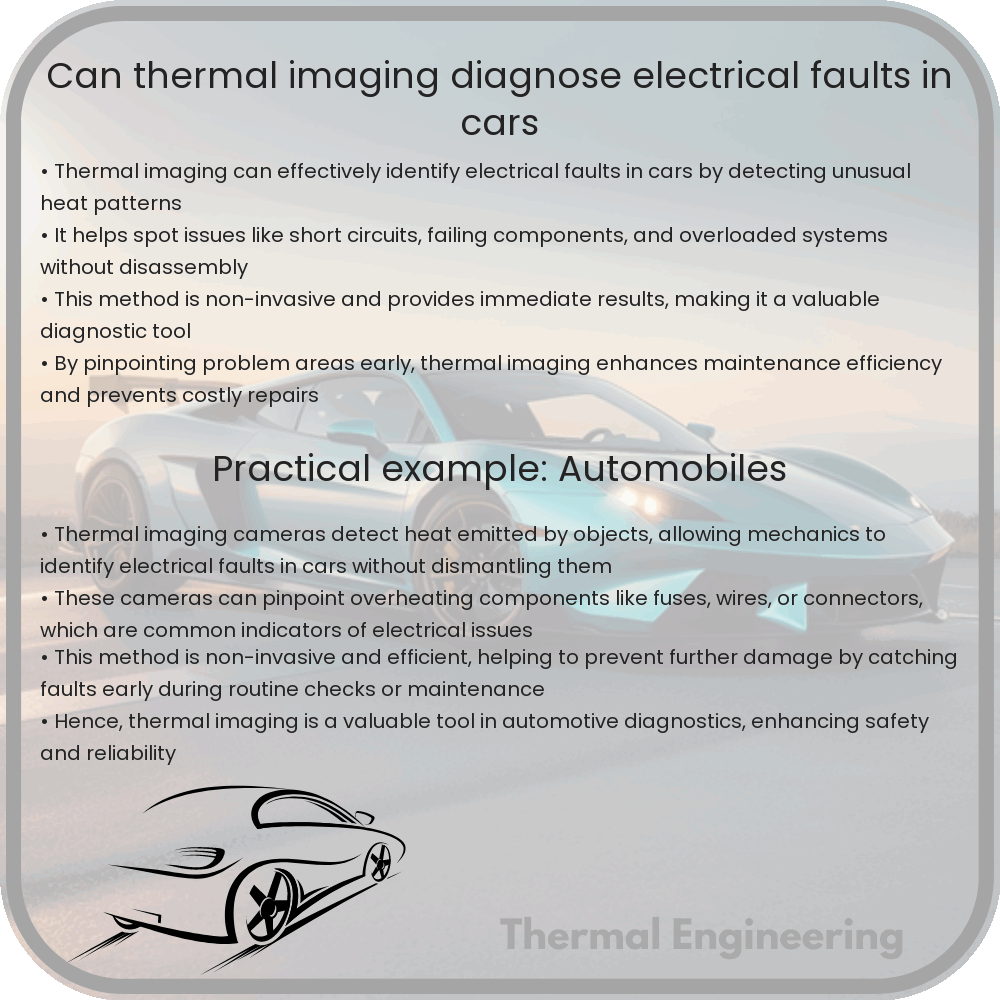
Thermal imaging technology has become an invaluable tool across various engineering fields, including automotive diagnostics. This technology uses infrared (IR) cameras to detect and measure thermal energy emitted from an object or scene. The resultant data is then used to create images known as thermograms, which vividly map out temperature variations. Given its capabilities, the question arises: Can thermal imaging effectively diagnose electrical faults in cars?

Understanding Thermal Imaging in Automotive Diagnostics

Thermal imaging in automotive diagnostics primarily helps in identifying problems related to electrical systems by visualizing the temperature emitted by various car components. This method is non-invasive and highly effective in pinpointing areas of excessive heat, often a telltale sign of many underlying mechanical and electrical issues.

Applications of Thermal Imaging in Car Electrical Fault Diagnosis

  • Identifying Overheated Components: Electrical faults in cars can cause certain components to overheat. Using thermal imaging, technicians can quickly determine hot spots as irregular temperature distributions in circuits, wires, or electrical units. This makes it possible to address the issue before it escalates into a more serious problem.
  • Locating Short Circuits: Short circuits can be challenging to locate with traditional testing equipment. Thermal cameras can visualize the extra heat generated by a short, illuminating the precise location of the electrical fault.
  • Assessing Fuse Functionality: Fuses that are close to blowing or have already blown may exhibit abnormal heat patterns. Thermal imaging can efficiently identify these faults, assisting in quick replacements and preventing potential hazards.
  • Inspecting Electrical Connections: Loose or corroded connections can increase electrical resistance and lead to heat generation. With thermal imaging, mechanics can scrutinize these connections and rectify issues to ensure optimal functioning of the car’s electrical system.

Benefits of Using Thermal Imaging

  • Non-Invasive Technology: Unlike some diagnostic methods, thermal imaging does not require disassembly or invasive probing, which can save time and reduce the risk of damaging sensitive vehicle components.
  • Instantaneous Results: Thermal cameras provide real-time feedback, which is crucial for quickly diagnosing and resolving automotive electrical issues.
  • Comprehensive Analysis: This technology allows for a full-scale examination of an electrical system, pinpointing various potential issues in a single inspection.
  • Preventive Maintenance: Regular thermal inspections can detect slight abnormalities before they develop into significant problems, offering a robust preventive maintenance tool.

Limitations of Thermal Imaging

While thermal imaging is highly effective, it does have limitations, such as:

  • Dependence on Temperature Differences: Thermal imaging is only effective if there is a noticeable temperature difference between the faulty component and its surroundings. If the ambient temperature is too close to the component’s temperature, the thermal camera may not pick up the discrepancy.
  • Line of Sight: Infrared cameras require a clear line of sight to the component being inspected. This can be challenging in cramped engine spaces where components are not easily visible.
  • Initial Cost: High-quality thermal imaging equipment can be costly, which might be a significant investment for smaller workshops or hobbyists.

Conclusion

Thermal imaging provides a powerful and efficient way to diagnose electrical faults in cars. By enabling easy detection of temperature anomalies and helping to visualize the condition of electrical components, thermal imaging aids mechanics and technicians in maintaining vehicle safety and functionality. Despite its limitations, the benefits of using thermal imaging in automotive diagnostics make it a valuable tool in the modern automotive industry.

How do thermal fluctuations influence protein folding

Explore the key role of thermal fluctuations in protein folding, impacting stability, folding rates, and pathways in biological processes.

How do thermal fluctuations influence protein folding

Understanding the Influence of Thermal Fluctuations on Protein Folding

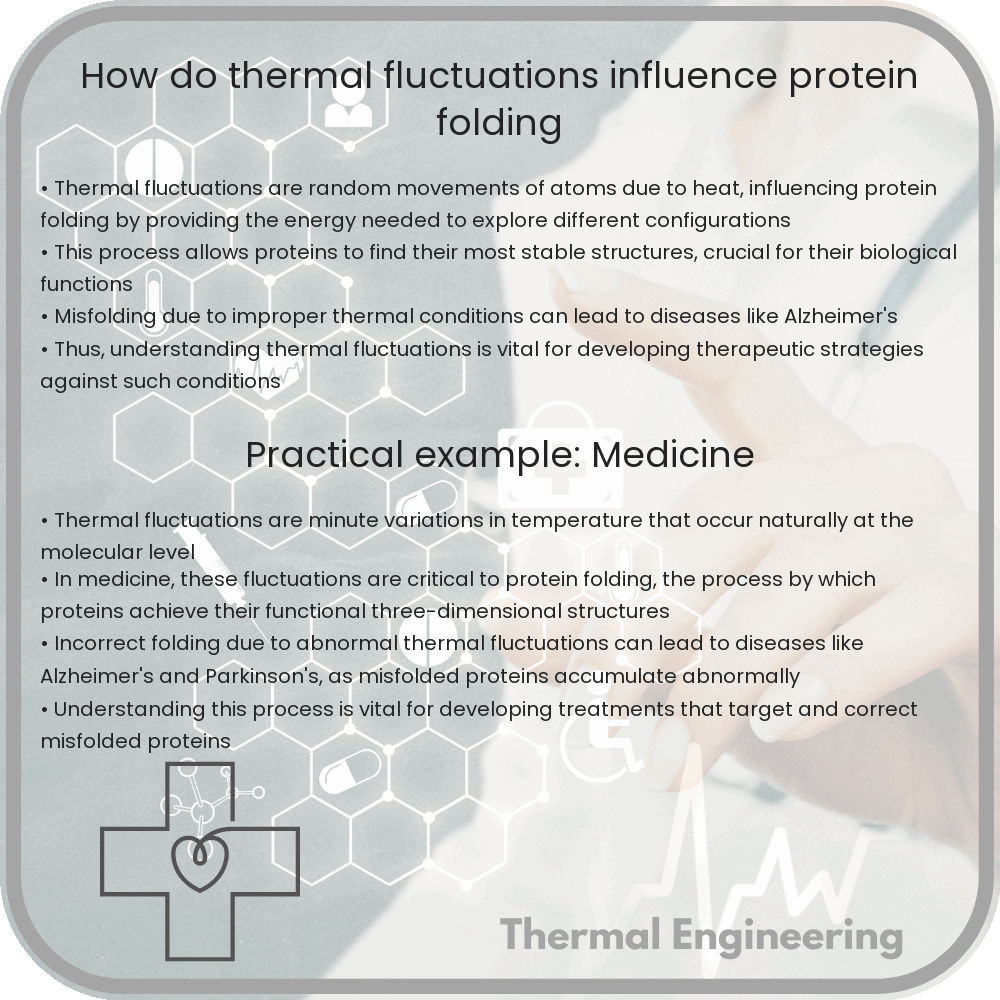
Protein folding is a crucial biological process where a protein structure assumes its functional, three-dimensional shape. This process is influenced by a myriad of factors, both environmental and molecular. One such environmental factor is temperature, and its inherent thermal fluctuations. These fluctuations play a significant role in the dynamic process of protein folding, affecting the stability, speed, and final structure of proteins.

What are Thermal Fluctuations?

Thermal fluctuations refer to the random movement of atoms and molecules in a substance, driven by temperature changes. In biological systems, these fluctuations can impact molecular interactions significantly. At higher temperatures, molecules have more kinetic energy and move more vigorously. Conversely, lower temperatures result in reduced molecular movements. Such variations can drastically influence how proteins fold and function.

Impact on Protein Folding

  • Altering Folding Rates: Increased thermal energy can accelerate the movement of a protein’s atoms, potentially speeding up the folding process. However, excessive movement might also lead to incorrect folding or misfolding, which can be detrimental to protein function.
  • Folding Pathway Selection: Proteins can fold along various pathways, leading to the same or different functional forms. Thermal fluctuations can influence the pathway a protein takes, thus affecting the folding landscape. This can lead to variability in how proteins fold under different thermal conditions.
  • Stability of the Proteins: Thermal fluctuations can destabilize certain weakly-stable regions of a protein, leading potentially to unfolded or misfolded states that might affect the protein’s functionality or lead to aggregation.

Theoretical Approaches to Studying Thermal Fluctuations in Protein Folding

Several models and theoretical frameworks have been developed to explore how thermal fluctuations affect protein folding. These include:

  1. Anfinsen’s Dogma: This principle posits that the primary sequence of a protein determines its three-dimensional structure. Thermal fluctuations are critical in dictating the move toward the lowest energy state, essential for proper folding.
  2. Energy Landscape Theory: This theory suggests that a protein’s folding is influenced by a rugged energy landscape with multiple local minima and a global minimum. Thermal fluctuations help the protein overcome energy barriers between these minima, guiding the folding pathway towards the global minimum where the most stable structure lies.
  3. Molecular Dynamics Simulations: These simulations provide a computational method to visualize how thermal energy affects protein folding. By simulating the atomic movements within a protein at different temperatures, scientists can predict folding rates and pathways.

Conclusion

The complex interplay between protein structure and environmental factors like temperature is pivotal in biophysics and molecular biology. Understanding how thermal fluctuations influence protein folding is not just crucial for comprehending biological processes but also for applications in biotechnology and medicine, such as in the design of temperature-stable proteins or in the study of diseases associated with protein misfolding. Ongoing research continues to explore these intricate dynamics, aiming to harness knowledge for innovative solutions in science and engineering.

What is the role of heat in fermenting kombucha

Understand how heat impacts the fermentation of kombucha, influencing process speed, flavor, and safety.

What is the role of heat in fermenting kombucha

The Role of Heat in Fermenting Kombucha

Kombucha is a popular fermented drink made from tea and sugar, involving a symbiotic culture of bacteria and yeast (SCOBY). This beverage has gained popularity for its potential health benefits, which include aiding digestion and boosting immune health. An important factor in the fermentation process of kombucha is the role of heat. The temperature during fermentation impacts the activity of the microorganisms in SCOBY and thus influences both the rate of fermentation and the quality of the final product.

Optimal Temperature for Kombucha Fermentation

The ideal temperature range for kombucha fermentation is typically between 20°C to 30°C (68°F to 86°F). Maintaining this temperature range is crucial because it facilitates an optimal environment for the yeast and bacteria in the SCOBY to thrive and ferment the sweetened tea.

  • Yeast Activity: Yeast performs best within this temperature range; they metabolize the sugars to produce alcohol and carbon dioxide. This metabolic activity is vital for the subsequent actions of the bacteria.
  • Bacterial Activity: The bacteria in the SCOBY primarily convert the alcohol into acetic acid, which gives kombucha its distinctive sour taste. The warmth within the stated range enables bacteria to efficiently transform the alcohol into various acids.

Effects of Temperatures Outside the Ideal Range

Temperatures outside of the 20°C to 30°C range can significantly affect the fermentation process:

  • Below 20°C (68°F): Colder conditions slow down the metabolism of yeast and bacteria, prolonging the fermentation process. This often results in a less acidic and subtly flavored kombucha. Moreover, lower temperatures can give rise to unwanted mold growth.
  • Above 30°C (86°F): Warmer conditions can accelerate fermentation, leading to a shorter fermentation cycle. However, this may result in an overly sour kombucha and can also increase the risk of harmful bacterial contamination.

Maintaining Consistent Brewing Temperatures

To consistently produce high-quality kombucha, it is essential to manage the temperature of the fermentation environment meticulously. This can be achieved in various ways:

  • Using a Heating Pad: Placing a heating pad under the fermentation container can help in maintaining a steady, warm temperature, especially in cooler climates.
  • Thermal Wraps: Wrapping the fermentation container in insulation or using a specially designed thermal wrap can help maintain the necessary warmth without external heat sources, which is particularly useful in variable temperature environments.
  • Location: Simply placing the fermentation container in a consistently warm area of a building, away from drafts and temperature fluctuations, can help maintain ideal fermentation conditions.

Conclusion

The role of heat in the fermentation of kombucha is crucial. It influences not only the speed of the fermentation process but also the flavor profile and safety of the final product. By controlling and maintaining an ideal temperature range, kombucha brewers can ensure that they produce a consistently high-quality drink that is both tasty and healthy.

How does heat affect the aging of whiskey

Learn how heat impacts whiskey aging, affecting flavor, maturation rate, and chemical reactions in oak barrels.

How does heat affect the aging of whiskey

The Impact of Heat on the Aging Process of Whiskey

Whiskey aging is a delicate science that relies heavily on environmental factors, with temperature being one of the most crucial. The interaction between the whiskey and its environment, particularly the influence of heat, plays a significant role in defining the final flavor and character of this beloved spirit. This article explores how heat affects the aging process of whiskey, shedding light on the chemical dynamics at play.

Temperature Fluctuations and Whiskey Aging

The aging of whiskey typically occurs in wooden barrels, most commonly made from oak. These barrels are not just passive containers; they interact chemically with the whiskey. Heat influences these interactions profoundly. As temperature increases, the chemical reactions responsible for transforming the taste, color, and aroma of the whiskey are accelerated.

  • Expansion and Contraction: Wood is a porous material and reacts to changes in temperature. Heat causes the wood to expand, allowing the whiskey to penetrate deeper into the barrel. Conversely, a drop in temperature leads to contraction, causing the wood to squeeze the whiskey back out. This process, known as ‘breathing’, helps infuse the whiskey with flavors from the wood.
  • Increased Evaporation: Higher temperatures lead to increased evaporation rates. Commonly known as the “Angel’s Share,” this evaporation process results in a concentration of flavors and an increase in the whiskey’s overall smoothness and complexity.
  • Enhancement of Chemical Reactions: Heat boosts the rate of chemical reactions in the barrel. This includes the oxidation of alcohols to aldehydes and acids, and the esterification processes that form esters. These reactions are crucial for developing the flavor characteristics typical of aged whiskeys.

Regional Impact on Whiskey Aging

Geographic location, defined by its climatic conditions, particularly temperature, plays a pivotal role in the whiskey’s aging timeline. Distilleries in warmer climates, like Kentucky or Tennessee, often experience faster aging cycles because higher average temperatures accelerate the whiskey-barrel interactions.

  1. Tropical Aging: In tropical climates, the constant high temperatures lead to a much quicker maturation process. Whiskeys aged in these climates can develop complexities often achieved in temperate regions over much longer periods.
  2. Temperate Aging: Cooler climates slow down the aging process, allowing for prolonged and more gradual interactions between the whiskey and the barrel. This can result in whiskeys with subtly different flavor profiles, often perceived as smoother and more rounded.

Heat Management in Whiskey Production

Understanding the critical role of temperature, distilleries often implement strategies to manage heat’s impact effectively. Some distilleries use climate-controlled warehouses to maintain a more consistent aging process, while others might choose warehouse locations strategically based on desired temperature fluctuations.

Conclusion

Heat has a profound influence on the aging of whiskey, affecting everything from the rate of maturation to the flavor profile of the final product. Both excessive heat and cool temperatures can lead to distinct characteristics in whiskey. Therefore, distilleries must carefully consider their aging environments to craft spirits that meet their desired qualities and satisfy the palates of whiskey aficionados worldwide.

This exploration into the effects of heat on whiskey aging highlights the scientific intricacies behind producing this time-honored drink and illustrates the delicate balance required in crafting premium spirits.

What are the thermodynamics of black hole radiation

Explore the intricacies of Hawking radiation, a pivotal concept that illustrates how black holes can emit radiation and potentially evaporate, challenging traditional notions of black hole permanence.

What are the thermodynamics of black hole radiation

Understanding the Thermodynamics of Black Hole Radiation

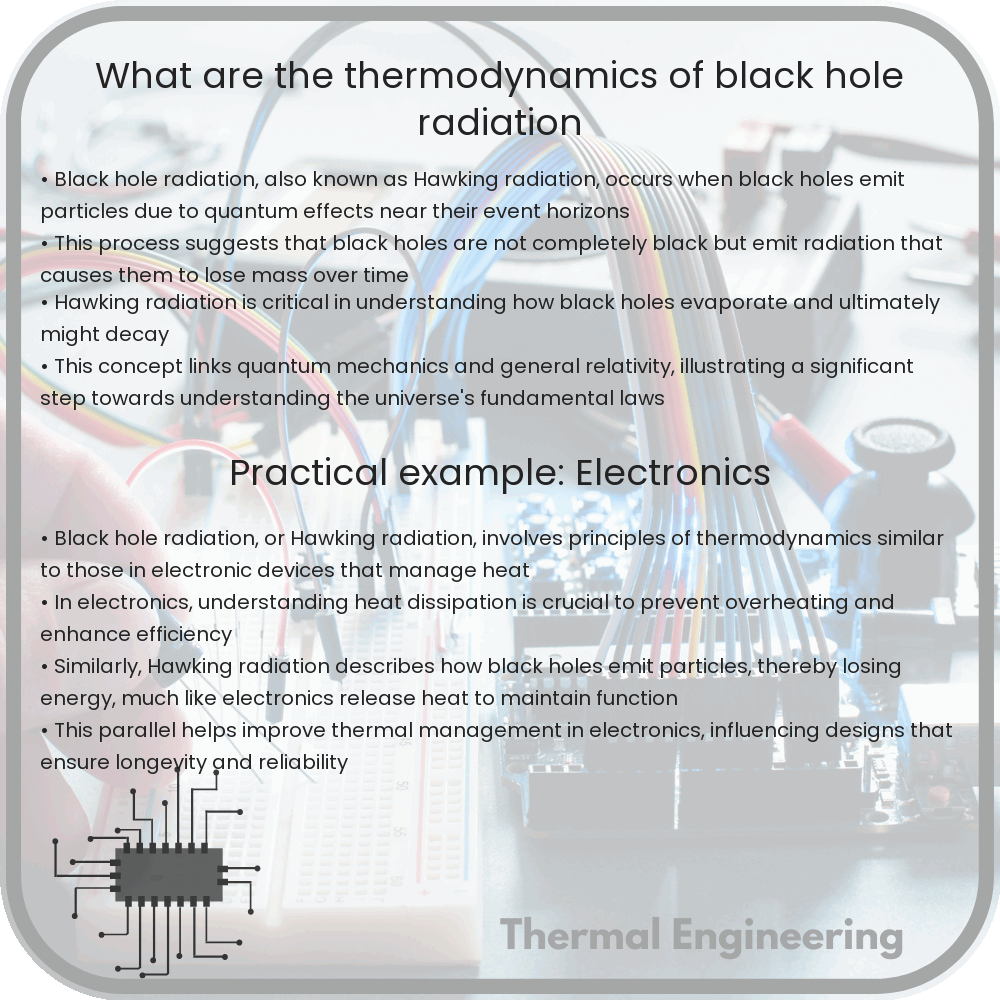
Black hole radiation, more commonly known as Hawking radiation, is a theoretical prediction that arises from the field of quantum mechanics and general relativity. It suggests that black holes, which were once thought to absorb everything and emit nothing, actually emit radiation and can potentially evaporate over time. This phenomenon profoundly connects the realms of thermodynamics, quantum physics, and gravitational theory.

Theoretical Foundation

The concept of black hole radiation was proposed by physicist Stephen Hawking in 1974, fundamentally challenging the understanding that nothing could escape from a black hole. The theory combined principles from quantum mechanics with general relativity, depicting a scenario where particle-antiparticle pairs are created near the event horizon of a black hole.

  • Event Horizon: The boundary around a black hole beyond which no matter or radiation can escape.
  • Particle-Antiparticle Pairs: In quantum mechanics, these pairs of particles with opposite charges may appear spontaneously near the event horizon.

When these pairs form, one particle may fall into the black hole while the other escapes. The particle that escapes carries away energy, leading to a decrease in the mass of the black hole—a process not visible but theoretically sound.

Mathematical Descriptions

The temperature T of the Hawking radiation from a black hole can be described by the equation:

\[ T = \frac{\hbar c^{3}}{8 \pi G M k_{B}} \]

Where:

  • \(\hbar\) (h-bar) is the reduced Planck constant,
  • c is the speed of light in vacuum,
  • G is the gravitational constant,
  • M is the mass of the black hole,
  • kB is the Boltzmann constant.

This relationship shows that the thermal radiation temperature is inversely proportional to the mass of the black hole, suggesting that larger black holes emit less radiation and thus have lower temperatures.

Entropy and Information Paradox

Another intriguing aspect of black hole thermodynamics is the concept of entropy. The entropy of a black hole is proportional to its surface area (A) and can be expressed as:

\[ S = \frac{k_{B} c^{3} A}{4 G \hbar} \]

This implies that the black hole’s entropy, which accounts for the unknown information within the black hole, increases as its surface area grows. Connected to this is the information paradox, a famous dilemma about whether information that falls into a black hole is lost forever or can be in some way retained or emitted back out, contravening the classical notions of physics.

Implications and Modern Research

The phenomenon of black hole radiation has numerous implications for modern physics, including the eventual fate of black holes and the ultimate theory of quantum gravity, which seeks to unify quantum mechanics with general relativity. While directly observing Hawking radiation remains beyond current technological capabilities, these theoretical insights continue to inspire extensive research and debate in theoretical physics, cosmology, and quantum mechanics.

Hawking radiation not only enhances our understanding of celestial mechanics but also challenges and expands the scope of theoretical physics. By bridging elements from various physics fields, it remains one of the most fascinating topics in the study of cosmology and black hole physics.

How do thermal barriers protect spacecraft on re-entry

Learn how thermal barriers safeguard spacecraft during re-entry by managing extreme heat generated at hypersonic speeds.

How do thermal barriers protect spacecraft on re-entry

Understanding Thermal Barriers in Spacecraft Re-entry

Re-entry into Earth’s atmosphere presents one of the most hazardous phases of space travel. As a spacecraft descends from space, it encounters the Earth’s atmosphere at high speeds, leading to intense heat generation due to friction and compression of air. To withstand these extreme conditions, spacecraft are equipped with thermal protection systems (TPS), which serve as barriers against the extreme heat. This article explores how thermal barriers work to protect spacecraft during this critical phase of space travel.

Why is Thermal Protection Needed?

As the spacecraft re-enters the Earth’s atmosphere, it typically travels at speeds exceeding Mach 25 (25 times the speed of sound). At these hypersonic speeds, the compression of atmospheric gases and friction against the spacecraft’s surface generates extreme heat. The temperature can soar up to 1,650 degrees Celsius (3,000 degrees Fahrenheit) or higher, which is well beyond the melting temperatures of common spacecraft materials like aluminum. Without adequate protection, the structural integrity of the spacecraft would be compromised, leading to potential failure and loss of the mission and crew.

Types of Thermal Protection Systems

  • Ablative Heat Shields: This is the most commonly used type of TPS and works by absorbing heat through the pyrolysis (decomposition caused by high temperatures) of the shield material. As the material ablates (erodes), it removes heat from the spacecraft, keeping the underlying structure cooler. Materials often used include reinforced carbon-carbon or heat-resistant phenolic resins.
  • Refractory Insulation Tiles: Another approach involves using tiles made from heat-resistant materials such as silica fibers. These tiles can withstand extremely high temperatures without melting. The space shuttle’s thermal protection system famously used thousands of these lightweight silica tiles.
  • Reinforced Carbon-Carbon (RCC): Used in high-temperature areas such as the nose caps and wing leading edges of the space shuttle, RCC can withstand extreme temperatures and is crucial for protecting the more vulnerable parts of the spacecraft.

How Thermal Barriers Work

The effectiveness of thermal protection systems lies in their ability to manage heat transfer. There are three primary modes of heat transfer:

  1. Conduction: The process by which heat moves directly through a material. TPS materials are designed to have low thermal conductivity to slow down the transfer of heat to the spacecraft’s interior.
  2. Convection: The transfer of heat through fluids (in this case, the atmospheric gases). The outer layer of the TPS interacts with atmospheric gases and prevents the transfer of heat by convection to the spacecraft.
  3. Radiation: Emission of heat in the form of electromagnetic waves. High temperatures cause the TPS to radiate energy back into the atmosphere, thus reducing the heat load on the spacecraft.

In addition to handling intense heat, thermal protection systems must also be engineered to handle mechanical stresses and changes in atmospheric pressure during descent. They must also remain intact despite experiencing erosion and other physical stresses during the re-entry process.

Conclusion

The remarkable design and engineering of thermal barriers are crucial for safe space missions, especially during the perilous phase of re-entry. Through a combination of ablation, insulation, and reflective properties, thermal protection systems shield spacecraft and their occupants, ensuring that they can withstand the most extreme conditions encountered during their journey back to Earth. By continuously advancing these technologies, engineers work to improve the safety and efficiency of space travel, paving the way for more ambitious missions in the future.