Facebook Instagram Youtube Twitter

How does a thermal oxidizer clean exhaust

Learn about thermal oxidizers and their role in industrial exhaust cleaning, including operation principles, components, types, and environmental impact.

How does a thermal oxidizer clean exhaust

Understanding How a Thermal Oxidizer Cleans Exhaust

Thermal oxidizers, also known as thermal incinerators, play a crucial role in managing pollutants in industrial exhaust streams. They are engineered to remove hazardous air pollutants (HAPs), volatile organic compounds (VOCs), and odorous emissions that are commonly released from various industrial processes. The role of a thermal oxidizer is simple yet vital: to clean industrial exhaust before it is released into the atmosphere, thus contributing to environmental conservation and pollution control. This article explores the fundamental principles, design, and operation of thermal oxidizers.

Principle of Operation

The fundamental principle behind thermal oxidizers is the combustion of pollutants. The process involves heating a mixture of exhaust air and pollutants to a high temperature, which promotes a chemical oxidation reaction. This reaction typically occurs at temperatures ranging from 650°C to 1000°C. The high heat is sufficient to break down the chemical bonds in the pollutants, transforming them into less harmful substances such as carbon dioxide and water vapor.

Main Components

  • Burner: Provides the heat needed to reach the oxidation temperature necessary for the combustion of VOCs and other pollutants.
  • Combustion Chamber: A well-insulated chamber where the actual oxidation of pollutants occurs.
  • Heat Recovery System: Although not present in all thermal oxidizers, this component recovers heat from the combustion gases to improve energy efficiency.
  • Exhaust Stack: A tall chimney through which the cleaned gases are released into the atmosphere.

Types of Thermal Oxidizers

There are several types of thermal oxidizers, each suited to specific industrial applications based on the nature of the exhaust stream and operational efficiency requirements:

  1. Direct-Fired Thermal Oxidizers (DFTO): These are the simplest forms, where the exhaust stream is fed directly into a firing chamber, achieving combustion temperatures swiftly without heat recovery.
  2. Regenerative Thermal Oxidizers (RTO): Known for their heat recovery capability, RTOs use ceramic media to capture and reuse heat, leading to higher energy efficiency and lower operational costs.
  3. Recuperative Thermal Oxidizers: These use a primary heat exchanger to preheat the incoming air by recovering heat from the outgoing clean exhaust. This reduces the fuel consumption needed to reach oxidation temperatures.
  4. Catalytic Thermal Oxidizers: By incorporating catalysts, these oxidizers lower the required temperature for oxidation, thereby reducing energy consumption and handling temperature-sensitive materials more effectively.

Environmental and Efficiency Considerations

Thermal oxidizers are an essential component of modern pollution control strategies. Their ability to convert harmful pollutants into water and carbon dioxide helps industries meet stringent environmental regulations. The choice between different types of thermal oxidizers often depends on specific factors like the type of pollutants, volume of exhaust, energy costs, and desired efficiency levels. Furthermore, advancements in heat recovery technology continue to enhance the eco-friendliness and cost-effectiveness of these systems by significantly reducing fuel consumption and associated emissions.

Conclusion

Thermal oxidizers provide a critical solution for pollution control in numerous industrial settings. By understanding their functionality and operation, industries can effectively plan and implement appropriate pollution mitigation strategies, ensuring compliance with environmental standards and promoting sustainable industrial practices. With ongoing technological improvements, the efficiency and effectiveness of thermal oxidizers are expected to advance, further aiding in the global effort to reduce industrial pollution.

How thermopiles generate voltage from heat

Learn how thermopiles harness the Seebeck effect to convert heat into voltage for temperature sensing and energy harvesting applications.

How thermopiles generate voltage from heat

Understanding Thermopiles: Converting Heat to Voltage

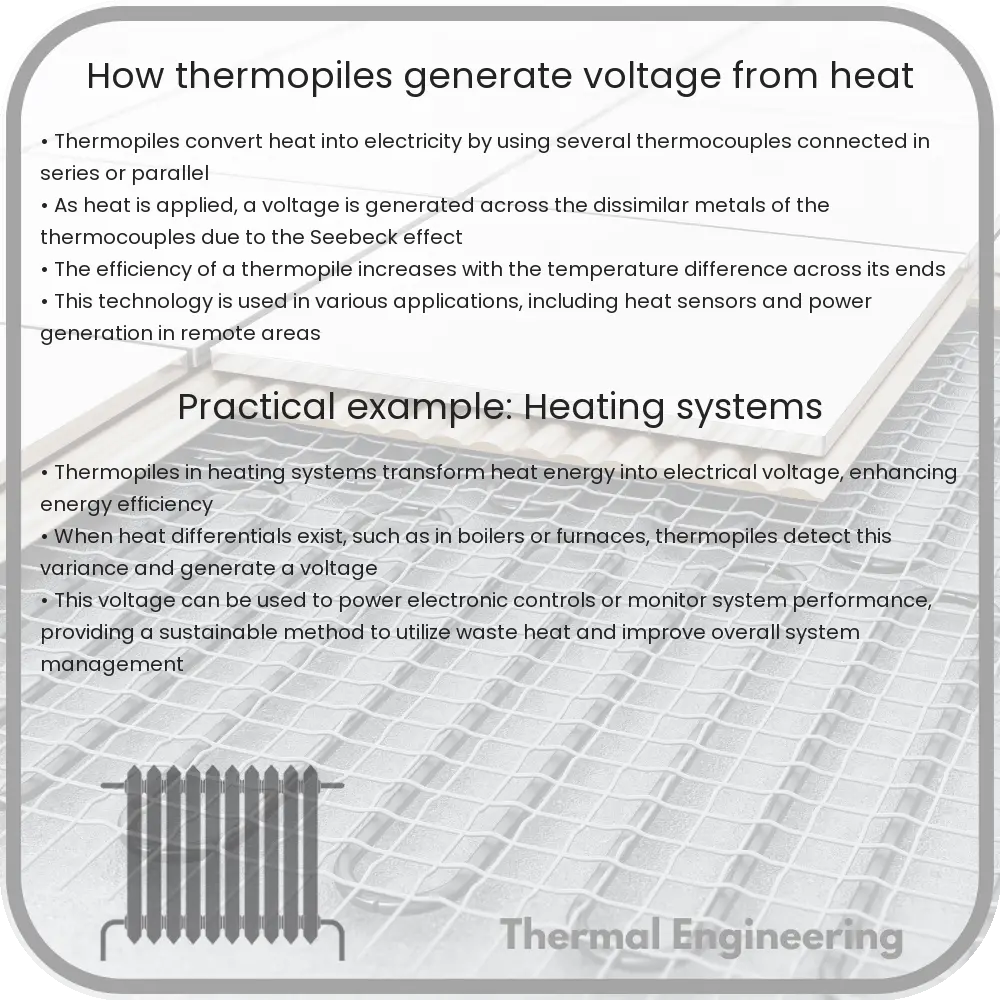
Thermopiles are devices that convert thermal energy (heat) directly into electrical energy using a phenomenon known as the Seebeck effect. This technology is widely used in applications ranging from industrial temperature sensors to remote power generation systems. Understanding how thermopiles work involves exploring the basic principles of thermoelectricity and the physical structure of these devices.

The Seebeck Effect: The Core Principle Behind Thermopiles

The operation of thermopiles hinges on the Seebeck effect, discovered by German physicist Thomas Johann Seebeck in 1821. The Seebeck effect occurs when a temperature difference is established between two dissimilar electrical conductors or semiconductors, inducing a voltage difference between the materials. In essence, when one end of each material is heated more than the other, an electrical voltage is generated across the circuit.

The voltage V generated can be described by the equation:

V = S * ΔT

Where:

  • V is the voltage generated,
  • S is the Seebeck coefficient, which varies depending on the materials used, and
  • ΔT is the temperature difference between the hot and cold junctions.

Structure and Composition of a Thermopile

A thermopile is effectively a series of thermocouples, which are pairs of different metals or semiconductors (known as thermoelements) joined at their ends. A typical thermocouple consists of two wires made of different materials, connected in a loop. In a thermopile, several of these thermocouples are connected in series to increase the output voltage, since each thermocouple adds a small voltage together.

The choice of materials for the thermocouples is crucial, as different materials produce different Seebeck coefficients. Common materials include bismuth telluride, antimony, and alloys like Constantan (made from copper, nickel, and manganese).

Applications of Thermopiles

Thermopiles are primarily used for temperature measurement and thermal sensing. They are particularly advantageous in situations where contactless temperature measurements are necessary, such as in infrared thermometers, where they are used to measure radiation from an object and convert it into temperature readings.

Moreover, thermopiles can be found in various energy harvesting applications where waste heat is abundant. For instance, they can convert the heat from industrial processes or automotive exhausts into usable electrical energy, contributing to more efficient energy use.

Advantages and Limitations

The primary advantage of thermopiles is their ability to generate electricity without any moving parts, which ensures minimal wear and tear and long-term reliability. They are also capable of operating over a broad range of temperatures and can be designed to fit various applications due to their scalability.

On the downside, the efficiency of thermopiles is generally low compared to other power generation technologies. The voltage output is also relatively small, which can limit their use in applications requiring higher power outputs unless combined with other methods of electricity generation.

Conclusion

Thermopiles present a fascinating application of the thermoelectric effect to generate voltage from heat differences. Whether used in industrial sensors, remote power generation, or energy efficiency systems, thermopiles serve as crucial components in a wide array of engineering solutions. They embody an elegant bridge between thermal and electrical energy, illustrating a key principle of thermodynamics and its practical utility in modern technology.

How heat affects adhesive curing

Learn how temperature impacts adhesive curing time and quality, essential for manufacturing strong, reliable bonds in various industries.

How heat affects adhesive curing

Understanding How Heat Affects Adhesive Curing

Adhesive curing is a critical process in the manufacturing and assembly of various products, ranging from electronics to automotive components. The cure process of adhesives is influenced by several factors, with temperature being one of the most significant. Heat can accelerate the chemical reactions involved in curing, ultimately affecting the performance and reliability of the adhesive joint.

The Basics of Adhesive Curing

Curing is the process through which an adhesive transitions from a liquid or paste to a solid state, developing its ultimate strength and adhesion characteristics. This transformation typically occurs due to chemical reactions such as polymerization, where small molecules join to form larger structures. The rate and extent of these reactions are strongly dependent on temperature.

Impact of Heat on Curing Time

Increasing the temperature can significantly reduce the curing time of adhesives. This is because heat provides energy that accelerates the molecular movements, enhancing the rate at which the curing chemical reactions occur. Practically, this means that a higher temperature can lead to a faster buildup of adhesive strength.

  • For thermosetting adhesives, heat can reduce curing time from hours to minutes, making it a crucial factor in speeding up production lines.
  • For thermoplastics, elevated temperatures allow the material to flow and adhere properly before cooling and solidifying into the desired shape.

Temperature and Cure Quality

While faster curing can be advantageous, it is vital to consider the effects of heat on the quality of the cured adhesive. Elevated temperatures can lead to non-uniform curing, stresses, or even degradation of the adhesive components:

  • Non-uniform curing: Rapid temperature increases can cause the outer layers of an adhesive to cure much faster than the inner layers. This can result in internal stresses and potential failure points.
  • Thermal degradation: Excessively high temperatures can break down the chemical structure of certain adhesives, reducing their overall strength and effectiveness.

Optimal Temperature for Adhesive Curing

Manufacturers typically specify an optimal temperature range for the application and curing of their products. This range is designed to provide the ideal balance between curing speed and adhesive performance. It’s crucial to follow these guidelines to ensure the integrity and durability of the adhesive bond:

  • Ensuring the adhesive and substrates are maintained within this temperature range can help in achieving uniform curing.
  • Using controlled heating methods such as ovens, heat lamps, or heated presses can help maintain the proper temperature during curing.

Conclusion

The relationship between heat and adhesive curing is an essential aspect of product assembly and manufacturing. Understanding how temperature influences both the curing speed and the quality of adhesives can help engineers and technicians optimize their processes for better product performance and reliability. Adhering to recommended temperature guidelines is crucial for achieving the strongest and most durable adhesive bonds.

How heat affects paint drying

Learn how heat affects paint drying, influencing evaporation and curing processes, and get tips for optimal painting in various temperatures.

How heat affects paint drying

Understanding How Heat Affects Paint Drying

Paint drying is a process that’s more complex than it might appear at first glance. While many factors including the type of paint, the thickness of the application, and environmental conditions play roles, heat is among the most significant factors influencing drying time. Here, we’ll explore why heat matters and how it affects the drying process.

The Basics of Paint Drying

Paint drying can be categorically divided into two phases: evaporation and curing. Evaporation involves the solvent in the paint (which can be water or an organic compound) evaporating, leaving behind the paint pigment and binders. Curing is a chemical process where the binders harden, bonding the pigment to the surface. Both processes are influenced by heat.

Impact of Heat on Evaporation

The evaporation rate of the solvent in paint increases with temperature. According to the principles of thermodynamics, increasing the ambient temperature will increase the energy of the solvent molecules, making them more likely to overcome the attraction to other molecules and transition from a liquid to a gas phase. This is guided by the simple Clausius-Clapeyron relation:

ln(p2/p1) = -ΔHvap / R * (1/T2 – 1/T1)

where ln represents the natural logarithm, p2 and p1 are the vapor pressures at two temperatures, ΔHvap is the enthalpy of vaporization, R is the universal gas constant, and T1 and T2 are the absolute temperatures. From this relationship, we can infer that as temperature (T) increases, vapor pressure also increases, thereby accelerating the drying process.

Impact of Heat on Curing

Curing rates also generally increase with temperature. Most paint binders are polymeric materials that respond to temperature in complex ways. The higher the temperature, the more molecular motion occurs, aiding the cross-linking process essential for the paint to harden and adhere. For chemically curing paints like two-part epoxies or urethanes, heat can dramatically accelerate the chemical reactions that solidify the paint.

However, excessive heat can be detrimental. Very high temperatures can lead to uneven curing, which might cause surface defects such as blisters and bubbles. Moreover, some paints may discolor if subjected to high temperatures during the curing phase.

Practical Implications

  • Optimal Painting Conditions: Understanding the impact of heat can help in choosing the best conditions to paint. For instance, painting in too hot conditions should be avoided to prevent fast solvent evaporation that can lead to an uneven finish.
  • Use of Artificial Heating: In colder climates, artificial heating can be employed to enhance drying and curing rates. However, care must be taken to ensure the temperature is controlled and does not exceed the paint’s heat tolerance level.
  • Special Paint Formulations: Manufacturers sometimes formulate paints differently for specific climates to optimize drying times according to typical temperature conditions.

In conclusion, heat is a crucial factor affecting the drying and curing of paint. By managing temperature conditions effectively, one can ensure not only quicker drying times but also a smoother, more durable finish. Whether you’re a professional painter or a DIY enthusiast, considering the impact of heat on your painting projects can lead to better results and more efficient work.

How thermal printers create images

Learn how thermal printers use heat to create images on specially treated paper, offering a fast, cost-effective, and reliable printing solution.

How thermal printers create images

Understanding How Thermal Printers Create Images

Thermal printers are a fascinating piece of technology widely used in various applications such as receipt printing in shops, ticket printing at kiosks, and labeling in industrial environments. Unlike traditional inkjet or laser printers, thermal printers do not require ink or toner to produce images. Instead, they rely on a controlled heating process to generate prints. This article explores the basic principles behind thermal printers and how they use heat to create images.

Components of a Thermal Printer

At the core of a thermal printer are three key components:

  • Thermal Head: This is the critical component that generates heat. The thermal head consists of a series of tiny heating elements that are precisely controlled to generate the necessary heat patterns.
  • Platen: A platen is a rubber roller that feeds the thermal paper through the printer. It ensures that the paper makes firm contact with the thermal head.
  • Thermal Paper: This special paper is chemically treated to change color when heated. The paper’s surface has a heat-sensitive pigment that reacts to the heat from the thermal head.

How Images are Formed

The process of creating an image on thermal paper involves several steps:

  1. Heating Elements Activate: The printer receives a digital image input, which is converted into a pattern of electrical impulses. These impulses precisely activate the heating elements in the thermal head.
  2. Heat Application: As the thermal paper passes under the thermal head, the activated elements apply heat to specific areas of the paper. The temperature and duration of heat application are carefully controlled to produce the desired image quality.
  3. Chemical Reaction: The heat-sensitive coating on the thermal paper reacts to the heat, causing a color change in the heated areas. This reaction typically turns the paper from white to black, although other colors can be used by modifying the chemical composition of the coating.

Variants of Thermal Printing

There are two main types of thermal printing technologies:

  • Direct Thermal Printing: This method involves the process described above, where heat is applied directly to the thermal paper. Direct thermal printing is commonly used for applications where the longevity of the printed image is not critical, such as receipts and tickets.
  • Thermal Transfer Printing: For applications requiring more durable prints, thermal transfer printing is used. In this method, heat is applied to a wax or resin-based ink ribbon that melts onto the paper, thereby transferring the ink to create the image. This technique is suitable for printing more durable labels and barcodes.

Advantages of Thermal Printing

Thermal printing offers several advantages, making it an attractive choice for many applications:

  • Speed: Thermal printers are generally faster than ink-based printers because they create images directly through heating without involving any mechanical ink distribution processes.
  • Cost-effectiveness: The lack of ink or toner supplies reduces ongoing operating costs. Maintenance requirements are also typically lower.
  • Reliability: Fewer moving parts reduce the likelihood of mechanical failures.
  • Compactness: The simplicity of the design allows for smaller, more compact printer designs.

Whether for quick receipt printing, labeling packaging, or issuing tickets, thermal printers provide an efficient and reliable method of producing images. By understanding the principles that drive thermal printing, users can better select and maintain their devices for optimum performance.”

How heat affects fermentation processes

Explore the impact of temperature on fermentation efficiency, highlighting optimal ranges and enzyme activity for industrial applications.

How heat affects fermentation processes

Understanding How Heat Affects Fermentation Processes

Fermentation is a critical process in many industries, including food and beverage, pharmaceuticals, and biofuels. Essentially, it involves the conversion of carbohydrates to alcohols and carbon dioxide or organic acids through the action of yeasts or bacteria. The efficiency and rate of fermentation can be significantly influenced by various factors, one of which is temperature. Let’s explore how heat affects fermentation processes and why managing temperature is crucial in these biochemical reactions.

The Role of Temperature in Fermentation

Temperature is a key environmental factor that impacts the rate of fermentation. Each fermenting organism has an optimal temperature range that supports its maximum activity. Deviating from this range can reduce efficiency or even halt the process entirely.

  • Optimal Temperature Range: Most yeast fermentations, such as those used in brewing and baking, have an optimal range between 20°C to 30°C (68°F to 86°F). Lactic acid bacteria used in yogurt and cheese production generally prefer slightly higher temperatures, typically around 30°C to 40°C (86°F to 104°F).
  • Enzyme Activity: Fermentation is driven by enzymes, which are proteins that facilitate chemical reactions. Temperature affects enzyme activity by altering their structure. Within the optimal range, higher temperatures typically increase the rates of enzyme-catalyzed reactions.
  • Thermal Denaturation: At temperatures beyond the optimal range, enzymes and other proteins can denature, losing their structure and function. This can lead to slowed or stopped fermentation processes.

Effects of Heat on Fermentation Kinetics

The kinetics of fermentation describe how the rate of fermentation changes over time and under different conditions. The Arrhenius equation is often used to illustrate the temperature dependence of reaction rates:

k = A * e-Ea/(RT)

  • k: Rate constant of the reaction
  • A: Frequency factor, representing the number of successful collisions
  • Ea: Activation energy of the reaction (energy required to initiate the reaction)
  • R: Universal gas constant
  • T: Absolute temperature (in Kelvin)

According to this equation, even a small increase in temperature can significantly increase the rate of fermentation, provided the temperature remains within the range that is tolerable to the yeast or bacteria.

Practical Applications and Considerations

In industrial settings, maintaining the right fermentation temperature is crucial for maximizing yield and efficiency. Here are a few practical considerations:

  • Temperature Control Systems: Fermenters are often equipped with heating or cooling systems that help maintain a constant temperature. This is crucial not only for optimizing fermentation rates but also for preventing the growth of undesirable microorganisms that could contaminate the product.
  • Scaling Up Processes: When scaling up fermentation processes from laboratory to industrial scales, the heat generated by the fermentation itself can significantly affect the temperature. Industrial fermenters must be designed to handle this additional heat load efficiently.

Conclusion

Temperature management is a critical component of optimizing fermentation processes. By understanding and controlling the heat during fermentation, producers can ensure that biochemical processes are conducted efficiently, safely, and with the highest yield possible. This not only improves the quality of the end products but also enhances the economic viability of the fermentation-based industries.

Whether in brewing, dairy productions, or biofuel manufacturing, paying close attention to the thermal aspects of fermentation helps businesses to thrive and produce consistently high-quality results.

How does a sauna use heat for health

Dive into the engineering behind saunas and learn how the application of heat contributes to various health benefits including detoxification and stress relief.

How does a sauna use heat for health

Understanding the Engineering Behind Saunas: How Heat Contributes to Health

The use of saunas for health benefits is a tradition that dates back centuries, particularly in Nordic countries. The basic principle behind a sauna is simple: it uses heat to induce sweat and, in the process, provides various health benefits. This article will look at how the engineering of saunas harnesses heat to promote health, the types of saunas, and some of the physiological effects of using a sauna.

Types of Saunas

There are primarily two types of saunas: traditional steam saunas and infrared saunas. Each uses heat differently to achieve similar health benefits.

  • Steam Saunas: Also known as Finnish saunas, these involve a room heated by a stove, either wood-burning or electric, that heats stones. Water is periodically thrown on these heated stones to produce steam and increase the room’s humidity. Temperatures typically range from 70°C to 100°C.
  • Infrared Saunas: Instead of heating the air around you, infrared saunas use infrared lamps to directly warm your body. This type of sauna operates at a lower temperature range — usually between 40°C to 60°C — which can be more tolerable for people who find traditional saunas too hot.

Engineering Principles in Sauna Design

Creating an effective sauna involves a keen understanding of heat transfer, thermodynamics, and human physiology. The design and construction of a sauna must effectively manage heat to ensure efficiency and safety. Here are a few key engineering considerations:

  1. Insulation: Effective insulation is critical in sauna design to keep the heat contained within the sauna while preventing the outside walls from becoming too hot, thus ensuring energy efficiency and safety.
  2. Ventilation: Good ventilation is necessary to manage the humidity and temperature levels, contributing to a comfortable and safe environment. Fresh air helps control the amount of oxygen in the room while allowing for the removal of contaminants.
  3. Material Choice: Saunas need materials that can withstand high temperatures and humidity without deteriorating. Cedarwood is commonly used due to its resistance to rot and mildew as well as its ability to absorb and expel moisture without warping.

Health Benefits of Sauna Use

The use of a sauna can contribute to several health benefits:

  • Detoxification: Sweating promotes detoxification by flushing toxins from the body through the pores, which helps to cleanse the skin and reduce the load on the kidneys and liver.
  • Relaxation and Stress Reduction: The heat in a sauna helps to relax muscles, soothe aches in muscles and joints, and promote relaxation by triggering the release of endorphins, the body’s natural pain relieving and happiness chemicals.
  • Improved Circulation: The heat increases blood circulation. This enhanced circulation can help reduce inflammation, ease muscle pain, and lower blood pressure.
  • Cardiovascular Health: Regular sauna use has been linked to a reduced risk of cardiovascular diseases. The heat mimics the effects of mild exercise by increasing heart rate and promoting sweating.

Conclusion

The scientific and engineering principles behind saunas make them not only a part of wellness culture but also a fascinating study in the application of thermal dynamics and material science. By understanding how saunas use heat and observing the recommended safety practices, individuals can enjoy both the relaxation and health benefits they offer safely and effectively. Whether opting for a steam sauna or an infrared sauna, the core benefits focus on health, wellness, and relaxation, grounded in centuries of tradition and modern engineering knowledge.

How heat exchangers recover waste heat

Learn about heat exchangers and their role in energy conservation through waste heat recovery in various engineering sectors.

How heat exchangers recover waste heat

Understanding How Heat Exchangers Recover Waste Heat

Heat exchangers are devices used to transfer heat between two or more fluids at different temperatures, effectively conserving energy by recovering waste heat that would otherwise be lost to the environment. This technology is vital in many engineering fields, including automotive, aerospace, and manufacturing industries, due to its efficiency in energy conservation and emission reduction.

Principles of Heat Exchange

Heat exchangers operate on the basic principle of thermodynamics that heat always flows from a hotter substance to a cooler substance. By recovering and transferring heat from waste streams (such as flue gases or exhaust) back into the system, heat exchangers can significantly enhance the efficiency of a process or system. The key processes involved in a heat exchanger include conduction, where heat is directly transferred through a substance when there is a difference in temperature, and convection, which involves the heat transfer via fluid motion.

Types of Heat Exchangers Used in Waste Heat Recovery

  • Shell and Tube Heat Exchangers: These consist of a series of tubes, one set carrying the fluid to be heated or cooled, while the other carries the fluid that provides the heat or absorbs the heat. Due to their design, they are well-suited for high-pressure applications.
  • Plate Heat Exchangers: These feature plates stacked over each other to form channels for fluids to flow through. Plate exchangers are generally more effective than shell and tube types, offering larger surface areas for heat transfer.
  • Regenerative Heat Exchangers: This type uses a rotating wheel or drum to store heat temporarily and transfer it from the hot fluid to the cooler fluid, remarkably maximizing heat recovery.

The Process of Recovering Waste Heat with Heat Exchangers

The process starts with the hot exhaust gases being directed into the heat exchanger. As these gases pass through or over the heat exchanger, they transfer their heat to the colder working fluid (which could be water, air, or any other fluid depending on the application) flowing in the opposite direction. This transfer occurs without the mixing of the two fluids, thanks to the solid partitions which preserve the purity of both streams.

The effectiveness of a heat exchanger is largely dependent on the temperature differences between the hot and cold fluids, the flow arrangement of the fluids, and the surface area available for heat transfer. The following equation often represents the heat transfer rate (Q) in a heat exchanger:

Q = U * A * ΔTlm

Where:

  • U is the overall heat transfer coefficient,
  • A is the heat transfer surface area, and
  • ΔTlm is the logarithmic mean temperature difference between the two fluids.

Applications and Benefits

Heat exchangers used in waste heat recovery find applications in various industrial sectors such as chemical plants, power plants, and refineries. By reusing waste heat, these industries can reduce energy costs, improve energy efficiency, and minimize environmental impacts. For example, in power plants, recovered heat can be used to preheat the feedwater, reducing the amount of fuel required to generate steam. Similarly, in automotive applications, recovered exhaust heat can be used to warm up the engine faster, thereby reducing fuel consumption and emissions.

Conclusion

Heat exchangers are a cornerstone of modern engineering practices related to energy conservation. Their ability to recover waste heat not only highlights the application of thermodynamic principles but also underscores their importance in sustainable and efficient energy management. As industries continue to push for greater energy efficiency, the role of heat exchangers in waste heat recovery will undoubtedly expand.

How thermal inversion affects weather

Learn about thermal inversion, a key weather phenomenon affecting temperature gradients, air quality, and environmental conditions, and its crucial role in weather forecasting.

How thermal inversion affects weather

Understanding Thermal Inversions and Their Impact on Weather

Thermal inversion is a meteorological phenomenon that plays a significant role in weather patterns and air quality. Normally, air temperature decreases with an increase in altitude, but during a thermal inversion, this typical temperature gradient reverses. Here, we will explore what causes thermal inversions, their effects on the weather, and their implications for environmental conditions.

What Causes Thermal Inversions?

Thermal inversions occur when a layer of warm air settles over a layer of cooler air near the ground. This situation can arise under several circumstances:

  • Radiational Cooling: During the night, the ground loses heat quickly by emitting infrared radiation. The air in contact with the ground cools down more rapidly compared to the air above, leading to an inversion at sunrise, particularly on clear, calm nights.
  • Subsidence: Large-scale sinking of the Earth’s atmosphere can warm the air adiabatically (without heat exchange) as it descends, creating a warm layer atop cooler air.
  • Geographical Features: Mountain valleys are prone to inversions because cold air, being dense, slides down the mountain slopes and accumulates in the valley, getting trapped under warmer air aloft.
  • Frontal Inversions: When a cold air mass underlies a warm air mass, as happens at the front between different air masses, an inversion is formed.

Effects of Thermal Inversions on Weather and Environment

Thermal inversions influence local weather conditions and air quality in several ways:

  • Trapping Pollution: Since the inversion layer acts like a lid, it traps pollutants such as smog, smoke, and particulates close to the ground, leading to increased pollution concentrations and potential health hazards.
  • Stability and Cloud Formation: Inversions can lead to stable atmospheric conditions, suppressing turbulence and the vertical mixing of air. This stability inhibits cloud formation and can lead to clear, sunny skies above the inversion layer while restricting visibility below it.
  • Temperature Variations: During an inversion, temperatures at higher altitudes can be warmer than at the ground, significantly affecting local climate conditions. For instance, mountain regions might experience warmer conditions on elevated terrains compared to colder valleys.

Implications for Weather Forecasting and Environmental Management

Understanding and predicting thermal inversions are crucial for accurate weather forecasting and environmental management. Here’s how they play a role:

  • Health Advisories: Forecasters can issue health advisories when prolonged inversions are predicted, warning sensitive populations such as asthma patients about poor air quality conditions.
  • Agricultural Planning: Knowledge of inversion patterns can help in planning agricultural activities, such as pesticide application, since inversions can affect the dispersion of aerosols.
  • Renewable Energy: Solar energy generation might be optimized by avoiding hours of expected fog and low lying clouds due to inversions, especially in solar farms located in valleys.

In conclusion, thermal inversions, while a natural phenomenon, have profound effects on weather patterns, air quality, and various human activities. By understanding these inversions, we can better manage their impacts on our environment and health, enhancing both meteorological predictions and everyday decision making.

How thermal interface materials enhance contact

An insightful guide to Thermal Interface Materials (TIMs), explaining their function in improving thermal contact for electronic device efficiency and longevity.

How thermal interface materials enhance contact

Understanding Thermal Interface Materials: Enhancing Thermal Contact in Device Performance

Thermal Interface Materials (TIMs) play a crucial role in the engineering world, especially in the design and maintenance of electronic components. TIMs are used to enhance the thermal contact between two or more surfaces, which improves heat dissipation and increases the efficiency and longevity of electronic devices.

What Are Thermal Interface Materials?

Thermal interface materials are substances inserted between two components to enhance the thermal coupling between them. Their primary role is to fill the air gaps and microscopic irregularities on the contact surfaces, which are inherent due to the nature of most surface finishes. By displacing the air (which is a poor conductor of heat) and replacing it with a material that has better thermal conductivity, TIMs facilitate a more efficient transfer of heat away from its source.

Types of Thermal Interface Materials

  • Thermal Greases: Also known as thermal pastes, these are viscous compounds that can be spread or dabbed onto the surface of the component. They generally offer very good thermal conductivity and are easy to apply.
  • Thermal Pads: These are solid sheets, often made of silicone filled with conductive materials such as metal oxides or nitrides. They are easier to handle and install compared to greases and are often used in mass production.
  • Phase Change Materials: These materials change state from solid to liquid at certain temperatures. Upon changing states, they conform better to surface irregularities, improving thermal conductivity.
  • Thermal Adhesives: These are glues mixed with thermally conductive materials. They not only help in heat dissipation but also provide mechanical bonding between surfaces.

How Do TIMs Enhance Thermal Contact?

The effectiveness of a TIM in reducing thermal resistance can be explained through the equation:

Rth = t / (k * A)

Where:

  • Rth is the thermal resistance.
  • t is the thickness of the TIM.
  • k is the thermal conductivity of the TIM.
  • A is the contact area over which heat is transferred.

From the equation, we see that the thermal resistance is inversely proportional to both the thermal conductivity of the material and the contact area, and directly proportional to the thickness of the material layer. By optimizing these factors, TIMs significantly reduce the thermal resistance and enhance heat transfer between contacting surfaces.

Applications of Thermal Interface Materials

Thermal interface materials find usage in a myriad of applications across various industries:

  • Computing Hardware: In CPUs, GPUs, and other processing units to dissipate heat efficiently and maintain operational temperatures.
  • Telecommunications: In routers, switches, and radio frequency amplifiers to prevent overheating during continuous operations.
  • Power Electronics: In power supplies and converters, where managing heat is critical for functionality and safety.
  • LED Lighting: In lighting systems to enhance the lifespan of LEDs by maintaining lower operating temperatures.

Conclusion

Thermal Interface Materials are essential components in modern engineering, particularly in areas where efficient heat management is crucial. By effectively reducing thermal resistance and enhancing the thermal contact between surfaces, TIMs play a significant role in improving the performance and durability of electronic devices. As technology advances and devices become more compact and powerful, the role of TIMs is expected to become even more pivotal.

Understanding and selecting the right type of thermal interface material for specific applications is key to achieving the best thermal management solution, thereby enhancing device performance and reliability.