Facebook Instagram Youtube Twitter

Molten salt energy storage

Learn about molten salt energy storage, a key technology for enhancing renewable energy efficiency by storing heat for consistent power supply.

Molten salt energy storage

Molten Salt Energy Storage: An Overview

Molten salt energy storage, particularly utilized in the field of solar power generation, offers a significant advantage in managing energy supply by storing excess heat for later use. This technology is crucial for enhancing the efficiency and reliability of renewable energy sources, which are inherently intermittent due to their dependence on weather conditions.

How it Works

The basic principle of molten salt energy storage involves the absorption and storage of energy in the form of heat. Salts are heated to a molten state using surplus energy generated during peak sunlight hours. This molten salt, usually consisting of a eutectic mixture of sodium nitrate and potassium nitrate, can reach temperatures of up to 600°C. The high boiling point of these salts allows them to store large amounts of thermal energy effectively and at relatively low cost.

Components and Process

The system primarily includes a solar receiver, thermal storage tanks, and steam generators. During operation, molten salts are pumped through the solar receiver, where they are heated by concentrated solar power. The hot salts are then stored in an insulated tank. When energy generation is needed (for example, during the night or on cloudy days), the stored hot salt is transferred to a heat exchanger to produce steam. This steam drives a turbine, generating electricity much like conventional steam power plants.

Benefits of Molten Salt Energy Storage

  • Increased Efficiency: By storing excess heat, these systems can smooth out the variations in solar power availability, providing a steady, reliable power output regardless of sunlight conditions.
  • Cost-Effectiveness: Molten salts are relatively inexpensive and abundant, and their capability to store heat for up to several hours reduces the need for expensive, fast-reacting power reserves.
  • Scalability: Systems can be designed for varying scales, from small, distributed systems to large, central station facilities.
  • Environmental Impact: This technology supports the increased penetration of renewable energy sources, reducing reliance on fossil fuels and lowering greenhouse gas emissions.

Challenges Faced

  • Corrosion: High operating temperatures and the corrosive nature of molten salts can degrade materials used in storage tanks and piping systems over time.
  • Energy Conversion Efficiency: The process of converting stored heat back to electricity usually has a round-trip efficiency of 30-40%, implying a significant loss of stored energy.
  • Initial Capital Cost: Despite the low cost of salts, the initial setup cost for molten salt energy storage systems is high, especially for large-scale implementations.

Future Prospects

The ongoing development of advanced materials that are more resistant to high temperatures and corrosion could alleviate some of the current challenges, increasing the system’s efficiency and lifespan. Research into alternative salts with lower melting points and better thermal properties is also under way. Moreover, integrating molten salt storage with other renewable energy sources such as wind or geothermal systems might enhance the versatility and efficiency of energy storage technology as a whole.

In conclusion, molten salt energy storage stands out as a promising solution for overcoming the limitation of intermittent renewable energy sources, offering a pathway towards more consistent and reliable green energy systems.


Heat exchanger performance analysis

Dive into the intricacies of heat exchanger performance analysis, covering key indicators, mathematical models, and methods to optimize efficiency in engineering systems.

Heat exchanger performance analysis

Understanding Heat Exchanger Performance Analysis

Heat exchangers are crucial components used in various engineering fields such as HVAC (heating, ventilating, and air conditioning), automotive industries, power plants, and chemical processing. Analyzing the performance of heat exchangers is essential for optimizing their efficiency and reliability. This article will discuss the factors influencing heat exchanger performance and the methods commonly used to analyze them.

Key Performance Indicators in Heat Exchangers

Performance of heat exchangers can be assessed by several indicators, but the primary ones include:

  • Heat Transfer Rate (Q): This is the rate at which heat is transferred from the hot fluid to the cold fluid in the heat exchanger. It is typically measured in watts (W) or kilowatts (kW).
  • Effectiveness (ε): This parameter measures the effectiveness of the heat exchanger to transfer the maximum possible heat between fluids. It is a ratio of the actual heat transfer to the maximum possible heat transfer.
  • Pressure Drop (ΔP): This represents the loss of pressure of the fluids as they pass through the heat exchanger, influencing energy efficiency and fluid velocity.

Mathematical Formulas Used in Performance Analysis

The performance of heat exchangers can often be described using simplified models where the heat transfer and flow dynamics are governed by specific equations:

  • Heat Transfer Rate: Q = U * A * ΔTlm
  • Log Mean Temperature Difference (ΔTlm): ΔTlm = (ΔT1 – ΔT2) / [ln(ΔT1/ΔT2)]
  • Overall Heat Transfer Coefficient (U): Determined by the materials, design of the exchanger, and the nature of the fluids.

Here, ΔT1 and ΔT2 are the temperature differences between the hot and cold fluids at each end of the heat exchanger respectively.

Methods of Heat Exchanger Performance Analysis

Several methods and techniques are employed to analyze heat exchanger performance:

  1. Experimental Methods: Involves direct testing of the heat exchanger using prototypes to measure parameters such as heat transfer rate and pressure drop under controlled conditions.
  2. Computational Fluid Dynamics (CFD): This numerical method involves simulating the fluid flow and heat transfer within the heat exchanger using computational models, providing insights into performance improvements and optimizations.
  3. Empirical Models: Based on experimental data, these models offer simplified equations to predict performance under various operating conditions.

Challenges in Performance Analysis

Heat exchanger analysis is not without challenges. Factors such as fouling, scaling, and corrosion can alter the performance over time. Additionally, manufacturing variances and operational inconsistencies can deviate the actual performance from predicted models. Regular maintenance and accurate monitoring are crucial to ensure the efficiency and longevity of heat exchangers.

Conclusion

Performing a thorough performance analysis of heat exchangers is crucial for enhancing their efficiency and reliability in real-world applications. By understanding and applying the principles of heat transfer and fluid dynamics, engineers can design, operate, and maintain heat exchangers effectively, ensuring sustainable and efficient energy use in various industries.

This overview provides a fundamental understanding of how heat exchanger performance analysis is conducted and the importance of this practice in maintaining system efficiency. Whether for academic, professional, or personal knowledge, grasping these concepts is essential for anyone engaged in fields involving thermal energy management.

How waste-to-energy plants work

Delve into the workings of waste-to-energy plants, their role in converting non-recyclable waste to power, and the balance they provide in modern waste management and renewable energy production.

How waste-to-energy plants work

Understanding Waste-to-Energy Plants

Waste-to-energy (WTE) plants offer a two-pronged solution to waste management and energy production by converting non-recyclable waste into usable forms of energy, typically electricity or heat. This process not only helps in reducing landfill usage but also produces energy from materials that would otherwise be considered waste. In this article, we will explore how waste-to-energy plants operate and their significance in modern waste management practices.

Basic Process at Waste-to-Energy Plants

The fundamental operations in a waste-to-energy plant involve several key stages, which include waste delivery, processing, combustion, energy recovery, and pollution control. Each stage plays a crucial role in ensuring the efficiency and environmental safety of the plant.

  • Waste Delivery and Handling: The process begins with the collection of municipal solid waste (MSW) which is delivered to the WTE facility. This waste is typically non-recyclable and would have ended up in landfills. It is then managed at the facility to prepare for combustion, involving sorting and removal of oversized items or materials that might interfere with combustion.
  • Combustion: The core of a WTE plant is its incinerator. Waste is burned at high temperatures (usually above 850oC), which reduces its volume by approximately 70-90%. This incineration process converts the organic substances present in the waste into gases, ash, and heat.
  • Energy Recovery: The heat generated from the combustion of waste is used to produce steam. This steam is then utilized to drive turbines which generate electricity. In some cases, the steam can be used directly for district heating or industrial processes.
  • Pollution Control: Controlling emissions is crucial in a WTE facility to minimize environmental impact. Advanced pollution control systems filter out contaminants such as dioxins, furans, mercury, and particulate matter from the combustion gases before they are released into the atmosphere.
  • Ash Handling: Post-combustion, the remaining ash is treated as per regulatory standards. This ash contains inert material and metal residues that can sometimes be recycled and used in construction or road filling.

Benefits of Waste-to-Energy

Waste-to-energy plants have multiple benefits:

  • Reduction in Waste Volume: Transforming waste into energy substantially decreases the amount of waste going to landfills, thereby extending their lifespan and reducing environmental strain.
  • Energy Generation: WTE technology provides a renewable energy source which reduces reliance on fossil fuels, contributing to energy security and greenhouse gas reduction.
  • Resource Recovery: Metals and other materials are often recovered during the WTE process, promoting recycling and resource conservation.
  • Job Creation: These facilities contribute to local economies by creating jobs in operation and maintenance.

Environmental Impact and Challenges

While waste-to-energy plants offer significant advantages, they also face challenges, particularly concerning emissions and residual waste management. Modern WTE facilities operate under strict environmental regulations to control and reduce harmful emissions. Continuous advancements in technology and rigorous monitoring are crucial to ensure that these plants operate within the acceptable standards set to protect the environment and public health.

In summary, waste-to-energy plants play a pivotal role in managing municipal solid waste while providing renewable energy. They help mitigate the impact on landfills, enhance energy security, and contribute to sustainable waste management and energy supply strategies. Continued technological improvements and stringent environmental governance are essential for maximizing their benefits and minimizing potential adverse impacts.

How thermally conductive polymers dissipate heat

Learn how thermally conductive polymers enhance heat dissipation, their role in industry, and the technology behind their design.

How thermally conductive polymers dissipate heat

Understanding How Thermally Conductive Polymers Dissipate Heat

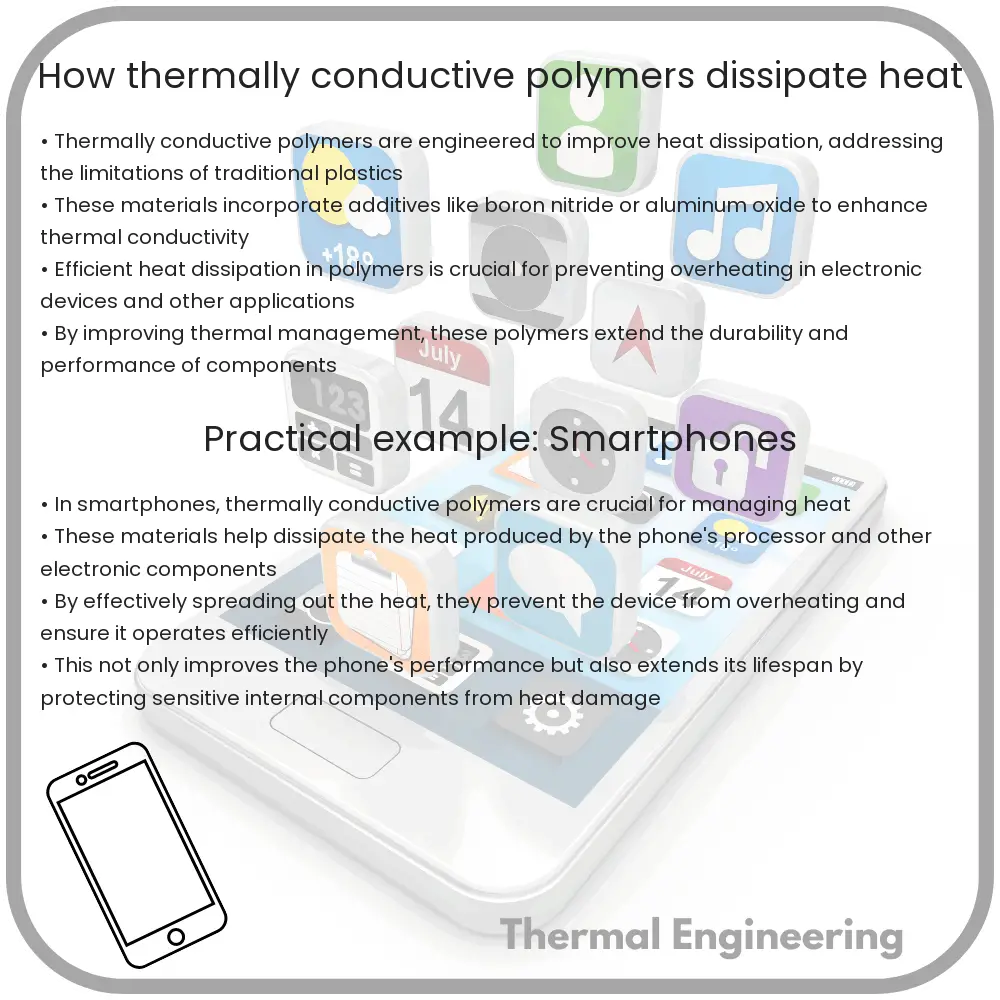
Thermally conductive polymers are materials specifically engineered to conduct heat effectively. They stand in contrast to traditional plastics which are generally poor conductors of heat, making the thermally conductive variants highly valuable in various industrial applications including electronics, automotive parts, and heat exchangers. In this article, we will explore the fundamentals of how these polymers work to dissipate heat, contributing to more efficient and safer operations in various devices.

Basics of Thermal Conductivity in Polymers

Thermal conductivity is a measure of a material’s ability to conduct heat. It is typically denoted by the symbol ‘k’ and measured in Watts per meter-Kelvin (W/m*K). In most organic polymers, the intrinsic thermal conductivity is low, generally around 0.1 to 0.5 W/m*K. This low conductivity is due to their molecular structure and the lack of free electrons which are primarily responsible for heat conduction in metals.

Thermally conductive polymers are engineered by integrating materials that have higher thermal conductivity into a polymer matrix. These materials can include metals, ceramics, or carbonaceous materials like graphite and carbon nanotubes. The choice of material depends on the desired properties of the final product, such as thermal conductivity level, mechanical strength, and electrical conductivity.

Dispersion of Heat Through Conductive Fillers

The key to enhancing the thermal conductivity of a polymer is the effective incorporation and distribution of conductive fillers within the polymer matrix. The fillers form a network through which heat can travel more efficiently than through the polymer alone. The efficiency of heat conduction in these composites depends on several factors:

  • Filler Material: High thermal conductivity materials like boron nitride, aluminum nitride, or carbon fibers are common choices.
  • Filler Shape and Size: The aspect ratio (the ratio between the length and diameter) and particle size of the filler influence how well heat is conducted across the polymer. Higher aspect ratios generally enhance thermal conductivity.
  • Filler Distribution and Alignment: Uniform distribution and alignment of fillers in the direction of heat flow enhance conductivity. Non-uniform distribution can create bottlenecks that hinder heat flow.
  • Interfacial Resistance: Heat must be transferred from the polymer matrix to the filler and then through the filler network. High interfacial resistance can impede heat flow, reducing the effectiveness of the composite.

Applications and Advantages

Thermally conductive polymers are increasingly used where heat dissipation is critical to device performance and longevity. In electronics, for example, these polymers can help manage the heat generated by components, thereby increasing their reliability and performance. Automotive parts made from thermally conductive polymers can withstand high temperatures and hence perform better and last longer.

The advantages of using thermally conductive polymers include:

  • Weight Reduction: Polymers are lighter than metals, which is valuable in applications like aerospace and automotive where weight is a concern.
  • Corrosion Resistance: Unlike metals, polymers are resistant to corrosion.
  • Ease of Manufacturing: Polymers can be molded into complex shapes, which can be advantageous in manufacturing.

In conclusion, thermally conductive polymers represent a significant advancement in materials science, providing new solutions for heat management in engineering applications. Their ability to combine thermal conductivity with the inherent benefits of polymers paves the way for innovative uses across various industries.

How heat affects rubber elasticity

Learn how heat impacts rubber elasticity, exploring the effects of temperature on rubber’s molecular structure and its practical applications.

How heat affects rubber elasticity

Understanding How Heat Affects the Elasticity of Rubber

Rubber is a material known for its high elasticity, which allows it to stretch significantly and still return to its original shape. This property makes rubber incredibly useful in a variety of applications, from car tires to rubber bands. However, rubber’s physical properties, including its elasticity, are noticeably affected by temperature changes. In this article, we explore how heat influences the elasticity of rubber and the underlying physics of these changes.

The Science Behind Rubber Elasticity

Rubber elasticity, also known as elastomeric behavior, is primarily due to the molecular structure of rubber. Natural rubber, for instance, is made up of long chains of molecules called polymers. These polymer chains are coiled and tangled, and they can stretch and move around when a force is applied. The ability of these chains to return to their original coiled state after being stretched is what gives rubber its elastic property.

At a molecular level, the behavior of these polymer chains can be described by entropy and temperature. Entropy, a measure of disorder in a system, increases when the polymer chains are disentangled as rubber is stretched. When the stretching force is removed, the natural tendency towards disorder drives the chains back to their original, tangled state, thus exhibiting elasticity.

Impact of Heat on Rubber Elasticity

The elasticity of rubber is highly dependent on temperature due to its impact on the polymer chains. As temperature increases, several changes occur:

  • The kinetic energy of the polymer molecules increases, which causes the molecules to move more vigorously. This increased motion makes the polymer chains more flexible and easier to stretch.
  • Heat can cause the rubber to soften, reducing the force needed to stretch it.
  • At very high temperatures, the thermal energy can begin to break down the chemical bonds within the polymer, leading to permanent deformation or loss of elasticity.

Interestingly, within a certain temperature range, increasing temperature can actually make rubber more elastic. However, beyond this range, the material will start to lose its elastic properties due to the reasons mentioned above.

The Glass Transition Temperature

A critical point in understanding how heat affects rubber elasticity is the glass transition temperature (Tg). Below Tg, rubber becomes hard and brittle like glass. As the temperature rises above Tg, rubber transitions into a softer, more elastic state. This transition is crucial because it signifies the temperature above which the material exhibits optimal elasticity. The specific Tg varies among different types of rubber, influenced by factors such as polymer composition and fabrication methods.

Practical Considerations and Applications

Understanding the thermal sensitivity of rubber is essential in applications where temperature variations are significant. For instance:

  • In tire manufacturing, engineers must consider the operating temperature ranges and the Tg of the rubber compounds used to ensure optimal performance and safety.
  • In the design of rubber seals and gaskets, the temperature range of the operating environment must be considered to avoid material failure.

In conclusion, while rubber’s natural elasticity is one of its most valuable properties, it is also greatly influenced by temperature. By comprehending and predicting how rubber behaves at different temperatures, engineers and designers can optimize rubber-based materials for a wide range of uses, ensuring both performance and durability.

Further Exploration

For those interested in diving deeper into the physics of materials, exploring concepts like thermodynamics, polymer science, and materials engineering can provide more insights into why materials behave the way they do under different environmental conditions.

How catalytic heaters generate warmth

Learn how catalytic heaters provide efficient, flameless warmth using chemical reactions, ideal for safe heating in various applications.

How catalytic heaters generate warmth

Understanding Catalytic Heaters: A Primer on Generating Warmth without Flames

Catalytic heaters are a fascinating piece of technology widely used in various applications where safe, flameless warmth is required. From heating trucks and buses to industrial and outdoor use, the science behind these devices offers a straightforward yet intriguing example of applied chemistry and engineering. In this article, we explore how catalytic heaters work and their benefits.

The Basics of Catalytic Heating

A catalytic heater generates heat through a chemical process known as catalysis, rather than by direct burning of fuel, which significantly reduces the risks of fire or explosion. This makes it particularly useful in environments where open flames can be hazardous.

Components of a Catalytic Heater

  • Catalyst: Typically a metal such as platinum or palladium applied to a ceramic substrate. The catalyst is crucial as it allows the fuel oxidation process to occur at a lower temperature.
  • Fuel Source: Commonly propane or natural gas, which are clean-burning and efficient fuels.
  • Heating Panel: The surface across which heat is radiated, usually made from aluminum due to its excellent thermal conductivity.

The Chemical Reaction

The process at the heart of the operation of a catalytic heater is the oxidation of gas. In simpler terms, the fuel (like propane) reacts with oxygen in the air, facilitated by the catalyst, to produce heat, water vapor, and carbon dioxide. The reaction can be broadly represented by the chemical equation:

C3H8 (propane) + 5O2 → 3CO2 + 4H2O + Heat

Here, the catalyst lowers the activation energy needed for the combustion reaction but does so without flaming. This results in a clean burn that is efficient and less likely to produce harmful byproducts.

Heat Distribution

The heat generated by the reaction is absorbed by the heating panel and then radiated into the surrounding space. This method of heat transfer is largely radiant, which is effective for directly warming people and objects in close proximity to the heater. Because of the nature of radiant heating, catalytic heaters can make occupants feel warm even if the ambient air remains cooler.

Advantages of Catalytic Heaters

  1. Safety: Since there is no flame, the risk of ignition of flammable materials is greatly reduced.
  2. Efficiency: These heaters convert almost all the fuel to heat, making them very efficient.
  3. Portability: Without the need for electrical connections, many catalytic heaters are portable and convenient for various applications.
  4. Eco-Friendly: The byproducts of the chemical reaction are primarily water vapor and a small amount of carbon dioxide, resulting in cleaner emissions than traditional combustion heaters.

Applications of Catalytic Heaters

Catalytic heaters are used in a variety of settings that benefit from their unique properties. Some common applications include:

  • Heating the cabins of vehicles in cold climates without idling the engine.
  • Providing warmth in outdoor recreational activities such as camping.
  • Heating industrial environments where safety regulations restrict open flames.
  • Emergency heating during power outages or in areas without access to electricity.

In conclusion, catalytic heaters offer an efficient, safe, and environmentally friendly way of generating heat in various settings. Their operation, based on the principles of catalysis, showcases an intricate blend of chemistry and engineering aimed at delivering warmth where conventional methods might fall short.

How heat affects fluid viscosity

Learn how heat impacts fluid viscosity, a crucial factor in applications like industrial lubrication, polymer processing, and food manufacturing.

How heat affects fluid viscosity

Understanding How Heat Affects Fluid Viscosity

In the study of fluid dynamics, viscosity is a key property that describes a fluid’s resistance to flow. It gauges the internal friction within a fluid and acts as a measure of how readily the fluid flows. Commonly observed, this property changes significantly with variations in temperature. Understanding how heat affects fluid viscosity is crucial for many practical and industrial applications including lubrication, polymer processing, and transportation of liquids.

The Relationship Between Temperature and Viscosity

The influence of temperature on the viscosity of a fluid is profound and can be explained through molecular interactions. As temperature increases, the kinetic energy of the molecules within the fluid also increases. This higher kinetic energy tends to reduce intermolecular forces that contribute to viscosity, thereby making the fluid less viscous. Conversely, a decrease in temperature results in decreased kinetic energy and increased viscosity.

  • Liquids: In most liquids, viscosity decreases with an increase in temperature. This is due to the increased molecular mobility that allows molecules to move more freely at higher temperatures.
  • Gases: In gases, viscosity increases with an increase in temperature, which contrasts with the behavior observed in liquids. This is due to the increased rate of momentum transfer between moving molecules at higher temperatures.

Mathematical Representation

For many liquids, the dependence of viscosity on temperature can be modeled using the Arrhenius equation:

\[ \eta = \eta_0 \exp\left(\frac{E_a}{R \times T}\right) \]

  • \(\eta\) is the viscosity,
  • \(\eta_0\) is a reference viscosity,
  • \(E_a\) represents the activation energy for flow,
  • \(R\) is the universal gas constant,
  • \(T\) is the absolute temperature (in Kelvin).

This equation illustrates how viscosity (\(\eta\)) exponentially decreases as the temperature increases, assuming \(E_a\) and \(R\) are constants and \(E_a/R\) has a positive value.

Practical Applications

The understanding of how heat affects viscosity has practical applications in various fields:

  1. Industrial Lubrication: Viscosity of oil is crucial for the efficient operation of machinery. Engineers choose oils with appropriate viscosity changes under operating temperatures to ensure proper lubrication.
  2. Food Processing: In the culinary and food processing industries, controlling the viscosity of various liquids like syrups and sauces is essential for consistency and quality control.
  3. Polymers: In polymer manufacturing, temperature control is critical as it affects the viscosity of molten polymers, influencing the ease and quality of processing and molding.

Conclusion

Understanding the relationship between temperature and viscosity is fundamental in both industries and natural phenomena. Whether it’s ensuring that oil remains fluid in the freezing Arctic or designing coatings that must perform under high temperatures, a solid grasp of how heat affects fluid viscosity supports smarter engineering and better product designs. Thus, fluid viscosity is not just an academic concept but a critical factor in tailoring technology to meet real-world challenges.

How thermal shock testing assesses durability

Thermal shock testing is a pivotal aspect of materials engineering, providing crucial insights into the endurance of materials under thermal stress.

How thermal shock testing assesses durability

Understanding Thermal Shock Testing and Its Role in Assessing Durability

Thermal shock testing is a crucial process in the field of engineering used to evaluate the ability of materials and products to withstand extreme changes in temperature. This form of testing is essential for determining the durability and reliability of components that are exposed to varying environmental conditions throughout their operational life.

What is Thermal Shock?

Thermal shock refers to the stress induced within a material when it undergoes rapid temperature fluctuations. When materials are suddenly exposed to a significantly different temperature, differential expansion or contraction occurs within its structure. This can lead to mechanical stress, and over time, cracks or other forms of failure may develop.

How Thermal Shock Testing Works

Thermal shock testing typically involves subjecting the material or product to extremely high and low temperatures successively in a controlled environment. This process can be carried out using various methods, but the two primary techniques are:

  • Single-Step Method: The test sample is suddenly exposed to a drastically different temperature and then held at that temperature for a predetermined period.
  • Two-Zone Method: The sample is rapidly moved between two environments at different temperatures without any dwell time.

The choice of method depends on the specific standards the product must comply with and the nature of the expected service conditions.

Parameters Assessed During Thermal Shock Testing

Several key parameters are closely monitored and evaluated during a thermal shock test:

  1. Resistance to Fracture: Assessment of the point at which cracks appear or existing cracks propagate due to thermal stress.
  2. Material Integrity: Evaluation of any degradation in material properties, like strength and elasticity, after repeated thermal cycling.
  3. Functional Performance: Checking if the component meets operational requirements after exposure to thermal shocks.

Engineers use this data to understand how a component behaves under sudden temperature changes and to predict its lifespan under such conditions.

Applications of Thermal Shock Testing

Thermal shock testing is used across various industries where materials are subject to harsh environmental conditions. Some of these applications include:

  • Electronics: Ensuring that devices operate reliably under rapid temperature changes, especially in outdoor environments.
  • Aerospace: Testing components that will experience extreme fluctuations, like those found during high-altitude or space flights.
  • Automotive: Verifying the durability of engine parts and exhaust systems that undergo rapid heating and cooling cycles.
  • Ceramics and Glassware: Evaluating the thermal endurance of cookware, laboratory equipment, and building materials.

By simulating real-world conditions, thermal shock testing helps in designing more durable and reliable products. It allows manufacturers to predict failures and mitigate risks by improving material formulations and structural designs.

Conclusion

Thermal shock testing is a pivotal aspect of materials engineering, providing crucial insights into the endurance of materials under thermal stress. It aids in the advancement of technology by ensuring that products are not only effective but also robust and dependable in diverse environmental conditions. By understanding and employing the principles of thermal shock testing, engineers continue to enhance the safety, efficiency, and longevity of products across all domains of manufacturing.

How pyrometry measures high temperatures

Learn about pyrometry, the engineering science of high-temperature measurement, its principles, types of pyrometers, and their industrial applications.

How pyrometry measures high temperatures

Understanding Pyrometry: The Science of Measuring High Temperatures

Pyrometry is a specialized field in engineering and science that focuses on the measurement of high temperatures, particularly in industrial processes and research applications where precise temperature control is crucial. This article explores how pyrometry works, the different types of pyrometers used, and their applications in various industries.

What is Pyrometry?

Derived from the Greek words ‘pyro’ meaning fire and ‘metry’ meaning measure, pyrometry deals with the methods and devices used to measure temperatures above those typically measurable with conventional thermometers. This technique is essential in environments where materials are processed at high temperatures, such as in metallurgy, ceramics, and glass manufacturing.

Types of Pyrometers

There are several types of pyrometers, each suited to different temperature ranges and applications. The most commonly used include:

  • Optical Pyrometer: Measures the visible light emitted by a hot object to determine its temperature. The principle is based on the Planck’s law of black body radiation, where the temperature is deduced from the color of the light emitted.
  • Infrared Pyrometer: Works on the principle that all objects emit infrared radiation at temperatures above absolute zero (-273.15°C). These devices measure the intensity of infrared radiation to calculate the temperature of the object.
  • Radiation Pyrometer: Similar to infrared pyrometers, radiation pyrometers focus on the total radiation emitted by an object to determine its temperature. This type is useful for measuring extremely high temperatures.

How Pyrometers Measure High Temperatures

Pyrometers measure temperature without making physical contact with the object being measured. This is a significant advantage in situations where contact with a hot object is impractical or risky. The two main principles used in pyrometry are:

  • Displacement Law: As the temperature of an object increases, the peak wavelength of the emitted radiation shifts to shorter wavelengths. Optical pyrometers use this principle to measure high temperatures by comparing the color of the light emitted from the object to that of a calibrated light source.
  • Stefan-Boltzmann Law: This law states that the total energy radiated per unit surface area of a black body is proportional to the fourth power of the black body’s temperature. Infrared and radiation pyrometers often use this principle to determine the temperature by measuring the intensity of the infrared or total radiance.

Applications of Pyrometry

Pyrometry is vital in industries where precise temperature measurements are critical:

  • Steel Industry: Ensuring the correct melting temperatures for different grades of steel.
  • Glass Production: Controlling the temperature of molten glass to produce high-quality products.
  • Semiconductor Manufacturing: Maintaining specific temperatures during the production of semiconductors is crucial for the functionality and quality of electronic devices.
  • Power Generation: Monitoring the temperature of turbines and other critical equipment in power plants to optimize their efficiency and safety.

Pyrometry plays a crucial role in advancing technology and industrial production by providing a reliable method to measure high temperatures accurately, thereby ensuring quality, safety, and efficiency in thermal processes.

How thermal break improves window insulation

Learn about thermal breaks in window insulation, their role in energy efficiency, the materials used, and how they contribute to a comfortable indoor climate.

How thermal break improves window insulation

Understanding Thermal Breaks in Window Insulation

In the realm of building insulation, windows play a crucial role in maintaining energy efficiency and comfort. One effective method for enhancing window insulation is the use of a thermal break. In this article, we’ll explore what thermal breaks are, how they operate, and why they are significant in window design.

What is a Thermal Break?

A thermal break, also known as a thermal barrier, is a material inserted between the inside and outside aluminum frames of a window. It functions as an insulator, reducing thermal conductivity and preventing heat transfer. This element is essential in creating energy-efficient windows, especially in regions with extreme weather conditions.

Composition and Materials

Typically, thermal breaks are made from materials with low thermal conductivity. Some common materials include:

  • Polyamide
  • Polyurethane
  • Fiberglass

These materials are not only effective insulators but also provide adequate strength and durability to window frames, ensuring they remain structurally sound over time.

How Thermal Breaks Improve Insulation

The primary function of a thermal break is to reduce the amount of heat that passes through the frame of the window. During winter, it minimizes the heat escaping from inside to the outside, and in summer, it reduces the outdoor heat entering the interior of a building. This insulation is made possible due to the following mechanisms:

  1. Reduction of Thermal Conductivity: By incorporating materials with low thermal conductivity in the design, thermal breaks significantly reduce the rate at which heat can transfer through the window frame.
  2. Minimizing Convection: The design of the thermal break creates an air gap which reduces air movement (convection) within the frame, further enhancing its insulating properties.
  3. Limiting Radiation: Some thermal breaks may include materials that reflect radiant heat, thus improving the overall insulation of the window.

Benefits of Thermal Breaks

The installation of thermal breaks in windows offers numerous benefits, notably:

  • Energy Efficiency: By reducing heat loss in winter and heat gain in summer, thermal breaks contribute significantly to lowering energy consumption. This can lead to considerable savings on heating and cooling bills.
  • Improved Comfort: Thermal breaks help maintain a more consistent indoor temperature, thereby enhancing the comfort level of a building’s occupants.
  • Condensation Reduction: Lower thermal conductivity also reduces the risk of condensation and frost formation on window surfaces which can prevent mold growth and water damage.
  • Environmental Impact: With decreased energy usage, thermal breaks indirectly help reduce the building’s carbon footprint, contributing to a cleaner environment.

Conclusion

Thermal breaks are a critical component in the design of modern, energy-efficient windows. By understanding how thermal breaks work and the benefits they offer, property owners and builders can make informed decisions that lead to more sustainable and comfortable living environments. With advancements in materials technology, the effectiveness and variety of thermal breaks are likely to increase, further improving energy efficiency in the building sector.