Facebook Instagram Youtube Twitter

Axial Flow Pump | Operation, Irrigation & Flood Uses

Learn about axial flow pumps, their operation, components, and applications in irrigation and flood control for efficient fluid management.
Axial Flow Pump | Operation, Irrigation & Flood Uses

Understanding Axial Flow Pumps

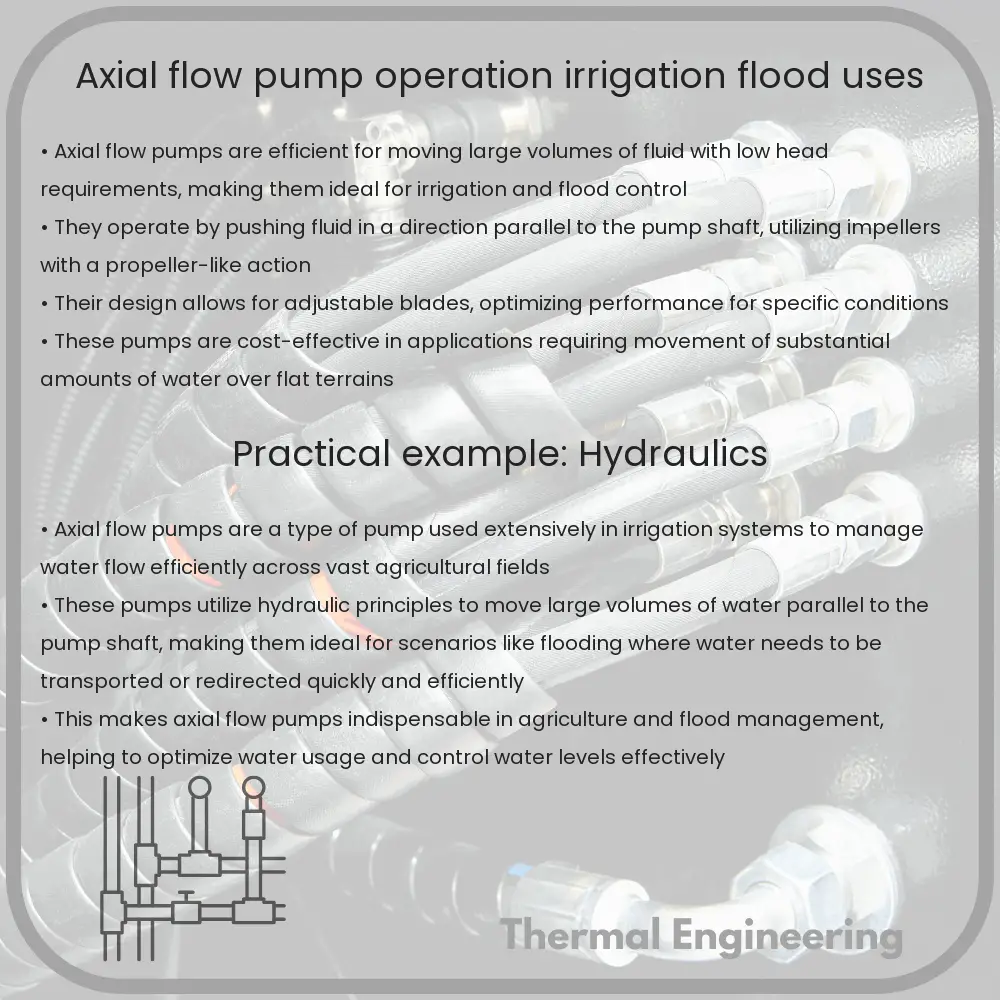
An axial flow pump, or AFP, is a common type of pump that essentially functions as a propeller in a pipe. The propeller pushes the fluid in a direction parallel to the pump shaft, along the axis of rotation. This design allows the movement of a high volume of fluid at a relatively low discharge pressure, making it particularly suitable for applications requiring a high flow rate over a low head.

Operation Principle of Axial Flow Pumps

The basic operating mechanism of an axial flow pump involves fluid entering the pump impeller along or parallel to the shaft and being energized by the impeller. This action increases the fluid’s velocity and pressure, which is then slightly modified by the shape of the pump casing to convert some of the velocity into useful pressure. Unlike centrifugal pumps, axial flow pumps use their impellers like a propeller to directly push water in their designed direction without the redirection of flow.

Components and Design

Key components of axial flow pumps include:

  • Impeller: The impeller in an AFP resembles a propeller. It consists of several blades aligned parallel to the shaft.
  • Shaft: The shaft transfers mechanical energy from the motor to the impeller.
  • Casing: The casing houses the impeller and helps in directing the flow and maintaining pressure.

The design of these pumps allows them to move fluid with a higher flow rate, which is measured in cubic meters per second (m3/s), making them efficient for large-scale applications.

Applications in Irrigation and Flood Control

Axial flow pumps are particularly advantageous in scenarios where large volumes of water need to be moved over short heights, or ‘head’. Common uses include:

  • Irrigation Systems: Their high flow rate capability makes axial flow pumps ideal for transporting water across vast areas of farmland, especially in low-lying agricultural regions.
  • Flood Control: Axial flow pumps are efficient at managing water levels in lakes, rivers, and other bodies to prevent flooding. They can rapidly move large volumes of water to safer places or storage reservoirs.

Advantages and Limitations

While axial flow pumps are highly efficient for certain applications, they also have specific advantages and limitations to consider:

  • Advantages: High efficiency in moving large volumes of fluid, low hydraulic and energy losses due to the direct flow pathway, and relatively easy maintenance.
  • Limitations: Not suitable for high head applications, susceptible to clogging with large debris, and potentially high initial and installation costs.

Conclusion

Axial flow pumps play a crucial role in modern engineering, particularly in agriculture and flood management. With an understanding of their operation, design, and appropriate applications, engineers can better integrate these tools into necessary infrastructures to maximize their benefits while overcoming potential challenges.
Liquid Ring Vacuum Pump | Principle, Materials, Uses

Learn about liquid ring vacuum pumps, their operation, construction materials, and industrial applications.

Liquid Ring Vacuum Pump | Principle, Materials, Uses

Liquid Ring Vacuum Pump: An Overview

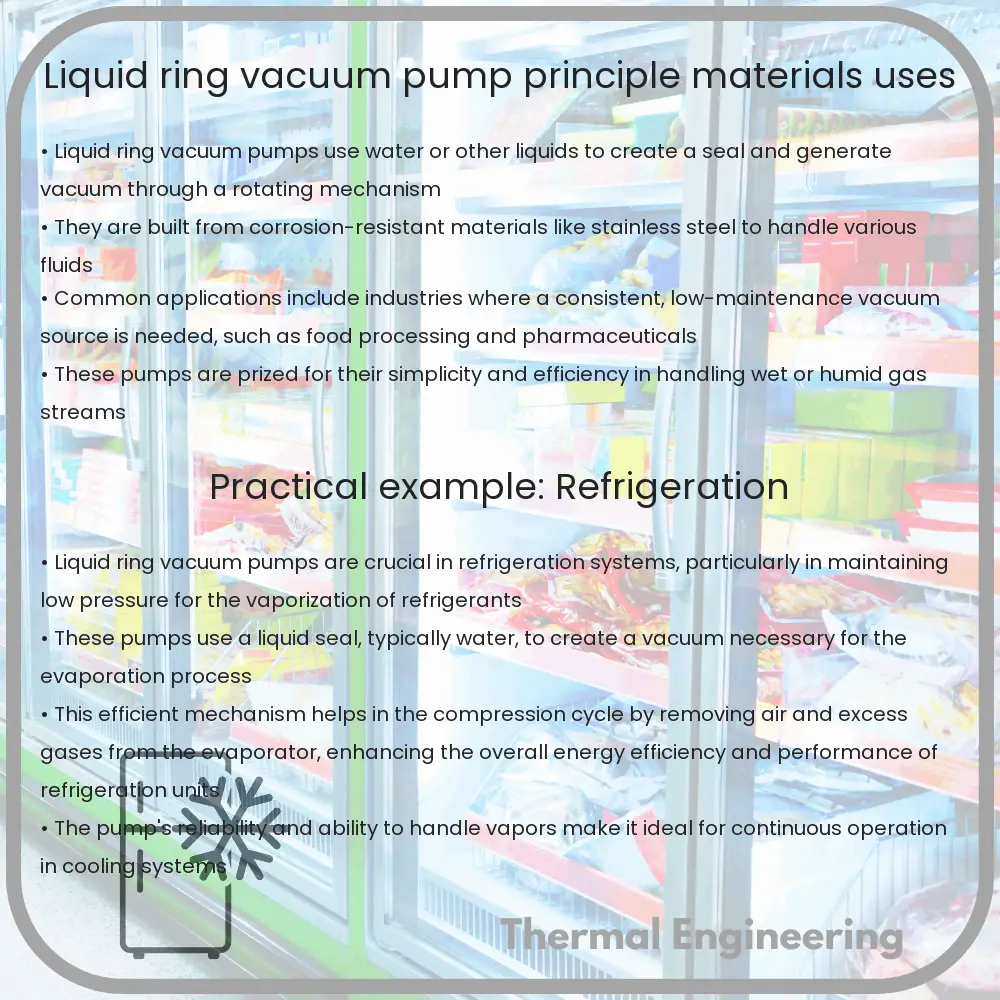
A liquid ring vacuum pump is a robust and essential device used in various industrial applications. It operates on a simple yet effective mechanism facilitating the maintenance of the desired vacuum. Used widely in industries such as chemical, power, food, and more, these pumps offer an efficient solution for handling gaseous substances and vapors. Below, we explore the principle of operation, the materials used in making these pumps, and their common applications.

Principle of Operation

The liquid ring vacuum pump functions on the principle of a rotating positive displacement mechanism. Essentially, it consists of an impeller located eccentrically within a cylindrical casing partially filled with sealing liquid, typically water. As the impeller rotates, the liquid is thrown outward due to centrifugal force and forms a concentric ring along the inner wall of the casing. This creates crescent-shaped cavities between the blades of the impeller which expand and contract as they rotate.

During operation, gas enters the pump through an inlet port, gets trapped in these crescent-shaped cavities, and is carried around the casing. The process compresses the gas as the impeller blades pass the discharge port, effectively increasing the pressure and disposing of the gas. This pumping cycle allows the establishment of a continuous vacuum in systems connected to the pump.

Materials Used in Construction

Liquid ring vacuum pumps must be constructed from materials that can withstand harsh working conditions, including exposure to corrosive environments. Common materials employed include:

  • Stainless Steel: Used for its resistance to corrosion, strength, and durability. It is ideal for pumps handling aggressive chemicals.
  • Cast Iron: Often used for its cost-efficiency and good mechanical properties. However, it is less resistant to corrosion compared to stainless steel.
  • Bronze: Used in areas susceptible to corrosion, especially for impellers where higher mechanical strength is required.
  • Ceramics and Plastics: Employed for specific components that contact highly corrosive fluids or for applications that require lighter weight parts.

Common Uses of Liquid Ring Vacuum Pumps

Liquid ring vacuum pumps see a variety of applications across multiple industries due to their reliability and ease of maintenance. Some typical uses include:

  1. Chemical Industry: Vacuum filtration, distillation, and evaporation processes.
  2. Pharmaceutical Industry: Used in the production of medicines where maintaining a contaminant-free environment is critical.
  3. Food Processing: Employed in operations such as vacuum stuffing, filling, and dehydration processes.
  4. Power Generation: For condenser exhausting in power plants.
  5. Sugar Industry: In sugar mills to enhance the efficiency of sugar production processes.

Understanding liquid ring vacuum pumps is essential for industries that require reliable vacuum generation. Their functionality, coupled with versatility in handling different materials and operating conditions, makes them an indispensable tool in many industrial operations. Equipped with this knowledge, industries can make informed decisions about incorporating these pumps into their systems for optimal performance and efficiency.

Centrifugal Fan | Design, Ventilation Efficiency

Explore the design and efficiency of centrifugal fans in industrial and HVAC applications, focusing on components, performance, and energy consumption.

Centrifugal Fan | Design, Ventilation Efficiency

Centrifugal Fans: Understanding Their Design and Ventilation Efficiency

Centrifugal fans are widely used in various industrial processes and HVAC systems due to their ability to move air or gases efficiently. These fans work on the principles of centrifugal force and are essential for systems requiring stable airflow under high-pressure conditions.

Design Aspects of Centrifugal Fans

Centrifugal fans consist mainly of an impeller and a casing. The design is crucial for the fan’s overall performance, durability, and efficiency. Here are the key components and design considerations:

  • Impeller: This is the heart of the fan, equipped with a number of blades, which can be forward curved, backward curved, or radial. The choice of blade type affects the efficiency, noise level, and the fan’s performance characteristics.
  • Casing: Typically spirally shaped, the casing’s primary function is to direct the airflow smoothly into and out of the fan while minimizing air leakage and maximizing efficiency.
  • Inlet and outlet ducts: These are designed to ensure minimal resistance to airflow and are critical in preventing performance losses.
  • Drive mechanism: Centrifugal fans can be driven directly by a motor or through a belt-and-pulley system. Each method has its own advantages in terms of speed control and maintenance requirements.

The design of centrifugal fans also considers factors like operating environment, expected airflow and pressure needs, and efficiency requirements. Advanced computational tools and fluid dynamics analysis are often used to optimize the fan’s design.

Ventilation Efficiency of Centrifugal Fans

Ventilation efficiency in centrifugal fans refers to how effectively the fan can move the intended volume of air or gas at minimal energy cost. Several factors influence this efficiency:

  1. Aerodynamic design of blades: Well-designed blades reduce turbulence and energy loss, thereby increasing airflow efficiency.
  2. Motor efficiency: A high-efficiency motor consumes less power for the same output, contributing to better overall energy usage.
  3. System resistance: The total resistance within the ventilation system should be optimized. Excessive resistance can overload the fan and reduce efficiency.
  4. Sealing and alignment: Proper sealing and alignment of the fan components prevent leakages and uneven airflow, both of which can impair efficiency.

To quantify the efficiency of a centrifugal fan, one often refers to its static efficiency, defined as the ratio of the power output (in terms of air movement) to the power input (electrical energy). The equation is given by:

Static Efficiency (%) = (Air Power / Input Power) * 100

where Air Power is calculated as the product of the air flow rate (m³/s), the pressure increase (Pa), and the air density (kg/m³), and Input Power refers to the electrical power consumed by the fan.

Application in Real-World Engineering

Centrifugal fans are employed in a variety of applications across different industries. They are crucial in ventilation systems for buildings, in industrial exhaust systems, and for cooling in HVAC systems. The specific design and efficiency requirements may vary based on the application’s particular needs such as volume flow rate, static pressure, and environmental conditions.

To meet these diverse needs, engineering involves meticulous planning and testing to ensure that the centrifugal fan design aligns with the intended application’s parameters. Regular maintenance and checks are also essential to maintain efficiency and performance over time.

Overall, centrifugal fans play a pivotal role in modern engineering, contributing significantly to environmental control, industrial processes, and air quality management. Understanding their design and operational efficiencies helps in optimizing their use and extending their service life.

Hydraulic Accumulator | Types, Function, System Use

Learn about hydraulic accumulators, key components in managing fluid pressure and efficiency in hydraulic systems across industries.

Hydraulic Accumulator | Types, Function, System Use

Understanding Hydraulic Accumulators

A hydraulic accumulator is a vital component in hydraulic systems, used to store and discharge energy in the form of pressurized fluid. Essentially, it serves as a reservoir that can supply additional fluid to the system during periods of high demand and absorb excess fluid during low demand, helping to manage pressure fluctuations and enhance efficiency.

Types of Hydraulic Accumulators

Hydraulic accumulators are mainly classified into three types based on their mechanism and construction:

  • Bladder Accumulator: This type includes a rubber bladder inside a steel shell. Hydraulic fluid is stored under pressure in the space outside the bladder. As the system pressure increases, the bladder compresses, allowing the accumulator to store more fluid.
  • Piston Accumulator: Consisting of a cylindrical chamber with a piston in it, this accumulator works as the piston moves back and forth, separating the hydraulic fluid from a gas (usually nitrogen). The movement of the piston can vary depending on system demands, making it very efficient for systems requiring a high flow rate and numerous pressure fluctuations.
  • Diaphragm Accumulator: Similar to bladder types but instead uses a flexible diaphragm instead of a bladder to separate the hydraulic fluid from the gas. This type is typically used in smaller, lower-pressure settings.

Function of Hydraulic Accumulators

The primary functions of hydraulic accumulators include:

  1. Energy Storage: Accumulators store energy by compressing a gas when the system hydraulic fluid is pumped in, which can be released to do useful work when needed.
  2. Shock Absorption: They help absorb shock caused by sudden changes in hydraulic pressure, thereby protecting the system from potential damage.
  3. Pulsation Damping: Accumulators reduce pressure fluctuations and flow pulsations within the hydraulic system, ensuring a smooth operation.
  4. Maintaining Pressure: They help in maintaining pressure in a hydraulic system by compensating for fluid losses, which may occur due to leakage.

System Uses of Hydraulic Accumulators

Hydraulic accumulators are utilized across various applications, emphasizing their versatility in different engineering fields. Some typical system uses include:

  • Energy Savings: Accumulators make it possible for hydraulic systems to operate with smaller pumps, as they can handle peak load demands by releasing stored energy, leading to significant energy savings.
  • Emergency Operations: In the event of a power failure, the stored energy in an accumulator can be used to operate the system until power is restored or the system is safely shut down.
  • Enhanced System Performance: By smoothing out fluctuations in pressure and flow, accumulators contribute to the optimal performance and efficiency of hydraulic systems.

In summary, hydraulic accumulators are essential components in modern hydraulic systems, enhancing performance, efficiency, and safety across various industrial, automotive, and aerospace applications. Their ability to store energy, reduce shocks, and maintain system pressures helps in crafting robust, reliable, and high-performing systems.

Steam Meter | Accuracy, Types, Management Principles

Learn about steam meters, their types, accuracy, and management for industrial use in monitoring and efficiency.

Steam Meter | Accuracy, Types, Management Principles

Understanding Steam Meters: Types, Accuracy, and Management Principles

Steam meters play a crucial role in monitoring and managing the usage of steam in various industrial applications, from power generation to food processing. Their primary function is to measure the volume or mass of steam flowing through a system, enabling efficient operations and helping to reduce energy costs. The accuracy of steam meters is fundamental to effective steam management, ensuring precision in process control and financial transactions.

Types of Steam Meters

There are several types of steam meters, each suited for specific types of applications and operating conditions. The choice of meter depends on factors such as the steam quality (wet, saturated, or superheated) and the required accuracy levels. Here are some of the most commonly used types:

  • Vortex Flow Meters: These meters utilize vortex shedding principles to measure steam flow. Steam flows past a bluff body, generating vortices that are counted to determine the flow rate. Vortex meters are known for their high accuracy, especially in high-pressure and high-temperature steam applications.
  • Turbine Flow Meters: Turbine meters measure steam flow based on the rotational speed of a turbine placed in the flow stream. The speed of rotation proportional to the velocity of steam is used to calculate flow rate. These meters are appreciated for their precision in continuous high-flow situations.
  • Orifice Plate Meters: Using differential pressure across an orifice plate installed in the pipeline, these meters calculate steam flow. While generally less expensive, they may require more maintenance and can introduce significant pressure drop in the system.
  • Coriolis Flow Meters: These meters directly measure mass flow by detecting the deflection of vibrating tubes as steam flows through them. Coriolis meters are highly accurate and provide excellent mass flow data regardless of pressure or temperature changes.
  • Ultrasonic Flow Meters: Utilizing the time-of-flight or Doppler effect principle, ultrasonic flow meters measure the flow rate of steam by detecting changes in the ultrasonic signals sent through the steam flow. These are non-intrusive meters and maintain high accuracy across a wide range of flow rates.

Accuracy of Steam Meters

The accuracy of steam meters can vary significantly depending on the type of meter and the specific application conditions. Factors affecting accuracy include:

  • Steam Quality: Wet or saturated steam can affect measurement accuracy as droplets in the steam can cause measurement errors in some types of meters.
  • Installation Conditions: Improper installation or the presence of pipe bends, valves, or other fittings close to the meter can disrupt flow patterns and affect accuracy.
  • Calibration: Regular calibration according to the manufacturer’s specifications is crucial to maintain accuracy over time.
  • Temperature and Pressure Fluctuations: These can affect the density of the steam, thus impacting the accuracy of volume-based measurements.

In terms of numerical accuracy, manufacturers typically specify the accuracy of steam meters as a percentage of reading (e.g., ±1% of rate) or a percentage of full scale (e.g., ±0.5% of full scale). Understanding these specifications in the context of your application is critical to choosing the right steam meter.

Management Principles for Steam Metering

Effective management of steam metering involves not only selecting the right type of meter but also implementing best practices for installation, maintenance, and data management:

  • Proper Installation: Ensure that steam meters are installed following the manufacturer’s guidelines, particularly with regard to upstream and downstream piping requirements.
  • Regular Maintenance: Steam meters should be maintained regularly to ensure they remain accurate and reliable. This includes checking for scaling, corrosion, or any other factors that could impair meter function.
  • Data Integration: Integrate steam meter data with plant-wide management systems to enhance efficiency analysis and decision-making. Real-time data monitoring helps in identifying trends, inefficiencies, and opportunities for energy savings.
  • Training: Personnel should be trained not only in the technical aspects of meter operation but also in interpreting data and troubleshooting common issues.

Efficient management and accurate measurement of steam using appropriate meters is essential in optimizing industrial processes, ensuring safety, and achieving economic benefits through energy conservation and process efficiency. By understanding the different types of steam meters, their accuracy, and management principles, industries can make informed decisions that lead to more sustainable and cost-effective operations.

Thermal Fluid System | Range, Safety, Heating/Cooling Uses

Learn how thermal fluid systems operate across various temperatures, ensuring efficient heat transfer in industrial applications.

Thermal Fluid System | Range, Safety, Heating/Cooling Uses

Understanding Thermal Fluid Systems

Thermal fluid systems are a vital component of various industrial processes involving heating and cooling. These systems are designed to transfer heat efficiently and safely across different temperatures and are used in various industries including pharmaceuticals, food processing, and petrochemicals.

Key Components of Thermal Fluid Systems

At the core of thermal fluid systems are three fundamental components:

  • Heat Transfer Fluids (HTF): These are typically oils or salts that have high boiling points and low freezing points, allowing them to operate at a wide range of temperatures without changing phase.
  • Heaters: They are used to add heat to the system, often through combustion or electric resistance.
  • Coolers: Utilized to remove excess heat, either to maintain a steady process temperature or to reduce the fluid temperature for safe handling and storage.

These components work together to form a closed loop that ensures efficient heat transfer and maintains the quality of the heat transfer fluid over time.

Range of Operation

Thermal fluid systems can typically operate over a wide temperature range, often from about -100°C to 400°C. This wide range makes them suitable for applications requiring precise temperature control. The specific range can vary based on the type of fluid used and the design of the system.

Safety Considerations

Safety is paramount in the design and operation of thermal fluid systems due to the high operating temperatures and the potential for thermal fluid degradation:

  • Thermal Degradation: At high temperatures, thermal fluids can degrade, forming potentially hazardous byproducts. Systems must be monitored and maintained to prevent degradation.
  • Leakage and Fire Risk: Leaks can be dangerous, as many thermal fluids are flammable. Regular inspections and maintenance are crucial to prevent leaks.
  • Pressure Build-up: Although most systems operate at low pressure, any blockages or malfunctions can lead to dangerous pressure build-ups. Pressure relief systems are therefore essential.

Implementing rigorous safety protocols and regular system checks helps mitigate these risks, ensuring a safe operational environment.

Applications in Heating and Cooling

Thermal fluid systems are incredibly versatile, finding utility in various applications:

  1. Process Heating: Industries that require precise temperature for manufacturing goods often use thermal fluid systems. For example, in the chemical industry, controlled heat application is crucial for facilitating reactions and processing materials.
  2. Process Cooling: In sectors like plastics or rubber manufacturing, rapid and controlled cooling is necessary after heating processes. Thermal fluid systems can be integrated with cooling units to achieve this.
  3. Indirect Heating: Food and beverage industries often require indirect heating to avoid contaminating the product. Thermal fluids circulate through heat exchangers to provide the needed heat without direct contact with the product.

Conclusion

Thermal fluid systems are essential for efficient, safe, and reliable temperature control in many industrial applications. By understanding the operational range, maintaining rigorous safety standards, and applying these systems appropriately, industries can maximize efficiency while ensuring safety and reliability. With their ability to provide both heating and cooling, thermal fluids are indispensable in the modern industrial landscape.

Gas Fired Heater | Efficiency, Space & Industrial Heating

Explore the efficiency, applications, and technological advancements of gas fired heaters in residential, commercial, and industrial settings.

Gas Fired Heater | Efficiency, Space & Industrial Heating

Understanding Gas Fired Heaters: Efficiency, Space, and Industrial Heating

Gas fired heaters are a prevalent choice in various applications ranging from residential space heating to large-scale industrial processes. This type of heater uses natural gas, a cost-effective and relatively clean burning fuel, to generate heat. In this article, we explore the efficiency of gas-fired heaters, their uses in heating spaces, and their significance in industrial settings.

Efficiency of Gas Fired Heaters

Efficiency in gas fired heaters is denoted by how effectively they can convert the energy contained in natural gas into useful heat. This efficiency is typically measured by the Annual Fuel Utilization Efficiency (AFUE) percentage, which tells you how much of the gas is utilized for heating your space versus the amount lost in exhaust gases. Modern gas fired heaters can achieve AFUE ratings from 89% to 98%, indicating very high efficiency and lower fuel costs compared to older models.

The high efficiency of these heaters is largely due to advancements in technology such as:

  • Condensing Technology: Modern condensing gas heaters can achieve higher efficiency by condensing the escaping water vapor and using its heat of vaporization.
  • Modulating Flame: Some gas heaters adjust the flame size based on real-time heating demand, thereby maximizing fuel efficiency.
  • Electronic Ignition: Replacing the traditional pilot lights, electronic ignitions only activate when the heater is on, reducing gas wastage.

Gas Fired Heaters in Space Heating

In residential and commercial spaces, gas fired heaters provide a reliable and efficient way to maintain a comfortable environment. They are particularly popular in regions where natural gas is readily available and less expensive than electricity. The benefits of using these heaters for space heating include:

  • Fast Heating: Gas heaters warm up quickly, distributing heat evenly and rapidly throughout the space.
  • Cost-Effective: Depending on local energy prices, natural gas can be more economical than heating with electricity or oil.
  • Reliability: Gas heating systems are known for their robustness and longevity with proper maintenance.

Industrial Applications of Gas Fired Heaters

Industrially, gas fired heaters play crucial roles in processes that require large volumes of high-temperature heat. Common applications include:

  • Processing Facilities: Used in chemical, petrochemical, and refining industries to heat raw materials and fluids.
  • Power Generation: Gas turbines utilize these heaters for raising the temperature of gases before entering the turbine, increasing the efficiency of electricity generation.
  • Large scale cooking operations and drying processes.

The design of industrial gas fired heaters often includes sophisticated controls and safety systems to handle the high capacities and temperatures without sacrificing efficiency or operational safety.

Conclusion

Whether for warming up a cozy living space or facilitating large-scale industrial processes, gas fired heaters are an essential technology in today’s world. Their ability to deliver heat efficiently and economically makes them a preferred choice in many scenarios. As technology evolves and energy prices fluctuate, the importance of gas fired heaters remains significant, underpinning their ongoing relevance in the energy landscape.

HVAC Coil | Functionality, Varieties

Learn about the essential roles and types of HVAC coils in heating and cooling systems, ensuring optimal air quality and comfort.

HVAC Coil | Functionality, Varieties

Understanding HVAC Coils: Functionality and Varieties

HVAC systems, or Heating, Ventilation, and Air Conditioning systems, are crucial for maintaining indoor air quality and comfort. Central to the operation of HVAC systems are the HVAC coils, which play a vital role in heat exchange. In this article, we will explore the functionality of HVAC coils and the different types available in the market.

Functionality of HVAC Coils

HVAC coils are designed to facilitate the transfer of heat either into or out of air streams in the HVAC system. These coils come in various types, each serving a specific function:

  • Evaporator Coils: These coils absorb heat from the air inside a building. The absorbed heat is then transferred to a refrigerant, which evaporates, effectively cooling the air inside the building.
  • Condenser Coils: In contrast to evaporator coils, condenser coils release absorbed heat to the outside environment. This process occurs when the refrigerant gas is compressed and converted into a liquid, releasing the heat that was absorbed indoors.

Both types of coils are essential for the cooling and heating processes in climate control systems and their efficiency affects overall system performance and energy consumption.

Varieties of HVAC Coils

  • Copper Coils: Known for their superior thermal conductivity, copper coils are a popular choice in HVAC systems. They also exhibit excellent resistance to corrosion, which extends the lifespan of the coils.
  • Aluminum Coils: These coils are lighter and generally less expensive than copper coils. They are also highly resistant to corrosion, but their thermal conductivity is slightly lesser compared to copper.

Another differentiation in HVAC coils is based on their design:

  • Slab Coils: Primarily used in small residential systems, slab coils are simple, flat, and typically only consist of a single pathway for air to move through them.
  • A-Coils: Shaped like an ‘A’, these coils have a larger surface area, which makes them more efficient at heat absorption and release. They are widely used in residential and commercial HVAC systems.
  • Spiral Coils: These coils are designed in a circular or spiral pattern to maximize the air contact surface area, consequently, they are very efficient in heat exchange processes.

Conclusion

The choice of coil in an HVAC system depends on factors such as energy efficiency, cost, resistance to corrosion, and space constraints. Understanding the functionality and varieties of HVAC coils can assist in choosing the right coil for specific HVAC needs, enhancing system effectiveness and economizing on energy costs.

This fundamental insight into HVAC coils not only broadens one’s understanding of how HVAC systems maintain comfortable indoor environments but also helps in making informed decisions regarding HVAC maintenance and upgrades.

Industrial Oven | Temp Control, Design

Learn about industrial ovens, their temperature control mechanisms, and design features essential for manufacturing efficiency and product quality.

Industrial Oven | Temp Control, Design

Understanding Industrial Ovens: Temperature Control and Design Elements

Industrial ovens are critical components in various manufacturing processes, where precise temperature control and efficient design play key roles in product quality and process efficiency. These ovens are used for a range of applications including drying, curing, baking, and heat treatment of materials and components. Understanding the fundamentals of their temperature control mechanisms and design features is essential for optimizing their operation and output.

Key Components of Temperature Control Systems

Temperature control in industrial ovens is essential for maintaining the integrity and quality of processed materials. It involves several key components:

  • Thermostats: These are the primary devices used to set the desired temperature within the oven. They detect the internal temperature and turn the heat on or off to maintain the set point.
  • Thermocouples: These sensors measure temperature at various points inside the oven to provide feedback for temperature adjustments, enhancing accuracy across the oven’s space.
  • Controllers: Modern industrial ovens use PID (Proportional, Integral, Derivative) controllers that adjust the heating rate by calculating the difference between the desired and actual temperatures. The formula used is: ΔT = Tset – Tactual, where ΔT is the temperature difference, Tset is the set temperature, and Tactual is the current inside temperature.

These components work together to stabilize oven temperature and ensure uniform heating, which is crucial for process consistency and product quality.

Design Considerations for Industrial Ovens

The design of an industrial oven affects its performance, efficiency, and suitability for specific processes. Several design elements must be considered:

  • Insulation: Proper insulation reduces heat loss, improves efficiency, and helps to maintain a uniform temperature inside the oven. Materials such as mineral wool or ceramic fiber are commonly used.
  • Airflow: Efficient airflow design, including options for vertical or horizontal airflow, ensures uniform distribution of heat within the oven cavity. This is crucial for achieving even processing of materials.
  • Size and Loading: The size of the oven should match the volume of goods to be processed. Additionally, the loading configuration (batch or continuous) impacts productivity and process flow.
  • Material Handling: Integration with conveyance systems for loading and unloading can enhance process automation and reduce cycle times.
  • Safety Features: Design features like emergency stops, over-temperature alarms, and fire suppression systems are critical for ensuring operational safety.

Applications of Industrial Ovens

Industrial ovens cater to a variety of industries and applications, reflecting their versatile design and control features. Common applications include:

  • Electronics: For curing and drying processes in semiconductor manufacturing.
  • Automotive: Heat treatments and finishing of automotive parts.
  • Painting: Drying of coated surface materials to enhance finish durability.
  • Aerospace: Composites curing and thermal treating of aerospace components.

Understanding the intricacies of temperature control and oven design helps in selecting the right industrial oven for specific applications, optimizing manufacturing processes, and ensuring high-quality outcomes. Whether for large-scale production or specialized manufacturing, the efficiency and effectiveness of these ovens play a critical role in industrial advancements and innovations.

Conclusion

Industrial ovens are more than just large heating chambers. They are complex systems designed with precise temperature controls and customized features tailored to meet specific industrial needs. A deep understanding of these systems allows for improved process efficiency, product quality, and operational safety, making them an indispensable part of modern manufacturing.

Thermal interface materials for electronics

Learn about Thermal Interface Materials (TIMs), crucial for managing heat in electronics, enhancing device performance and lifespan.

Thermal interface materials for electronics

Understanding Thermal Interface Materials in Electronics

Thermal Interface Materials (TIMs) play a crucial role in the world of electronics by enhancing the thermal management of devices. As electronic components operate, they generate heat that must be dissipated efficiently to maintain performance and prolong device lifespan. TIMs are used to improve the heat conduction between heat sources and heat sinks.

Types of Thermal Interface Materials

There are several types of TIMs, each with unique properties and applications:

  • Thermal Greases: These are viscous pastes applied between the components. They contain thermally conductive particles suspended in a silicone or synthetic oil binder. Thermal greases are popular due to their easy application and effective filling of air gaps.
  • Thermal Pads: These are pre-formed squares or rectangles of solid material that soften at higher temperatures to conform to the surface irregularities. They are simpler to handle than greases and are commonly used for mass production.
  • Phase Change Materials: Solid at room temperature but melt and flow to fill gaps at operating temperatures, phase change materials provide good thermal conductivity when melted and solidify upon cooling, ensuring minimal thermal resistance.
  • Metal-Based TIMs: Including soft metals like indium or metal-filled elastomers, these TIMs offer very high thermal conductivity but are generally more expensive.
  • Thermal Adhesives: These are thermally conductive glues that can both bond components and enhance thermal transfer. They are used where a permanent bond is beneficial.

Importance of Thermal Conductivity

Thermal conductivity is a key performance indicator for TIMs. It determines how effectively a material can transfer heat from a heat source, such as a processor, to a heat sink, such as an aluminum radiator. The unit of thermal conductivity is Watts per meter-Kelvin (W/m*K). Higher values indicate better thermal performance, leading to lower device temperatures and potentially longer electronic component life.

Moreover, the thickness and application accuracy also significantly affect the thermal resistance provided by TIMs. Even the highest conductivity material can underperform if applied too thickly or unevenly, leaving air pockets that impede thermal transfer.

Applications in Electronics

Thermal interface materials find applications across a diverse range of electronic equipment:

  • Computers and Servers: High-performance CPUs and GPUs use TIMs to ensure efficient heat dissipation, maintaining optimum operating temperatures even under high load.
  • Power Electronics: Devices like power transistors and rectifiers rely on TIMs to manage thermal load, which is critical in high voltage and current applications.
  • LED Lighting: High-brightness LEDs generate significant amounts of heat and require effective thermal management to maintain light output and color stability.
  • Consumer Electronics: From smartphones to gaming consoles, TIMs help protect sensitive components from overheating, thereby enhancing performance and durability.

Future Developments

As electronic devices continue to shrink in size while increasing in performance, the demands on thermal interface materials are growing. Future developments in TIMs focus on materials with even higher thermal conductivities, improved environmental resistance, and easier application processes. Innovations such as nanomaterial-enhanced compounds and graphene-based TIMs are some of the promising areas of research that may lead to next-generation heat management solutions.

In conclusion, thermal interface materials are essential components that significantly influence the reliability and efficiency of electronic devices. Their development and proper application are critical for advancing today’s technology-laden world.