Facebook Instagram Youtube Twitter

Supercritical Generator | Efficiency, Design

Learn about supercritical generators, which boost efficiency in power plants by using steam above the critical point, reducing emissions and enhancing performance.

Supercritical Generator | Efficiency, Design

Introduction to Supercritical Generators

Supercritical generators represent a significant advancement in power generation technology, particularly in the domain of thermal power plants. Operating above the critical point of water (22.1 MPa pressure and 374°C temperature), these generators increase the efficiency of converting heat into electricity by utilizing supercritical steam conditions. This innovative approach not only boosts efficiency but also contributes to reductions in greenhouse gas emissions compared to traditional subcritical power plants.

Efficiency of Supercritical Generators

The key to the enhanced efficiency of supercritical generators lies in their operation at extremely high pressures and temperatures. By operating above the critical point, the water directly transitions from a liquid to a supercritical fluid, skipping the phase change to steam. This process eliminates the latent heat of vaporization, allowing for a more efficient heat transfer process.

In terms of numbers, traditional subcritical power plants generally achieve thermal efficiencies in the range of 33% to 36%. In contrast, supercritical power plants can achieve efficiencies of about 37% to 45%. The increase in efficiency not only makes these plants more economical but also reduces the environmental impact per unit of electricity generated.

Design Features of Supercritical Generators

The design of supercritical generators involves several critical features that differentiate them from their subcritical counterparts:

  • Boiler Tube Material: The boiler tubes in supercritical generators are made from advanced alloys capable of withstanding the extremely high temperatures and pressures encountered in supercritical conditions. These materials are crucial for maintaining structural integrity and operational reliability.
  • Heat Exchange System: The heat exchange systems in supercritical generators are designed to efficiently handle the transfer of heat at supercritical conditions, maximizing the conversion of thermal energy into mechanical energy.
  • Temperature and Pressure Control: Sophisticated control systems are necessary to manage the precise temperature and pressure conditions required for supercritical operation, ensuring optimal performance and safety.

These design enhancements enable supercritical generators to operate more efficiently and reliably under extreme conditions, providing significant advantages over traditional designs.

Conclusion

Supercritical generators mark a significant step forward in thermal power generation technology. By operating at conditions above the critical point of water, these generators can achieve higher efficiencies, reducing both the cost and environmental impact of electricity generation. Advanced materials and control systems play a crucial role in the functionality and success of these generators, making them a cornerstone of modern efficient power generation systems.

As technology and materials science continue to advance, it is likely that the efficiency and adoption of supercritical generators will continue to increase, playing an increasingly important role in meeting global energy needs sustainably.

Heat Pump | Principles, Variants

Learn how heat pumps operate, their different types, and applications in heating and cooling systems.

Heat Pump | Principles, Variants

Understanding Heat Pumps: Principles and Variants

Heat pumps are a fascinating and essential technology used to transfer heat from one place to another, utilizing a small amount of external energy. By exploiting the principles of thermodynamics, heat pumps efficiently maintain heating and cooling in buildings and are also used in various industrial processes. In this article, we’ll explore the basic principles of heat pumps, their different types, and their applications.

How Do Heat Pumps Work?

At its core, a heat pump moves thermal energy opposite to the direction of spontaneous heat flow by absorbing heat from a cold space and releasing it to a warmer one. The operation of a heat pump involves four main components: the evaporator, the compressor, the condenser, and the expansion valve. The process follows these general steps:

  • Evaporation: A refrigerant absorbs heat from the environment in the evaporator, causing it to change from a low-pressure liquid to a vapor.
  • Compression: The vapor is compressed by the compressor, which increases its pressure and temperature.
  • Condensation: The heated vapor travels through the condenser, where it releases the absorbed heat and changes back into a liquid.
  • Expansion: The high-pressure liquid passes through the expansion valve, reducing its pressure and cooling it down before it returns to the evaporator, thereby completing the cycle.

The efficiency of heat pumps is often measured by the Coefficient of Performance (COP), which is the ratio of heat output to the work input:

COP = Heat Output / Electrical Energy Input

Types of Heat Pumps

There are several variants of heat pumps, designed to suit different applications and environments:

  1. Air Source Heat Pumps (ASHPs): These are the most common type, which extract heat from the outside air, even in cold weather. They are generally used for heating buildings.
  2. Ground Source Heat Pumps (GSHPs): Also known as geothermal heat pumps, they extract heat from the ground. This type is more efficient than ASHPs as the ground temperature is more stable than air temperature.
  3. Water Source Heat Pumps: These systems extract heat from water sources, such as lakes, rivers, or ponds. Similar to GSHPs, the temperature of water sources are typically more stable, offering efficiency benefits.
  4. Hybrid Heat Pumps: These combine features of air and ground source systems, and can select the most efficient source based on temperature conditions.
  5. Absorption Heat Pumps: Powered by heat sources such as natural gas or solar energy, rather than by electricity, these are particularly useful in industrial settings where waste heat is available.

Applications of Heat Pumps

Heat pumps are versatile technologies used in a variety of settings:

  • Residential Heating and Cooling: Heat pumps offer an effective and energy-efficient method for regulating the temperature in homes.
  • Commercial Buildings: Large scale heat pumps are implemented in commercial settings for both heating and cooling large buildings.
  • Industrial Heat Recovery: Industrial heat pumps are used in manufacturing to recover heat from exhaust gases or other waste heat sources, reducing the overall energy consumption.
  • Water Heating: Heat pump water heaters are used in both residential and commercial settings to efficiently provide hot water.

In summary, heat pumps represent a critical tool in the quest for energy efficiency and environmental sustainability. By understanding the basic principles and the various types of heat pumps, one can appreciate the engineering and environmental considerations that go into constructing systems for heating and cooling across different climates and building types.

Double Pipe Exchanger | Simplicity, Limitations

Learn about the double pipe heat exchanger, a simple yet efficient tool for heat transfer between two fluids, widely utilized in various industries.

Double Pipe Exchanger | Simplicity, Limitations

Understanding the Double Pipe Heat Exchanger

The double pipe heat exchanger, also known as a hairpin or jacketed pipeline, is one of the simplest forms of heat exchangers. It is commonly used in industries for the transfer of heat energy between two fluids. This exchanger consists of two concentric pipes, one inside the other. The inner pipe carries one fluid, while the space between the inner and outer pipes carries another fluid. Heat transfer occurs across the wall of the inner tube from the hotter to the cooler fluid.

Design and Operation

In a double pipe heat exchanger, one fluid flows through the inner tube and the other flows through the annular space between the inner and outer tubes. The flow arrangement can be either parallel flow or counterflow. In parallel flow, both fluids enter the exchanger at the same end and move in the same direction. In counterflow, the fluids enter at opposite ends and move in opposite directions, which generally provides a more efficient heat transfer.

The materials used for the pipes depend on the properties of the fluids, temperature conditions, and the required strength of the construction. Common materials include copper, aluminum, stainless steel, and carbon steel.

Applications

Double pipe heat exchangers are versatile and used in a variety of applications including:

  • Heating and cooling processes in chemical plants
  • Preheating or cooling of fluids in food and beverage production
  • Temperature regulation in pharmaceutical manufacturing
  • Small scale energy recovery tasks

Simplicity and Advantages

One of the main benefits of a double pipe heat exchanger is its simplicity:

  • Easy to design: Its simple structure makes it easy to design and manufacture.
  • Cost-effective: Less material and lower manufacturing cost make it economical for small scale applications.
  • Maintenance: It is easier to clean and maintain due to its accessible pipe design.
  • Flexible operations: It can operate under a wide range of temperatures and pressures.

Limitations

Despite its simplicity and benefits, double pipe heat exchangers have several limitations:

  • Scalability: Mainly suitable for small scale operations. For larger scale applications, more complex heat exchangers like shell and tube or plate heat exchangers are more efficient.
  • Efficiency: Generally less efficient for large volume or high heat duty tasks compared to more complex designs.
  • Limited surface area: The heat transfer area is limited to the outer surface of the inner tube and the inner surface of the outer tube, constraining the operational capacity.

Conclusion

The double pipe heat exchanger, with its simplicity and cost-effectiveness, is an excellent choice for small scale applications requiring heat transfer. Although it has limitations in scale and efficiency, its ease of maintenance and flexibility in operation make it a popular choice in many industries. Understanding its principles and applications helps in selecting the right type of heat exchanger for specific needs.

Cryogenic Exchanger | LNG Tech, Uses

Learn how cryogenic heat exchangers are crucial in LNG technology for efficient natural gas processing at extremely low temperatures.

Cryogenic Exchanger | LNG Tech, Uses

Understanding Cryogenic Heat Exchangers in LNG Technology

Liquefied Natural Gas (LNG) technology has become integral in the global energy market, primarily due to the increasing demand for cleaner energy sources. Within this technology, the cryogenic heat exchanger plays a pivotal role, enabling the efficient handling and processing of natural gas at extremely low temperatures. This article explores the mechanics of cryogenic exchangers, their uses, and why they are vital in LNG applications.

What is a Cryogenic Heat Exchanger?

A cryogenic heat exchanger is designed to operate at very low temperatures, typically below -150°C (-238°F). Its primary function is to facilitate heat transfer between substances without allowing them to mix. This is particularly critical in the liquefaction process of natural gas, where the temperature needs to be lowered drastically to convert the gas into a liquid state. This transformation significantly reduces the volume of the natural gas, making it easier and more economical to transport over long distances.

Types of Cryogenic Exchangers Used in LNG Technology

  • Plate-Fin Heat Exchangers: These exchangers are known for their high efficiency and compact size. They consist of multiple layers of corrugated sheets separated by flat plates, forming channels for fluids to pass through, which allows for efficient heat transfer.
  • Spiral Heat Exchangers: As the name suggests, these exchangers comprise a spiral body made from two long metal plates wrapped around each other. They are highly effective in handling fluids at different pressure levels and are resistant to clogging.
  • Shell and Tube Heat Exchangers: One of the most traditional types, these exchangers consist of a series of tubes bundled together within a sealed cylindrical shell. They are particularly favored for their robustness and ability to handle large volumes of fluids.

Applications and Importance of Cryogenic Exchangers in LNG

Cryogenic heat exchangers are critical in several stages of the LNG supply chain:

  1. Liquefaction: During this process, natural gas is cooled to about -162°C (-260°F), turning it into liquid form. Cryogenic heat exchangers are key in cooling the gas efficiently and effectively to this temperature.
  2. Storage and Transport: Maintaining the low temperature of LNG during storage and transport is essential to prevent it from evaporating. Cryogenic exchangers play a role in managing the temperatures within storage tanks and vessels.
  3. Regasification: Before natural gas can be distributed through pipelines, the LNG must be converted back to its gaseous state. This process, known as regasification, involves warming the LNG, and again, cryogenic exchangers are employed to manage this temperature transition efficiently.

The use of cryogenic heat exchangers in LNG technology not only supports energy efficiency but also enhances safety in handling and processing natural gas. By containing and controlling the extreme temperatures involved in the LNG process, these exchangers prevent potential hazards and ensure the structural integrity of the entire system.

Conclusion

The cryogenic heat exchanger is a cornerstone technology in the LNG industry, facilitating critical processes such as liquefaction, storage, and regasification. Its ability to manage extreme temperatures and efficiently transfer heat between substances makes it invaluable in making LNG a viable and transportable energy resource. As the calls for cleaner and more efficient energy solutions grow, the role of cryogenic exchangers will likely become even more pivotal.

In the end, understanding cryogenic heat exchangers provides insights into not just how LNG technology works but also reflects on broader engineering challenges and solutions in the face of global energy needs.

Feedwater Heater | Efficiency Boost, Types

Learn about feedwater heaters, key components in power plants that enhance efficiency by preheating boiler feedwater using turbine-extracted steam.

Feedwater Heater | Efficiency Boost, Types

Understanding Feedwater Heaters: Enhancing Power Plant Efficiency

Feedwater heaters are crucial components in power plants, particularly in steam-based systems. They play a fundamental role in increasing the efficiency of the overall thermal cycle by preheating the boiler feedwater using steam extracted from the turbine. This process not only improves the thermal efficiency but also helps in minimizing the stress on the boiler due to thermal shock.

How Feedwater Heaters Boost Efficiency

The primary function of feedwater heaters is to recover heat from the steam exhausted from the turbines and transfer it to the boiler feedwater. This reduces the fuel consumption required to convert the feedwater into steam, which in turn increases the efficiency of the power generation cycle. By raising the temperature of the incoming water, the heat absorption in the boiler occurs at a higher temperature, which improves the overall thermodynamic efficiency according to the Carnot principle.

Types of Feedwater Heaters

Feedwater heaters are categorized into two main types based on their heat exchange process and construction:

  • Open Feedwater Heaters (Direct Contact Type): In these heaters, the steam mixes directly with the feedwater. This allows not only heat but also mass transfer as condensed steam adds to the feedwater flow. Despite their simplicity and effectiveness in certain applications, they are less common in modern power plants due to control and purity issues.
  • Closed Feedwater Heaters: These are more commonly used in modern power plants and utilize a heat exchanger to separate the steam from the boiler feedwater. They can further be divided into two types:
    • Low-Pressure Heaters: Placed after the condensate pump and before the boiler feed pump, these heaters use extracted steam from the low-pressure turbines.
    • High-Pressure Heaters: Installed after the boiler feed pump, thus operating at higher pressures, and usually utilize steam extracted from the high-pressure turbines.

Impact on Power Plant Operations

Integrating feedwater heaters into a power plant configuration can significantly impact operational efficiency. They reduce the fuel costs substantially by improving the thermal efficiency of the plant. Moreover, by preheating the feedwater, the risk of thermal shock in the boiler is mitigated, which enhances the operational lifespan and reliability of the boilers.

From an environmental standpoint, improving efficiency with the aid of feedwater heaters also means less fuel is burned per unit of electricity generated, leading to lower emissions of greenhouse gases and pollutants.

Conclusion

Feedwater heaters are integral components that enhance the efficiency and operation of power plants. By understanding the various types and their functions, engineers can design more effective and efficient thermal power systems. The choice between open and closed types, as well as between low and high-pressure configurations, will depend on specific plant requirements and operational strategies. Ultimately, the implementation of feedwater heaters contributes to a more sustainable and economical power generation landscape.

Thermal Breeder Reactor | Safety, Principle

Learn about thermal breeder reactors, nuclear reactors that generate more fissile material than they consume, enhancing nuclear fuel sustainability.

Thermal Breeder Reactor | Safety, Principle

Introduction to Thermal Breeder Reactors

A thermal breeder reactor is a type of nuclear reactor that offers a way to generate more fissile material than it consumes. It harnesses the concept of breeding to extend the utilization of nuclear fuel, particularly thorium and uranium, making it a potentially sustainable option in nuclear energy generation. Understanding the principles behind thermal breeder reactors, as well as their safety features, is crucial for advancing nuclear technology and improving energy sustainability.

Principle of Operation

The core principle underlying the operation of thermal breeder reactors is the breeding ratio, the ratio of new fissile atoms created to fissile atoms consumed. In an ideal breeder reactor, this ratio is greater than one, which means the reactor produces more fissile material than it uses. The most common breeding reaction in thermal breeders involves thorium-232 absorbing a neutron to become thorium-233, which then undergoes two beta decay processes to transform into uranium-233, a fissile material.

Thermal breeder reactors operate using slow neutrons (thermal neutrons), unlike fast breeders that use fast neutrons. The presence of a moderator, such as graphite or heavy water, in thermal breeders slows down the neutrons emitted during fission to make them more effective at causing further fission in the bred fissile material (e.g., U-233 from Th-232).

Safety Features

Safety is paramount in the design and operation of any nuclear reactor, including thermal breeders. Here are several key safety features typically found in these reactors:

  1. Containment Structures: Strong, reinforced concrete structures surround the reactor, providing a barrier against the escape of radioactive materials in the event of an accident.
  2. Emergency Shutdown Systems: Also known as SCRAM systems, these can swiftly shut down the reactor in case of an anomaly by inserting control rods to absorb neutrons and halt the fission chain reaction.
  3. Passive Cooling Systems: Many modern thermal breeders incorporate passive safety systems that do not require external power or operator intervention to function effectively, thereby enhancing safety during potential power outages.
  4. Redundant Safety Systems: Multiple, independent systems ensure that even if one fails, others can perform the necessary safety functions.

Challenges and Environmental Considerations

While thermal breeder reactors offer many benefits, they also pose unique challenges and environmental considerations:

  • Waste Management: Although breeder reactors can use some forms of nuclear waste as fuel, they also produce waste that must be carefully managed due to its radioactivity and potential environmental impact.
  • High Initial Costs: The technology for breeding fissile materials is complex and costly to develop and maintain, making the initial investment in breeder reactors higher than conventional reactors.
  • Proliferation Risk: The ability of breeder reactors to produce plutonium, another fissile material, can pose proliferation risks if not adequately safeguarded.

Conclusion

Thermal breeder reactors represent a significant step forward in making nuclear energy more sustainable by effectively generating more fuel than they consume. However, realizing their full potential requires overcoming significant engineering, safety, and regulatory challenges. With ongoing technological advancements and stringent safety measures, thermal breeders could play a pivotal role in the future of nuclear energy.

Heat Sink | Electronic Cooling, Design

Learn about heat sinks, their crucial role in electronics for dissipating excess heat, enhancing device performance and preventing overheating.

Heat Sink | Electronic Cooling, Design

Understanding Heat Sinks in Electronics

Heat sinks are essential components in the world of electronics, playing a crucial role in maintaining the optimal operational temperature of devices. Their primary function is to dissipate excess heat generated by electronic components to prevent overheating and improve performance. This article delves into the fundamentals of heat sinks, exploring their design and how they function within electronic systems.

What is a Heat Sink?

A heat sink is a physical structure that absorbs and dissipates heat from a hot surface, typically a semiconductor device, through thermal contact (either direct or indirect). It is usually made from metals with high thermal conductivity such as aluminum or copper to facilitate effective heat transfer. The design of a heat sink includes various features such as fins or pins, which increase its surface area and enhance its ability to release heat into the surrounding environment, usually air.

Key Principles of Heat Sink Design

To effectively design a heat sink, several factors need to be considered to optimize its performance. These include material selection, surface area, and methods of heat transfer:

  • Material Selection: The choice of material impacts the thermal conductivity. Copper, for example, has a higher thermal conductivity than aluminum but is also heavier and more expensive.
  • Surface Area: Increasing the surface area of the heat sink maximizes its cooling potential. Designs incorporate fins or pins to provide more surface area within a compact volume.
  • Natural vs. Forced Convection: Heat sinks may rely on natural convection (where heat dissipation occurs without external forces) or forced convection (using devices like fans to enhance air movement over the heat sink).

Thermal Resistance and Its Importance

Thermal resistance is a crucial metric in the effectiveness of a heat sink. It is defined as the temperature difference across the heat sink per unit power dissipation. The equation to express thermal resistance (Rth) is given by:

Rth = ΔT / P

Where ΔT is the temperature difference between the input and output of the heat sink, and P is the power being dissipated. Lower thermal resistance indicates a more effective heat sink.

Factors Affecting Heat Sink Efficiency

  • Fin Design: The shape, size, orientation, and spacing of the fins can all influence the rate of heat transfer from the heat sink.
  • Air Velocity: Higher air velocities around the heat sink enhance heat dissipation by reducing the boundary layer thickness.
  • Attachment Methods: The method used to attach the heat sink to the device (e.g., thermal adhesive, clips, or soldering) impacts the overall thermal resistance.

Applications of Heat Sinks

Heat sinks find applications in various electronic devices to prevent overheating that can reduce efficiency or cause failure. These include:

  • Computers and laptops (CPU, GPU)
  • Power semiconductors such as transistors and diodes
  • Light-emitting diodes (LEDs)
  • Communication devices

As electronic devices continue to reduce in size and increase in power, the importance of effective heat sinks also significantly rises. Designers are continually challenged to create innovative solutions that address the heat management needs of modern electronics.

Conclusion

Heat sinks are critical in managing the thermal performance of electronic devices. By understanding the basic components and principles underlying their function and design, engineers can tailor solutions that meet specific cooling requirements. As technology advances, the evolution of heat sink designs will continue to play a pivotal role in electronics cooling strategies.

Rotary Regenerator | Benefits, Operation

Learn about rotary regenerators, devices crucial for enhancing energy efficiency and reducing costs in HVAC and industrial systems.

Rotary Regenerator | Benefits, Operation

Understanding the Rotary Regenerator

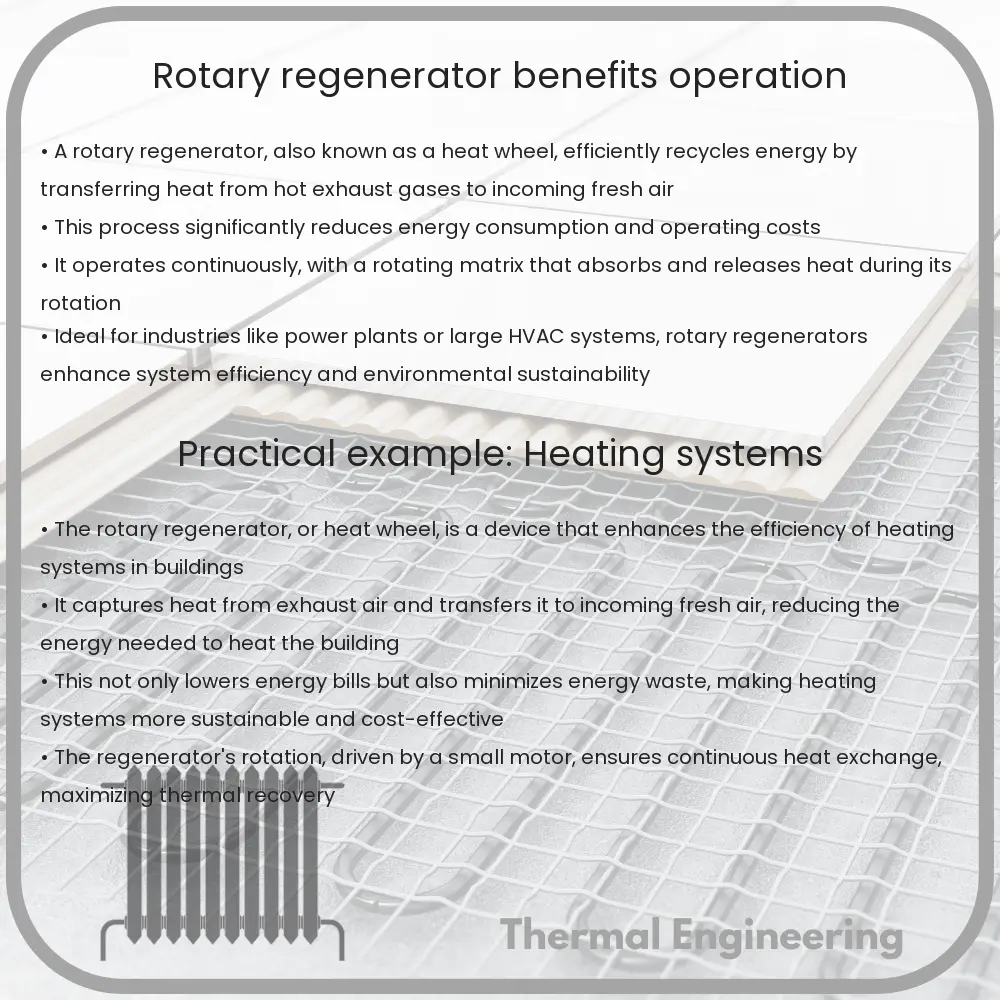
Rotary regenerators, also known as rotary heat exchangers or rotary wheels, are advanced devices used to recover and transfer heat from one air stream to another in heating, ventilation, and air conditioning systems (HVAC), as well as in various industrial processes. This technology is critical for improving energy efficiency, reducing environmental impact, and lowering operational costs.

How a Rotary Regenerator Operates

The central component of a rotary regenerator is a large wheel comprised of a heat-absorbing material, typically metal or a specially treated fiber. This wheel rotates slowly between the inbound (supply) air stream, which needs to be conditioned, and the outbound (exhaust) air stream, from which energy can be recovered. As the wheel turns, it absorbs heat from the exhaust air and transfers it to the incoming cooler air.

This process involves several key steps:

  1. Heat Absorption: As the wheel passes through the outgoing exhaust air stream, the heat is absorbed into the wheel’s material.
  2. Rotation: The wheel rotates, carrying the absorbed heat towards the incoming air stream.
  3. Heat Transfer: When the heated section of the wheel enters the supply air stream, the stored heat is transferred to the cooler incoming air, thus pre-heating it before entering the facility.

The rotation speed of the wheel can be adjusted to control how much heat is transferred. This is crucial in maintaining the desired temperature and humidity levels within the space being conditioned.

Benefits of Rotary Regenerators

  • Energy Efficiency: By recovering heat that would otherwise be expelled into the atmosphere, rotary regenerators significantly reduce the energy required to heat or cool air, leading to substantial energy savings.
  • Cost Effectiveness: The initial investment in a rotary regenerator can often be offset by the reduction in HVAC operational costs over time.
  • Environmental Impact: Lower energy consumption means reduced greenhouse gas emissions, contributing to a more sustainable operation.
  • Flexibility: Rotary regenerators can be used in a wide range of applications, from small commercial buildings to large industrial facilities.
  • Improved Air Quality: Some rotary regenerators can also remove contaminants from exhaust air, thereby improving the incoming air quality.

Applications of Rotary Regenerators

Rotary regenerators are widely used across several industries, including:

  • Commercial and residential HVAC systems
  • Automotive industry for waste heat recovery
  • Power plants to enhance boiler efficiency
  • Industrial drying processes where high energy recovery is essential

In conclusion, rotary regenerators are a crucial component in modern energy recovery and management systems, offering significant benefits in terms of energy efficiency, cost savings, and environmental conservation. The widespread implementation of such technologies stands as a testament to the ever-increasing emphasis on sustainability and efficiency in today’s industrial landscape.

Turbine Blade Cooling | Importance, Methods

Delve into the critical role and advanced methods of turbine blade cooling essential for maintaining efficiency and integrity in high-temperature environments.

Turbine Blade Cooling | Importance, Methods

Understanding Turbine Blade Cooling

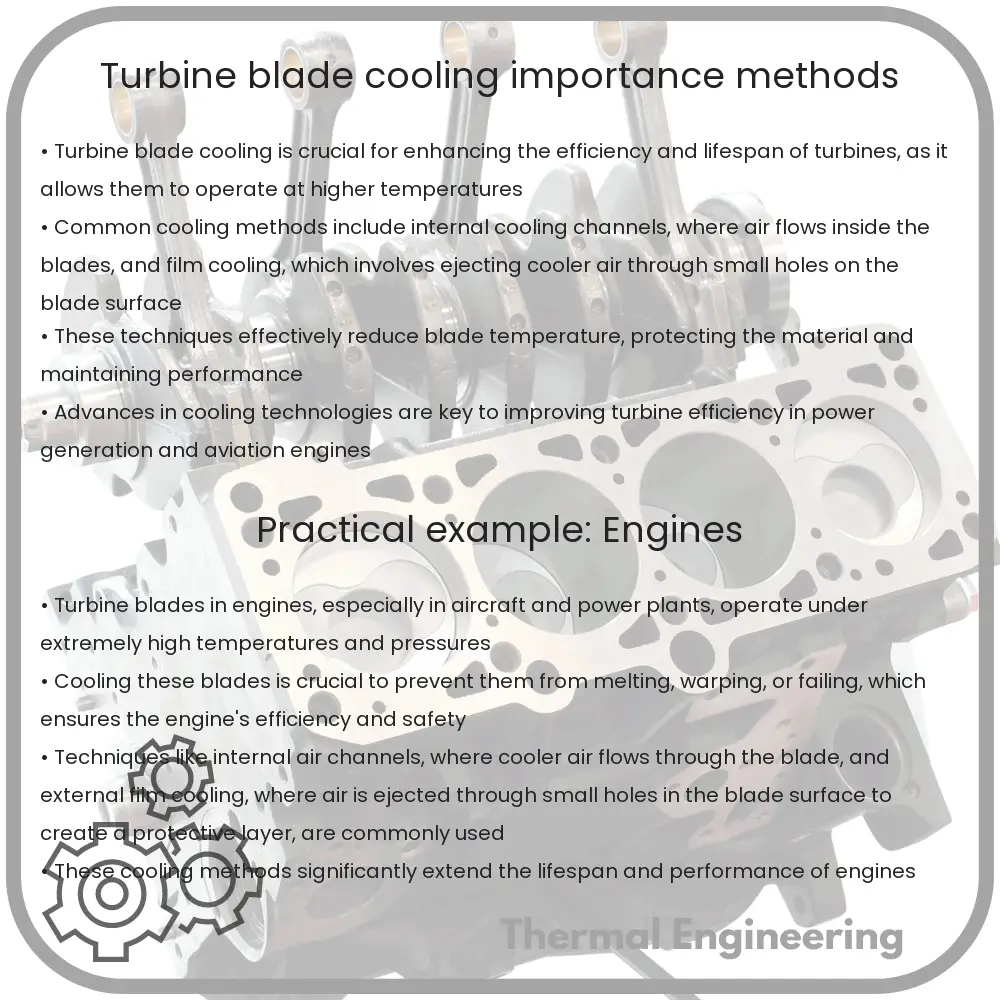
Turbine blades are critical components in various engines, including those used in aircraft and power plants. As these blades are exposed to extremely high temperatures during operation, cooling them effectively becomes vital to ensure their longevity, efficiency, and safety. The importance of turbine blade cooling is primarily to protect the blade material from overheating, which can lead to thermal fatigue, reduced mechanical strength, and, eventually, blade failure.

The Importance of Turbine Blade Cooling

Turbine blades operate in high temperature environments where the gas temperatures can be significantly higher than the melting point of the blade material itself. Cooling is essential to:

  • Maintain structural integrity by reducing the thermal stresses.
  • Enhance efficiency by enabling higher working temperatures without damage.
  • Prevent oxidation and corrosion of blade materials caused by high temperatures.
  • Extend the life of the blades, thereby increasing the reliability and reducing maintenance costs.

Methods of Turbine Blade Cooling

There are several techniques utilized to cool turbine blades effectively. These methods can be broadly categorized into internal cooling, external cooling, and compound cooling techniques.

  • Internal Cooling: This method involves cooling the blade from the inside using air that is often bled from the compressor stage of the turbine. The internal cooling techniques can further be divided into:
    1. Convection Cooling: Air is passed through channels within the blade, absorbing heat as it moves.
    2. Impingement Cooling: Jets of air impinge on the internal surface of the blade, enhancing the heat transfer.
    3. Pin Fin Cooling: Arrays of pins are added inside the channels to increase the surface area, improving the cooling by convection.
  • External Cooling: This refers to methods that apply cooling to the outer surface of the blade.
    1. Film Cooling: In this technique, cool air is ejected through small holes on the blade’s surface, creating a protective “film” of cooler air that insulates the blade from the hotter gases outside.
    2. Transpiration Cooling: Similar to perspiration, this involves passing cooling air through porous blade materials, providing a more uniform cooling effect than film cooling.
  • Compound Cooling: This method combines internal and external cooling techniques to maximize the cooling effect, typically used in the most thermally stressed parts of the blade.

Each of these cooling techniques has its own advantages and is chosen based on specific requirements such as the maximum temperature tolerance, efficiency requirements, and material properties of the turbine blades. Advanced methods are continually being developed to improve the effectiveness and efficiency of turbine blade cooling, allowing turbines to operate at even higher temperatures for increased performance.

Conclusion

Efficient turbine blade cooling is essential for safe, long-lasting, and economically viable turbine operations. The constant evolution of cooling techniques is pivotal in turbine technology, pushing forward the boundaries of what is technically achievable. Understanding these methods provides a glimpse into the complex interplay of thermal dynamics, materials science, and aerodynamics in modern engineering applications.

For students and professionals alike, appreciating the challenges and solutions in turbine blade cooling is a step toward mastering the broader field of turbine technology and thermal engineering.

Passive thermal management in architecture

Learn about passive thermal management in architecture, a strategy enhancing energy efficiency by using natural environmental conditions.

Passive thermal management in architecture

Understanding Passive Thermal Management in Architecture

Passive thermal management refers to strategies used in building design that enhance comfort and reduce the reliance on mechanical heating or cooling systems. This concept leverages the natural environmental conditions to regulate internal building temperatures, significantly improving energy efficiency and decreasing environmental impact. Here, we explore the principles, techniques, and benefits of passive thermal management in architecture.

Principles of Passive Design

Passive design utilizes thermal mass, orientation, insulation, and natural ventilation to achieve temperature stability. These elements work together to harness or repel heat naturally from the external environment.

  • Thermal Mass: Materials like concrete, brick, and stone can absorb and store heat energy during the day and release it slowly when temperatures drop, stabilizing indoor conditions.
  • Orientation: The positioning of a building plays a crucial role. For instance, in northern latitudes, maximizing southern exposure is beneficial to capture heat from the sun during colder months.
  • Insulation: Proper insulation is essential to retain heat in colder climates and keep interiors cool in warm climates. It acts as a barrier to heat flow between inside and outside of a building.
  • Natural Ventilation: Strategic placement of windows, vents, and openings facilitates cross-ventilation, using wind and air pressure differences to cool buildings and flush out excess humidity.

Popular Techniques in Passive Thermal Management

  1. Solar Control and Shading: Using devices like sunshades, overhangs, and louvres to mitigate unwanted solar gain which could lead to overheating, especially in hot climates.
  2. Earth Sheltering: Building into the earth to take advantage of the ground’s thermal mass, which remains at a constant temperature year-round, reducing heating and cooling demands.
  3. Roof Gardens: Also known as green roofs, these provide excellent insulation, reduce heat loss in winter, and minimize heat absorption during summer due to the soil and vegetation.
  4. Thermal Zones: Planning the layout to position rooms used at specific times of the day in areas that naturally reach ideal temperatures during those times.

Benefits of Passive Thermal Management

Integrating passive thermal management strategies offers multiple advantages:

  • Energy Efficiency: Reduces dependence on active heating and cooling systems, thereby lowering energy consumption and utility bills.
  • Environmental Impact: Less energy consumption translates into reduced greenhouse gas emissions, supporting sustainability.
  • Thermal Comfort: Improves indoor thermal comfort and air quality by utilizing natural sources for heating and cooling.
  • Cost-Effectiveness: Minimizes operational costs over time, due to decreased use of mechanical systems and lower maintenance requirements.

Challenges in Implementation

Despite its benefits, passive thermal management faces certain challenges in implementation:

  • Site Dependency: The effectiveness of passive strategies heavily depends on the site’s climate, geography, and local environmental conditions.
  • Architectural Constraints: Existing buildings may require significant redesign or renovation to integrate effective passive design features.
  • Initial Costs: While long-term gains are significant, the initial investment for materials like high-quality insulation and thermal mass can be substantial.

Passive thermal management represents a cornerstone of modern sustainable architecture. By understanding and applying these principles and techniques, architects and engineers can create buildings that are not only energy-efficient but also harmonious with their natural surroundings.