Facebook Instagram Youtube Twitter

Thermal management solutions for electric vehicles

Explore the importance of thermal management in electric vehicles for optimizing performance, safety, and efficiency.
Thermal management solutions for electric vehicles

Understanding Thermal Management in Electric Vehicles

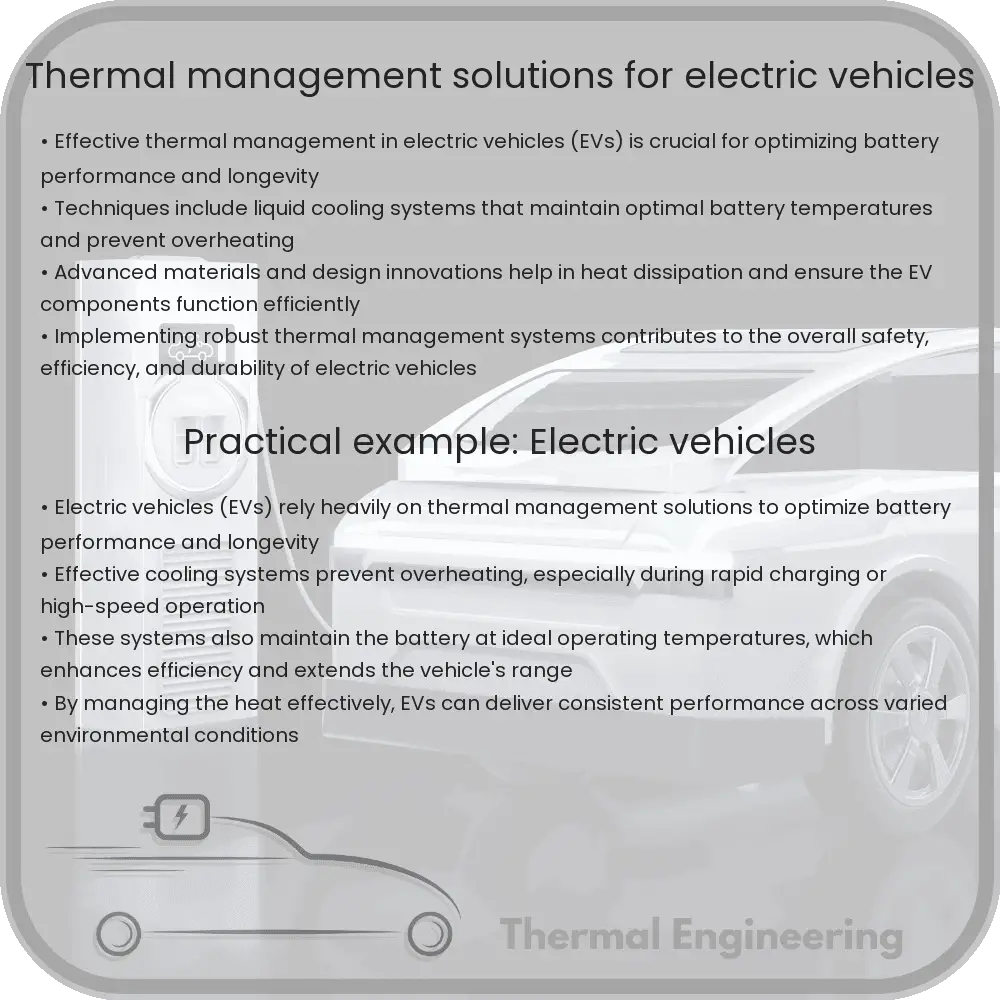
Thermal management in electric vehicles (EVs) refers to the process of regulating the temperature of various critical components, including battery systems, electric motors, and power electronics. Effective thermal management is crucial for maximizing the efficiency, performance, safety, and longevity of these components. As the adoption of electric vehicles grows, so does the importance of sophisticated thermal management systems.

Why is Thermal Management Critical in EVs?

EV batteries perform optimally within a specific temperature range. Excessive heat can lead to increased battery degradation, thereby reducing its lifespan and efficiency. On the flip side, low temperatures can diminish battery capacity and impact vehicle range. Similarly, other components like motors and electronics also require stable operating temperatures to function efficiently. Thus, maintaining the ideal temperature is paramount for overall vehicle performance.

Components of an EV Thermal Management System

  • Battery Thermal Management System (BTMS): Controls the battery pack’s temperature, using active methods like liquid-cooling or air-cooling systems, or passive techniques such as phase change materials.
  • Thermal management for Power Electronics and Electric Motors: Uses heat sinks, cooling plates, or fluid-based cooling to dissipate the heat generated by inverters, converters, and motors.
  • Cabin Heating and Cooling: Involves using waste heat from the powertrain or implementing heat pumps and resistive heaters to maintain comfortable cabin temperatures.

Key Strategies for Effective Thermal Management

  1. Active Liquid Cooling Systems: These are the most commonly used solutions in modern EVs. Coolant fluid is circulated through components to absorb and transfer heat away. The efficiency of liquid cooling makes it favorable for handling high heat loads.
  2. Air Cooling: Less complex than liquid cooling, this method utilizes air flow to reduce temperatures. While generally less efficient, it is lighter and can be suitable for vehicles with lower thermal loads.
  3. Phase Change Materials (PCM): PCM absorbs and releases thermal energy while transitioning between solid and liquid states, helping maintain consistent battery temperatures and mitigating the impact of external temperature variations.
  4. Heat Pumps: Increasingly popular in EVs, heat pumps can efficiently transfer heat into or out of the cabin and battery system. They are particularly beneficial in cold climates, improving battery performance and range.

Challenges and Future Trends

The design of thermal management systems in EVs faces several challenges. Integrating these systems without significantly increasing weight or reducing vehicle efficiency requires innovative approaches. Additionally, as battery technology progresses towards higher energy densities and faster charging capabilities, thermal management solutions must evolve to handle increased thermal loads.

Conclusion

Effective thermal management is essential for the optimal performance and durability of electric vehicles. By ensuring that all critical components operate within their ideal temperature ranges, engineers can enhance vehicle efficiency, safety, and comfort. The continuous improvement and innovation in thermal management technologies will play a pivotal role in the advancement of electric vehicles, making them a more attractive option for a growing number of consumers.

Thermal Imaging Binoculars | Tech, Wildlife Observation

Learn how thermal imaging binoculars work, utilizing infrared detection to enhance visibility in low-light conditions for diverse applications like wildlife observation and security.

Thermal Imaging Binoculars | Tech, Wildlife Observation

Understanding Thermal Imaging Binoculars

Thermal imaging binoculars are a fascinating blend of technology and practical application. They leverage the principles of heat and light to enable visibility in the dark, which proves invaluable in various situations such as in wildlife observation and security enforcement. Let’s explore how these devices work and their key uses.

How Do Thermal Imaging Binoculars Work?

At the core of thermal imaging technology is the concept of infrared energy (heat) detection. Every object emits heat as infrared radiation which is invisible to the naked eye. Thermal imaging binoculars detect this radiation and convert the information into an image we can see.

The main components of thermal imaging binoculars include:

  • An Infrared Detector: This component detects infrared radiation in the environment.
  • A Lens: The lens focuses the infrared light emitted by all of the objects in view.
  • A Signal-Processing Unit: This translates the information from the detector into data for the display.
  • A Display: This shows what the binoculars detect with variations in temperature represented in different colors or shades of grey.

The process begins when infrared radiation from objects passes through the binoculars’ lens and strikes the infrared detector. The detector records a detailed temperature pattern called a thermogram, which is then processed into electric impulses. These impulses are sent to the signal-processing unit, where they are translated into data for the display. The final image appears on the display, with warmer objects shown in one color and cooler objects in another, allowing for clear visibility regardless of lighting conditions.

Applications of Thermal Imaging Binoculars

Thermal binoculars have a wide range of applications, underscoring their importance across various fields:

  • Wildlife Observation: Analysts use thermal imaging to observe nocturnal wildlife seamlessly without disturbing them. It helps researchers detect animals based on their heat signatures even in complete darkness or dense foliage.
  • Search and Rescue: In rescue operations, particularly in smoke, fog, or night-time, thermal imaging binoculars can pinpoint human heat signatures, helping rescuers locate and assist people more effectively.
  • Security and Surveillance: Security personnel employ these binoculars for monitoring purposes, as they can detect intruders or unauthorized activity even in total darkness or through camouflage.

Conclusion

Thermal imaging binoculars meld sophisticated technology with practical functionality, rendering them indispensable in many professional fields as well as in leisure pursuits like wildlife observation. As technology advances, we can expect these devices to become even more versatile and accessible, opening up more possibilities for their use across a host of activities that benefit from non-invasive and night-time observation.

Venturi Meter | Principle, Types, Flow Rate

Learn about the Venturi meter, a device used to measure fluid flow rate in pipes based on the Venturi Effect and Bernoulli’s Principle.

Venturi Meter | Principle, Types, Flow Rate

Understanding the Venturi Meter: Principle, Types, and Calculating Flow Rate

A Venturi meter is a device commonly used to measure the flow rate of a fluid in a pipe. It operates on a simple yet elegant principle derived from Bernoulli’s Equation and the Continuity Equation. This article explores the underlying principles of the Venturi meter, its various types, and how it is used to calculate the flow rate of a fluid.

Principle of Operation

The Venturi meter utilizes the Venturi Effect, an application of Bernoulli’s Principle, which states that an increase in the speed of a fluid occurs simultaneously with a decrease in pressure or potential energy of the fluid. The meter features a constricted section or ‘throat’ which forces the fluid to increase velocity and subsequently decrease its pressure. This change in pressure is the key to measuring the flow rate.

Mathematically, the principle can be supported by Bernoulli’s Equation:
p1 + 0.5*ρ*v12 + ρgh1 = p2 + 0.5*ρ*v22 + ρgh2

Here, p indicates the pressure, ρ is the fluid density, v represents velocity of the fluid, g is acceleration due to gravity, and h is the height at respective points 1 and 2.

Combined with the Continuity Equation:
A1*v1 = A2*v2

where A is the cross-sectional area of the flow, this principle allows the venturi meter to calculate the flow rate.

Types of Venturi Meters

There are several types of Venturi meters which range in design to suit different applications:

  • Classic Venturi Tube: Features a gradually narrowing entrance and a longer throat.
  • Short Tube Venturis: Offers a shorter build by having a shorter throat and a rapid expansion in the divergence section.
  • Insert Type Venturi: Designed for easy installation in existing pipe systems, usually with a cylindrical entry followed by a conical converging section.

Calculating Flow Rate

To calculate the flow rate using a Venturi meter, one can use the simplified version of Bernoulli’s Equation resultant from measurements taken directly by the device:

Q = C*A2*√((2*ΔP)/ρ)

Where:

  • Q is the volumetric flow rate
  • C is the discharge coefficient, accounting for fluid dynamics not captured in the ideal equation
  • A2 is the area of the throat
  • ΔP is the pressure differential between the upstream and throat
  • ρ is the density of the fluid

This formula enables users to obtain a direct measurement of the fluid’s flow rate by observing the pressure difference, which the device can measure accurately.

Conclusion

The Venturi meter remains a favored choice for non-invasive flow rate measurement in various fluids due to its simplicity, reliability, and accuracy. Understanding its operating principles, types available, and calculation methods can help users in engineering to accurately monitor and control fluid dynamics in systems.

Ventilation Heat Recovery | Design, Efficiency, Air Quality

Learn about Ventilation Heat Recovery systems, their efficiency, components, and impact on sustainable building design.

Ventilation Heat Recovery | Design, Efficiency, Air Quality

Understanding Ventilation Heat Recovery Systems

Ventilation Heat Recovery (VHR) systems are becoming an essential part of modern building design due to their efficiency and ability to enhance indoor air quality. These systems provide a sustainable energy solution by recovering heat that would otherwise be lost in the ventilation process.

How Ventilation Heat Recovery Works

At its core, a VHR system works by capturing residual heat from exhaust air leaving the building and transferring it to fresh air being introduced into the building. This process is facilitated through a heat exchanger. Typically, two separate air streams flow through the heat exchanger without mixing, where heat from the outgoing air stream is transferred to the cooler incoming air stream.

Components of VHR Systems

  • Heat Exchanger: The key component where the heat transfer occurs. Common types are plate heat exchangers and rotary heat exchangers.
  • Fans: To move the air through the system—both the stale indoor air out and fresh outdoor air in.
  • Filters: To clean the air coming into the building, ensuring that it’s free from pollutants and particulates.
  • Ducts: Serve as pathways for the air to travel through the system.
  • Controls: Systems to adjust the ventilation rates and recovery efficiency as needed.

Design Considerations for VHR Systems

Designing an effective VHR system involves several considerations to optimize performance and cost-efficiency:

  1. Building Size and Layout: Larger buildings or those with complex layouts may require more robust systems or multiple units.
  2. Climate Conditions: Local climate impacts the heat recovery needs and the risk of condensation, influencing system choice and specifications.
  3. Energy Goals: Higher recovery efficiencies might be desired for buildings aiming for low energy consumption or net-zero energy status.
  4. Air Quality Requirements: Spaces with stringent air quality demands, like hospitals or labs, might need advanced filtering and control systems.

Efficiency of Ventilation Heat Recovery

The efficiency of a VHR system is predominantly defined by the effectiveness of its heat exchanger. The efficiency is commonly expressed as a percentage of the heat recovered from the exhaust air. Effective systems can achieve efficiencies of 50-80%, significantly reducing the energy required to heat fresh air to a comfortable temperature.

Impact on Air Quality

While the primary function of VHR systems is to save energy, they also significantly impact indoor air quality. By using filters and controlled ventilation, these systems can reduce levels of pollutants such as dust, pollen, and even pathogens. Properly maintained filters and adequate ventilation rates ensure that the indoor environment remains healthy, particularly important in sensitive areas like residential homes, schools, and healthcare facilities.

The Future of Ventilation Heat Recovery

As buildings become more energy-efficient, the role of VHR systems is expanding. Innovations in materials and technology promise higher efficiency rates, better integration with other building systems, and smaller, more cost-effective units. Looking forward, VHR tech will continue to play a vital role in achieving modern sustainability targets in construction and renovation projects worldwide.

Understanding and implementing efficient Ventilation Heat Recovery systems is an essential step towards greener, cost-effective, and healthier building environments, marking a significant advancement in how we think about and manage our living and working spaces.

Indirect Water Heater | Integration, Efficiency, Hot Water

Learn about indirect water heaters, their integration with heating systems, efficiency, and benefits in providing a consistent hot water supply.

Indirect Water Heater | Integration, Efficiency, Hot Water

Understanding Indirect Water Heaters: Integration, Efficiency, and Hot Water Supply

An indirect water heater represents a highly efficient choice for hot water production in homes and buildings. Unlike conventional direct-fired tanks or tankless water heaters, indirect water heaters utilize the home’s existing heating system to heat water. This integration can lead to significant energy savings and improved heating efficiency. Here we explore how indirect water heaters function, their integration with heating systems, and the benefits they bring in terms of energy efficiency and consistent hot water supply.

How Do Indirect Water Heaters Work?

Indirect water heaters are integrated with a residential or commercial boiler. Instead of burning fuel to directly heat the water, these systems use the boiler’s hot water or steam. The heart of an indirect water system is the heat exchanger. Here, heat is transferred from the heated water or steam from the boiler through the exchanger to heat the water in the storage tank.

  • Integration with Heating System: Typically, a closed-loop circuit circulates boiler water through the heat exchanger. The domestic water in the tank is heated as it passes through or around the exchanger.
  • Thermal Storage: Indirect water heaters generally have a well-insulated storage tank, which keeps the water hot for longer periods without requiring constant heating.

Integration with Home Heating Systems

Integration of indirect water heaters with home heating systems is straightforward if a boiler system is already in place. During installation, the water heater is connected to the primary heating system’s loop. Cold water enters the tank, is heated by the heat exchanger, and then hot water exits the tank to be distributed throughout the household as needed. This design maximizes the use of the heat generated by the boiler, ensuring little to no energy goes to waste.

Advantages of Using Indirect Water Heaters

  • Improved Energy Efficiency: Since indirect water heaters utilize the heat from the boiler that would otherwise be used only for space heating, this can enhance overall energy usage. Efficient heat transfer in a well-insulated tank means energy retention is significantly better compared to traditional gas or electric water heaters.
  • Cost-effective: Utilizing one system for both heating and hot water can reduce initial costs and maintenance overhead compared to managing two separate systems.
  • Longevity: Indirect water heaters often have fewer mechanical parts than direct-fired water heaters, reducing the risk of wear and tear and potentially extending the lifespan of the unit.
  • Space Saving: By combining the functions of a boiler and a hot water heater, space is saved in the home’s utility area.

Considerations When Choosing an Indirect Water Heater

While the benefits of indirect water heaters are substantial, there are a few considerations to keep in mind:

  • Requires a Compatible Boiler: An indirect water heater is a viable option only if the home already has a compatible boiler. Installing a new boiler just to accommodate an indirect water heater might not be cost-effective.
  • Initial Investment: The upfront cost of an indirect water heater can be higher than traditional water heaters. However, the long-term savings in energy costs often justify the initial expenditure.

In conclusion, indirect water heaters offer an efficient and effective solution for integrating hot water production with home heating systems, harnessing the power of existing boilers and potentially cutting overall energy expenditure. Homeowners looking for an energy-efficient and long-term solution to their hot water needs might find these systems particularly advantageous.

High-temperature thermal insulation

Explore the essentials of high-temperature thermal insulation, its materials, applications, and principles for enhanced energy efficiency and safety.

High-temperature thermal insulation

Understanding High-Temperature Thermal Insulation

High-temperature thermal insulation is an engineering solution designed to limit heat transfer between objects in thermal contact or in the range of radiative influence. Such types of insulation are crucial for systems operating at high temperatures, typically above 1000°C, such as in industrial furnaces, boilers, and high-speed aircraft. The effectiveness of high-temperature thermal insulation is pivotal not only for energy conservation but also for safety and improving the lifespan of equipment.

Types of High-Temperature Thermal Insulation Materials

Several materials are employed in high-temperature thermal insulation, each chosen based on its thermal conductivity, chemical stability, and physical properties at high temperatures:

  • Ceramic Fibers: These materials are very effective at insulation and can withstand temperatures up to 2300°F (1260°C). They are lightweight and generally composed of alumina-silica.
  • Calcium Silicate: Known for its high structural strength and thermal efficiency, calcium silicate can handle temperatures up to 1200°F (650°C). It is commonly used in piping insulation and industrial applications.
  • Mineral Wool: Made from molten glass, stone, or industrial waste, mineral wool is capable of high performance at temperatures ranging from 600°F to 1800°F (315°C to 982°C) and is widely used in both thermal and sound insulation.
  • Aerogels: Known for their low thermal conductivity and high temperature resistance, silica aerogels can withstand temperatures over 2000°F (1093°C), though their mechanical strength is less than other insulative materials.

Principles of Heat Transfer in High-Temperature Applications

In high-temperature environments, thermal insulation works by combating the three modes of heat transfer: conduction, convection, and radiation:

  • Conduction: Heat transfer through direct contact. Insulation reduces this by having materials with low thermal conductivities.
  • Convection: Heat transfer through fluids (liquids or gases). Effective insulation minimizes air movement or traps it in small, enclosed spaces.
  • Radiation: Transfer of heat through electromagnetic waves. Reflective surfaces or materials that absorb and emit minimal radiation are preferred in high-temperature insulations.

Applications of High-Temperature Thermal Insulation

The applications of high-temperature thermal insulation are vast and critical in various industrial sectors:

  • Energy Production: In power plants, effective insulation of boilers, steam pipes, and turbines leads to significant energy savings and reduced greenhouse gas emissions.
  • Manufacturing Processes: Industries such as metal, glass, and ceramics require high-temperature insulation to improve the efficiency and quality of their products.
  • Aerospace: High-speed aircraft and spacecraft use high-temperature insulation to protect equipment and enhance performance in extreme temperature conditions.
  • Automotive: Insulation in car exhaust systems and engine compartments improves vehicle performance and passenger comfort.

Challenges and Innovations

Despite the effectiveness of existing materials, high-temperature insulation faces challenges such as:

  • Durability: High temperatures can degrade materials over time, decreasing their insulative properties.
  • Cost: Some high-performance insulation materials can be costly, limiting their use in certain applications.
  • Installation Complexity: Applying and maintaining insulation in high-temperature environments can be difficult, requiring specialized skills and tools.

Innovations in material science and technology continue to evolve, striving to address these challenges. New materials and composites, better fabrication techniques, and improved performance metrics are constantly being developed, pushing the boundaries of what high-temperature thermal insulation can achieve.

Conclusion

High-temperature thermal insulation is key to energy efficiency, safety, and the operational success of many industrial applications. As technology progresses, the materials and methods used in this field continue to improve, offering more effective and sustainable options. Understanding the basics of these insulation techniques allows engineers and scientists to develop better solutions and enhance the performance of high-temperature systems.

Jacketed Heating Vessel | Design, Process Industry Use

Learn about jacketed heating vessels, essential for precise temperature control in industries like pharmaceuticals, chemicals, and food processing.

Jacketed Heating Vessel | Design, Process Industry Use

Jacketed Heating Vessel: An Overview

Jacketed heating vessels are a crucial component used in various sectors of the process industry such as pharmaceuticals, chemical manufacturing, and the food and beverage sector. These vessels are designed to control the temperature of the contents being processed, allowing for precise control necessary for complex chemical reactions and processing tasks.

Design Principles of Jacketed Heating Vessels

The design of a jacketed heating vessel focuses on thermal efficiency, compliance with safety regulations, and durability. The basic structure consists of an outer jacket that covers the main container. Between the main vessel and the jacket, there is an annular space through which heating or cooling media can flow. This design allows for uniform heating or cooling of the vessel’s contents.

  • Materials: The choice of material is crucial for both the inner vessel and the jacket. Commonly used materials include stainless steel and glass-lined steel, chosen for their ability to withstand corrosive contents and high temperatures.
  • Heating Medium: The medium flowing in the jacket can be steam, hot water, or oil, chosen based on the required temperature and the nature of the process.
  • Insulation: To improve thermal efficiency and safety, the outer surface of the jacket is often insulated with materials that reduce heat loss and protect personnel.
  • Agitation: Many jacketed vessels are equipped with agitators. These can be impellers, paddles, or other types designed to mix the contents thoroughly, ensuring uniform heat distribution.

Thermal Considerations

Understanding the heat transfer in a jacketed vessel is crucial for its design and operation. The basic equation governing the heat transfer rate in a jacket system is given by:

Q = U * A * ΔT

where:

  • Q is the total heat transfer rate,
  • U is the overall heat transfer coefficient,
  • A is the heat transfer area,
  • ΔT is the temperature difference between the jacket’s inlet fluid and the vessel contents.

The overall heat transfer coefficient, U, is influenced by the conductivity of the materials, the fluid velocities, and the fouling factors during the process.

Applications in the Process Industry

Jacketed vessels are integral to the process industry, considering their ability to provide precise temperature control. Here are a few applications:

  1. Chemical Reactions: Many chemical reactions require heat input or need to be conducted at controlled temperatures to ensure yield and safety.
  2. Pharmaceuticals: In the manufacture of drugs, precise temperature control can be crucial for the effectiveness and stability of the product.
  3. Food and Beverage: Cooking, pasteurization, and sterilization often use jacketed vessels to process large volumes under controlled conditions to ensure product safety and consistency.

Conclusion

Jacketed heating vessels are vital tools in the arsenal of many industries requiring precise temperature management. Whether it’s synthesizing complex chemicals, brewing beer, or manufacturing medications, these vessels support a controlled, efficient, and safe production process. As technology and materials science advance, the design and capabilities of jacketed vessels will continue to evolve, further enhancing their role in the industrial sector.

Infrared Sauna | Tech, Health Benefits, Relaxation

Learn about infrared saunas, their technology, health benefits, and use for deep relaxation and therapy.

Infrared Sauna | Tech, Health Benefits, Relaxation

Introduction to Infrared Saunas

Infrared saunas are a modern evolution of the traditional steam-based sauna, utilizing infrared technology to heat the body directly rather than just warming the air around it. This technology employs infrared panels that emit light, which is absorbed by the skin, converting to heat and providing a deep, penetrating warmth that promises a variety of health and relaxation benefits.

How Infrared Saunas Work

Unlike conventional saunas that heat the air within the enclosure to high temperatures, infrared saunas use infrared heaters to produce radiant heat. This heat is absorbed directly by the skin, without significantly increasing the air temperature. There are typically three types of heaters based on the wavelength of infrared used: near, mid, and far infrared. Each type targets different depths below the skin, which can affect various health aspects differently.

Key Components of Infrared Sauna Technology

  • Infrared Panels: These are responsible for emitting the infrared rays. They range in type from carbon fibers, which distribute heat evenly and are energy efficient, to ceramic ones that provide high-intensity heat.
  • Control Units: Modern infrared saunas are equipped with digital control units to regulate temperature and session time, allowing users to customize their experience based on personal preference and health goals.
  • Wood Construction: The type of wood used in the construction of an infrared sauna not only impacts the aesthetics but also the durability and heat distribution characteristics. Cedar and hemlock are commonly used due to their natural resistance to moisture and decay.

Health Benefits of Infrared Saunas

  1. Detoxification: Sweating at the cellular level, encouraged by the deep penetration of infrared waves, aids in releasing toxins stored in the body.
  2. Relaxation and Stress Reduction: The heat generated helps relax muscles and relieve tension throughout the body, significantly reducing stress levels.
  3. Improved Circulation: As the body heats up, blood flow increases, which can help lower blood pressure, improve circulation, and enhance cell health.
  4. Weight Loss: The intense heat causes the heart rate to increase, which can burn calories, supporting weight loss efforts along with proper diet and exercise.
  5. Pain Relief: Infrared heat can deeply penetrate tissue, muscles, and joints, increasing circulation and speeding oxygen flow to these areas, aiding in the healing of muscle injuries and relieving pain.
  6. Skin Purification: The elimination of toxins from the pores and increased circulation can lead to clearer, softer, and healthier-looking skin.

Relaxation and Use in Therapy

Aside from the physical health benefits, infrared saunas are noted for their therapeutic and calming effects on the mind. The gentle heat helps soothe the nervous system, promoting relaxation and a meditative state. Many users report a significant reduction in stress levels, improved mood, and better sleep patterns after regular sessions. Furthermore, the personal, quiet environment of an infrared sauna provides a retreat from the stresses of daily life, encouraging mindfulness and peace.

Conclusion

While infrared saunas share some similarities with traditional saunas, their unique ability to heat the body directly using infrared light allows for a plethora of health benefits that go beyond simple relaxation. Whether it’s for detoxification, pain relief, improved circulation, or stress reduction, the technology behind infrared saunas provides an efficient, relaxing way to help improve overall health. As with any health treatment, potential users should consult with healthcare providers to ensure the sauna experience is safe and beneficial for their specific health needs.

Thermal Mass Meter | Principle, Gas Flow Measurement

Learn how thermal mass meters measure gas mass flow rates directly, unaffected by temperature and pressure changes, ideal for various industrial uses.

Thermal Mass Meter | Principle, Gas Flow Measurement

Understanding Thermal Mass Meters

Thermal mass meters are sophisticated instruments used for measuring the mass flow rate of a gas. Unlike other flow meters that measure the volume of the fluid, thermal mass meters directly measure the mass flow. This characteristic makes them particularly useful in industrial applications where gas volumes are affected by temperature and pressure.

Principle of Operation

The fundamental principle behind thermal mass meters is based on heat transfer. Essentially, the device measures how much heat is absorbed or carried away by the gas flow. There are two main components involved in this process: a heater and a temperature sensor. These components could be either incorporated into a single probe or configured as two separate probes immersed in the fluid stream.

How It Works

The operation of a thermal mass meter can be discussed in steps:

  • Heating Element: The gas enters the meter and flows past a heating element, which is maintained at a constant temperature above that of the incoming gas.
  • Temperature Sensing: Downstream of the heating element, one or more temperature sensors measure the temperature of the gas. The principle states that the amount of heat lost by the heater depends on the mass flow rate of the gas. A higher mass flow rate will result in more heat being carried away from the heater.
  • Heat Transfer Analysis: The meter measures the temperature change and correlates it to the mass flow rate using the known properties of the gas and basic heat transfer equations.

The typical equation used to derive the mass flow rate from the measured temperature difference is:

ṁ = C * Q / ΔT

where ṁ is the mass flow rate, C is a calibration constant, Q is the heat added, and ΔT is the temperature difference between the two sensors.

Advantages of Using Thermal Mass Meters

  • Direct Measurement: By measuring mass flow directly, the readings are not influenced by pressure and temperature changes, unlike volume flow measurements. This makes thermal mass flow meters highly effective in various process conditions.
  • No Moving Parts: The absence of moving parts reduces maintenance requirements and enhances meter longevity.
  • Accuracy: They provide high accuracy and repeatability, which is critical in processes where precise gas flow measurement is necessary.
  • Range of Applications: Can be used in a wide variety of applications, including but not limited to chemical reactions, combustion processes, and HVAC systems.

Conclusion

Thermal mass meters offer a reliable and efficient solution for measuring gas flow in industrial and engineering applications. Their principle of operation based on heat transfer ensures that they provide accurate readings unaffected by environmental changes. As industries increasingly focus on optimizing processes and improving energy efficiency, the role of devices like thermal mass meters becomes more significant. Understanding how these meters work and their advantages helps in selecting the right flow measurement solution for specific applications.

Superheated Steam Generator | Design, Industrial Steam

Learn about superheated steam generators, devices crucial for creating high-temperature steam in industrial applications, enhancing efficiency in power generation, food processing, and more.

Superheated Steam Generator | Design, Industrial Steam

Understanding Superheated Steam Generators

Superheated steam generators play a crucial role in various industrial processes, including power generation, food processing, and chemical manufacturing. These devices are specifically designed to produce superheated steam, which is steam that has been heated beyond its saturation temperature, at a pressure where it would normally be a liquid. This article will explore the design principles and industrial applications of superheated steam generators.

Design Principles of Superheated Steam Generators

The basic design of a superheated steam generator involves several key components: a boiler, superheater, and often a reheater. The process begins in the boiler, where water is converted into saturated steam. This steam then passes into the superheater where it is heated above its saturation point, without increasing its pressure.

  • Boiler: The boiler is the initial phase where water is heated to form steam. It operates under high pressure and temperature.
  • Superheater: Located after the boiler, the superheater increases the temperature of the steam without raising its pressure. This is typically achieved by passing the steam through tubes that are exposed to hot gases.
  • Reheater: In some designs, a reheater is used to reheat steam that has partially condensed, further boosting efficiency.

The efficiency of a superheated steam generator depends on its ability to retain heat and minimize energy loss. Materials that can withstand high temperatures and pressures, such as various grades of steel and alloy, are commonly used in construction.

Thermodynamic Considerations

In thermodynamic terms, the goal of superheating steam is to increase the Caloric content of the steam, which can be described by the equation for enthalpy (\( H \)):
\[ H = U + PV \] where \( U \) is the internal energy of the system, \( P \) is the pressure, and \( V \) is the volume. By adding heat to the steam in the superheater, \( U \) is increased, thereby increasing \( H \), without a change in \( P \) or \( V \).

Industrial Applications of Superheated Steam

Superheated steam has a variety of applications across industries due to its powerful energy-carrying capacity and ability to perform work efficiently:

  1. Power Generation: In power plants, superheated steam is used to drive turbines. The steam’s high energy allows for more efficient electricity generation.
  2. Chemical Manufacturing: The precise temperature control offered by superheated steam is ideal for processes requiring exact thermal inputs.
  3. Food and Beverage Processing: The dry nature of superheated steam makes it suitable for cooking and sterilization processes that require moisture control.

Conclusion

Superheated steam generators are essential for efficient, high-temperature steam production. Their design and operation harness the principles of thermodynamics to maximize energy utilization and enhance the performance of industrial processes. With advancements in materials and technology, superheated steam generators continue to evolve, offering greater efficiencies and broader applications in the industrial sector.