Facebook Instagram Youtube Twitter

Heat transfer in nuclear reactors

Explore the crucial process of heat transfer in nuclear reactors, focusing on conduction, convection, and radiation, ensuring reactor safety and efficiency.

Heat transfer in nuclear reactors

Understanding Heat Transfer in Nuclear Reactors

Heat transfer in nuclear reactors is a fundamental aspect of their operation and safety. It involves the removal of heat generated by nuclear fission to prevent the reactor from overheating, maintain nuclear reactions at safe rates, and convert this energy into electricity. Grasping how heat transfer works in nuclear reactors involves a look into three main mechanisms: conduction, convection, and radiation.

Heat Generation and Transfer Mechanisms

In a nuclear reactor, the fission of nuclear fuel generates heat. This heat production occurs primarily within the reactor core, which consists of fuel rods made typically of uranium or plutonium. The primary challenge is the efficient transfer of this heat to prevent any damage to the reactor and ensure its efficient operation. The heat transfer mechanisms involved include:

  • Conduction: Conduction refers to the transfer of heat through materials without the physical movement of the substance. In a nuclear reactor, heat conduction occurs within the fuel rod itself, transferring heat from the point where the fission reaction takes place to the surface of the fuel rods.
  • Convection: Convection is the heat transfer due to the bulk movement of a fluid. In most nuclear reactors, a coolant fluid, such as water, is circulated around the fuel rods. As the coolant comes into contact with the heated surface of the rods, it absorbs heat and becomes less dense, causing it to rise. Cooler fluid then replaces it, forming a convective cycle which effectively transfers heat away from the reactor core.
  • Radiation: Radiation is the transfer of energy by electromagnetic waves. In the high-temperature environment of a nuclear reactor, heat is also transferred through radiation from the hot surfaces of the fuel rods to the cooler surfaces of the reactor containment structure and subsequently to the surrounding coolant.

The Role of the Coolant System

The coolant system in a nuclear reactor plays a critical role in the heat transfer process. It not only helps in maintaining the reactor at safe operational temperatures but also in transferring the generated heat towards the production of steam. This steam is then used to drive turbines, which generate electricity. The effectiveness of the coolant system depends on the properties of the coolant used, the flow characteristics, and the layout of the coolant circuit within the reactor.

Mathematical Description of Heat Transfer

Heat transfer in reactor design can often be described with the heat equation, a form of the conduction equation derived from Fourier’s law:

q = -k * ∇T

where q is the heat flux, k is the thermal conductivity of the material, and ∇T represents the temperature gradient within the material. In engineering applications, solving this equation with boundary conditions appropriate to the reactor’s configuration allows engineers to predict heat flows and temperatures within the reactor components.

Importance of Heat Transfer in Reactor Safety

Effective heat transfer is critical for reactor safety. Excessive buildup of heat can lead to reactor meltdown, a catastrophic event exemplified by the Chernobyl and Fukushima disasters. Reactor design incorporates numerous safeguards and redundancies in heat transfer systems to prevent such scenarios, ensuring that excess heat can always be removed from the reactor core efficiently.

Understanding these principles provides a glimpse into the technical challenges and solutions in nuclear power technology. It emphasizes the importance of engineering principles in developing safe and sustainable solutions for energy production.
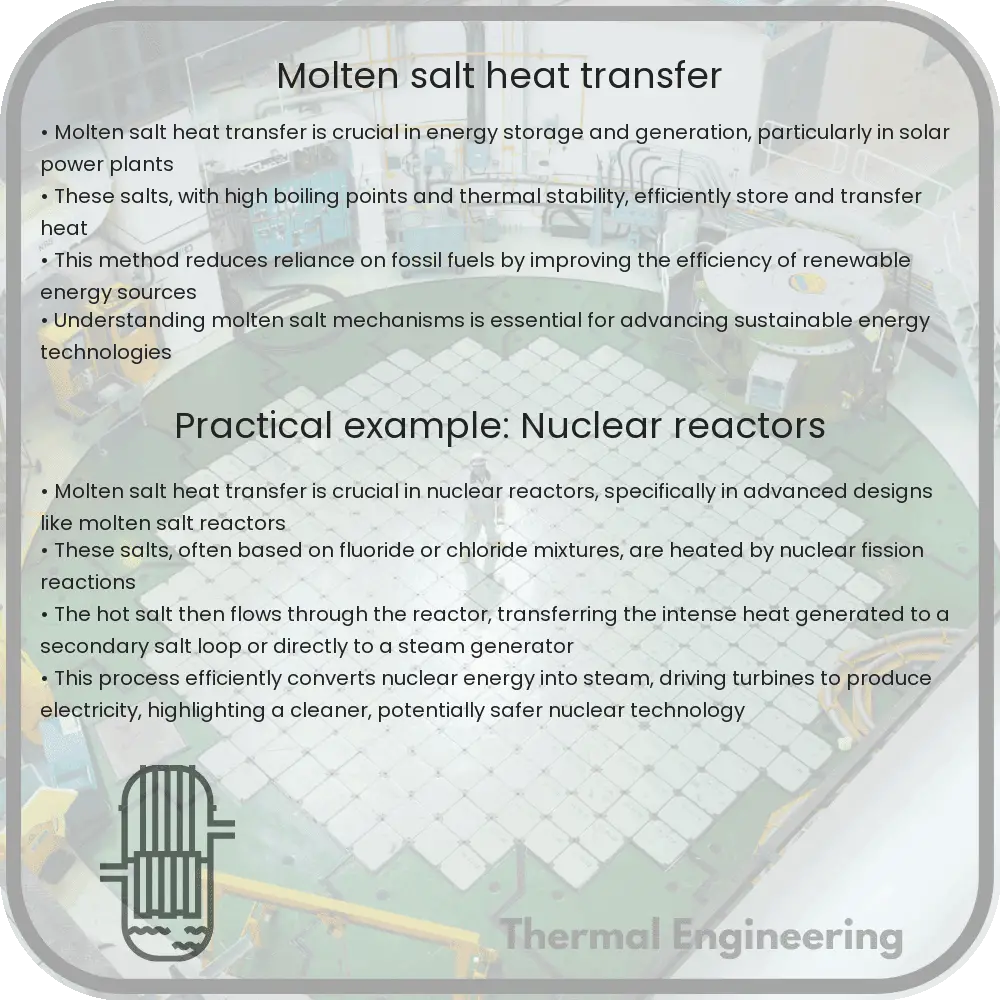

Molten salt heat transfer

Explore the uses, benefits, and challenges of molten salt heat transfer technology in industrial and energy sectors.

Molten salt heat transfer

Understanding Molten Salt for Heat Transfer

Heat transfer is a fundamental aspect of engineering, influencing everything from industrial processes to everyday appliances. Molten salt heat transfer technology represents an innovative approach, offering efficient and scalable solutions particularly in power generation and industrial applications. This article explores how molten salts are used in heat transfer, their benefits, challenges, and typical applications.

What Are Molten Salts?

Molten salts are simply salts that turn into a liquid state at elevated temperatures. Commonly used salts include sodium nitrate, potassium nitrate, and calcium nitrate. These materials exhibit excellent thermal storage capabilities and have high boiling points and low vapor pressures, which make them ideal for use as heat transfer fluids.

Properties of Molten Salts

  • High Boiling Points: Most molten salts have boiling points well above 500°C, allowing them to operate at high temperatures without transitioning into a gaseous state.
  • Good Heat Capacity: They can store and transfer large amounts of heat energy, which is crucial for thermal storage systems.
  • Low Vapor Pressure: Low vapor pressures reduce the risk of the salt vaporizing at high temperatures, thus ensuring safer operating conditions and less structural stress on containment systems.
  • Chemical Stability: Molten salts remain chemically stable at elevated temperatures, which is essential for long-term applications.

Applications of Molten Salt Heat Transfer

  1. Concentrated Solar Power (CSP) Plants: Molten salts are widely used in CSP plants to store and transfer solar energy. They absorb heat during daytime and can store it efficiently until electricity is needed, including during the night.
  2. Nuclear Power: Advanced nuclear reactors, such as molten salt reactors, utilize molten salt both as a coolant and a fuel solvent. These reactors benefit from the high boiling point and thermal conductivity of molten salts.
  3. Industrial Processes: Various industrial processes require high-temperature operations. Molten salts are used to transport heat to chemical reactors, smelters, and other equipment.

Challenges with Molten Salt Heat Transfer

Despite the benefits, there are several challenges associated with using molten salts in heat transfer applications:

  • Corrosivity: Molten salts can be highly corrosive to metals used in heat exchangers and storage tanks, which necessitates the use of corrosion-resistant materials.
  • Freezing Point: Salts have high freezing points, which can lead to solidification if the temperature drops too low. This can damage equipment and disrupt process operations.
  • Maintenance: The system requires careful maintenance to prevent and manage the deposition of salts, which can affect heat transfer efficiency and the overall operation of the system.

Future Outlook

The use of molten salts in heat transfer continues to be a subject of research and development. Innovations focus on developing new salt formulations with lower melting points and enhanced thermal properties. Additionally, engineers and scientists are working on advanced materials that can withstand the corrosive nature of molten salts, reducing maintenance costs and extending the lifespan of equipment.

Molten salt heat transfer technology holds significant promise for sustainable and efficient energy management in various sectors. As challenges are addressed, this technology is expected to play a pivotal role in the future of energy and industrial processes.

Heat transfer in ocean thermal energy

Learn about the principles of heat transfer in Ocean Thermal Energy Conversion (OTEC) and its role in sustainable energy production.

Heat transfer in ocean thermal energy

Understanding Heat Transfer in Ocean Thermal Energy Conversion (OTEC)

Ocean Thermal Energy Conversion (OTEC) is a fascinating engineering approach that leverages the temperature difference between the warmer surface water and the colder deep water of the ocean to generate electricity. Fundamentally, this method relies on the principles of heat transfer to operate efficiently. This article delves into the basics of heat transfer within the OTEC system and its impact on energy production.

Principles of Heat Transfer in OTEC

Heat transfer in OTEC systems occurs through three primary mechanisms: conduction, convection, and radiation. However, in the context of OTEC, conduction and convection are most relevant.

  • Conduction: In the heat exchangers of OTEC plants, conduction plays a crucial role. This is the process by which heat is transferred directly through a material, from a higher temperature part to a lower temperature part. Metal surfaces in the heat exchangers facilitate this transfer, moving thermal energy from the warm surface sea water to the working fluid, typically ammonia or a Freon, which has a low boiling point.
  • Convection: This mechanism involves the transfer of heat by the physical movement of fluid. In OTEC, convection occurs when the warm surface water heats the working fluid, causing it to vaporize. The vapor then drives a turbine, generating electricity, before it is cooled by colder deep-sea water, condenses back into a liquid, and is recirculated through the system.

Key Components and Their Roles

In an OTEC system, heat transfer efficiency is crucial and is heavily dependent on the design of several key components:

  1. Evaporator: Warm surface ocean water passes through this component, transferring its heat to the working fluid, thereby vaporizing it. The effectiveness of heat transfer in the evaporator is pivotal for efficient energy generation.
  2. Condenser: After the turbine, the vaporized working fluid needs to be cooled so that it can condense back to a liquid state. This is achieved by transferring heat to the colder deep-sea water. The efficiency of the condenser directly affects the system’s overall performance.

Challenges and Efficiency

One of the main challenges in maximizing the efficiency of OTEC systems is minimizing thermal losses between the ocean’s surface and deep waters. The larger the temperature difference, the more potential energy can be converted into electrical energy. Typically, OTEC systems are most effective in equatorial regions where the temperature difference between surface and deep water is greatest, often around 20°C to 25°C.

Efficiency in OTEC systems also depends on minimizing other losses, such as those due to friction and resistance in the turbines and pipes. Advances in materials science and thermodynamic cycles are continually researched to enhance these aspects.

Environmental Impacts and Future Prospects

OTEC technology does not only offer a sustainable way to generate electricity but also poses minimal environmental impact compared to fossil fuels. The cool water discharged can also potentially be utilized for mariculture and air conditioning, adding further value to this system.

With increasing focus on renewable energy sources, OTEC has the potential to become a significant player in the global energy landscape, particularly in tropical island communities where the temperature gradient of ocean waters is ideal. Continuing advancements in engineering and materials are expected to further enhance the efficiency and viability of OTEC systems.

Thermal conductivity of insulating materials

Learn about thermal conductivity, the measure of a material’s ability to conduct heat, critical in evaluating insulating materials.

Thermal conductivity of insulating materials

Understanding Thermal Conductivity of Insulating Materials

Thermal conductivity is a fundamental property that defines the ability of a material to conduct heat. In the context of insulating materials, thermal conductivity plays a critical role in determining how effective the material is at reducing the rate of heat transfer. This article explores what thermal conductivity is, how it is measured, and why it is so important for insulating materials.

What is Thermal Conductivity?

Thermal conductivity, denoted as ‘k’, is a measure of a material’s ability to conduct heat. It is defined as the rate at which heat passes through a specified material, expressed typically in watts per meter-kelvin (W/(m*K)). This means that a higher thermal conductivity value indicates a better ability of the material to conduct heat, and vice versa.

Key Factors Affecting Thermal Conductivity

  • Material Composition: Different materials exhibit varying levels of thermal conductivity. Metals, for example, generally have high thermal conductivity, while non-metals and gases have low conductivity.
  • Temperature: The temperature of the material also affects its thermal conductivity. Generally, as temperature increases, the thermal conductivity of insulators decreases, and vice versa for conductors.
  • Density and Structure: The density and microscopic structure of a material also influence its heat conducting properties. Porous and fibrous materials, such as wool and foam, generally have lower thermal conductivities and are thus used as insulators.

Measurement of Thermal Conductivity

Thermal conductivity is measured using various methods, the most common being the steady-state and transient techniques. The steady-state technique involves maintaining a constant temperature difference across the sample, while transient techniques involve observing how the material responds to a change in temperature over time.

Importance of Thermal Conductivity in Insulating Materials

Insulating materials are used to reduce unwanted heat transfer, and their efficiency is largely determined by their thermal conductivity. A low thermal conductivity is beneficial for insulating materials as it means less heat is lost through the material, making it more effective in its role. Some common insulating materials include fiberglass, polystyrene, and polyurethane foam.

  • Fiberglass: Composed of fine fibers of glass, fiberglass exhibits low thermal conductivity due to its porous structure.
  • Polystyrene: Used in both residential and commercial settings for insulation, polystyrene has a low thermal conductivity which can further decrease with the addition of air pockets.
  • Polyurethane Foam: Known for its high resistance to heat flow due to low thermal conductivity, polyurethane foam is widely used in building insulation.

Applications of Insulating Materials

Insulating materials with low thermal conductivity play a crucial role in a number of applications, primarily aimed at energy efficiency and safety:

  • Building Insulation: Homes and buildings use insulation to reduce heating and cooling demands, thereby improving energy efficiency and comfort.
  • Refrigeration: Insulating materials are crucial for efficient operation of refrigerators and freezers, minimizing the energy required to maintain cold conditions.
  • Industrial Applications: In industrial settings, insulation helps in maintaining the required temperature processes and protects workers from extreme temperatures.

In conclusion, the thermal conductivity of insulating materials is a key property that defines their effectiveness. By understanding and utilizing materials with appropriate thermal conductivity values, it is possible to greatly enhance energy efficiency in a variety of applications, from domestic to industrial environments.

Heat transfer in packed beds

Learn about the principles and applications of heat transfer in packed beds, a critical process in enhancing industrial efficiency and safety.

Heat transfer in packed beds

Understanding Heat Transfer in Packed Beds

Heat transfer in packed beds is a fundamental concept used in various engineering applications such as chemical reactors, petroleum refineries, and thermal storage systems. A packed bed consists of a container filled with solid particles or pellets, through which fluid (either liquid or gas) flows. The process of heat transfer in this setup is critical for optimizing the efficiency and safety of industrial processes.

Basics of Heat Transfer in Packed Beds

Heat transfer in packed beds occurs mainly through conduction, convection, and radiation, though in most cases, conduction and convection are predominant. The effectiveness of heat transfer depends on several factors:

  • Particle size: Smaller particles have a higher surface area-to-volume ratio, which enhances heat transfer but can also increase pressure drop across the bed.
  • Fluid velocity: Higher velocities improve heat transfer due to increased convection, but can lead to erosion of the particles if too high.
  • Thermal conductivity: Higher conductivity of the particle material enhances heat transfer.
  • Packing arrangement: Randomly packed beds usually promote better heat transfer compared to regularly structured packs due to increased turbulence.

Mathematical Model

To quantify heat transfer in packed beds, engineers use various models and correlations. One popular approach is by using the dimensionless numbers such as Reynolds (Re), Prandtl (Pr), and Nusselt (Nu) numbers. A common empirical correlation for heat transfer in packed beds is given by the following relationship:

Nu = 2 + 1.1 * Re0.6 * Pr0.33

This correlation considers that both fluid and particle properties affect the overall heat transfer efficiency. Here:

  • Re (Reynolds number) indicates the ratio of inertial forces to viscous forces and is calculated as \( Re = \frac{D_p * u_f * \rho}{\mu} \), where \( D_p \) is the particle diameter, \( u_f \) is the fluid velocity, \( \rho \) is the fluid density, and \( \mu \) is the fluid viscosity.
  • Pr (Prandtl number) is the ratio of momentum diffusivity to thermal diffusivity and is calculated as \( Pr = \frac{c_p * \mu}{k} \), where \( c_p \) is the specific heat at constant pressure, and \( k \) is the thermal conductivity of the fluid.
  • Nu (Nusselt number) is the dimensionless temperature gradient at the surface and is a measure of convective heat transfer relative to conductive heat transfer across (normal to) a boundary.

Applications and Practical Considerations

The principles of heat transfer in packed beds are employed in numerous industrial applications. For instance, in chemical engineering, packed bed reactors utilize these principles to ensure optimal heating or cooling, which is crucial for controlling the reaction rates and yields. Similarly, in the field of renewable energy, packed beds are used in thermal storage systems where heat accumulated during the day can be stored and released during cooler temperatures.

In designing these systems, engineers must balance factors such as the pressure drop, structural integrity of the bed, maintenance ease, and cost-effectiveness. Monitoring and optimizing the flow characteristics and heat transfer properties are crucial for maximizing performance while ensuring operational stability and safety.

Understanding and applying the fundamentals of heat transfer in packed beds is essential for the design and operation of efficient industrial systems. By leveraging the correlations and principles outlined, engineers can predict and enhance system performance to meet specific operational needs.

Heat transfer in cryosurgery

Learn about the crucial role of heat transfer in cryosurgery, focusing on conduction and convection, to optimize cancer treatment techniques.

Heat transfer in cryosurgery

Understanding Heat Transfer in Cryosurgery

Cryosurgery, also known as cryotherapy, is a surgical technique that uses extreme cold to destroy abnormal or diseased tissue, including cancer cells. The process involves the application of cryogenic substances, such as liquid nitrogen or argon gas, which rapidly lowers the temperature of the targeted tissues. Understanding the principles of heat transfer is crucial in optimizing this technique for effective and safe treatments. This article explores the basic concepts of heat transfer within the context of cryosurgery.

Basics of Heat Transfer

Heat transfer in cryosurgery involves primarily two modes: conduction and convection. Understanding these modes helps in effectively designing and applying cryosurgical procedures.

  • Conduction: This is the transfer of heat through a solid material from a region of higher temperature to a region of lower temperature. In cryosurgery, conduction occurs when the cryoprobe makes contact with the tissue, allowing heat to flow from the tissue to the cold probe.
  • Convection: Convection involves the transfer of heat by the movement of fluids. Though not the primary mode of heat transfer in cryosurgery, it can occur if there is any fluid (like blood) moving around the frozen tissue area.

During cryosurgery, the Joule-Thomson effect, which is a thermodynamic process, also plays a critical role. This effect occurs when a gas expands without performing external work and without a heat transfer; the temperature of the gas decreases significantly.

Heat Transfer Equation in Cryosurgery

The basic heat transfer equation used in cryosurgery can be expressed as:

Q = k * A * (T1 – T2) / d

Where:

  • Q is the heat transfer rate
  • k is the thermal conductivity of the tissue
  • A is the cross-sectional area through which heat is being transferred
  • T1 is the initial temperature of the tissue
  • T2 is the temperature of the cryogen
  • d is the distance over which the heat is being transferred

This equation helps in determining the amount of heat that needs to be removed to reduce the tissue temperature to a level where cell destruction occurs.

Thermal Properties of Tissues

The effectiveness of cryosurgery largely depends on the thermal properties of the tissue, which include thermal conductivity and specific heat capacity. These properties vary significantly among different types of tissues, which influences the freezing rate and the size of the iceball formed during cryosurgery:

  • Thermal Conductivity: Tissues with higher thermal conductivity transfer heat more quickly, potentially leading to a faster and more extensive freezing effect around the cryoprobe.
  • Specific Heat Capacity: The specific heat capacity impacts how much energy is required to lower the tissue temperature; tissues with high specific heat capacity require more energy to freeze.

Challenges in Heat Transfer During Cryosurgery

One of the primary challenges in cryosurgery is controlling the extent of the freezing process to avoid damage to surrounding healthy tissues. Precise control of the probe’s temperature and its operational time is vital to confine the iceball to the target area. Additionally, the potential for thermal damage due to the thawing process (post-freeze) must be carefully managed.

In conclusion, understanding heat transfer mechanisms in cryosurgery allows for better control and optimization of the procedure, leading to improved patient outcomes and minimized risks. The role of heat transfer in this context is crucial for developing effective cryosurgical tools and techniques, making it a fundamental aspect of study and innovation in medical cryotechnology.

Heat transfer coefficient measurement

Learn how the heat transfer coefficient is measured and applied in various engineering fields to optimize system efficiency and design.

Heat transfer coefficient measurement

Understanding Heat Transfer Coefficient Measurement

The heat transfer coefficient is a critical parameter in various fields of engineering, such as mechanical, chemical, and civil engineering. It measures how well heat is transferred between two mediums, typically a solid surface and a fluid. The coefficient is crucial for designing efficient heat exchangers, optimizing industrial processes, and enhancing energy conservation methods.

Basics of Heat Transfer Coefficient

The heat transfer coefficient, symbolically represented as h, is defined as the amount of heat transferred per unit area per unit temperature difference between a surface and a fluid. It is expressed in watts per square meter per degree Celsius (W/m2°C).

The formula to calculate the heat transfer coefficient is given by:

\[
h = \frac{Q}{A \cdot \Delta T}
\]

where:

  • Q is the heat transfer rate in watts (W),
  • A is the surface area in square meters (m2),
  • \Delta T is the temperature difference between the surface and the fluid in degrees Celsius (°C).

Methods of Measuring Heat Transfer Coefficient

There are several techniques to measure the heat transfer coefficient, each suited to different applications. Here are some commonly used methods:

  1. Transient Method: In this method, the change in temperature is monitored over time under controlled conditions. It is suitable for quick measurements and provides reasonably accurate data without requiring steady-state operation.
  2. Steady-State Method: Unlike the transient method, the steady-state method measures the heat transfer coefficient under stable conditions. It generally offers accurate results but can be time-consuming as it requires the system to reach a thermal equilibrium.
  3. Wilson Plot Technique: This approach is used predominantly in determining convective heat transfer coefficients in situations where the fluid properties are changing with temperature. It involves plotting the heat transfer coefficient against the reciprocal of the overall heat transfer coefficient to extrapolate true values.

Applications of Heat Transfer Coefficient in Engineering

Understanding and accurately measuring the heat transfer coefficient is vital in multiple engineering applications:

  • Design of Heat Exchangers: The coefficient impacts the size and efficiency of heat exchangers, which are crucial in power plants, refrigeration, and air conditioning systems.
  • Thermal Management: In electronics and aerospace engineering, maintaining temperature control is essential for the durability and efficiency of components. Knowing the heat transfer coefficient helps in designing effective cooling strategies.
  • Process Engineering: Chemical processes often require precise temperature control to ensure reaction efficiency and safety. Accurate measurements of heat transfer coefficients facilitate better design and operational conformance.

In conclusion, heat transfer coefficient measurement is indispensable in many areas of engineering. By applying the right measurement techniques, engineers can enhance system performance, achieve energy efficiency, and conform to environmental standards. Continuous advancements in this field promise even more precision in future engineering designs and applications.

Microscale heat transfer phenomena

Explore how heat is transferred at microscopic scales, crucial for enhancing the performance and reliability of modern microelectronics.

Microscale heat transfer phenomena

Understanding Microscale Heat Transfer Phenomena

Microscale heat transfer refers to the study of how heat moves at very small scales, typically in the order of micrometers (10-6 meters) or less. This area of study has become increasingly important with the rise of modern technologies, including microelectronics, where managing heat efficiently is crucial for performance and reliability.

Basics of Heat Transfer

Heat transfer at the microscale involves the same fundamental modes as in macroscopic systems: conduction, convection, and radiation:

  • Conduction: The transfer of heat through a material by means of molecular agitation within the material without any motion of the material as a whole.
  • Convection: The transfer of heat from one place to another by the movement of fluids.
  • Radiation: The transfer of energy by electromagnetic waves that can occur in a vacuum.

However, at the microscale, the characteristics of these modes can change significantly due to the increased importance of surface effects and the different behavior of materials at such small scales.

Challenges in Microscale Heat Transfer

Understanding heat transfer at microscales presents unique challenges:

  • Increased Surface Area: At smaller scales, the surface-area-to-volume ratio increases, which enhances the effects of surface-related phenomena such as surface tension and adhesion.
  • Material Behavior: The thermal properties of materials can differ markedly at the microscale compared to the macroscale, impacting conduction.
  • Boundary Layers: The relative thickness of thermal boundary layers can be comparable to the dimensions of the microscale system, which affects convection processes.

Heat Transfer in Microelectronics

One of the most prominent applications of microscale heat transfer is in the cooling of microelectronic components. As these devices operate, they generate heat that must be dissipated to prevent overheating and ensure proper functioning. Techniques used in managing this heat include:

  • Using heat sinks to enhance conduction
  • Employing microchannel cooling systems for improved convection
  • Applying thermally conductive materials

Each method exploits the principles of microscale heat transfer to maintain optimal temperature and performance levels in electronic devices.

Future Directions

Research in microscale heat transfer continues to grow as the demand for smaller and more efficient technological devices increases. Innovations include the development of nanofluids, which enhance heat transfer capabilities, and the exploration of superlattice structures for better thermal management.

Understanding and utilizing microscale heat transfer phenomena is essential for advancing numerous technologies crucial to daily life and industry. As such, the field promises not only new insights into heat transfer processes but also significant improvements in technology and systems engineering.

Heat transfer in plasma

Understanding the mechanisms of heat transfer in plasma and their applications in fields like engineering and technology.

Heat transfer in plasma

Understanding Heat Transfer in Plasma

Heat transfer in plasma represents a fascinating area of study in both physics and engineering fields. Plasma, often referred to as the fourth state of matter, consists of a gas in which a significant number of electrons have been ionized, freeing them from their respective atoms. This results in a mixture of charged particles (ions and electrons), neutral atoms, and molecules which exhibit collective behavior. The unique properties of plasma make it highly relevant in various applications, from industrial manufacturing processes like plasma cutting and welding, to environmental applications such as waste treatment, and even in the quest for controlled thermonuclear fusion.

Key Mechanisms of Heat Transfer

Heat transfer in plasma primarily occurs through three fundamental mechanisms: conduction, convection, and radiation. Understanding each mechanism is crucial for designing and optimizing processes involving plasmas.

Conduction

In plasma, conduction occurs mainly due to the interactions among the charged particles. Electrons, being much lighter than ions, move more quickly and thus contribute more to thermal conduction. The thermal conductivity (κ) in a plasma can be expressed using the classical formula derived from kinetic theory:

κ = (nekB2Te) / (meνei)

where:

  • ne is the electron density,
  • kB is the Boltzmann constant,
  • Te is the electron temperature,
  • me is the electron mass, and
  • νei is the electron-ion collision frequency.

Convection

In convection, energy is transferred by the bulk movement of heated particles within the plasma. This process is more complex than conduction and depends on the fluid dynamics of the plasma, which can be influenced by magnetic fields in magnetized plasmas. The convective transport in plasma is essential in many technological applications where forced circulation of plasma is used to achieve uniform temperature distributions and efficient heat transfer.

Radiation

Plasmas can emit radiation across a broad spectrum, from infrared to ultraviolet, and even X-rays, depending on the temperature and composition of the plasma. Radiative heat transfer becomes significantly important at high temperatures, where plasma can lose energy by emitting photons. This mechanism is particularly relevant in astrophysical plasmas and in thermonuclear fusion reactors where plasma temperatures can reach several million degrees Celsius.

Applications of Heat Transfer in Plasma

The principles of heat transfer in plasma are applied in various engineering and industrial applications. For example:

  • Welding: Plasma welding tools utilize conduction and radiation to melt and fuse materials with precision.
  • Material Processing: Thermal plasma is used for synthesis of materials, such as nanomaterials, where control over temperature and the rate of cooling is crucial.
  • Energy Generation: In controlled nuclear fusion, heat transfer through radiation and convection within the plasma is a critical area of research.
  • Environmental Applications: Plasma torches can decompose hazardous waste through intense localized heat, leveraging heat transfer principles to ensure complete breakdown of materials.

Conclusion

Heat transfer in plasma encompasses a range of complex processes that are integral to various scientific, technological, and industrial applications. By understanding the mechanisms of conduction, convection, and radiation in plasma, engineers and scientists can design more effective systems and processes that exploit these unique properties of plasma for innovative solutions across multiple disciplines.

The study of plasma not only opens doors to advancing current technologies but also paves the way for the development of new applications, such as more efficient energy solutions and advanced manufacturing techniques.

Thermal effects in hydraulic systems

Explore how thermal effects influence hydraulic systems, affecting fluid viscosity, component performance, and system efficiency.

Thermal effects in hydraulic systems

Understanding Thermal Effects in Hydraulic Systems

Hydraulic systems are crucial in various industrial applications including construction machinery, automotive systems, and aircraft hydraulics. One significant challenge in these systems is managing the thermal effects that can impact performance and longevity. Temperature variations in hydraulic systems affect fluid properties, system components, and overall efficiency. In this article, we will explore how temperature changes influence hydraulic systems and discuss methods to manage these effects.

How Temperature Affects Hydraulic Fluids

Temperature variations primarily affect the viscosity of hydraulic fluids. Viscosity is a measure of a fluid’s resistance to gradual deformation by shear stress or tensile stress. For hydraulic fluids, the ideal viscosity range is crucial for efficient system operation.

  • Increasing Temperature: As the temperature increases, fluid viscosity decreases. Low viscosity can lead to increased internal leakage in hydraulic components, reduced system efficiency, and increased wear and tear.
  • Decreasing Temperature: Conversely, a decrease in temperature can cause the fluid to become more viscous, which makes it more difficult to pump through the system. Higher viscosity can strain the hydraulic pump, leading to energy losses and potential component failures.

Thermal Expansion of Components

Like most materials, the components of hydraulic systems expand and contract with temperature fluctuations. This expansion and contraction can affect the clearances and tolerances within the hydraulic system, potentially leading to:

  • Component Misalignment: Changes in component dimensions due to thermal expansion can lead to misalignment, increased friction, and premature wear.
  • Seal Failures: Seals in hydraulic systems are particularly susceptible to thermal variance, which can cause them to crack, harden, or become brittle, leading to leaks and system contamination.

Heat Generation in Hydraulic Systems

Heat generation is an inherent characteristic of hydraulic systems, primarily due to fluid friction and inefficiencies in components like pumps and valves. Here’s how heat is produced:

  • Hydraulic pumps convert mechanical energy from a motor into hydraulic energy. This process is not 100% efficient and some of the energy is converted into heat.
  • Fluid friction, or the resistance to flow within hydraulic pipes and components, also generates heat as the hydraulic fluid moves through the system.

Excessive heat can degrade hydraulic fluids, potentially leading to a reduction in fluid life and a decrease in lubrication quality. Overheating also raises the risk of thermal damage to system components.

Managing Thermal Effects in Hydraulic Systems

Efficient management of thermal effects in hydraulic systems is critical for maintaining performance and longevity. Some common strategies include:

  • Use of Heat Exchangers: Installing heat exchangers can help remove excess heat from the hydraulic fluid, maintaining fluid viscosity within desirable limits.
  • Choosing the Right Hydraulic Fluid: Selecting a fluid with appropriate thermal properties for the specific application and operating environment can greatly reduce potential thermal issues.
  • Maintenance and Monitoring: Regular system checks, including monitoring temperature and fluid condition, can help catch and mitigate emerging thermal problems before they cause system failure.

In conclusion, understanding and managing thermal effects in hydraulic systems are essential. By selecting the correct fluid, maintaining system components, and employing mechanisms to control temperature, engineers can ensure that hydraulic systems operate efficiently and durably in varied thermal environments.